

Vendor Management Strategy: 2026 Executive Framework
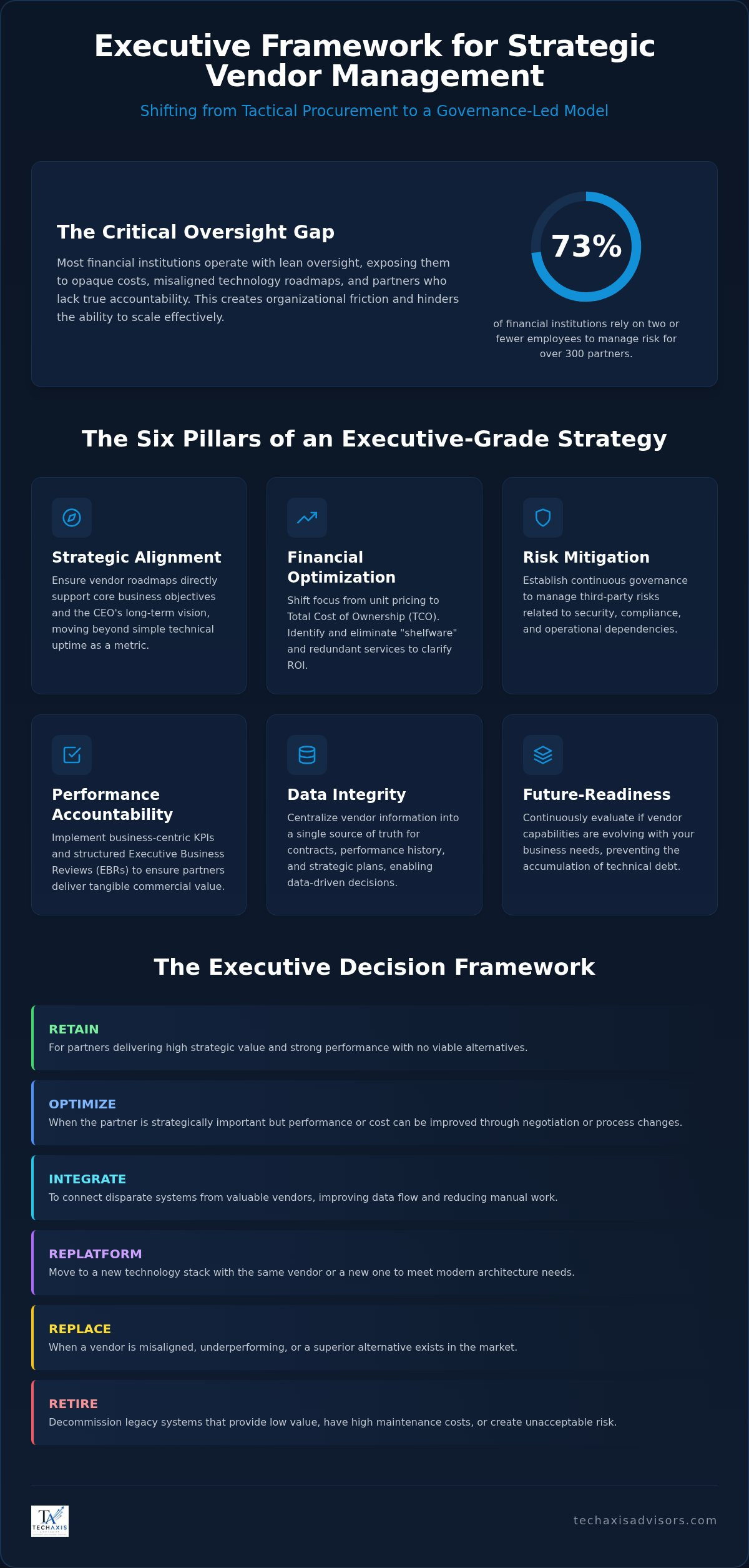
Did you know that 73% of financial institutions rely on two or fewer employees to manage risk across more than 300 different partners? This lean oversight often leads to opaque technology costs and software partners that lack real accountability. Developing a robust vendor management strategy for leadership isn't just a procurement task; it's a critical governance function. You likely feel the friction when technical roadmaps drift away from your core business objectives. The stakes are high. Opaque spending and misaligned roadmaps create organizational anxiety that hinders scaling.
This article provides a 2026 executive framework designed to transform these relationships into strategic assets. You'll learn how to replace tactical firefighting with a repeatable oversight model that reduces execution risk and clarifies the ROI on your technology spend. We'll examine the shift from unit pricing to total cost of ownership within a modern executive technology operating model. This framework provides the structured approach necessary to ensure your partners actually drive the growth they promised.
Table of Contents
Beyond Procurement: Why Vendor Management is a Strategic Leadership Priority
Vendor management is often misclassified as a procurement checklist or a legal review of terms. In reality, it's a pillar of technology governance that dictates your firm's ability to scale. A mature third-party management approach ensures every external partner remains aligned with your operational integrity. Without this oversight, your technology stack becomes a collection of disconnected tools rather than a cohesive engine for growth.
Implementing a robust vendor management strategy for leadership requires moving beyond the initial contract negotiation. It's a continuous cycle of assessment and adjustment. Leaders must ensure that external capabilities evolve alongside the business. When this alignment fails, technical debt accumulates as vendors provide outdated solutions that no longer fit your enterprise architecture. This misalignment creates friction that slows down every subsequent technology initiative, turning what should be an asset into a legacy burden. Effective governance identifies these gaps before they impact the bottom line.
The 'Set and Forget' Trap in Growth-Stage Companies
Rapid expansion often forces leaders to prioritize speed over structure. This creates the "set and forget" trap. Companies sign multi-year contracts during a growth spurt but fail to revisit them as their needs change. The result is a fragmented portfolio of redundant platforms and overlapping services. This lack of oversight doesn't just waste capital. It creates organizational anxiety during digital transformations because the underlying dependencies are unknown. You cannot manage what you haven't documented, and you cannot optimize what you don't track. Growth-stage firms frequently discover they're paying for features they don't use while lacking the ones they actually need.
Aligning Vendor Performance with Business Strategy
Technology roadmaps must directly support the CEO's three-to-five-year vision. If a vendor's development path diverges from your strategic goals, they're no longer a partner; they're an obstacle. You must move past "uptime" as the primary metric. While technical availability is important, the true measure of success is business value. Does the platform reduce your time to market? Does it lower operational costs? Addressing these problems we solve requires an executive shift from tactical purchasing to active strategic partnership management. This ensures your technology spend generates a measurable return rather than just an ongoing expense. High-performing organizations treat their vendors as extensions of their own team, holding them to the same standards of accountability and strategic contribution.
The Six Pillars of an Executive-Grade Vendor Management Strategy
Effective governance requires more than a spreadsheet of renewal dates. It demands a structured framework that provides visibility into how every dollar spent translates into operational capability. A comprehensive vendor management strategy for leadership centers on six core pillars: strategic alignment, financial optimization, risk mitigation, performance accountability, data integrity, and future-readiness. These pillars bridge the gap between high-level business goals and the granular reality of technical execution. Visibility is the precursor to control.
Adopting modern Vendor Management Strategies allows executives to move from passive oversight to active value creation. This transition is critical given that 73% of financial institutions have two or fewer employees managing vendor risk despite overseeing hundreds of partners. Centralizing your data into a "Vendor Intelligence" repository is the first step toward reclaiming control. This repository acts as a single source of truth, housing contract terms, performance history, and strategic roadmaps. It replaces fragmented emails and buried PDFs with accessible, decision-ready data that supports long-term scaling.
Strategic Alignment and Portfolio Rationalization
A rigorous diagnostic of your current vendor utility often reveals significant waste. Growth-stage firms frequently accumulate "shelfware," which is licensed software that provides zero business value yet continues to drain the budget. Rationalizing your portfolio involves mapping each vendor to specific business outcomes. This process identifies redundancies where multiple platforms perform the same function. By consolidating these services, you simplify your architecture and increase your leverage during negotiations. This creates a unified view of the technology ecosystem, providing the clarity needed for board-level reporting and capital allocation.
Risk Management, Cybersecurity, and AI Governance
By 2026, vendor oversight must include rigorous AI and data governance. You must evaluate how your partners handle your data and whether their AI models comply with evolving regulations like the NIS2 Directive or the CCPA. Mission-critical partners require independent technology risk assessments that go beyond standard SOC 2 reports. These evaluations examine actual execution risk and supply chain vulnerabilities. Given that 40% of cyberattacks now originate in the extended supply chain, verifying a vendor's security posture is a non-negotiable leadership responsibility. Specialized AI advisory and automation readiness ensures your partners remain aligned with these emerging standards. If your current portfolio feels fragmented, consider how an executive-level assessment can bring necessary clarity to your technology spend.
The Executive Decision Matrix: Retain, Optimize, or Replace?
Decisions regarding legacy technology are rarely binary. For the C-suite, the challenge lies in determining whether an existing platform is a foundational asset or a source of escalating risk. A mature vendor management strategy for leadership requires a rigorous decision matrix that weighs the cost of migration against the silent costs of stagnation. Organizations often stay with legacy partners out of a misplaced sense of loyalty or a fear of transition, yet this inertia often results in overpaying for diminishing returns. You must evaluate your partners based on their current utility, not their historical significance.
Static oversight models fail as your organization evolves. Your technology stack must remain elastic enough to support Changing Business Models that demand higher levels of integration and data fluidity. If a vendor cannot keep pace with your operational requirements, they become a bottleneck. This assessment isn't just about technical features. It's about the Total Cost of Ownership (TCO), which includes license fees, internal maintenance hours, and the opportunity cost of being unable to pivot. High-performing leaders use evidence-based findings to decide when to reinvest and when to exit.
Evaluating the Business Case for Modernization
Modernization doesn't always necessitate a full replacement. We utilize a structured framework to determine the most pragmatic path forward: Retain, Optimize, Integrate, Replatform, Replace, or Retire. Retaining a system is appropriate if it meets 80% of business needs with minimal friction. Optimization involves refining workflows to extract more value from existing licenses. However, if a platform requires excessive "workarounds" to function, it may be time to replace or retire it. Calculating TCO is essential here. You must look beyond the initial invoice to include the costs of security patches, custom integrations, and the productivity lost to inefficient interfaces. This clarity allows you to allocate capital toward vendors that actually accelerate growth.
Assessing Technical Debt and Integration Risk
Technical debt is the hidden tax on your future innovation. Legacy vendors often rely on closed architectures that hinder AI adoption and modern data reporting strategies. When your data is trapped in silos, your ability to make executive-level decisions is compromised. This creates operational friction that frustrates your team and slows down client delivery. Identifying these risks early is a core component of our executive services. We examine how a vendor's technical limitations might be creating downstream liabilities for your firm. If a partner cannot provide the transparency or integration capabilities required for 2026 standards, the risk of staying often outweighs the risk of moving to a more modern ecosystem.
Establishing Accountability: Performance Monitoring and SLA Governance
Accountability is the bridge between a signed contract and realized value. Traditional monitoring often focuses on technical uptime, but this is a baseline requirement rather than a strategic metric. A robust vendor management strategy for leadership shifts the focus toward business-centric outcomes. If a platform is technically available but fails to support your data strategy or operational scaling, it's a failure of governance. Leadership must demand transparency that links vendor activity to specific organizational goals.
Meaningful Service Level Agreements (SLAs) require business penalties that reflect the actual cost of failure. Most standard agreements offer minor service credits that don't compensate for lost productivity or regulatory risk. Effective governance ensures that SLAs are tied to critical path items like data accuracy and system latency. By 2026, analytics and reporting capabilities are expected to account for 68.6% of the vendor management software market share. This reflects the increasing executive demand for reliable, decision-ready information from every partner in the ecosystem.
Defining Business-Centric KPIs for Technology Partners
Performance metrics should mirror your firm's operational maturity. Instead of just tracking ticket response times, measure "Time to Value" for new feature implementations. This tracks how quickly a vendor can move an idea from concept to production. For wealth management and private equity firms, reporting reliability is a non-negotiable KPI. You cannot make informed decisions if your vendor's data exports are inconsistent or require manual reconciliation. These KPIs provide the evidence needed for objective performance evaluations during executive business reviews.
Continuous Improvement and Relationship Management
Strategic partnerships require a shift from a policing mindset to a collaborative model. Regular Executive Business Reviews (EBRs) serve as the primary forum for this alignment. These sessions should focus on the vendor's roadmap and how it supports your three-year vision. Maintaining an "Action Register" ensures that performance gaps identified in these reviews are actually addressed. This register tracks specific improvement initiatives, assigned owners, and hard deadlines. This structured approach to advisory leadership ensures that disputes are resolved through evidence rather than emotion, protecting your operations from disruption.
Scaling Strategic Oversight with Advisory Leadership
Growth-stage organizations often face a critical gap in their executive technology operating model. While internal teams focus on daily operations, strategic oversight of external partners often falls to the wayside. Entrusting a complex vendor management strategy for leadership to mid-level managers who lack technical authority is a common mistake; it's a gap that often leads to the "Set and Forget" trap mentioned earlier. These individuals may manage the relationship, but they often lack the seniority to challenge a vendor's roadmap or enforce accountability. This creates a vacuum where technical debt grows and business alignment fades. Independent advisory leadership fills this void by providing the senior-level bandwidth required for effective governance.
The Fractional CTO as a Governance Partner
A Fractional CTO acts as a bridge between your business objectives and your technical ecosystem. They provide the same level of strategic counsel as a full-time executive but on a retained basis that fits a growth-stage budget. This role is essential for aligning infrastructure with long-term goals and ensuring that every technology investment is defensible. By providing objective oversight, they prevent vendor lock-in and ensure that your partners remain focused on delivery. This level of execution leadership is particularly valuable during complex transitions, as detailed in our Fractional CTO Guide.
Moving from Tactical Oversight to Strategic Partnership
Transitioning from tactical firefighting to strategic governance turns your vendor portfolio into a competitive advantage. Instead of reacting to outages or billing errors, your leadership team can focus on how these partners enable future growth or acquisition readiness. A structured approach to vendor management strategy for leadership builds a scalable operating foundation that increases enterprise value. It replaces organizational anxiety with a disciplined process for identifying, improving, and mastering external relationships. This maturity allows you to pivot quickly as market conditions change, knowing your technology partners are prepared to support the shift.
Mastering the Executive Technology Operating Model
Transitioning from tactical procurement to a governance-led model is essential for scaling in 2026. A mature vendor management strategy for leadership ensures that every external partner remains aligned with your long-term business objectives. This framework provides the structural integrity needed to reduce execution risk and eliminate the passive oversight traps that often plague growth-stage firms. By utilizing a rigorous decision matrix to evaluate technical debt and establishing business-centric KPIs, you regain control over your technology spend and operational roadmap.
Our advisors are former CIOs, CTOs, and CISOs who understand the high stakes of these decisions. We provide executive clarity through evidence-based assessments powered by the TechAxis Executive Intelligence Platform. As a Certified Women-Owned Small Business (WOSB), we focus on delivering the senior-level oversight necessary to bridge the gap between technical complexity and business growth. This disciplined approach ensures your technology ecosystem remains an engine for progress rather than a source of organizational friction.
Building a scalable operating foundation starts with disciplined oversight and qualified delivery partners. We look forward to helping you bring clarity and order to your technology ecosystem.
Frequently Asked Questions
What is the difference between vendor management and vendor governance?
Vendor management focuses on the tactical execution of contracts and renewals, whereas vendor governance is the strategic framework that aligns those partners with business outcomes. Governance ensures that external technology spend directly supports the CEO's long-term vision. A mature vendor management strategy for leadership treats these relationships as foundational assets rather than simple expenses. This shift allows executives to move from passive oversight to active value creation and risk mitigation across the entire enterprise.
How often should leadership review the technology vendor portfolio?
Leadership should conduct a high-level review of mission-critical partners quarterly, while the full technology portfolio requires a comprehensive annual audit. Quarterly reviews focus on performance against business-centric KPIs and Service Level Agreements. Annual audits allow for portfolio rationalization, identifying redundant software or "shelfware" that no longer provides utility. This cadence ensures that your technology stack remains elastic enough to support changing business models without accumulating unnecessary technical debt or opaque costs.
What are the biggest risks of not having a formal vendor management strategy?
The primary risks include escalating technical debt, opaque technology costs, and significant security vulnerabilities within the supply chain. Research indicates that 40% of cyberattacks now originate in the extended supply chain, making unmanaged vendors a liability. Without a formal strategy, firms often suffer from a "Set and Forget" trap where redundant platforms overlap and costs spiral. This lack of oversight creates organizational anxiety and hinders your ability to scale operations efficiently during digital transformations.
When should we consider replacing a legacy technology vendor?
You should consider replacement when the Total Cost of Ownership (TCO) exceeds the business value or when a vendor's closed architecture hinders your AI and data reporting strategy. We recommend using the "Retain, Optimize, Integrate, Replatform, Replace, or Retire" framework to make this decision. If a platform requires excessive manual workarounds or creates operational friction that slows down client delivery, it's a clear signal that the partnership is no longer serving your strategic interests.
How can a Fractional CTO help with vendor oversight?
A Fractional CTO provides the senior-level bandwidth and technical authority required to manage complex vendor relationships without the cost of a full-time hire. They act as a governance partner, challenging vendor roadmaps and ensuring that Service Level Agreements have meaningful business penalties. This independent advisory leadership bridges the gap between high-level business goals and granular technical execution, providing the objective oversight necessary to prevent vendor lock-in and ensure long-term scalability.
What metrics should a CEO look for in a technology vendor report?
A CEO should prioritize business-centric metrics such as "Time to Value" for new features, data reporting accuracy, and measurable ROI on technology spend. Technical uptime is a baseline requirement; true leadership reports focus on how the vendor enables operational maturity. Look for reports that demonstrate alignment with your three-to-five-year vision and provide transparency into how the vendor is mitigating execution risk. These metrics move the conversation from technical performance to commercial impact.
How do we manage vendor risk in the age of Artificial Intelligence?
Managing AI-related vendor risk requires rigorous independent technology risk assessments and a focus on data governance. You must verify how partners handle your proprietary data and whether their AI models comply with emerging regulations like the NIS2 Directive or CCPA. A robust vendor management strategy for leadership includes evaluating a vendor's AI roadmap for transparency and security. This ensures that your firm isn't inadvertently inheriting liabilities through a partner's unmanaged or unethical use of automated systems.
Is it better to have a few large vendors or many specialized ones?
Consolidating with a few large vendors offers greater negotiation leverage and architectural simplicity, while specialized vendors often provide superior agility and specific functionality. The right balance depends on your firm's maturity and operational complexity. Large vendors reduce the administrative burden of oversight, but they can lead to vendor lock-in. Specialized partners offer a competitive edge in specific areas but require more intensive governance to ensure they don't create fragmented data silos across your organization.



Comments