

Managing Outsourced Software Development Risks: An Executive Framework
What if the greatest risk in outsourced software development isn’t the vendor’s work, but the decisions your organization leaves undefined? External teams can add valuable capability and delivery capacity. But your leadership remains accountable for business outcomes, priorities, and acceptance. Managing outsourced software development risks starts with making that accountability explicit.
It’s reasonable to expect clear ownership, reliable visibility into progress, and confidence that security and quality are being addressed. In practice, unclear scope, shifting decisions, and undocumented technical choices can make those expectations difficult to meet. This article offers a practical executive framework for identifying and prioritizing risks, setting accountability and escalation, and keeping delivery aligned with business objectives. It also explains how to oversee quality, security, and schedule changes while reducing dependence on vendor knowledge. The goal isn’t to control every development task. It’s to establish governance and reporting that help leaders make informed decisions before delivery issues become business problems.
Table of Contents
Managing outsourced software development risks starts with business exposure
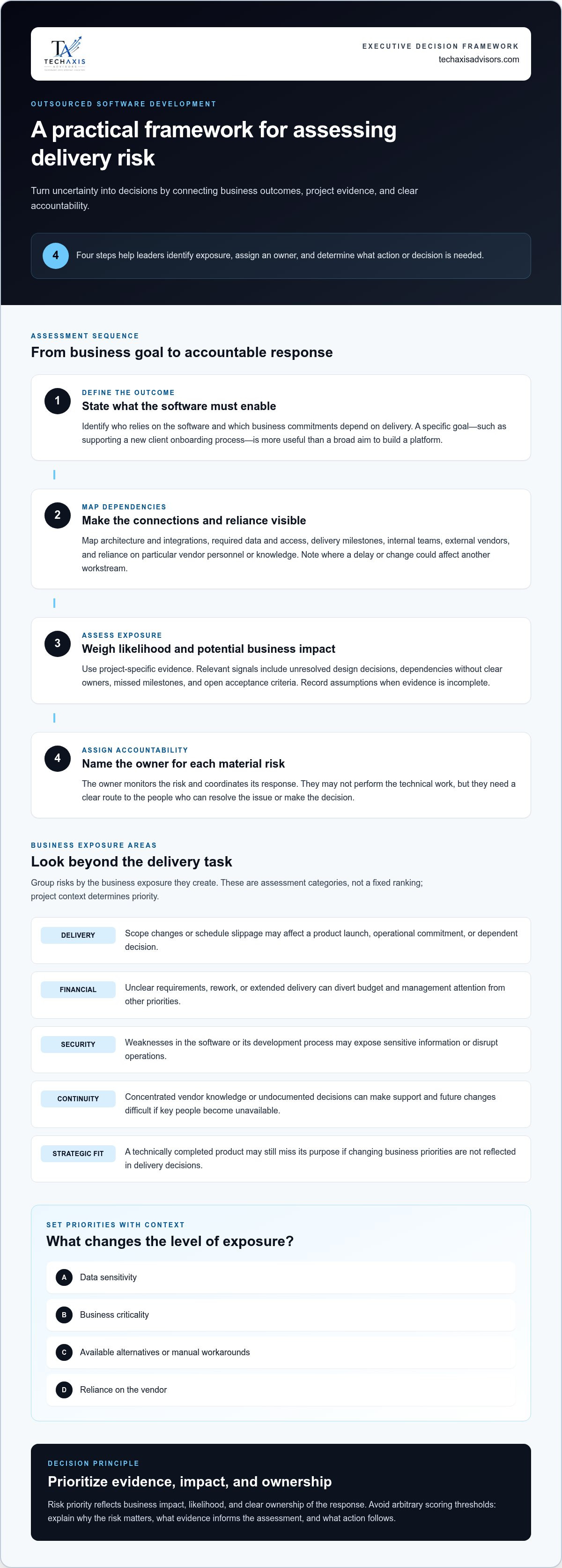
A practical framework for assessing outsourced software development risks
Governance that keeps outsourced software delivery visible and accountable
Controls across contracting, delivery, acceptance, and transition
When executive advisory can strengthen outsourced development oversight
Managing outsourced software development risks starts with business exposure
External development capacity can help an organization move faster or access skills it doesn’t have internally. It also increases reliance on people, processes, and technical decisions outside the organization’s direct control. The executive question isn’t simply whether a vendor can deliver. It’s what a delay, defect, security issue, or loss of knowledge would mean for business commitments and operations.
Group risk by the exposure it creates instead of treating it as a generic list of project problems. An overview of offshore software development risks can help frame management considerations in external delivery arrangements. The level of exposure, however, depends on the specific project and business context.
Outsourced development risk is the potential business impact of relying on external people, decisions, or systems to deliver and sustain software. Managing outsourced software development risks therefore starts with understanding what the software supports, what information it handles, and how the organization would continue if delivery or vendor support were interrupted.
Delivery: Scope changes or schedule slippage may affect a product launch, operational commitment, or decision that depends on the software.
Financial: Unclear requirements, rework, or extended delivery can divert budget and management attention from other priorities.
Security: Weaknesses in software or its development process may expose sensitive information or disrupt operations.
Continuity: Concentrated vendor knowledge or undocumented decisions can make support and future changes difficult if key people become unavailable.
Strategic alignment: A technically completed product may still miss its purpose if changing business priorities aren’t reflected in delivery decisions.
Severity depends on context. A defect in an internal tool with a manual workaround may carry less exposure than a failure in software central to a client-facing process. Data sensitivity, business criticality, available alternatives, and reliance on the vendor all affect priority.
Which outsourced development risks matter most to executives?
Focus on the consequences behind delivery signals. A scope change can alter a launch commitment. Slippage can reduce the time available for decisions or operational readiness. Quality issues may require remediation and interrupt operations, while security issues may create exposure beyond the development team. If essential system knowledge sits with one vendor team and decisions aren’t documented, continuity becomes a business concern, not just a technical inconvenience.
Why does outsourcing change the risk profile?
A vendor may be responsible for performing agreed delivery work, but the organization remains accountable for the business outcomes the software is expected to support. Multiple internal and external teams can add handoffs: business leaders set priorities, internal technology teams define dependencies, and vendor teams implement changes. If decision ownership or acceptance is unclear, gaps emerge. That doesn’t make outsourcing inherently unsafe. It makes project-specific accountability and oversight essential. TechAxis Advisors describes the organizations it supports and their leadership needs.
A practical framework for assessing outsourced software development risks
A useful assessment turns uncertainty into decisions. Start with the business outcome, then examine what the software depends on, where failure could affect that outcome, and who has authority to act. This keeps managing outsourced software development risks tied to business priorities instead of an unfiltered inventory of technical concerns.
Define business outcomes. State what the software must enable, who relies on it, and which commitments depend on delivery. “Support a new client onboarding process” is more useful than the broad aim to “build a platform.”
Map dependencies. Identify the architecture and integrations involved, required data and access, delivery milestones, internal teams, external vendors, and reliance on particular vendor personnel or knowledge. Note where a delay or change could affect another workstream.
Assess exposure. For each risk, consider its likelihood based on project-specific evidence and its potential impact. Evidence may include unresolved design decisions, dependencies without clear owners, missed milestones, or open acceptance criteria. Record assumptions where evidence is incomplete.
Assign accountable owners. Name the person responsible for monitoring each material risk and coordinating its response. The owner may not perform the technical work, but should have a clear route to the people who can resolve the issue or make a decision.
Risk priority reflects business impact, likelihood, and clear ownership of the response. Avoid false precision from arbitrary scoring thresholds. A qualitative assessment can still support sound decisions if it explains why a risk matters, what evidence informs the view, and what action follows.
How should leaders prioritize project risks?
Separate risks that need executive decisions from routine delivery issues managed by the project team. Assess material risks against the software’s business criticality, how quickly operations could recover, and the cost of delay to a business commitment. For example, a dependency that threatens a key decision milestone may warrant leadership attention before a lower-impact task slips. Document the evidence and assumptions, then revisit the priority when scope, dependencies, or delivery conditions change.
What should an executive risk register capture?
Keep the register concise enough to use in governance discussions. For each risk, capture its potential business impact, evidence and assumptions, accountable owner, planned response, review trigger, and linked milestone or decision. Include dependencies on data, platforms, internal teams, and external vendors. A trigger might be an unresolved integration decision or a milestone change. This helps leaders see when escalation is needed instead of relying on status summaries alone.
If leadership needs an independent view of exposure or clearer decision ownership, a confidential executive conversation about development oversight can help clarify the next step.
Governance that keeps outsourced software delivery visible and accountable
Effective governance makes decision rights visible before delivery pressure builds. The business sets priorities and remains accountable for outcomes. The delivery team makes implementation decisions within agreed boundaries. When those roles blur, small changes can stall or materially affect scope without reaching the right decision-maker. A clear governance model gives leaders visibility without drawing them into routine technical choices, and supports a disciplined approach to technology problems leaders need to solve.
Separate executive authority from delivery authority
Document who decides, who recommends, and who executes. A compact responsibility matrix can clarify the division:
Business sponsor: approves business priorities, material scope changes, funding tradeoffs, and final acceptance against agreed outcomes.
Technology lead: recommends architecture and security boundaries, manages technical dependencies, and escalates decisions that cross approved limits.
Vendor delivery lead: coordinates implementation, reports delivery status, identifies blockers, and resolves routine work within the agreed plan.
Executive steering group: resolves cross-functional tradeoffs and material risks that could change business outcomes, timing, or scope.
Adapt these roles to the organization’s size, but give each decision one accountable authority. Shared input is useful. Shared accountability can leave a decision unresolved.
Which decisions should stay with the business?
Business leaders retain authority over priorities, risk tolerance, funding choices, and whether a deliverable meets its intended purpose. Delivery teams should be able to make implementation choices within approved architecture, security, and budget boundaries. Define the escalation path for exceptions: who raises the issue, who assesses its business effect, and which leader decides whether to change scope, timing, or resources. This keeps delivery moving while ensuring consequential tradeoffs aren’t made by default.
How can reporting improve oversight without adding bureaucracy?
Use a short, consistent dashboard tied to outcomes and decisions, not a reproduction of technical activity. Each reporting cycle should make changes and exceptions easy to spot. Include:
Milestone confidence: whether key dates remain credible, with reasons for any change.
Unresolved decisions: the decision needed, its owner, and when a delay could affect delivery.
Defects: material quality issues, their effect, and the planned response.
Dependencies: items awaiting internal teams, platforms, data, or vendors.
Scope changes: requests under review, approved changes, and their impact on commitments.
Review trends and exceptions, then escalate issues through agreed thresholds and decision paths. This gives executives a focused view without asking them to inspect every task. Where leadership continuity is needed, fractional CTO leadership can help connect business priorities, vendor oversight, and delivery decisions.
Controls across contracting, delivery, acceptance, and transition
Risk controls should run through the entire engagement, not stop at vendor selection or contract signature. Contract and statement-of-work language establish the operating baseline: intended business outcomes, scope boundaries, responsibilities, ownership, and how acceptance will be demonstrated. Clear terms give leaders a reference point when delivery changes or assumptions prove incorrect.
What should be clear before development begins?
Define intended outcomes, deliverables, assumptions, acceptance evidence, and decision owners. Clarify intellectual property ownership and the organization’s access to code, documentation, and project artifacts in the governing agreement. Also establish how proposed changes, delays, unresolved dependencies, and material risks will be raised, assessed, approved, or escalated. These are operating decisions, not details to leave until a disagreement occurs.
During delivery, use controls that connect day-to-day work to that baseline:
Change approval: assess a proposed change’s effect on scope, timing, cost, and business priorities before accepting it.
Decision records: capture significant technical and business decisions, their rationale, and assumptions that could later change.
Testing and acceptance: agree on the evidence required to assess quality and whether each deliverable meets its stated purpose.
Dependency tracking: make work that relies on internal teams, data, platforms, integrations, or other vendors visible, with an owner and status.
Limit access to what the work requires, and establish data boundaries before information is shared. The level of review should reflect project sensitivity, the data involved, and the potential business impact of an issue. This doesn’t replace the organization’s security and compliance processes. It helps ensure external development fits within them.
How should leaders protect continuity and handover?
Make usable documentation and knowledge transfer part of delivery expectations, not an end-of-project request. Documentation should help the organization understand how the software is configured, how important decisions were made, and which dependencies affect ongoing work. For inherited vendor arrangements, technology due diligence for growth-stage companies can help leaders understand existing dependencies before making commitments about future work.
Plan the transition before an engagement ends. Identify how responsibilities, credentials, environments, project artifacts, and open issues will be handed over, who will receive them, and how unresolved items will be tracked. A handover is complete when the next accountable team can understand what exists, what remains open, and what decisions or support are needed to continue. These controls make managing outsourced software development risks a lifecycle discipline rather than a last-minute exit task.
When executive advisory can strengthen outsourced development oversight
External delivery may be progressing while leadership still lacks an independent view of whether decisions, risks, and vendor commitments align with business priorities. Executive advisory can help when internal technology leaders have limited capacity, ownership is fragmented, or executives need a clearer basis for a funding, scope, or delivery decision. Its role isn’t to take accountability away from the business. It is to strengthen the information and oversight leaders use to exercise it.
TechAxis provides advisory leadership, governance, vendor oversight, and coordination with qualified delivery partners. A structured Executive Intelligence Assessment is an executive decision-support engagement, not a technical audit. It organizes evidence about the current situation, highlights business-relevant exposure, and gives leaders a prioritized basis for action. The objective is clarity for decisions, not a promise that risks will be eliminated or a project will succeed.
What does an executive assessment contribute?
A structured assessment can move from diagnostic work and evidence gathering through synthesis and roadmap development. Board-ready materials can include findings, a prioritized roadmap, and an action register, helping leadership see what requires a decision, what can be addressed through delivery governance, and what needs further analysis. Recommendations should reflect business strategy, risk tolerance, and organizational objectives, rather than treating every technical issue as equally urgent. The assessment informs choices; accountable leaders decide what to pursue.
How can advisory continue from assessment to execution?
Some organizations need a defined assessment and roadmap. Others need continued counsel to sustain oversight as work proceeds. Ongoing advisory or fractional leadership can help keep governance active, maintain alignment between vendor activity and business priorities, and support follow-through on decisions. This may include preparing leadership discussions, clarifying tradeoffs, and tracking whether agreed actions are moving forward. Qualified partners can support delivery work, while advisory leadership focuses on direction, accountability, and coordination.
Fit depends on the gap. If leaders need an evidence-based view before deciding, an assessment may be appropriate. If priorities and governance are clear but executive technology capacity is limited, ongoing advisory or fractional leadership may better address the need. Learn how executive advisory and leadership can clarify the role this support may play in your organization’s oversight model.
Managing outsourced software development risks is ultimately an executive discipline: business leaders set direction, maintain accountability, and ensure delivery decisions remain connected to intended outcomes. A confidential conversation can help determine whether an assessment, strategic advisory, or fractional leadership is the most relevant next step.
Make risk oversight part of every major delivery decision
Outsourced development arrangements evolve as priorities, dependencies, and delivery conditions change. Treat risk governance as a capability to revisit at meaningful decision points, not a document completed at kickoff. Managing outsourced software development risks is more effective when leaders adjust oversight as the work and business context shift.
A practical next step is to consider whether your current leadership model gives decision-makers the visibility and authority they need. Are emerging tradeoffs reaching the people accountable for business outcomes? Can internal teams sustain vendor oversight if delivery needs change? Clear answers can help identify whether a focused assessment, ongoing advisory, or additional executive technology leadership is the right next step.
Structured executive decision-support engagements can turn current evidence into board-ready findings, a prioritized roadmap, and an action register. Leaders can use these materials to clarify choices and decide how to proceed in line with business priorities.
With clear ownership and a practical path forward, your leadership team can approach the next decision with greater confidence.
Frequently Asked Questions
Is outsourced software development inherently riskier than building in-house?
No. Risk depends on the software’s importance, internal capabilities, vendor reliance, and governance. Compare both models against your needs for control, continuity, security, and oversight. For example, a prototype with limited data may need less supervision than software supporting a core client process. Outsourcing changes who delivers the work, not who is accountable for business outcomes.
Can a company outsource software development and retain ownership of its code?
Ownership depends on the agreements covering the engagement and work produced. Address intellectual property, source-code access, documentation, and project artifacts in the contract. Align these terms with acceptance and handover expectations. For example, establish how the organization can access current code during delivery rather than waiting until the project ends.
How often should executives review an outsourced software development project?
Set reviews around decision needs, project risk, and milestones rather than a universal schedule. An executive review may be useful before a release decision or when an integration issue could affect a business commitment. Keep routine task updates with the delivery team, and bring leaders in when an issue requires a business tradeoff or crosses an agreed escalation threshold.
What happens if an outsourced development partner misses a milestone?
Determine the cause, business impact, dependencies, and recovery options through the agreed escalation process. A delay might stem from an unresolved internal approval, an integration issue, or changed requirements. The accountable business owner can then decide whether to adjust sequence, scope, resources, or timing. Record the decision and update expectations for affected stakeholders.
Can an outsourced development team access production data?
Access should match the work required and follow the organization’s security and data-handling policies. Before granting it, define approved information, environments, permissions, and the responsible approver. Where suitable, test data may avoid unnecessary use of production information. If production access is necessary, document the business reason and any exceptions, with controls proportionate to data sensitivity.
How can a company reduce dependence on one software development vendor?
Build continuity into delivery. Keep current code and project materials accessible to the organization, and assign an internal owner who understands key decisions and dependencies. Arrange knowledge transfer as major components are completed rather than postponing it until the relationship ends. Track open work and transition needs so another team can continue without relying solely on vendor-held knowledge.



Comments