

Custom Software Build vs. Buy Analysis: An Executive Decision Framework
What if the right software decision is the one that leaves your organization with the least ownership while still protecting what makes the business distinct? A custom software build vs buy analysis should not start with a preferred technology. Start with the workflows, capabilities, and controls the business needs, then assess which path can support them with manageable cost, risk, and responsibility.
The tradeoffs are real. A purchased platform may not fit essential workflows, while custom development creates ongoing responsibility for maintenance, integration, and governance. Extending or adapting an existing solution can offer a middle path, but only if the organization can support the resulting environment.
This article provides a practical framework for comparing building, buying, and extending software. You will assess strategic fit, total ownership, risk, and execution capacity, then use the findings to shape a defensible investment rationale for executives or the board. The goal is a clear decision with accountable next steps, not a technology choice based on upfront cost alone.
Table of Contents
Custom Software Build vs. Buy: Start With the Business Problem
Which business capability must improve, and why now? That is the executive question behind a custom software build vs buy analysis. Starting with a preferred platform or a request for a custom workflow can narrow the decision too early. First define the outcome the business needs, who depends on it, and what currently prevents progress.
A strategic requirement is different from a technology preference. Faster processing, clearer reporting, or a more consistent client experience may be business outcomes. A request to preserve a familiar screen or reproduce an existing process exactly is a preference until its impact on those outcomes is clear. Distinguishing the two helps leaders identify where flexibility matters and where a standard process may be sufficient.
Solution choice: Decide whether to buy a platform, build custom software, or buy and extend a platform to support the defined capability.
Business-case validation: Test whether the expected business value justifies the full ownership, risk, and execution commitment of the selected path.
Define the capability and the decision boundary
Describe the intended outcome in operational terms. Identify the users, workflow, and executive accountable for the decision. Clarify whether the capability differentiates the business, such as a distinctive service process, or supports common functionality that a standard platform may handle. Map the systems and constraints already in place, including data dependencies, integration needs, governance expectations, and team capacity. This boundary keeps the decision focused on the business need rather than an open-ended search for software.
Recognize the real alternatives
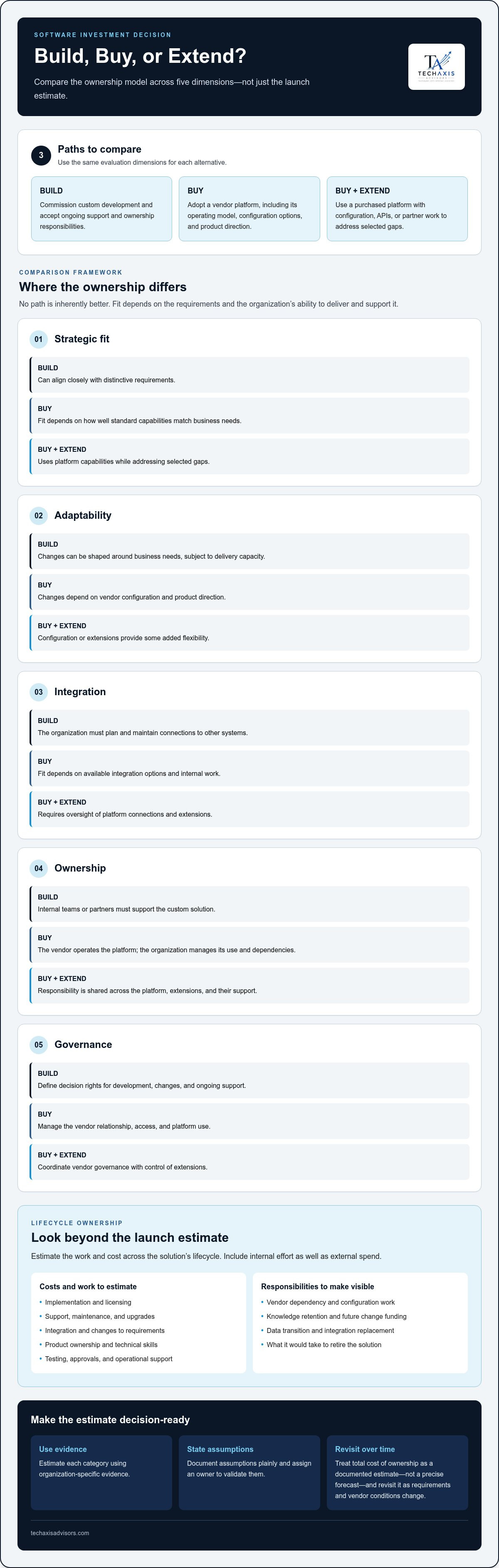
Buying means adopting a vendor platform along with its operating model, configuration options, and product direction. Commercial off-the-shelf (COTS) software is packaged software available for purchase; its fit depends on how well its capabilities align with the organization’s needs. Building means commissioning custom development and accepting responsibility for ongoing support, changes, and ownership. Extending combines a purchased platform with configuration, APIs, or partner work to address specific gaps.
These options are not inherently better or worse. For example, a firm seeking more consistent reporting might adopt a platform with suitable reporting functions, extend it to connect existing systems, or build a specialized tool if the reporting capability is central to how it competes. The decision should reflect actual requirements, not the assumption that customization is always more responsive or that a vendor product is automatically simpler.
Set the decision boundary before comparing solutions: what must improve, what can remain standard, and which existing systems or operating constraints cannot be ignored? A disciplined starting point makes comparisons more relevant and gives executives a clear basis for evaluating alternatives.
Compare Build, Buy, and Extend Across Total Ownership
A solution’s purchase price or development estimate is only one part of the commitment. A useful custom software build vs buy analysis compares what the organization must fund, operate, govern, and eventually change or exit. Use the same evaluation dimensions for each option so an attractive launch estimate does not obscure the work required afterward.
Evaluate the lifecycle, not just launch
Build a lifecycle estimate that includes implementation, licensing, support, maintenance, upgrades, integration, and changes to requirements. Include internal effort as well as external spend: product ownership, technical skills, testing, approvals, and operational support all consume capacity. For a purchased platform, account for vendor dependency and the work of managing configuration or integrations. For a custom solution, consider how knowledge will be retained and changes funded when team members or priorities shift.
Plan for transition, too. Identify what it would take to move data, replace an integration, or retire the solution. Estimate each category using organization-specific evidence, state assumptions plainly, and assign an owner to validate them. Total cost of ownership is a documented estimate, not a precise forecast. Revisit it as requirements and vendor terms become clearer.
Test strategic fit, control, and risk
Compare each option against differentiation, data needs, integration demands, and business continuity requirements. In a financial services organization, the choice should also fit established governance processes and the organization’s risk tolerance. Relevant controls and decision rights depend on the organization and its context; do not assume a technology path automatically satisfies them.
Vendor dependency and technical debt are risks to assess, not inevitable results. Examine where the organization relies on a vendor’s roadmap, a specialist’s knowledge, or fragile connections between systems. Then decide who will monitor those dependencies and approve changes. A lifecycle comparison with named assumptions and owners gives executives a firmer basis for weighing tradeoffs. For an independent executive perspective on the decision, start a confidential conversation.
When to Build, Buy, or Extend: Match the Choice to the Work
The right path depends on what the work requires and what the organization can own. A custom software build vs buy analysis should also consider whether an existing system can be retained, optimized, integrated, or replatformed before replacement enters the discussion. That broader view can prevent the organization from adding a new solution when improving the current environment would address the need.
Use this comparison to identify tradeoffs, not to declare a universal winner:
Build: Pros include close alignment with distinctive workflows and greater control over changes. Cons include responsibility for delivery, ongoing support, maintenance, and governance, all of which require sustained ownership and capacity.
Buy: Pros include access to established platform capabilities and a vendor operating model. Cons include dependence on the platform’s available workflows and direction, along with the need to manage licensing, integrations, and vendor relationships.
Buy and extend: Pros include using a platform for core needs while adapting selected gaps through configuration or integration. Cons include coordinating platform and extension ownership, and managing the boundaries between vendor capabilities and custom work.
Conditions that may support a custom build
A build may be justified when a capability is central to differentiation and available alternatives cannot meet essential requirements. The evidence should show which requirements are necessary, why workarounds or platform changes fall short, and how the capability supports business objectives. Preference for a bespoke interface or familiar process is not enough on its own.
Before approving a build, name the accountable owner and establish how the organization will fund, govern, support, and maintain the software after launch. Confirm that delivery capacity includes more than initial development. AI-assisted coding may change how some work is produced, but it does not remove the need for review, integration, security oversight, ongoing support, or maintenance.
Conditions that may support buying or extending
Buying may fit common business capabilities when the platform’s functions, operating model, and vendor terms meet the organization’s needs. Extending may fit when a platform already covers the core workflow and specific gaps can be addressed without taking on a full custom system. The tradeoff is straightforward: less custom ownership can mean limits on workflow or platform direction.
For example, a financial services firm reviewing its client onboarding workflow might first assess whether its existing systems can be optimized or integrated. If a platform can support the essential process, buying or extending could be viable. If a distinctive capability remains unmet, a focused build may warrant evaluation, provided the firm can govern and support it. This is an illustrative scenario, not a client case study.
The decision should follow the work. Match required capabilities to strategic importance, platform fit, and the organization’s ability to own the chosen path.
Use a Decision Framework Before Approving Software Investment
A defensible recommendation should show how the organization moved from a business need to a decision, and who will be accountable after approval. This custom software build vs buy analysis gives executives a consistent record to review, challenge, and update as assumptions change.
Define the business need. State the outcome to improve, the users and workflows affected, why action is needed, and how success will be assessed. Separate essential requirements from preferences.
Set the decision boundary. Record existing systems, dependencies, constraints, stakeholder needs, and relevant governance expectations. Name the executive decision owner and the people responsible for validating operational requirements.
Include the full range of options. Assess whether to retain, optimize, integrate, replatform, replace, or retire existing software. Where a new capability is needed, compare buying, building, and extending against those options rather than treating a new system as the default.
Compare alternatives consistently. Use the same criteria for each viable path: strategic fit, required capabilities, lifecycle ownership, delivery capacity, risk, and expected business value. Document evidence, assumptions, unresolved questions, and why rejected alternatives do not meet the organization’s priorities.
Confirm the business case and ownership. Record lifecycle responsibilities, funding assumptions, operational support, vendor oversight, integration dependencies, and change decision rights. Assign accountable owners rather than leaving these obligations implicit.
Approve, monitor, and review. Capture the rationale, approval authority, next steps, and review checkpoints. Revisit the decision when requirements, business priorities, platform conditions, or delivery assumptions materially change.
Make the recommendation accountable
The approval record should make clear what the organization is choosing and what it is not choosing. Include the evidence behind the recommendation, the key tradeoffs, risks requiring active management, and assumptions that still need validation. This gives leaders a practical basis for approval and makes later review more disciplined than relying on a presentation or vendor proposal alone.
Make ownership and governance explicit
Name an executive sponsor, an operational owner, and the people authorized to approve scope or funding changes. Set review points for delivery progress, vendor performance, integration dependencies, and the continued fit of the solution. A structured executive assessment can organize decision-making and follow-through. For growth-stage companies, technology due diligence can also inform the assumptions leaders bring into an investment or operating decision.
These steps turn a software recommendation into an accountable management decision. The record should be clear enough for executives to explain why the selected path fits the business, what responsibilities follow, and when the choice will be reviewed.
Turn the Build-or-Buy Decision Into an Executive Roadmap
A software recommendation has value only when leaders can act on it. The conclusion of a custom software build vs buy analysis should connect the selected option to business priorities, accountable owners, funding decisions, and a clear sequence of work. It should also state what remains uncertain and how those open questions will be resolved.
What executives need to take forward
An executive-ready recommendation should bring the decision into one view. Summarize the business need, the options assessed, the evidence supporting the preferred path, and the assumptions that shaped the analysis. Make tradeoffs and principal risks visible, including the responsibilities that continue after implementation. This lets executives understand not only what is proposed, but why it fits the organization’s objectives and risk tolerance.
Translate the recommendation into practical management tools:
A prioritized roadmap that sequences decisions and work according to business importance and dependencies.
An action register that assigns each next step to an accountable owner, with timing and status tracking set by the organization.
An executive presentation that makes the rationale, choices, and required approvals clear for leadership or board review.
These outputs turn analysis into an operating plan. They also help distinguish approval of a direction from approval of every delivery detail. The engagement should support that progression, from clarifying the decision through setting priorities and establishing follow-through.
Where executive advisory adds continuity
Software decisions often cross functional boundaries. As work moves forward, requirements, vendor proposals, integration choices, and business priorities can shift. Ongoing executive counsel helps keep decisions aligned with strategy and risk tolerance while maintaining clear governance, decision rights, and accountability. The role is not to advocate for building or buying, but to help leadership preserve the logic of its decision as execution proceeds.
TechAxis Advisors’ structured Executive Intelligence Assessments are executive decision-support engagements, not technical audits. They provide evidence-based findings and prioritized roadmaps for leadership consideration. When execution is required, TechAxis supports it through advisory leadership, governance, vendor oversight, and qualified delivery partners. An assessment informs the decision and its follow-through; it does not by itself deliver or implement the software.
This perspective is informed by founder Aarati Dikshit’s more than 25 years of CIO, CTO, and CISO experience. Executives can explore how executive advisory and leadership can support technology decisions and their follow-through.
A disciplined roadmap gives leaders a basis for assigning ownership, reviewing progress, and revisiting assumptions as conditions change. The decision becomes more than a technology selection. It becomes an accountable business commitment.
Move From Decision to Measurable Progress
Approval is a starting point, not the finish line. Set a management cadence that keeps delivery aligned with the business outcome. Identify upcoming decision gates, assign an executive to resolve issues, and define what evidence will show whether the chosen path remains viable. This creates room to adjust as requirements, capacity, or business priorities change.
Keep the custom software build vs buy analysis connected to those reviews. Record material changes to the original assumptions and explain how they affect ownership, risk, or expected value. If the rationale no longer holds, leaders can make a deliberate adjustment rather than allowing the initiative to continue by default. Clear decision rights help teams move forward while preserving executive oversight.
The next step is to identify the leadership support needed to advance the decision.
With clear ownership and steady oversight, your organization can move forward with greater confidence.
Frequently Asked Questions
Does buying software eliminate the need for internal technology work?
No. A platform still needs internal coordination, especially during rollout and routine use. Before launch, identify who will handle user onboarding, route support issues, coordinate vendor communications, and communicate planned changes to affected teams. For example, a business unit may own training while a technology lead manages escalations. Clear handoffs show users where to turn and give leaders visibility into recurring service issues.
Can a company combine custom software with a purchased platform?
Yes. To make a combined solution manageable, define a clear boundary between the vendor platform and custom components. Specify which system is authoritative for each data element, and document how a change in one component could affect the other. Before wider release, test representative workflows across the connection, including how errors are identified and resolved. This makes the combined design easier to maintain as either component changes.
Who should own a custom software build-versus-buy decision?
An executive with authority over the affected business outcome should sponsor the decision. To keep the recommendation balanced, ask the business owner to confirm workflow priorities, technology leadership to explain feasibility, and finance to review funding assumptions. If these perspectives conflict, the executive sponsor resolves the tradeoff and records the rationale. This prevents the decision from defaulting to whichever team controls procurement or development.
What should executives do if software requirements change after approval?
Classify the proposed change before authorizing work. Determine whether it reflects new evidence, a changed business priority, or a preference that can wait. Ask the requestor to identify affected users and processes, then compare the impact of acting now with deferring the change. This helps executives distinguish a necessary adjustment from scope expansion and preserve attention for requirements tied to the intended business outcome.
How should a company assess vendor dependency before buying software?
Test the organization’s assumptions with a practical exit scenario. Consider how teams would retrieve essential information, maintain affected workflows during a transition, and identify alternative ways to perform critical tasks. Note which steps depend on vendor assistance or specialized internal knowledge. This exercise can reveal where contingency planning is thin and help leaders decide whether additional transition preparation is warranted before adopting the platform.
Does AI-assisted development make custom software the better choice?
Not on its own. Before treating AI assistance as a reason to build, test it against a representative task using the organization’s own acceptance criteria. Evaluate whether the resulting work is understandable, maintainable, and suitable for intended users, not merely whether an initial version can be produced. The exercise can inform delivery assumptions, but the choice still depends on whether custom software addresses a business need that other options cannot meet.



Comments