

AI for Portfolio Management: Use Cases, Tradeoffs, and an Executive Decision Framework
AI can accelerate portfolio analysis, but it cannot take responsibility for an investment decision. That distinction is central to evaluating AI for portfolio management. Firms want to process information faster, apply strategies consistently, and manage growing complexity. But a confident output is not necessarily a reliable judgment, particularly when the underlying data or assumptions are weak.
Executives need more than a list of possible applications or vendor promises. They need to understand where AI can support analysis and operations, what data and integration those uses require, and who remains accountable for decisions and oversight.
This article offers a practical framework for weighing AI opportunities against business value, data readiness, and risk. It examines portfolio workflows, tradeoffs between approaches, and the governance needed to keep human judgment in the process. The goal is to identify a clear next step, not to assume that every promising use case belongs in production.
Table of Contents
AI for Portfolio Management: Define the Decisions It Should Support
Where AI Can Assist Across the Portfolio Management Workflow
Compare AI Approaches by Control, Data Needs, and Decision Risk
Use an Executive Framework to Evaluate Portfolio AI Readiness
Move from Portfolio AI Evaluation to an Accountable Next Step
AI for Portfolio Management: Define the Decisions It Should Support
Before evaluating a model or vendor, define the portfolio and the decision in scope. An investment portfolio is a collection of financial assets managed against objectives and constraints. A project portfolio groups initiatives competing for resources; a product portfolio concerns offerings and their performance; a private equity portfolio may refer to companies held by an investment firm. These contexts can share analytical techniques, but they involve different data, decision rights, and measures of value.
That distinction matters for executives. A system designed to summarize market information will not automatically help prioritize technology projects or assess the operating performance of portfolio companies. Define the use case precisely enough to identify whose decision it supports and what evidence that person needs.
Which portfolio-management decisions may AI support?
AI-supported portfolio analysis organizes information and surfaces patterns; authorized people remain accountable for investment decisions. AI may help synthesize research, monitor selected indicators, prepare reporting, or explore scenarios for review. These are potential applications, not universal capabilities or proof that a system will improve investment performance.
For example, an analyst could use a tool to assemble information from approved sources into a briefing, while a portfolio manager assesses its relevance to a mandate. Another workflow could flag a change in a monitored indicator for investigation. In both cases, the output is an input to review, not an instruction to trade. Objectives, risk constraints, liquidity needs, and delegated authority remain essential decision context.
Algorithmic trading is a related but distinct area: rules or models can generate or execute trading instructions. The overview of algorithmic trading provides background on that practice, but it should not be conflated with every use of AI for portfolio management. Automation and oversight depend on the specific system and its intended role.
Where does portfolio AI fit in financial services?
For asset managers and wealth management firms, investment-portfolio applications may sit alongside research, portfolio monitoring, investment reporting, and supporting operational processes. A firm might explore AI to help staff find relevant information or prepare a first draft of an internal report. Whether that is appropriate depends on data access, review procedures, and the consequences of an inaccurate output.
AI can also support broader financial-services work, such as client service or internal administration. Those uses may affect an investment business without directly informing portfolio choices. Keeping the distinction clear helps leaders identify the right owners, controls, and measures of business value. TechAxis Advisors describes the organizations it supports in its overview of asset managers and financial services firms.
Executive interest is not just about analytical capability. It also concerns decision quality, oversight, and operational capacity: which work should be assisted, who reviews the result, and how the organization maintains accountability. Start by naming the decision and its owner before considering the technology.
Where AI Can Assist Across the Portfolio Management Workflow
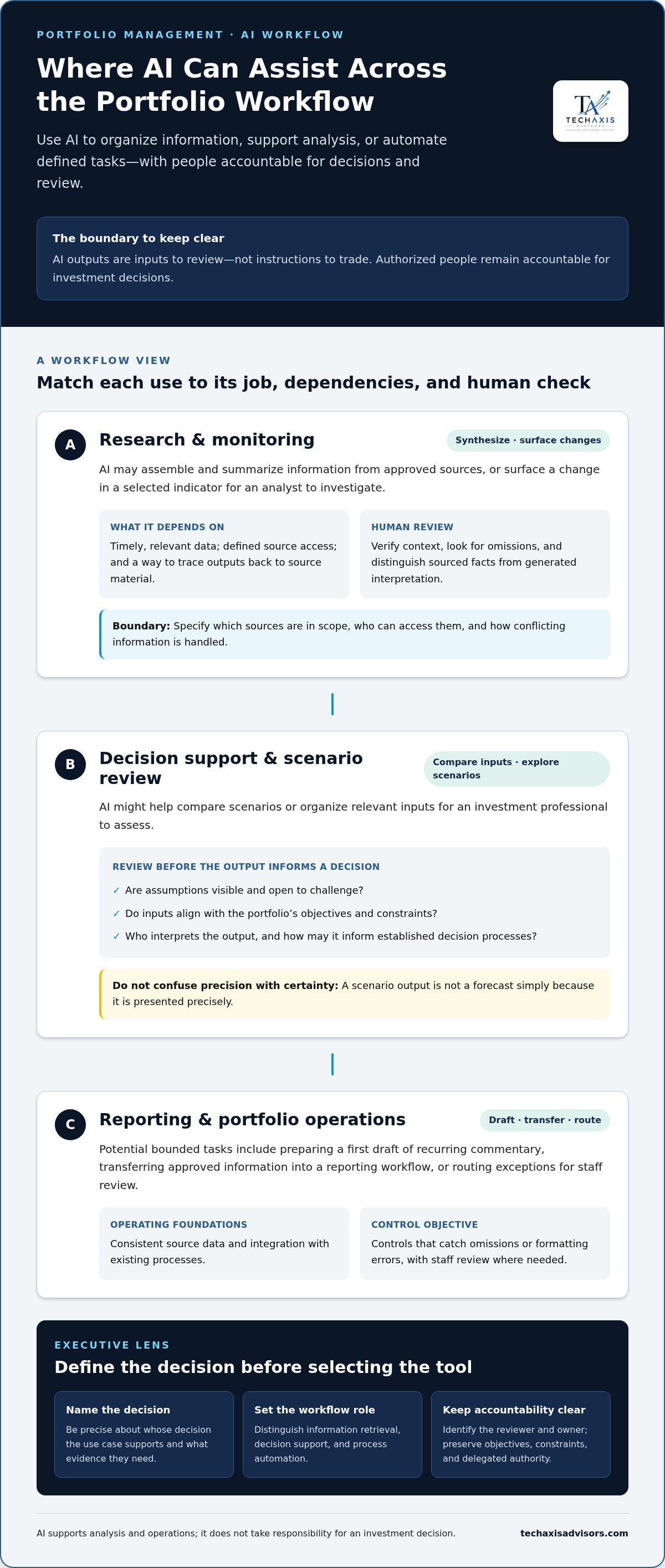
Evaluate potential uses by where the work occurs, not by the tool’s label. A workflow view helps leaders determine whether AI would inform a decision, retrieve information, or automate a repeatable task. Each role has different dependencies and review requirements. A use case is valuable only when it supports a defined decision or a clearly specified operating task.
Research, monitoring, and information synthesis
At the research stage, a system might help staff assemble and summarize information from approved internal and external sources. During monitoring, it might surface a change in an indicator for an analyst to investigate. These uses depend on timely, relevant data and a way to trace outputs to source material. Reviewers need to verify context, identify omissions, and distinguish sourced facts from generated interpretation before the information informs a decision.
Set boundaries before testing: which sources are in scope, who can access them, and what happens when information conflicts? If material is fragmented across systems or lacks consistent definitions, a summary may appear complete without resolving the underlying data problem. The U.S. Department of the Treasury’s AI in Finance resource offers financial-sector context for organizations assessing responsible use and risk management.
Decision support and scenario review
At the analysis stage, AI might help compare scenarios or organize relevant inputs for an investment professional. Its value depends on whether assumptions are visible, inputs align with the portfolio’s objectives and constraints, and the reviewer can challenge the analysis. A scenario output is not a forecast simply because it is presented precisely. Define who interprets it and how it may inform, but not replace, established decision processes.
Reporting and portfolio operations
Operational workflows may provide a bounded way to assess automation. Examples include preparing a first draft of recurring commentary, transferring approved information into a reporting workflow, or routing exceptions for staff review. These tasks depend on consistent source data, integration with existing processes, and controls that catch omissions or formatting errors. If a task requires judgment or exceptions are common, automation may shift work into review rather than reduce it.
Measure operational efficiency separately from investment performance. A faster reporting process may be useful, but it does not show that portfolio decisions have improved. Asset managers should also assess whether data definitions, ownership, and access are consistent enough for the intended workflow. An executive conversation about a portfolio AI use case can help clarify its decision purpose, dependencies, and oversight needs before implementation.
Compare AI Approaches by Control, Data Needs, and Decision Risk
“AI” can describe systems with different roles and control requirements. A rules-based workflow follows specified conditions. Predictive analytics estimates patterns from data. Generative AI produces or transforms content in response to instructions and information. These approaches are not interchangeable. For AI for portfolio management, compare them by task, input quality and lineage, and the consequences of an error.
Distinguish automation from analysis
A predictable task may be handled with conventional automation, without a model that infers patterns or generates text. A label alone does not establish suitability. Compare options by the decision’s materiality and reversibility: a draft that staff can correct presents a different control question from an output that could trigger a consequential portfolio action. The harder an action is to reverse, the stronger the case for explicit approval and documented review.
Weigh the tradeoffs before adoption
Weigh potential speed and scale against data consistency, source provenance, integration work, and the effort required to review outputs. Identify who owns data definitions, who resolves exceptions, and who is accountable when an output is incomplete or misleading. If information comes from disconnected sources, integrating the workflow may matter more than choosing a particular AI approach.
AI output is not automatically reliable investment advice or decision authority. Ask whether the responsible reviewer can trace the output to its inputs, understand its limitations, and decide when not to rely on it. If those controls are impractical, narrow the task or retain a fully manual review before expanding use.
Use an Executive Framework to Evaluate Portfolio AI Readiness
Readiness is not a general label. It is a decision about whether a specific use case has a clear purpose, workable data, accountable ownership, and controls proportionate to its consequences. Use this sequence to decide whether to proceed, narrow the scope, or address a foundational gap first.
Define the decision or constraint. The business sponsor identifies what needs to improve, such as the time required to prepare analysis or the consistency of an operational process. Define what the system may inform and what remains outside its scope.
Map the workflow. The process owner documents where information originates, who handles it, where handoffs occur, and who makes or approves the final decision. Include exceptions, not just the standard path.
Assess the data. The data owner identifies relevant sources, access conditions, definitions, quality issues, and update frequency. Determine whether the available information can support the use case or whether cleanup and integration must come first.
Evaluate controls. The executive accountable for the process, with technology and risk stakeholders as appropriate, defines review, escalation, access, and recordkeeping expectations. Decide who can use outputs and who can pause the workflow if concerns arise.
Select a bounded use case. The executive sponsor approves a limited task, user group, and test scope. Decide what evidence will justify continuing, revising, or stopping the evaluation.
Set a baseline before testing
Record how the workflow performs today before introducing AI. Depending on the task, a baseline might capture preparation time, correction frequency, handoff delays, or the volume of exceptions. Then define review criteria that match the purpose, such as whether staff can verify source material or whether a draft requires extensive correction.
There is no universal performance threshold that makes a portfolio use case ready. Set criteria based on the task’s materiality, risk tolerance, and available review capacity. If the baseline is unclear, a pilot may generate activity without establishing business value.
Make oversight part of the decision
Make accountability explicit. Name who reviews outputs, who resolves exceptions, and who owns the underlying decision. Technology governance for financial services connects these operational choices to executive oversight, including the authority to approve scope and respond when the workflow falls outside its intended use. Technology governance and AI advisory can support this alignment.
This framework turns AI for portfolio management from a broad ambition into a sequence of decisions with owners and evidence. If purpose, data, or oversight remains unresolved, the appropriate next step may be foundational work rather than a pilot.
Move from Portfolio AI Evaluation to an Accountable Next Step
An evaluation should end with a decision, not an open-ended commitment to “explore AI.” Proceed when the use case has a defined business purpose, workable data, an accountable owner, and review controls suited to its consequences. Narrow the scope when the goal is sound but the workflow or access needs clearer boundaries. Address foundational gaps first when data ownership, integration, or decision accountability is unresolved.
For AI for portfolio management, these signals help leadership distinguish a bounded opportunity from a technology initiative searching for a purpose. The next step may be a limited evaluation, targeted process or data work, or a decision to defer. Each is valid when it follows from evidence and organizational priorities.
When is an executive assessment useful?
An executive assessment is useful when leaders need an objective view of readiness, risk, or alignment with business priorities before committing resources. TechAxis Advisors’ structured Executive Intelligence Assessments are executive decision-support engagements, not technical audits. They organize evidence into findings, a prioritized roadmap, an action register, and an executive presentation, helping leaders determine what to advance, refine, or resolve first.
The process connects the opportunity to organizational context and decision needs. Assessment findings can inform subsequent advisory or fractional leadership when continued oversight is appropriate. For an overview of how those leadership options support executive decisions, explore executive advisory and leadership.
How can leaders sustain governance?
Approval starts oversight; it does not conclude it. Assign an executive owner to review whether the use remains within its approved purpose, whether exceptions are handled as intended, and whether changes to data or workflow require reassessment. Ongoing executive advisory or fractional technology leadership can help maintain governance, coordinate vendor oversight, and align qualified delivery partners when execution support is needed.
Set a review cadence that fits the use case and its impact, and document who can authorize changes or pause the workflow. This keeps responsibility visible as systems, processes, and business needs evolve. Oversight should be proportionate: a limited internal reporting task does not need the same structure as a workflow closely connected to investment decisions.
A disciplined next step could be an assessment, strategic advisory, or fractional leadership, depending on the gap. Start a confidential executive conversation about your portfolio AI priorities.
Make the Next Decision Deliberate
The next step is not necessarily to launch a pilot. Decide what evidence leadership needs before committing further: a clearer view of the business case, stronger data foundations, or defined ownership for ongoing oversight. Treat that decision as part of the investment, not an administrative step after technology selection.
AI for portfolio management can remain an executive priority as objectives and operating needs evolve. A clear decision now gives leaders a reference point for assessing future proposals against agreed priorities rather than evaluating each opportunity in isolation. TechAxis Advisors founder Aarati Dikshit brings more than 25 years of CIO, CTO, and CISO experience to executive technology and AI decision-making.
A measured next step can turn uncertainty into a decision leaders can explain, govern, and revisit as organizational needs evolve.
Frequently Asked Questions
Can AI manage an investment portfolio without human oversight?
AI should not be treated as an accountable portfolio manager. Some systems may be configured to take bounded actions, but an organization still needs to assign responsibility for their scope, outputs, and exceptions. For example, an investment team could require approval before acting on a proposed portfolio adjustment. Oversight should reflect the decision’s potential impact, how easily an action can be reversed, and the firm’s authority structure.
What data does AI for portfolio management depend on?
AI for portfolio management depends on data suited to the specific task. A research summary may require approved documents and source references, while portfolio analysis could draw on holdings, transactions, market information, and mandate constraints. Data quality involves more than accuracy: leaders should also consider freshness, consistent definitions, completeness, access rights, and traceability. A system can produce misleading outputs if its inputs omit relevant context or combine conflicting records.
How can executives compare generative AI with predictive analytics for portfolio workflows?
Compare them by the work required. Generative AI can produce a draft narrative from supplied information; predictive analytics estimates patterns from data. For instance, a team might evaluate generative AI for drafting commentary and predictive analytics for identifying relationships in historical portfolio data. Consider input requirements, how users can examine the basis of an output, the cost of an error, and the review effort each approach introduces.
Can AI improve portfolio reporting without changing investment decisions?
Yes. A firm can assess AI for administrative reporting tasks while keeping investment decisions and approval processes unchanged. For example, staff might use a system to prepare draft commentary from approved figures, then verify the figures and edit the narrative before distribution. Define which reports and data are in scope, preserve existing sign-off responsibilities, and track corrections or omissions. Treat any change to decision authority as a separate decision.
How should a financial-services firm evaluate an AI portfolio-management pilot?
Start with a limited workflow and user group, then compare the pilot with the current process using criteria chosen in advance. A reporting pilot might track preparation effort, corrections required, source traceability, and exceptions needing escalation. Include routine cases and unusual inputs, and record where human review changes the output. The sponsor should decide beforehand what evidence would support continuation, revision, or stopping, rather than judging the pilot by novelty or usage alone.
Does AI for portfolio management apply to private equity operating portfolios as well as investment portfolios?
It can apply to both, but the portfolios and decisions differ. An investment portfolio focuses on financial assets; a private equity operating portfolio may involve oversight of companies and their business performance. AI could be evaluated for consolidating approved operating information or identifying items for follow-up across companies. Account for differences in reporting definitions, systems, access permissions, and context before comparing outputs or drawing conclusions across portfolio companies.
When should an organization begin with an AI readiness assessment rather than a pilot?
Begin with an assessment when leaders cannot yet identify a suitable workflow, accountable owner, usable data, or workable review process. A pilot is premature if teams disagree about the objective or cannot establish how to judge the result. An assessment can clarify those gaps and whether they call for data preparation, governance decisions, or a narrower use case before testing begins.



Comments