

A Technology Vendor Selection Framework for Executive Teams
What if the vendor with the strongest feature list is the wrong choice for the business? A vendor selection framework for technology should begin with business outcomes, not product demonstrations. Yet executive teams often face requirements shaped by competing preferences, while delivery ownership, integration demands, and long-term dependence remain unresolved.
Proposals can make capabilities easy to compare without showing whether a vendor fits the operating model or can deliver against clear responsibilities. Risk and contract considerations may also surface late, when changing direction is harder. A disciplined process brings those questions into the decision before a preferred option becomes the default.
This article presents a repeatable framework for comparing vendors against business priorities, operational fit, material risks, and execution accountability. It explains how to define decision criteria, assess evidence rather than promises, and assign ownership for selection and the ongoing vendor relationship. The aim is a decision leaders can explain, govern, and carry through to implementation.
Table of Contents
Why technology vendor selection is an executive decision, not a feature contest
Build a technology vendor selection framework around evidence and business fit
Compare technology vendors by tradeoffs, risk, and execution evidence
Make the selection defensible with governance, stakeholder input, and decision gates
Connect vendor selection to executive decision support and accountable next steps
Why technology vendor selection is an executive decision, not a feature contest
A technology vendor decision can shape how work gets done, how information moves, and who is accountable when delivery falls short. A vendor selection framework for technology is a repeatable method for connecting business needs to evidence, decision rights, and accountable next steps. It keeps the team focused on the operating result the organization needs, not simply on which proposal has the longest feature list.
Feature fit is only one part of the assessment. A platform may offer the functions stakeholders want yet require changes to established workflows, depend on integrations that add complexity, or create data and oversight responsibilities the organization hasn’t planned for. Decision-makers also need to understand how implementation will be governed, who will own dependencies, and what ongoing work the relationship creates. A sound selection makes those implications visible alongside the vendor’s capabilities.
Illustrative example: A wealth management firm is considering a client reporting platform. One team values flexible report design; another prioritizes compatibility with existing data sources. Executives should first agree on the intended business outcome, then distinguish essential reporting and integration needs from preferences. The comparison can examine evidence for each requirement, the operational changes involved, and who will own delivery and oversight. The example illustrates a decision process, not a promised result. Organizations in wealth management and other sectors can have different priorities, as reflected on TechAxis Advisors’ industries and organizations page.
This is consistent with Best Value Procurement, which considers factors beyond price. For technology decisions, the broader principle is to assess business fit, operational implications, and the evidence behind a proposal together.
What should the framework help executives decide?
Begin with the business outcome the vendor relationship must support. Define what needs to change or improve in the organization’s work, rather than starting with a preferred product or a list of requested features. Separate essential capabilities, which materially affect that outcome, from preferences that won’t change the decision. Then make decision ownership explicit: name who approves the choice, who leads implementation, and who governs the relationship once the vendor is in place.
When is a formal technology vendor process warranted?
Use a more deliberate process when a decision touches sensitive data, core workflows, several systems, or multiple business functions. Scale the review to the potential business impact, organizational complexity, and risk exposure. A limited tool with few dependencies may need less governance than a platform embedded in daily operations. Also distinguish a new vendor choice from an existing-platform review. The first compares options; the second asks whether the current arrangement still fits business needs and what changes, if any, are justified.
The executive sponsor sets objectives, defines acceptable risk, and confirms who has authority to decide or accept unresolved issues. That direction prevents stakeholder input from becoming a contest of preferences. It also gives the team a clear basis for evaluating tradeoffs and documenting why the selected option serves the organization’s priorities.
Build a technology vendor selection framework around evidence and business fit
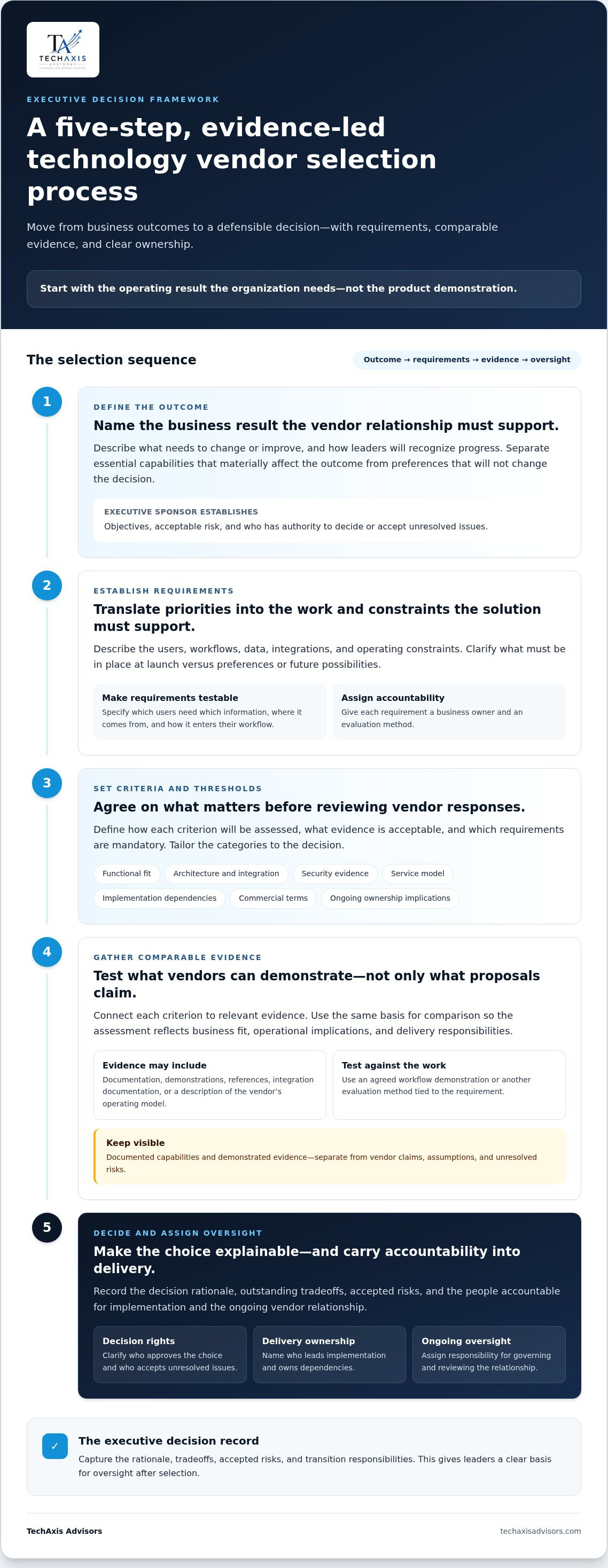
A useful framework turns business priorities into criteria the team can test consistently. Agree on what the organization needs to achieve before comparing proposals, then make the basis for the decision visible.
Define the outcome. State the business result the vendor relationship must support and how leaders will recognize progress.
Establish requirements. Describe the users, workflows, data, integrations, and operating constraints that shape the solution.
Set criteria and thresholds. Agree on what matters, how it will be assessed, and which requirements are mandatory.
Gather comparable evidence. Connect each criterion to documentation, demonstrations, references, or other relevant evidence.
Decide and assign oversight. Record the rationale, outstanding tradeoffs, and the people accountable for implementation and ongoing review.
Turn business priorities into testable requirements
“Improve reporting” is a priority, not yet a requirement. Specify which users need which information, where it comes from, how it enters their workflow, and what operating constraints apply. Then distinguish what must be in place at launch from preferences or future possibilities. Assign each requirement a business owner and an evaluation method, such as a workflow demonstration, integration documentation, or a description of the vendor’s operating model. This makes the evidence relevant to the work the organization needs to support.
Set comparable criteria before reviewing proposals
Agree on assessment categories before reading vendor responses. Depending on the decision, these may include functional fit, architecture, integration, security evidence, service model, implementation dependencies, commercial terms, and ongoing ownership implications. Define acceptable evidence for each category. For example, a capability claim may need to be demonstrated against an agreed workflow, while an integration requirement may call for technical documentation and a clear account of dependencies.
A weighted scorecard can help organize comparisons, but only after decision-makers agree on criteria, relative importance, and minimum thresholds. Otherwise, scoring can give subjective preferences a false appearance of precision. Use a consistent scale, describe what each score means, and record evidence alongside it. Treat missing information as an open question, not as proof that a vendor meets or fails a requirement. Document exceptions and assign an owner to resolve them.
Evaluate commercial terms in context. Consider the obligations and resources associated with implementation, operation, support, and future changes without relying on unsupported cost benchmarks. The comparison should show tradeoffs, not reduce a complex decision to a single total score.
Keep the decision record concise: capture key assumptions, evidence reviewed, unresolved tradeoffs, the accountable owner, and the rationale. For a practical view of how structured advisory work supports technology decisions, see how TechAxis structures its advisory work.
Compare technology vendors by tradeoffs, risk, and execution evidence
Once requirements are set, compare each option against the same dimensions. A vendor’s statement that its platform is secure, easy to integrate, or simple to operate is a claim, not evidence by itself. Record what supports each assertion, what remains an assumption, and what the organization would need to do to address any gap. This keeps the comparison useful to executives, not just to the team evaluating product features.
Use the table to expose tradeoffs, not to declare a universal winner. One option may align more closely with current workflows, while another may fit planned changes better but require more integration work. The right choice depends on which requirements matter most, what evidence supports each option, and which tradeoffs executives are prepared to accept. A vendor selection framework for technology should make those distinctions visible rather than hide them in a single score.
How should executives assess technology and operational fit?
Examine architecture and integrations against the systems the organization relies on and the operating changes it expects. Confirm who owns configuration, support, and dependencies across the vendor and internal teams. Where relevant, review a SOC 2 report or use the NIST Cybersecurity Framework to structure discussion of security practices. Neither reference automatically establishes that a vendor is compliant or that every risk is addressed.
How do you compare risk and long-term dependence?
Review access to organizational data, resilience evidence, subcontractor dependencies, and responsibilities for incident communication and response. Examine data portability and contractual exit provisions, then consider the practical work required to transition, including integrations and operational handoffs. A risk score can organize findings, but it doesn’t accept risk. Record the executive’s tolerance, any mitigation, and the owner responsible for follow-through.
References and documented capabilities can strengthen a vendor’s case, but keep them distinct from unresolved assumptions. Note the evidence date and scope, and capture exceptions explicitly. This gives decision-makers a clearer basis for weighing business fit, continuity, and the effort required to manage the relationship over time.
Make the selection defensible with governance, stakeholder input, and decision gates
A defensible decision depends on clear authority, timely input, and documented approval points. The vendor selection framework for technology should name one executive decision owner, then define who advises, evaluates, and approves. Without that distinction, stakeholder participation can blur accountability or allow unresolved preferences to delay the decision.
Which stakeholders should participate, and when?
Match participation to the decision’s scope. Business leaders explain workflow needs and operational impact; technology teams assess architecture and integration; security and other control functions review relevant risks; finance evaluates commercial implications; and operational owners identify support and transition needs. Involve affected groups while requirements are being shaped, not only after a preferred option emerges. Keep demonstrations and scoring anchored to agreed criteria so individual preferences inform, but don’t substitute for, evidence.
Use decision gates to make progress visible and prevent teams from advancing with material questions unresolved:
Requirements approval: Confirm business priorities, mandatory needs, and decision authority.
Evidence review: Assess vendor responses against the agreed criteria and identify gaps.
Risk acceptance: Record material risks, mitigation owners, and who has authority to accept residual exposure.
Selection approval: Document the chosen option, alternatives considered, and rationale.
Transition readiness: Confirm accountable owners, dependencies, and oversight arrangements before work moves forward.
What should the decision record and transition plan contain?
The decision record should preserve the selected option, alternatives considered, evidence reviewed, key assumptions, and accepted tradeoffs. Keep it concise enough for executives to use, but specific enough to explain why the decision was made. For acquisition-related choices, connect the record to broader technology due diligence for growth-stage companies, including how the proposed vendor relationship fits the organization’s technology environment and operating priorities.
Selection is a point in time; oversight continues. Assign named owners for contractual commitments, implementation dependencies, service review, and escalation. Define how material changes, such as a change in scope, a missed commitment, or a new dependency, reach the accountable executive. This separates approval of the vendor from management of the relationship and keeps responsibility clear after the decision.
Structured decision support can help leaders organize evidence, risks, and ownership into a usable record. TechAxis Advisors provides executive technology advisory and structured Executive Intelligence Assessments, with evidence-based findings and prioritized roadmaps to support leadership decisions.
Connect vendor selection to executive decision support and accountable next steps
A selection process should end with a clear executive decision record, not an assumption that the chosen vendor will deliver a particular result. The record captures why the option was selected, what evidence informed the decision, which risks were accepted, and who owns the next steps. It supports governance and follow-through, but it can’t guarantee vendor performance or business outcomes.
The vendor selection framework for technology creates value beyond comparison when its findings guide action. Leaders can use it to confirm priorities, address open risks, assign implementation dependencies, and set oversight responsibilities. That continuity matters: contract award is a decision point, not the end of executive accountability.
When can an executive assessment help?
An executive decision-support engagement can help when leaders need an objective view of a specific vendor choice, technology risk area, or unresolved set of priorities. A structured Executive Intelligence Assessment can organize evidence, clarify material risks, and identify which decisions need leadership attention. Deliverables include board-ready findings, a prioritized strategic roadmap, an action register, and a presentation tailored for executive review. These outputs help executives move from analysis to accountable next steps without treating assessment as a guarantee of results.
For example, if leaders have competing views on a platform proposal, an assessment can help separate documented capabilities from assumptions and identify dependencies that need an owner. The decision remains with the organization’s authorized leaders. The value is a clearer basis for that decision and an actionable record of what follows.
How can leadership continue after the selection decision?
Ongoing strategic counsel can keep technology decisions connected to business priorities as implementation and operating needs evolve. Governance and vendor oversight help track commitments, surface material changes, and maintain clarity about accountability. Fractional executive leadership can provide embedded guidance for execution, governance, and transformation where the organization needs senior technology leadership. TechAxis provides this advisory and leadership support to help organizations carry decisions into execution.
TechAxis’ fractional executive leadership can help organizations maintain decision ownership and oversight beyond vendor selection. The appropriate support depends on the decision’s complexity, the internal leadership available, and whether the priority is assessment, ongoing advisory, or fractional leadership.
Carry the decision into accountable action
A vendor choice should remain open to disciplined review as business needs, operating conditions, and dependencies change. Set a point to revisit the assumptions behind the decision, confirm that commitments still have owners, and raise material changes through the agreed governance path. That turns a vendor selection framework for technology into a durable management practice, not a one-time approval exercise.
Where the decision is complex or internal perspectives are divided, independent executive decision support can help leaders determine what evidence is still needed and which choices require senior attention. TechAxis founder Aarati Dikshit brings more than 25 years of experience as a CIO, CTO, and CISO to executive technology decisions. The focus is practical: strengthen clarity on the decision and the responsibilities that follow, without treating advice as a guarantee of vendor or business outcomes.
A considered decision gives your team a clear basis for moving forward, learning from execution, and adjusting governance as circumstances evolve.
Frequently Asked Questions
What is a technology vendor selection framework?
It’s a consistent method for deciding whether a vendor fits a defined business need. It helps leaders explain the choice and revisit the assumptions behind it if priorities or operating conditions change. A vendor selection framework for technology should make the reasoning understandable beyond the team that conducted the evaluation.
How many vendors should be included in a technology evaluation?
There’s no fixed number. Consider enough credible options to understand meaningful alternatives, without expanding the field for its own sake. A focused decision may require a narrower review, while a strategic platform choice may also warrant comparing a new vendor with extending an existing system or changing a process.
Should every technology vendor selection use an RFP?
No. An RFP can help when requirements are stable and comparable written responses will support the decision. For a limited, well-defined need, a lighter process may be more practical. Choose an approach that gathers evidence the decision-makers will actually use.
How do you evaluate an AI vendor?
Identify where AI is used, what data it handles, and whether third-party models or subcontractors are involved. Consider how outputs are reviewed and errors addressed. For example, if staff use generated summaries, define who checks them and how corrections are managed.
What should a technology vendor scorecard include?
Include decision criteria, their importance, minimum thresholds, and evidence supporting each rating. Add space for unanswered questions and exceptions. Shared scoring guidance helps evaluators apply ratings consistently and prevents a strong overall score from obscuring a critical unmet requirement.
How is vendor selection different from vendor management?
Selection determines whether an option fits the need and whether to proceed. Vendor management oversees the relationship after that decision, including commitments, service changes, and emerging issues. Regular reviews can help leaders identify when circumstances no longer match the assumptions behind the original choice.
How can executives reduce bias in vendor selection?
Set requirements and scoring guidance before demonstrations. Give vendors the same core scenarios, and have evaluators record evidence before group discussion. Document exceptions and disclose relevant conflicts of interest. This helps distinguish business-based judgment from preference for a familiar brand or persuasive presentation.



Comments