

The Executive Technology Consultant: A Guide to Strategic Leadership and Decision Clarity
Most technology investments fail not because of the code, but because of a fundamental disconnect between the server room and the boardroom. You've likely watched your technology spend grow while measurable business outcomes remain elusive. It's a common struggle in 2026, where the pressure to adopt AI and modernize infrastructure often outpaces the development of sound governance. It's exhausting to manage execution risk when technical debt continues to mount against your growth objectives. This lack of alignment often leaves leadership teams reacting to technical crises rather than driving strategic initiatives.
Engaging an executive technology consultant provides the structural oversight necessary to bridge this gap. You'll learn how to leverage high-level advisory to align technical execution with your specific board-level mandates and business strategy. We'll outline a framework for achieving decision clarity, reducing execution risk, and building a technology roadmap that's actually ready for the C-suite. This approach replaces organizational anxiety with a disciplined, evidence-based path toward operational scalability and long-term stability. By focusing on executive-grade clarity, you can ensure your technology investments finally yield the results your stakeholders expect.
Table of Contents
Beyond IT Support: The Strategic Mandate for Executive Technology Consulting
A Decision Framework for Evaluating Technology Assets and Strategy
Navigating the Advisory Landscape: Strategy Firms vs. Boutique Partners
The ROI of Fractional Technology Leadership in High-Stakes Environments
Selecting an Executive Technology Consultant: A Decision Checklist
Beyond IT Support: The Strategic Mandate for Executive Technology Consulting
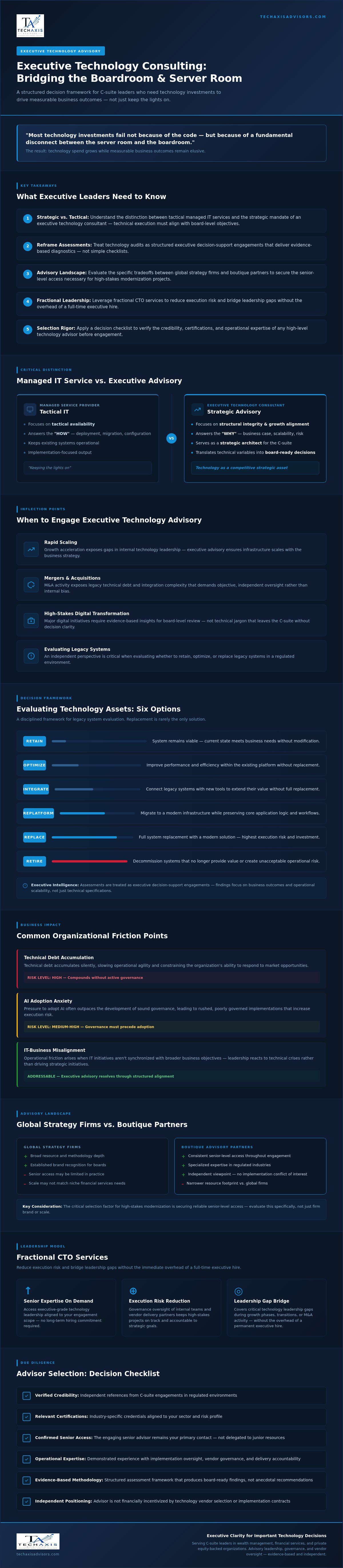
Technology leadership in 2026 requires more than technical proficiency. It demands a sophisticated understanding of how digital infrastructure drives enterprise value. An executive technology consultant doesn't just manage systems; they serve as a strategic architect for the C-suite. While a Managed Service Provider (MSP) focuses on tactical availability and keeping the lights on, an executive advisor focuses on structural integrity and growth alignment. This distinction is critical for leaders in wealth management and financial services who need their technology to do more than function; it must compete.
Many organizations face a common set of friction points. Technical debt accumulates silently, slowing down operational agility. Anxiety over AI adoption often leads to rushed, poorly governed implementations. Operational friction arises when IT initiatives aren't synchronized with broader business objectives. The goal of executive advisory is to translate these complex technical variables into clear, confident business decisions. By applying the rigorous frameworks typical of management consulting, these advisors provide the oversight necessary to transform technology from a cost center into a strategic asset.
The Distinction Between Implementation and Advisory
Implementation partners are primarily concerned with the "how" of technology. They focus on deployment, migration, and technical configuration. In contrast, an executive advisor focuses on the "why." They evaluate whether a specific investment supports the long-term roadmap or merely adds to existing complexity. This level of TechAxis Advisory & Leadership emphasizes governance as a tool to mitigate execution risk. For growth-stage firms, this means ensuring every technical move is backed by a business case that considers scalability and risk management rather than just technical feasibility.
When to Engage an Executive Technology Advisor
Certain inflection points necessitate high-level intervention. Rapid scaling, mergers and acquisitions, or high-stakes digital transformations often expose gaps in internal leadership. During board-level reviews, leadership needs evidence-based insights rather than technical jargon. An executive technology consultant provides an objective perspective, offering necessary oversight of both internal teams and external vendors. They ensure that third-party delivery partners remain accountable to the organization's strategic goals. This independent viewpoint is critical when evaluating whether to retain, optimize, or replace legacy systems in a regulated environment.
A Decision Framework for Evaluating Technology Assets and Strategy
Leadership teams in wealth management and financial services often inherit technical ecosystems built on years of incremental decisions. These legacy stacks frequently lack a cohesive strategy. An executive technology consultant introduces an evidence-based diagnostic approach to evaluate these assets. We treat these assessments as executive decision-support engagements rather than technical audits. This shift in perspective ensures that findings focus on business outcomes and operational scalability rather than just technical specifications.
Strategic clarity requires a transparent view of technical health. We use a proprietary Executive Intelligence Platform to deliver repeatable, data-driven findings that provide a foundation for board-level reporting. This methodology replaces organizational anxiety with a sense of controlled progress. It allows the C-suite to see exactly how technical infrastructure supports or hinders growth objectives. You can start with a confidential executive conversation to explore whether your current priorities require a full assessment or targeted strategic advisory.
The Six-Point Evaluation Framework
Replacing legacy systems is expensive and carries significant execution risk. It's rarely the only solution. A disciplined evaluation framework analyzes the business case for six distinct paths: retain, optimize, integrate, replatform, replace, or retire. This approach helps leadership identify where to preserve existing value and where to invest for future scale. By documenting these tradeoffs, we create a prioritized strategic roadmap that gives the board confidence in the proposed path forward. It moves the organization away from reactive cycles toward a more sustainable modernization strategy.
AI Readiness and Automation Maturity
AI adoption in 2026 requires a focus on governance and structural integrity. Many firms struggle with the gap between technical potential and organizational readiness. A pragmatic roadmap for automation prioritizes operational efficiency over abstract theory. We evaluate your data infrastructure and reporting strategy to ensure the foundation can support automation without creating new technical debt. This process ensures that AI initiatives deliver measurable business value and remain compliant with industry regulations. It's about building a leadership bridge between your current capabilities and the desired state of automation maturity through specialized technology advisory services.
Navigating the Advisory Landscape: Strategy Firms vs. Boutique Partners
Selecting the right advisory partner is as critical as the technology itself. Global strategy firms, often referred to as the Big Four, offer immense scale and broad resources. They're well suited for massive, multinational transformations that require hundreds of personnel. However, for growth-stage firms in financial services or private equity, the delivery model often matters more than the brand name. An executive technology consultant from a boutique firm provides a level of senior-level access that larger organizations struggle to replicate at a mid-market scale.
The primary value of a boutique partnership lies in the background of the advisors. These partners are frequently former CIOs, CTOs, and CISOs with decades of operational experience. They don't just provide abstract theory; they offer pragmatic guidance based on having sat in the same seat as the client. This boutique advantage ensures that the person who designs the strategy is the same person overseeing its execution. It eliminates the disconnect between high-level promises and the practical realities of technical leadership.
Assessing Scale and Expertise
Wealth management and private equity operate under strict regulatory requirements. These industries require specialized knowledge of compliance, data governance, and reporting. While global firms provide breadth, boutique advisors offer depth in specific operational mechanics. They maintain a professional, independent stance in vendor and platform management, ensuring that recommendations are based on business fit rather than partnership incentives. This independence is vital for maintaining objective oversight during high-stakes digital transitions where vendor bias can lead to significant technical debt.
The Delivery Model: Diagnostic to Execution
The workflow of an executive advisory engagement is methodical and highly organized. It begins with a diagnostic phase, followed by synthesis and the creation of a prioritized roadmap. Unlike static reports that often lack actionable depth, structured Executive Intelligence Assessments provide evidence-based findings that are board-ready. These assessments support execution through ongoing governance and the coordination of qualified delivery partners. It's a leadership-first model that ensures the organization has the necessary oversight to see a project through to completion. This approach bridges the gap between identifying a problem and achieving mastery over the new technical environment.
The ROI of Fractional Technology Leadership in High-Stakes Environments
Growth-stage companies often reach a point where technical complexity outpaces their internal leadership capacity. Hiring a full-time, high-level CTO in 2026 requires significant capital and carries substantial recruitment risk. A fractional model offers a pragmatic alternative. An executive technology consultant serving in a fractional capacity provides embedded leadership without the long-term overhead of a permanent executive hire. This approach allows firms to access veteran expertise precisely when they need to navigate complex transformations or scale operations.
For Private Equity investors, this leadership model serves as a vital value creation tool. Technology due diligence is no longer just a pre-acquisition checklist; it's a strategic assessment of a portfolio company's ability to scale. By identifying technical debt and operational gaps early, investors can protect their capital and accelerate growth. This objective oversight ensures that technical infrastructure supports the investment thesis rather than hindering it. It provides the board with the transparency needed to make informed decisions about resource allocation and risk management.
Scaling Technology Operating Models
Operational maturity is rarely achieved through technical upgrades alone. It requires a structured technology strategy that aligns with the firm's overarching goals. A fractional executive bridges the gap between high-level strategy and technical execution, ensuring that internal teams remain focused on high-impact initiatives. They provide the necessary leadership bridge to move an organization from reactive firefighting to disciplined, proactive growth. You can explore the specific triggers for this transition in our guide on When Does a Growth Company Need a Fractional CTO?
Risk Mitigation and Technology Governance
Financial services and asset managers operate under intense regulatory scrutiny. Managing cybersecurity risk and maintaining data integrity are non-negotiable requirements. A robust governance framework ensures that reporting structures drive data-driven decision-making across the enterprise. This is especially critical when implementing AI strategy in regulated sectors, where governance must precede adoption. Ensuring your firm is prepared for these challenges requires a methodical approach. Review our Technology Due Diligence for Growth-Stage Companies to evaluate your current posture.
Selecting an Executive Technology Consultant: A Decision Checklist
Choosing an executive technology consultant requires a shift from technical vetting to strategic evaluation. While technical proficiency is a baseline requirement, it's not the primary driver of enterprise value. You need a partner who understands the operational mechanics of wealth management or private equity. This means verifying credibility markers such as SBA WOSB or NJ MWBE/SBE certifications, which indicate a structured and professionally managed firm. These markers provide a layer of institutional trust that's critical when managing high-stakes technology decisions. They suggest a commitment to the rigorous standards expected in the financial services sector.
The background of the lead advisor is equally important. Theoretical knowledge doesn't survive the complexities of a mid-market digital transformation. You should seek advisors who have served as CIOs, CTOs, or CISOs in regulated sectors. This firsthand experience ensures they understand the pressure of board-level reporting and the reality of execution risk. Their deliverables must reflect this seniority. If an assessment feels like a generic technical audit rather than a structured executive decision-support engagement, it won't provide the clarity your board requires. Evidence-based findings should always prioritize business outcomes over technical specifications.
Key Questions for Prospective Advisors
Before engaging an executive technology consultant, you must probe their methodology to ensure it aligns with your organizational needs. Start by asking how they specifically align technology investments with your business strategy. A qualified advisor should be able to explain the mechanics of this alignment without relying on technical jargon. You also need to understand their methodology for assessing technical debt and AI readiness. It's essential that they use a repeatable, data-driven framework rather than a subjective checklist. Finally, ask if they can provide clear tradeoffs for "Retain vs. Replace" decisions. This ensures they aren't biased toward expensive, high-risk replacements when optimization or integration might be the more pragmatic path forward.
Next Steps for Executive Leadership
Identifying the right level of support starts with a confidential executive conversation. This initial dialogue helps clarify whether your current priority requires a structured assessment, ongoing strategic advisory, or fractional leadership. Each engagement model serves a different stage of organizational maturity. You can explore Who TechAxis Is For to see how these services align with the needs of wealth management and private equity-backed firms. The goal is to move from a state of technical anxiety to one of disciplined progress and mastery. By selecting an advisor who values tangible execution over abstract theory, you ensure your technology finally yields the results your stakeholders expect.
Achieving Strategic Alignment and Execution Mastery
The transition from technical complexity to strategic clarity requires a disciplined approach to leadership. A structured framework for evaluating legacy systems prevents unnecessary spend and reduces execution risk. By leveraging the expertise of an executive technology consultant, your organization can finally align technical infrastructure with its long-term growth objectives. This process replaces organizational anxiety with a sense of controlled progress. It ensures every technology investment is backed by a clear business case.
Our advisors are former CIOs, CTOs, and CISOs who understand the mechanics of scaling in regulated industries. We use a proprietary Executive Intelligence Platform to deliver board-ready diagnostics that move beyond technical jargon. As a Certified Women-Owned Small Business (WOSB), we provide the institutional trust and evidence-based findings necessary for high-stakes decision-making. You don't have to manage these transitions in isolation.
Establishing a leadership bridge today ensures your firm is prepared for the operational demands of tomorrow. We're ready to help you navigate your next transformation with confidence.
Frequently Asked Questions
What is the difference between an IT consultant and an executive technology consultant?
IT consultants usually focus on technical implementation and tactical support. An executive technology consultant operates at the board level to align technical execution with business strategy. They focus on decision support and governance rather than just fixing systems. This role bridges the gap between technical infrastructure and long-term enterprise value. It ensures that every technical move supports the firm's growth objectives and risk tolerance while providing senior-level oversight.
How does a fractional CTO support growth-stage companies?
A fractional CTO provides embedded executive leadership without the overhead of a full-time hire. They help companies scale their technology operating models while managing execution risk. This model is effective for growth-stage firms that need veteran expertise to navigate rapid transformation. The advisor brings the wisdom of a seasoned professional to drive structural integrity. It allows leadership to focus on core business while technical strategy remains disciplined.
What should be included in an executive AI readiness assessment?
An executive AI readiness assessment focuses on governance, data infrastructure, and operational impact. It identifies high-impact use cases while evaluating the structural integrity of your current data foundations. The assessment provides a pragmatic roadmap that addresses compliance and risk requirements for regulated industries. This ensures that AI adoption isn't just following a trend but is anchored to specific business outcomes. It replaces organizational anxiety with a clear path toward mastery.
How do executive technology advisors help with vendor management?
Executive advisors provide objective oversight of third-party delivery partners and software platforms. They ensure that vendor selections are based on business fit and long-term scalability rather than technical trends. By maintaining an independent stance, they help leadership avoid vendor bias and technical debt. This oversight includes managing service level agreements and ensuring that external partners remain accountable to the organization's strategic roadmap. It protects the firm's interests during complex negotiations and transitions.
Can an executive technology consultant help with M&A technology integration?
Yes, they provide technical due diligence and integration leadership to protect investment capital. They identify hidden technical debt and operational gaps before an acquisition is finalized. Post-close, they manage the integration of technical ecosystems to ensure the combined entity achieves expected synergies. This objective perspective allows Private Equity investors and leadership teams to make informed decisions about resource allocation. It ensures that technical infrastructure supports the broader investment thesis.
What are the benefits of using a proprietary platform for technology assessments?
A proprietary platform ensures that diagnostics are structured, repeatable, and evidence-based. It allows for a data-driven approach that moves beyond subjective technical audits. Using a platform like the TechAxis Executive Intelligence Platform provides board-ready findings that are consistent and transparent. This methodology ensures that every recommendation is traceable and anchored to verifiable data. It provides the C-suite with a clear foundation for reporting and long-term strategic planning.
How does executive technology advisory improve operational maturity?
Advisory services improve maturity by aligning technical operating models with business strategy. They introduce disciplined processes for governance, risk management, and resource allocation. This shift moves the organization from reactive firefighting to proactive, strategic execution. By building a leadership bridge between current capabilities and desired outcomes, advisors help firms master their technical environments. It creates a scalable foundation that supports rapid growth without increasing operational friction or technical debt.
What deliverables should I expect from a high-level technology engagement?
High-level engagements produce concise, board-ready briefs and prioritized strategic roadmaps. You should expect an action register with clear next steps and full methodology documentation. These artifacts focus on clarity and accountability rather than providing static, generic reports. Every deliverable is designed for executive review, ensuring that leadership can make confident decisions quickly. This emphasis on evidence-based insight distinguishes an executive technology consultant from traditional technical consulting or implementation projects.


Comments