

The Executive Guide to On-Demand CTO Consulting in 2026
By 2027, more than 30% of mid-size enterprises will have at least one fractional executive on retainer. This shift reflects a growing reality for leadership teams: the traditional full-time hire isn't always the most efficient path to technical maturity. Many organizations now turn to on-demand CTO consulting to bridge the gap between high-level strategy and daily execution. You likely recognize the friction caused by technical debt slowing your growth or the mounting uncertainty regarding AI governance as the August 2026 EU AI Act deadline approaches. It’s difficult to ensure your IT spend drives business outcomes when the technical roadmap feels disconnected from the boardroom.
This guide explores how executive-level technology leadership can align your technical execution with business strategy. We’ll examine the 2026 regulatory landscape, including the NIST Cybersecurity Framework 2.0, while maintaining operational agility. We'll provide a clear framework for reducing execution risk and gaining the clarity required for board-level decisions without the cost of a full-time hire.
Table of Contents
What is On-Demand CTO Consulting?
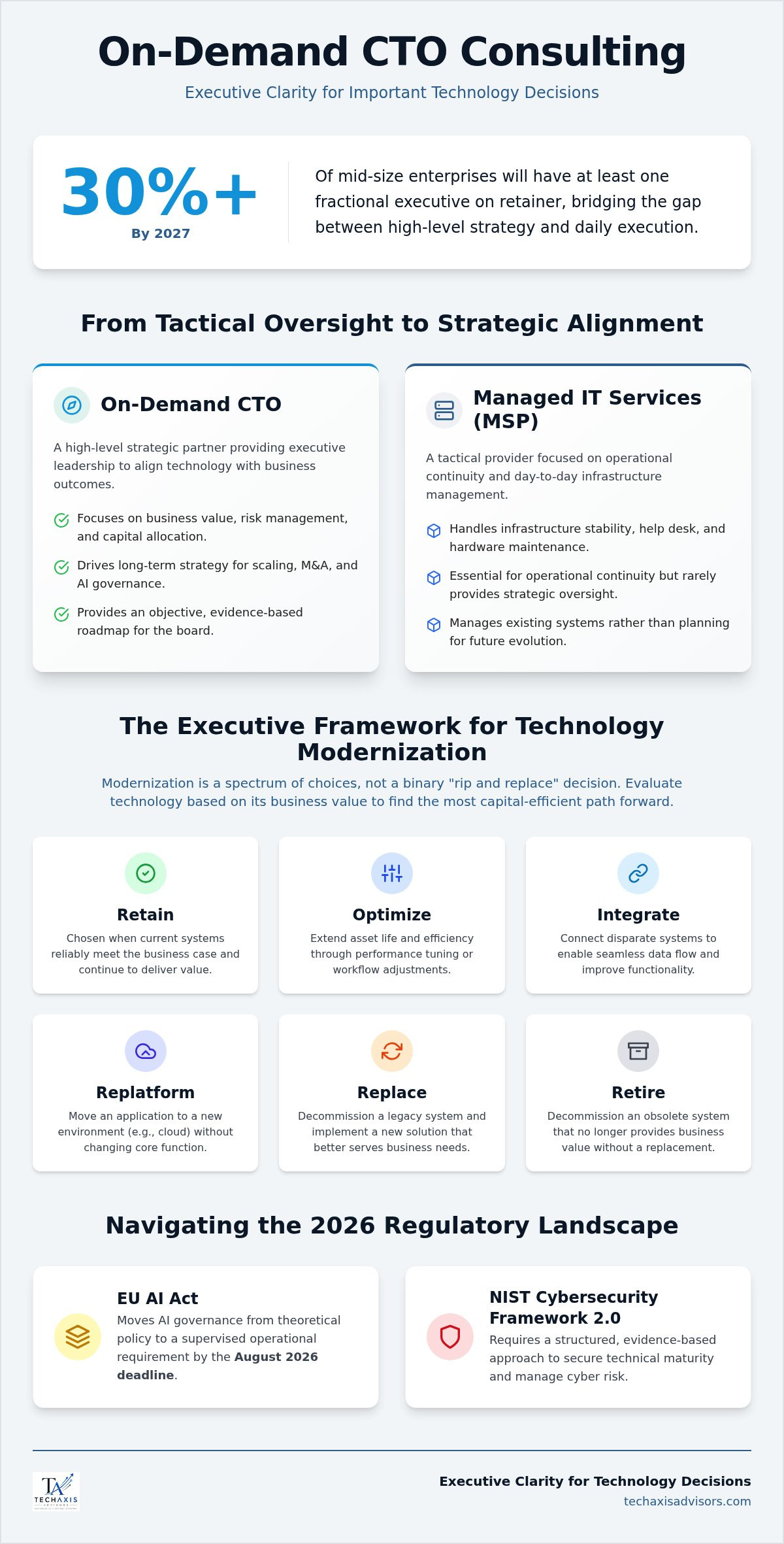
On-demand CTO consulting is a high-level strategic partnership that provides executive technology leadership on a fractional or project basis. It represents a fundamental shift from tactical IT oversight to strategic business alignment. While traditional IT roles focus on keeping systems running, this model ensures that every dollar spent on technology directly supports the long-term objectives of the firm. It's built for organizations that require sophisticated technical direction but don't yet need a full-time, permanent executive hire.
This approach differs significantly from Managed IT Services (MSP). An MSP typically handles infrastructure stability, help desk support, and hardware maintenance. They're essential for operational continuity but rarely provide the strategic oversight required to navigate complex market shifts. In contrast, advisory leadership focuses on the business value of technology. It addresses high-stakes scenarios such as rapid scaling, the governance of AI adoption, or preparing a company for a private equity acquisition.
The Role of the Modern On-Demand CTO
A Chief Technology Officer (CTO) operating in an on-demand capacity acts as a translator between complex technical ecosystems and business-focused decisions. They don't just manage software; they manage risk and capital allocation. By serving as a trusted advisor to the CEO and Board, they bridge the gap between abstract strategy and operational execution. This ensures that technical teams aren't just "building things," but are building the specific tools that drive revenue or improve margins.
Their work often involves creating structured frameworks for technology decisions. They provide the necessary oversight to ensure that vendor selections and platform migrations are based on objective data rather than technical preference. This level of discipline is critical for firms in regulated industries like wealth management or financial services, where compliance and data integrity are non-negotiable.
Why Growth-Stage Firms Leverage Fractional Leadership
Growth-stage firms often face a talent gap. They've outgrown their initial technical setups but cannot yet justify the $300,000+ salary of a veteran executive. On-demand CTO consulting provides access to veteran expertise at the CIO, CTO, or CISO level without the fully loaded cost of a full-time hire. This allows firms to benefit from the wisdom of a seasoned professional who has successfully scaled organizations before.
Scaling Flexibility: Involvement can increase during a major product launch or decrease during periods of steady-state operations.
Objective Perspective: An external advisor provides an unbiased view of internal technical debt and vendor performance.
Reduced Execution Risk: Senior oversight ensures that software projects are aligned with the actual needs of the business, preventing costly mid-project pivots.
By utilizing this model, leadership teams gain a disciplined partner who brings order to technical chaos. It replaces organizational anxiety with a predictable, evidence-based roadmap for growth.
The Executive Framework for Technology Modernization
Digital transformation often fails when leadership adopts a binary "rip and replace" mentality. This approach typically leads to budget overruns and operational disruption without guaranteed returns. Instead, a business-first strategy aligns technology operating models with specific long-term outcomes. By using evidence-based assessments, executives can identify high-impact modernization targets that preserve existing value while addressing critical gaps. The 'Retain vs. Replace' decision framework evaluates current technology based on its contribution to revenue, operational efficiency, and risk profile to determine the most capital-efficient path forward.
Effective on-demand CTO consulting provides the necessary distance to evaluate these systems objectively. Rather than defaulting to the newest software, the focus remains on the business case for each asset. This ensures that capital is allocated where it generates the most significant competitive advantage. It's about making disciplined choices that reflect the organization's actual maturity level.
Evaluating the Six Paths of Modernization
Modernization is rarely a single event. It's a spectrum of choices tailored to the specific needs of the firm. We evaluate systems through six specific lenses: retain, optimize, integrate, replatform, replace, or retire.
Retain and Optimize: This path is chosen when current systems meet the business case. Small adjustments to workflows or performance tuning can extend the life of a reliable asset without major capital expenditure.
Integrate and Replatform: These options focus on enhancing connectivity and cloud scalability. It's about making existing data more accessible across the enterprise without rebuilding the core logic.
Replace or Retire: Technology that creates more risk than value must be removed. This includes systems with unpatchable security vulnerabilities or those that no longer support the company's growth trajectory.
Reducing Technical Execution Risk
Technical debt is a persistent drag on operational scalability. It represents the accumulated cost of "quick fixes" that eventually slow down new feature development and increase maintenance overhead. Identifying this debt early is a core component of Technology Due Diligence for Growth-Stage Companies: An Executive Checklist. Without this clarity, software projects often drift away from their intended business purpose.
Strong governance ensures that technical execution remains disciplined. By establishing clear metrics for success, leadership can monitor progress without getting bogged down in granular details. If you're currently facing uncertainty regarding your technology roadmap, you might consider how a confidential executive conversation could clarify your modernization priorities.
On-Demand CTO vs. Full-Time CTO vs. MSP
Choosing the right leadership model depends on the specific maturity of your organization. It's a balance between daily maintenance and strategic direction. While many firms start with a Managed Service Provider (MSP), they eventually reach a threshold where tactical support no longer suffices. Understanding when a growth company needs a fractional CTO is critical for maintaining momentum. This transition usually occurs when technology must move from a cost center to a strategic driver of business value.
Cost and Expertise Trade-offs
A full-time CTO requires significant investment beyond base salary. Total compensation, equity grants, and benefits often exceed $300,000 annually. For many growth-stage firms, this creates unnecessary executive overhead. You pay for a full-time executive but may only require strategic input for a fraction of the work week. On-demand CTO consulting offers a more disciplined alternative. Industry data suggests that a fractional engagement typically costs 25% to 40% of the fully loaded annual cost of a comparable full-time hire. This model provides predictable spend and executive-grade experience without the long-term overhead. The tipping point for a full-time hire usually arrives when technical team management becomes a constant requirement that distracts from strategic board-level contributions.
Boutique advisory firms offer senior access that larger global strategy firms often struggle to match. In larger firms, a senior partner might sell the engagement only to delegate the work to less experienced staff. Boutique on-demand leadership ensures that a veteran operator remains your primary point of contact. This level of senior access is essential for firms that need agile execution and immediate clarity.
Strategic vs. Tactical Oversight
An MSP is designed for stability. They manage hardware, security patches, and help desk tickets effectively. However, an MSP cannot provide the technology governance required for M&A due diligence or complex AI strategy. They are tactical partners, not strategic architects. Independent, vendor-neutral advisory is essential when managing multiple delivery partners or white-label software teams. It ensures that technical decisions are based on objective business outcomes rather than the specific tools a vendor prefers to sell.
An on-demand CTO manages these delivery partners with a focus on accountability and transparency. They provide the necessary leadership bridge that a growing company might be missing. This oversight ensures that software projects stay aligned with the broader business strategy, reducing the risk of expensive technical pivots later in the growth cycle.
AI Strategy and Governance for Regulated Industries
In 2026, AI governance has shifted from a policy discussion to a supervised operational requirement. This is particularly true for firms in wealth management and private equity, where the August 2, 2026, compliance deadline for the EU AI Act has set a new global benchmark for "high-risk" systems. Building a pragmatic AI roadmap requires more than just technical implementation; it demands an AI in Financial Services: 2026 Strategic Framework that aligns with existing fiduciary duties. Executive leadership must ensure that every initiative meets the rigorous transparency and accountability standards expected by regulators and the board.
Strategic on-demand CTO consulting provides the necessary oversight to navigate this complex regulatory patchwork. This leadership ensures that AI adoption doesn't occur in a vacuum but is integrated into the firm's broader risk management strategy. AI Readiness is defined as an executive decision-support engagement that identifies the structural and regulatory requirements necessary to integrate automation into core business processes.
The Executive AI Readiness Assessment
A successful AI strategy begins with a critical evaluation of data architecture foundations. Implementing sophisticated models on top of fragmented or poor-quality data leads to unreliable outcomes and increased compliance risk. Identifying high-impact automation use cases requires a disciplined look at operational efficiency. This process is deeply tied to a Data Strategy for Asset Managers: 2026 Executive Framework. Without a clean, governed data layer, AI initiatives will fail to produce the evidence-based findings required for board-level reporting.
Governance-Driven Implementation
Governance is the primary mechanism for mitigating algorithmic bias and ensuring data privacy. The current version of the NIST Cybersecurity Framework (2.0) emphasizes "Govern" as a core function, placing technology risk directly in the hands of enterprise risk management. Boards now require clear, non-technical reporting on how AI models are being supervised. An on-demand CTO plays a vital role in vendor and platform management, ensuring that third-party AI tools adhere to the firm’s internal standards. They provide the necessary leadership bridge to verify that external delivery partners aren't introducing "black box" risks into the organization’s ecosystem.
Central to our approach is the proprietary TechAxis Executive Intelligence Platform. This tool enables structured diagnostics that replace organizational anxiety with data-driven clarity. Our engagement model follows a deliberate progression: a Diagnostic leads to a comprehensive Assessment, followed by a Strategic Roadmap and ongoing Execution Leadership. This ensures that every technical action is tied to a specific business outcome. We position ourselves as a disciplined partner for firms that need to align technical execution with strategic goals.
Evidence-Based Decision Support
We focus on providing board-ready briefs and prioritized action registers. These documents ensure that technology recommendations are transparent and traceable. This level of clarity is essential for improving operational maturity through technology. By providing evidence-based findings, we empower the C-suite to make informed choices without getting bogged down in technical jargon. Our structured Executive Intelligence Assessments provide prioritized roadmaps that allow for controlled progress in even the most complex environments.
Flexible Fractional Leadership Models
Our on-demand CTO consulting services offer an embedded executive presence. We don't replace your existing teams. We work with them and your delivery partners to turn strategic insights into tangible results. This model provides the long-term governance required for successful digital transformation. We act as an independent advisor, ensuring vendor oversight and accountability across all software projects. Our goal is to provide the senior-level leadership your company might be missing as it scales.
Securing Technical Maturity for Sustainable Growth
The 2026 technical landscape requires a disciplined approach to both innovation and governance. By integrating on-demand CTO consulting into your leadership model, you gain the strategic oversight necessary to navigate complex AI regulations and modernization trade-offs. This partnership ensures that your technology investments are governed by business outcomes rather than technical trends.
TechAxis Advisors provides the executive clarity required for these high-stakes decisions. Our founder, Aarati Dikshit, brings over 25 years of experience as a CIO, CTO, and CISO to every engagement. We utilize our proprietary TechAxis Executive Intelligence Platform to deliver structured, evidence-based findings that support board-level reporting. As a certified WOSB, MWBE, and SBE, we focus on providing senior access and agile execution for growth-stage firms.
Replacing organizational anxiety with controlled progress is the first step toward sustainable scaling. We look forward to helping you build a clear, prioritized roadmap for your firm's success.
Frequently Asked Questions
What exactly does an on-demand CTO do for a growth-stage company?
An on-demand CTO provides executive technology leadership to align technical execution with business strategy. They don't just manage systems; they manage capital allocation and technical risk. For a growth-stage firm, this involves creating a clear technology roadmap, overseeing vendor performance, and ensuring the operating model scales with the business. This leadership bridge allows the CEO to focus on growth while a seasoned professional handles technical governance and board-level reporting.
How much does on-demand CTO consulting typically cost compared to a full-time hire?
On-demand CTO consulting is significantly more cost-effective than a permanent hire. Industry data from May 2026 indicates that a fractional engagement typically costs 25% to 40% of the fully loaded annual cost of a comparable full-time CTO. This model eliminates expenses related to equity grants, benefits, and executive bonuses. It allows organizations to access senior expertise on a predictable, retainer-based model that scales according to current organizational needs and maturity.
Can an on-demand CTO help with AI strategy and governance?
Yes, an on-demand CTO is essential for navigating AI governance in regulated environments. They help identify high-impact automation use cases while ensuring compliance with frameworks like the EU AI Act or NIST Cybersecurity Framework 2.0. By establishing board-level reporting and oversight, they mitigate risks such as algorithmic bias and data privacy concerns. This leadership ensures that AI initiatives are evidence-based and aligned with the firm's specific risk tolerance and fiduciary duties.
Is on-demand CTO consulting the same as hiring an IT consultant?
No, these roles serve different organizational needs. An IT consultant usually addresses a specific technical problem or project. In contrast, on-demand CTO consulting provides broad, executive-level oversight and strategic direction. While a consultant might implement a specific tool, a CTO ensures that the tool fits the long-term business strategy. They act as a strategic architect rather than a tactical technician, focusing on operational maturity and enterprise-level risk management.
How long do typical on-demand CTO engagements last?
Engagement lengths vary based on the specific business issue. A structured Executive Technology Assessment might last a few weeks to provide an initial roadmap. Ongoing fractional leadership often continues for several months or years as the company scales or undergoes a major digital transformation. This flexibility allows firms to retain senior access during critical growth phases and adjust the level of involvement as the internal team matures or projects conclude.
Does TechAxis Advisors perform direct software implementation or coding?
TechAxis Advisors doesn't perform direct software builds, cloud migrations, or coding. Instead, the firm supports execution through advisory leadership, governance, and vendor oversight. We provide the strategic roadmap and qualified delivery partners necessary for success. For custom development needs, we utilize a specialized white-label partnership model. This ensures that our advice remains independent and focused on executive decision support rather than the mechanics of implementation.
How does an on-demand CTO help with technology due diligence for M&A?
An on-demand CTO provides an objective evaluation of a target company's technology stack during the M&A process. They identify hidden technical debt, security vulnerabilities, and scalability issues that could impact the valuation or integration timeline. By delivering board-ready findings and a prioritized action register, they help private equity firms and investors understand the true technical risk. This evidence-based approach ensures that investment decisions are grounded in structural integrity rather than technical assumptions.
What is an Executive AI Readiness Assessment?
An Executive AI Readiness Assessment is a structured diagnostic powered by the proprietary TechAxis Executive Intelligence Platform. It evaluates your firm's data architecture foundations and regulatory compliance landscape before you invest in AI tools. The assessment identifies high-impact automation use cases and delivers a prioritized roadmap for implementation. This engagement provides the executive clarity needed to move AI from a theoretical policy discussion to a supervised, governed operational requirement.



Comments