

The Executive Guide to Managing Risks of Implementing AI in Business
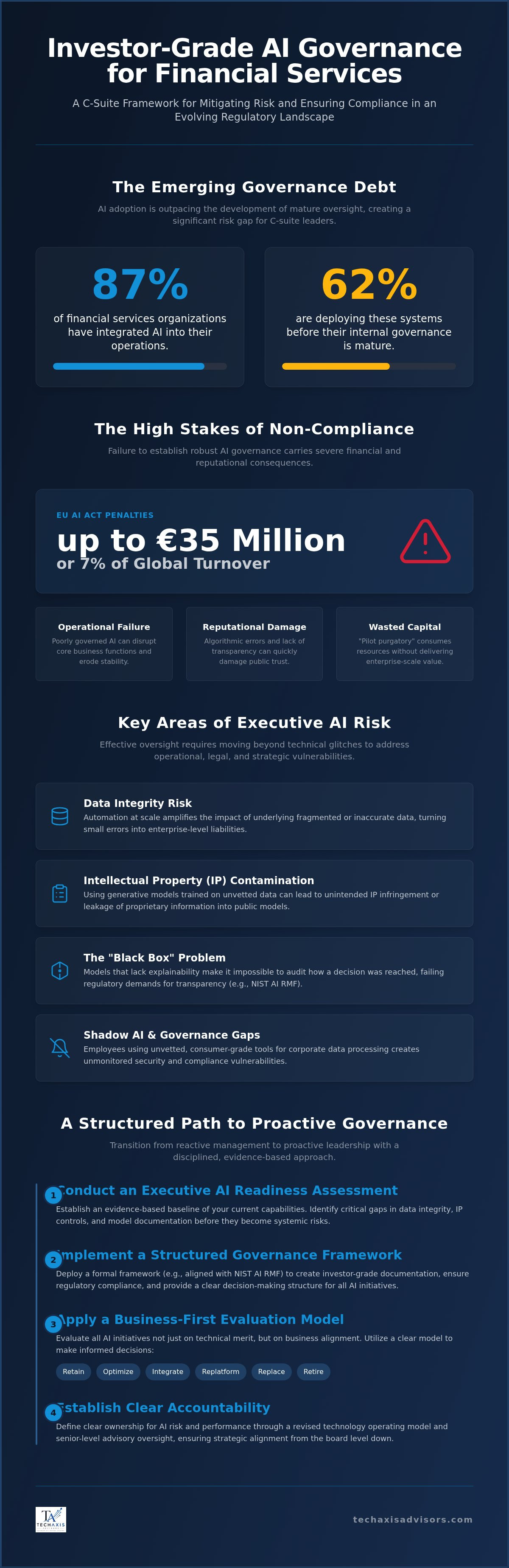
While 87% of financial services organizations have integrated AI into their operations, research shows that 62% are deploying these systems before their internal governance is mature. This creates a significant governance debt that leaves C-suite leaders vulnerable to operational failure and regulatory scrutiny. You're likely managing the tension between the need for rapid innovation and the uncertainty of a shifting compliance landscape. The fear of wasting capital on poorly integrated technology is compounded by the reality of strict oversight; failure to comply with the EU AI Act can result in penalties of up to €35 million or 7% of global turnover.
This guide introduces a pragmatic AI governance framework for financial services that replaces organizational anxiety with a disciplined, evidence-based approach to risk. We'll provide a clear roadmap to identify and mitigate implementation risks without stalling your strategic momentum. We'll move beyond abstract theory to deliver a structured progression of identification, improvement, and mastery. You'll gain the executive clarity needed to transition from reactive troubleshooting to proactive, investor-grade oversight that protects both your capital and your reputation.
Table of Contents
The Strategic Reality of AI Risks in 2026
For the C-suite, AI implementation risk isn't merely a technical failure. It's the strategic gap between what your technology can do and what your leadership can effectively oversee. As we move through 2026, the focus has shifted from experimental potential to verifiable business impact. Boards are now responsible for setting the organization’s risk tolerance for automated decision-making. This isn't a task to be delegated to IT; it's a fundamental governance requirement. 2026 represents a critical turning point because regulators have moved from issuing principles to enforcing specific mandates. Organizations can no longer hide behind "innovation" to excuse a lack of structural oversight.
The stakes are quantifiable. The EU AI Act became fully applicable on August 2, 2026, introducing penalties of up to €35 million or 7% of global annual turnover. In the United States, the Department of the Treasury released its sector-specific framework in February 2026, providing 230 control objectives that now serve as the benchmark for audit expectations. A robust AI governance framework for financial services is no longer optional. It's the necessary bridge between rapid adoption and long-term institutional stability.
The Shift from Experimental to Operational AI
Many growth-stage companies currently suffer from "pilot purgatory." This is a state where capital is consumed by perpetual testing that never reaches enterprise scale. It often stems from a reliance on anecdotal success stories from vendors rather than structured, evidence-based assessments. To escape this cycle, leaders must demand transparency in how models are trained and deployed. AI execution risk is the misalignment of automation and business strategy. When automation doesn't serve a specific, measurable business outcome, it's a liability rather than an asset.
Regulatory Pressures in Wealth Management and Finance
Wealth management firms face unique pressures regarding algorithmic transparency. The SEC’s 2026 Examination Priorities now specifically target how firms provide evidence of supervision for AI-driven advice. Compliance isn't just about the output; it's about the process. This includes managing data residency and the complexities of cross-border algorithmic decision-making. Non-compliance in these areas can lead to significant operational friction and reputational damage. For a comprehensive overview of these shifts, read our guide on the AI in Financial Services: 2026 Strategic Framework. Effective governance ensures that your firm remains on the right side of these evolving standards while maintaining strategic momentum.
Categorizing Executive AI Risk: Beyond Technical Glitches
Executive oversight often fails when it treats AI as a purely technical asset. The reality is that risks extend far into operational and legal territory. Data integrity remains the primary concern for most institutions. If your underlying data is fragmented or inaccurate, automation only accelerates the scale of errors. This "garbage in, garbage out" problem becomes an enterprise-level liability in regulated environments. A comprehensive AI governance framework for financial services must account for these non-technical variables to be truly effective. Similarly, intellectual property (IP) contamination is a growing threat. Using generative models trained on unvetted data can lead to unintended IP infringement or the leakage of proprietary trade secrets into public models.
High-stakes financial decisions require transparency. The "Black Box" problem occurs when models lack explainability, making it impossible to audit how a specific credit decision or investment recommendation was reached. To manage this, many firms align their internal controls with the NIST AI Risk Management Framework. This provides a structured method for documenting model behavior and ensuring accountability. Over-reliance on third-party vendors without sufficient oversight also creates operational fragility. If a vendor's system fails or their model drifts, your firm bears the reputational and regulatory consequences.
Shadow AI and Governance Gaps
Shadow AI emerges when employees use unvetted consumer-grade tools for corporate data processing. In wealth management, this often leads to sensitive client information being uploaded to external interfaces without encryption or audit trails. This gap usually indicates a lack of centralized technology leadership. Without a dedicated strategy, these silos create significant data leakage points that bypass traditional security protocols. It's a structural vulnerability that requires a move toward standardized, approved automation pipelines.
Algorithmic Bias and Reputational Fallout
Biased training data can lead to discriminatory lending or flawed investment outcomes. In private equity and wealth management, this isn't just a compliance issue; it's a threat to brand trust. If an algorithm systematically excludes specific demographics, the reputational fallout is immediate and lasting. Mitigating these risks requires structured executive intelligence assessments to identify bias early. You can start with a confidential executive conversation to evaluate your current oversight maturity and close these governance gaps.
Execution Risk vs. Opportunity Cost: A Decision Framework
Executive decision-making regarding AI often stalls because the choice feels binary: either move fast and risk failure, or move slowly and lose market share. A disciplined AI governance framework for financial services provides a third path. It allows leaders to categorize initiatives through a "Business-First Framework." This involves evaluating every potential project to decide whether to Retain, Optimize, Integrate, Replatform, Replace, or Retire existing systems. By categorizing technology this way, you avoid the trap of assuming every AI implementation requires a total infrastructure overhaul.
Evaluating the cost of inaction is just as critical as assessing the cost of failure. While 71% of financial organizations report that their AI investments are meeting or exceeding ROI expectations according to the 2026 Global AI in Finance Report by KPMG, the "governance debt" mentioned earlier can quickly erode these gains. High-impact use cases, such as automated regulatory reporting or client risk profiling, offer the best balance of low execution risk and high returns. These areas have clear data inputs and measurable outputs, making them ideal for establishing a successful track record before moving to more complex, agentic systems.
Private equity-backed organizations face unique pressures during acquisitions. Technology due diligence must now extend beyond simple security audits to include a rigorous assessment of the target's AI maturity. You must verify if the target's automation is built on proprietary data or if it's merely a wrapper for third-party tools. Understanding this distinction is vital for maintaining investor-grade documentation and ensuring the long-term scalability of the portfolio company.
Retain vs. Replace: The AI Modernization Dilemma
Modernization doesn't always mean replacement. In many wealth management environments, the most pragmatic path is to augment legacy systems with AI layers that improve data accessibility. However, layering automation on a foundation of fragmented data creates a fragile environment. You must analyze technical debt before committing capital to new automation. For a deeper look at aligning technology with operational goals, see our guide on Improving Operational Maturity Through Technology.
Vendor Management and Platform Risk
Assessing vendor stability is a core governance requirement. The AI market is currently undergoing rapid consolidation, which introduces the risk of vendor lock-in or sudden platform deprecation. You need clear service-level agreements (SLAs) that define not just uptime, but the accuracy and security of AI outputs. Your data policies must ensure that you retain ownership of any data used to fine-tune third-party models. Without these protections, your firm’s operational resilience is tethered to the survival and ethics of an external provider.
Building an Investor-Grade AI Governance Framework
Building structural integrity into your AI strategy requires a methodical approach that prioritizes accountability and transparency. An investor-grade AI governance framework for financial services must move beyond static policies to become a dynamic part of your technology operating model. This process begins with establishing a baseline through a structured Executive AI Readiness Assessment. This diagnostic identifies existing governance gaps and provides the evidence-based findings necessary to justify capital allocation and strategic direction.
Defining clear accountability is the next critical step. A revised technology operating model ensures that AI oversight isn't buried within a single department but is integrated across the enterprise. This is often supported by a cross-functional AI ethics and risk committee that provides ongoing oversight. This group ensures that automated decisions align with the firm's risk tolerance and regulatory obligations. Finally, you must implement continuous monitoring and an action register for algorithmic anomalies. This ensures that any model drift or bias is identified and remediated before it impacts the bottom line or triggers a regulatory inquiry.
The Role of Fractional Technology Leadership
A Fractional CTO provides the executive oversight required for these complex initiatives without the overhead of a full-time hire. This role is essential for bridging the gap between the board’s strategic vision and the technical team’s day-to-day execution. By providing independent advisory leadership, they ensure that vendor oversight and governance remain objective and results-oriented. They provide the "steady hand" needed to maintain momentum while managing the high stakes of growth-stage business challenges.
From Diagnostic to Strategic Roadmap
Assessment findings must be translated into prioritized, board-ready deliverables. A living roadmap allows your organization to adapt to rapid technological shifts and new regulatory updates without losing focus. This documentation is vital for private equity-backed firms that need to demonstrate investor-grade oversight during a sale or audit. Every action item in the register should be traceable, providing a clear record of decision-making and risk mitigation. This structured flow ensures that your firm moves from identifying a problem to mastering a solution without unnecessary organizational friction.
Navigating AI Adoption with Executive Clarity
Successful AI adoption is not a race to deploy the most tools. It is a disciplined effort to align automation with organizational maturity. Leaders must maintain a balanced approach that respects the high stakes of financial services while pursuing the efficiencies of modern technology. An independent, senior-level perspective is essential for shaping a long-term strategy that survives regulatory shifts and market consolidation. Without this oversight, firms risk building on a foundation of governance debt that eventually becomes too expensive to service. Governance is not a barrier to innovation; it is the structural framework that makes innovation safe and scalable.
TechAxis Advisors translates complex technology landscapes into confident decisions. We provide the necessary leadership bridge that growth-stage companies often lack. By focusing on evidence-based findings rather than technical trends, we help the C-suite identify which initiatives will drive the most significant operational impact. Our goal is to replace organizational confusion with a sense of controlled, disciplined progress. We serve as a strategic partner, ensuring your AI governance framework for financial services meets the highest standards of transparency and accountability.
The TechAxis Perspective on AI Advisory
We utilize a proprietary Executive Intelligence Platform to deliver data-driven findings. This platform allows us to move beyond anecdotal vendor claims to provide a clear, objective view of your technology environment. Our advisory is rooted in business-first alignment. We evaluate whether to retain, optimize, integrate, replatform, replace, or retire systems based on their contribution to your strategic goals. This no-nonsense approach values tangible execution over abstract theory. We encourage a confidential executive conversation to provide tailored, evidence-based guidance that addresses your specific organizational pain points.
Actionable Next Steps for Leadership
Your immediate priority determines the next phase of your AI journey. If you lack a clear baseline of your current capabilities, a diagnostic assessment is the necessary starting point. If you require ongoing governance and vendor oversight, fractional technology leadership provides the senior-level access your board requires. Before committing to large-scale automation, review your existing data foundations to ensure they are clean, accessible, and secure. You can explore our full range of TechAxis Services to determine which engagement model aligns with your current priorities.
AI is a tool for scale. Governance is the engine of sustainable growth. By establishing a clear roadmap today, you protect your capital and ensure your firm remains a trusted, investor-grade institution in an increasingly automated market.
Securing Operational Maturity in the Age of AI
Implementing an AI governance framework for financial services is no longer a matter of checking boxes for compliance. It's a fundamental requirement for maintaining investor-grade documentation and operational resilience. You've seen how the gap between technical capability and executive oversight creates significant liability. By adopting a "business-first" framework, you can evaluate legacy systems and new automation with the precision your board expects.
TechAxis Advisors provides the executive clarity needed to manage these high-stakes challenges. Led by Aarati Dikshit, a former CIO, CTO, and CISO with over 25 years of experience, we bring a seasoned professional's hand to your technology strategy. We use our proprietary Executive Intelligence Platform to deliver evidence-based findings that replace organizational anxiety with disciplined progress. As a certified WOSB and NJ MWBE, we operate as a fractional partner invested in your long-term success.
You don't have to navigate this transition alone. Strategic clarity is within reach, and we're here to help you secure the future of your organization.
Frequently Asked Questions
What is the biggest risk of implementing AI in a financial services firm?
The biggest risk is the strategic gap between technological deployment and executive oversight. When 62% of financial institutions deploy AI agents before their internal governance is mature, it creates significant governance debt. This misalignment often leads to regulatory failure or capital waste. It's not a technical glitch but a failure of leadership to establish a structural foundation for automated decisions that align with long-term business goals.
How can a business mitigate the risk of AI hallucinations in client-facing tools?
Hallucinations are mitigated through retrieval-augmented generation (RAG) and strict human-in-the-loop protocols. By grounding models in vetted, proprietary data rather than general knowledge, firms ensure outputs remain accurate. You must also implement an AI governance framework for financial services that includes continuous monitoring for anomalies. This structural approach ensures that client-facing tools provide reliable, evidence-based advice without the risk of generating false or misleading financial information.
Does AI implementation always require a full-time CTO?
A full-time hire isn't always necessary for growth-stage companies. Fractional CTO services provide the same executive oversight and senior-level expertise at a fraction of the cost. This model allows the board to access veteran leadership for high-stakes technology decisions without the long-term overhead. A fractional partner focuses on bridging the gap between strategic vision and technical execution, ensuring your automation initiatives remain aligned with specific operational milestones.
What is the difference between an AI audit and an Executive AI Readiness Assessment?
A technical audit focuses on past compliance and system security to identify existing errors. In contrast, an Executive AI Readiness Assessment is a decision-support engagement that looks forward. It establishes a baseline for your organizational maturity and provides a prioritized roadmap for future scaling. While an audit checks for mistakes, an assessment ensures your technology operating model is structurally sound and ready to support investment-grade growth.
How does Shadow AI impact corporate cybersecurity and data privacy?
Shadow AI creates massive data leakage points when employees use unvetted consumer tools for corporate tasks. In regulated environments, this bypasses traditional security protocols and exposes sensitive client data to external interfaces. It fundamentally compromises corporate cybersecurity and data privacy. Without centralized technology leadership, these silos grow unchecked, creating a fragmented environment that is nearly impossible to protect or audit during a rigorous regulatory examination.
Can AI risks be fully eliminated in a growth-stage company?
Risks cannot be fully eliminated, but they can be managed through disciplined oversight and structural integrity. Growth-stage companies must focus on mitigation rather than total avoidance. By using a structured AI governance framework for financial services, you can identify and categorize risks before they impact operations. The goal is to reach a state of controlled progress where innovation continues without exposing the organization to catastrophic legal fallout.
What regulatory bodies oversee AI use in wealth management as of 2026?
As of 2026, several bodies provide critical oversight. The SEC and FINRA have dedicated guidance on AI governance and vendor diligence. The U.S. Department of the Treasury's Financial Services AI Risk Management Framework, released in February 2026, serves as the primary benchmark for audit expectations. Internationally, the EU AI Act became fully applicable on August 2, 2026, introducing significant penalties for non-compliance in automated financial systems.
How do we evaluate the ROI of AI risk mitigation and governance?
ROI is measured by avoided penalties, such as the €35 million fines possible under the EU AI Act, and preserved capital efficiency. Governance ensures you don't waste resources on poorly integrated tools that fail to scale. Additionally, investor-grade documentation increases the valuation of private equity-backed firms. By establishing structural integrity early, you create a more resilient organization that can adapt to technological shifts without incurring massive remediation costs.



Comments