

Executive Technology Roadmap Consulting Services: A 2026 Strategy Guide
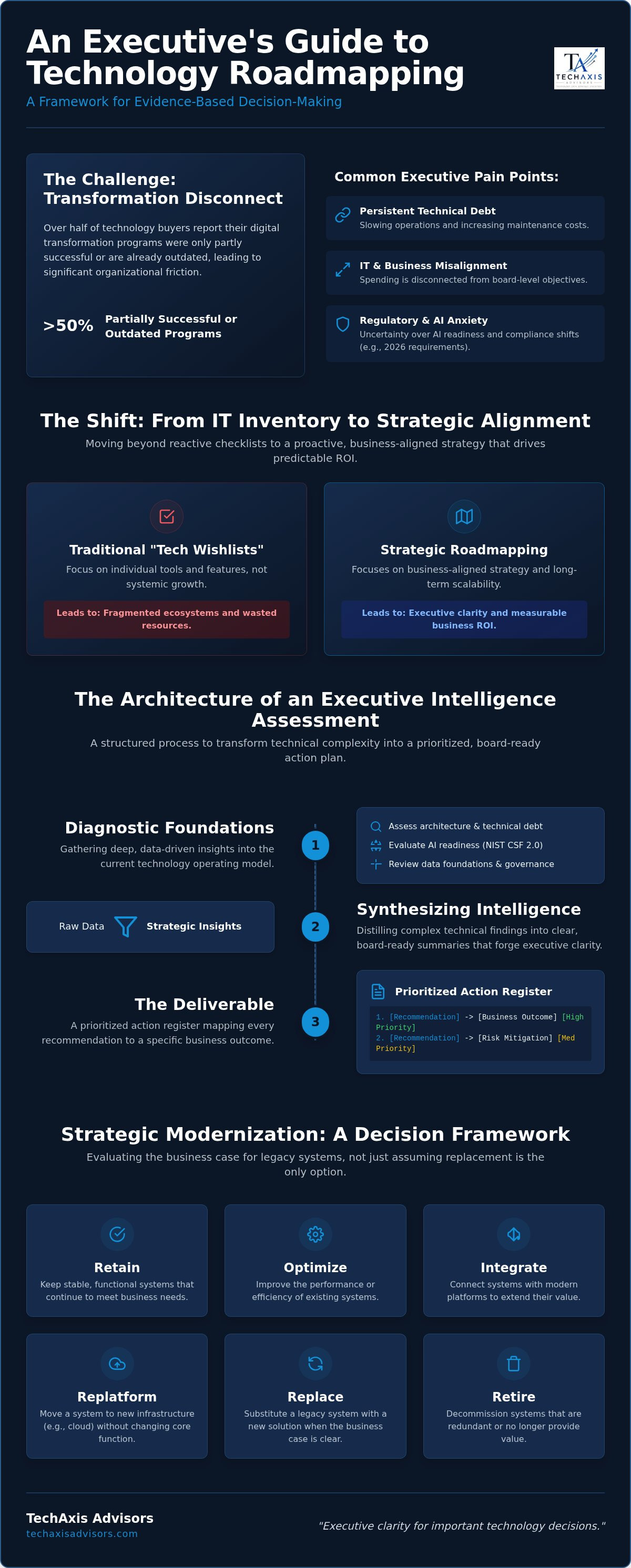
Over half of technology buyers report that their recent digital transformation programs were only partly successful or are already outdated. This disconnect often stems from a lack of specialized technology roadmap consulting services that bridge the gap between technical execution and business ROI. It's a frustrating reality for many executives. You've committed significant capital to modernization, yet technical debt continues to slow down operations while misalignment between IT spending and board-level objectives persists. Anxiety over AI readiness and shifting regulatory compliance only adds to the organizational burden.
This guide provides the executive clarity needed to move from reactive troubleshooting to proactive strategy. You'll learn how to transform complex technology ecosystems into clear, evidence-based roadmaps that align with C-suite objectives and board-level risk tolerance. Our objective is to replace organizational confusion with a disciplined, prioritized action register that ensures every technology investment supports your core mission and operational scalability.
We'll explore a structured framework for evaluating your current infrastructure, navigating the 2026 regulatory requirements for AI, and establishing a scalable foundation for data strategy. By the end of this guide, you'll have a clear methodology to bridge the gap between technical complexity and executive decision-making.
Table of Contents
Defining Technology Roadmap Consulting Services for the C-Suite
The Architecture of an Evidence-Based Executive Technology Assessment
Strategic Modernization: Evaluating the Business Case for Replatforming
Industry-Specific Roadmapping: Wealth Management and Private Equity
From Strategy to Execution: The Role of Fractional Technology Leadership
Defining Technology Roadmap Consulting Services for the C-Suite
Technology is a strategic asset, not just a line item. Most organizations struggle because their IT spending doesn't reflect their business priorities. High-level technology roadmap consulting services solve this by creating a direct link between operational goals and technical architecture. The primary deliverable isn't just a document; it's executive clarity. This clarity allows leaders to make informed decisions about where to allocate capital to reduce execution risk and improve organizational performance.
Traditional "tech wishlists" often fail because they focus on individual tools rather than systemic growth. These lists prioritize features over outcomes, leading to fragmented ecosystems and wasted resources. Executive-grade advisory differs from standard outsourced IT support by focusing on business-aligned strategy rather than mere maintenance or uptime. While an IT vendor might suggest a new server, a strategic consultant evaluates how that investment impacts the firm's long-term scalability and board-level risk tolerance.
The Shift from IT Inventory to Strategic Alignment
A list of software tools is not a strategy. It's an inventory. True strategic alignment requires a functional technology roadmap that serves as a blueprint for growth. This process moves the conversation away from individual applications and toward systemic integrity. When technical infrastructure aligns with long-term strategy, technology becomes a predictable driver of business ROI. This alignment is critical for ensuring that every dollar spent on technology advisory directly supports the company's mission-critical objectives.
Why Growth-Stage Companies Require External Advisory
Growth-stage companies often hit a "scaling gap." This occurs when the systems that supported a small team begin to fail as the enterprise expands. Internal teams frequently struggle to address these issues due to daily operational pressures or legacy biases. External technology roadmap consulting services provide an objective, evidence-based assessment of the current state. This independent perspective is essential for identifying true technical risks that might be obscured by internal politics or "the way we've always done it." Moving beyond these biases allows leadership to build a foundation that is both stable and ready for the complexities of modern financial services and private equity environments.
The Architecture of an Evidence-Based Executive Technology Assessment
Executive decision-support engagements move beyond the checklist-style technical audit. These engagements rely on structured Executive Intelligence Assessments designed to gather deep organizational intelligence. The goal isn't just to identify what's broken; it's to provide evidence-based findings that translate into board-ready summaries. By utilizing sophisticated technology roadmap consulting services, leaders gain a prioritized action register. This tool ensures accountability by mapping every technical recommendation to a specific business outcome or risk mitigation strategy, providing a clear path forward for the C-suite.
Diagnostic Foundations: Gathering Data-Driven Insights
Evaluating a current technology operating model requires a deep dive into the underlying architecture and technical debt. Technical debt isn't just a coding issue; it's a drag on operational execution that slows down growth and increases maintenance costs. In 2026, this evaluation must also address AI readiness. This includes assessing data foundations and governance structures, often aligned with frameworks like the NIST CSF 2.0. A thorough diagnostic identifies where legacy systems hinder maturity and where modern integrations can provide immediate relief without disrupting core business functions.
Synthesizing Intelligence into a Strategic Roadmap
The transition from raw data to a strategic roadmap is where executive clarity is forged. Complex technical findings are distilled into clear business choices. This involves developing a roadmap that reflects the organization's specific risk tolerance and capital allocation priorities. For a wealth management firm or private equity group, this often means prioritizing security and compliance over rapid feature deployment. Referencing standards like the IEEE Guide to Technology Roadmaps ensures the methodology remains grounded in industry-recognized principles rather than subjective opinions.
A successful roadmap identifies the exact sequence of investments needed to reach the desired state. It provides a scalable foundation for future AI and data initiatives while ensuring the organization can absorb change without operational disruption. By focusing on services that prioritize evidence over intuition, firms avoid the trap of misaligned IT spending and unverified vendor claims. If you're ready to move from technical confusion to a disciplined execution plan, you can start with a confidential executive conversation to explore your specific needs.
Strategic Modernization: Evaluating the Business Case for Replatforming
Modernization is often mistaken for a mandatory upgrade cycle. In reality, high-stakes technology investments require a rigorous business case that justifies capital outlay against measurable operational gains. Engaging technology roadmap consulting services allows leadership to move beyond the "rip and replace" mentality. Instead, this approach utilizes a structured framework to determine the most pragmatic path forward: Retain, Optimize, Integrate, Replatform, Replace, or Retire. This discipline prevents the common pitfall of over-engineering, which often leads to costly complexity where firms pay for features that offer no tangible business value.
The Decision Framework: Retain, Optimize, or Replace?
The decision to modernize starts with an objective look at the current state. Retaining a legacy system is often the right choice if the platform remains stable and doesn't create an operational bottleneck. Optimization or integration frequently provides a more cost-effective path than a full replatforming effort. For instance, wrapping an older database in a modern API layer can extend its utility without the risk of a wholesale migration. However, firms must identify the "tipping point" where technical debt creates unacceptable risk. When maintenance costs exceed the value of the output, retirement becomes the only viable strategic option.
Retain: Use when systems are stable and meet current regulatory requirements.
Optimize: Improve performance through configuration changes rather than code rewrites.
Integrate: Connect siloed systems to improve data flow across the enterprise.
Replace: Pursue only when legacy architecture fundamentally limits scalability or security.
Reducing Execution Risk in Complex Implementations
Execution risk is the primary reason technology projects fail to meet their objectives. Reducing this risk requires establishing a governance framework before the first line of code is written or the first vendor contract is signed. Independent oversight ensures that implementation partners remain aligned with the original strategic intent. This level of governance is especially critical during private equity acquisitions or wealth management mergers. For a deeper look at identifying these risks early, see our guide on Technology Due Diligence.
A disciplined roadmap ensures that modernization happens in logical phases. This prevents organizational fatigue and allows for course corrections based on evidence rather than assumptions. By focusing on the mechanics of scaling rather than the novelty of the tools, executives can maintain structural integrity throughout the transformation. This transition from theory to practice is where the value of technology roadmap consulting services becomes most apparent, providing the necessary leadership bridge to ensure project success.
Industry-Specific Roadmapping: Wealth Management and Private Equity
Regulated financial services operate under a high standard of care. A generic approach to infrastructure fails to account for the fiduciary duties and reporting requirements inherent to wealth management and private equity firms. Specialized technology roadmap consulting services must prioritize structural integrity and transparency over mere operational speed. For these organizations, technology is not just a support function. It's a mechanism for value creation and risk mitigation.
Governance-Driven AI Strategy for Financial Services
AI adoption in wealth management is no longer experimental. A 2026 Fidelity survey found that more than two-thirds of firms are already utilizing Generative AI. However, deployment without oversight is a liability. AI strategy must be anchored in existing fiduciary principles. The U.S. Treasury Department's February 2026 framework for financial institutions provides a clear example, mapping NIST AI Risk Management principles into 230 operational control objectives. Building an AI roadmap requires evaluating use cases for their impact on operational efficiency while balancing them against regulatory risk. For a detailed breakdown of these requirements, refer to our guide on AI in Financial Services.
Technology Value Creation in Private Equity Portfolios
In the private equity sector, technology due diligence serves as a critical lever for identifying risks during high-stakes acquisitions. A structured assessment uncovers technical debt that might otherwise erode the investment thesis. Post-acquisition, the focus shifts to scaling the technology operating model to prepare for a successful exit. This involves standardizing data and reporting strategies across portfolio companies to ensure a single-lens view of performance. This consistency is essential for transparency and operational maturity. By treating technology as a foundational asset, PE firms drive consistent growth across their holdings.
From Strategy to Execution: The Role of Fractional Technology Leadership
Strategy without execution is merely overhead. A static document, no matter how well-researched, cannot navigate the daily complexities of vendor management or technical delivery. This is where technology roadmap consulting services must transition into active leadership. Fractional CTO leadership turns a strategic roadmap into a disciplined execution plan. By embedding a seasoned executive into the organization, firms ensure that the high-level objectives defined during the assessment phase actually materialize into operational reality.
The cost-benefit analysis of fractional leadership is particularly compelling for growth-stage organizations. A full-time executive hire often involves significant search fees, equity grants, and a high base salary that may not be sustainable or necessary for the firm's current stage. Fractional partners provide senior-level expertise on a targeted basis. This model allows the C-suite to access elite advisory leadership without the long-term overhead of a permanent hire. It provides the wisdom of a veteran executive with the agility required for rapid transformation.
Embedded Executive Leadership for Transformation
Embedded leadership provides the necessary oversight to manage complex vendor ecosystems and internal technical teams. This role acts as a critical bridge. It translates board-level risk tolerance into specific technical requirements, ensuring that delivery teams don't lose sight of the business ROI. When a firm faces high-stakes transitions, such as a platform migration or AI implementation, having an independent advocate is essential for preventing project drift. To understand the specific triggers for this level of support, consider our analysis on When Does a Growth Company Need a Fractional CTO?.
Building a Scalable Operating Foundation
A scalable foundation requires continuous strategic counsel. Technology landscapes evolve rapidly; a roadmap built in January may require adjustment by June as new regulatory frameworks or market opportunities emerge. Fractional leadership ensures the roadmap stays aligned with these changing priorities. This ongoing governance prevents the accumulation of new technical debt and keeps the organization focused on structural integrity. It moves the firm away from reactive troubleshooting and toward a state of controlled, disciplined progress.
The transition from a fragmented technical environment to a streamlined, scalable operation starts with a clear view of the current state. Explore how an executive assessment can provide the clarity your board requires and establish the prioritized action register needed for your next phase of growth.
Securing Operational Scalability for 2026 and Beyond
Operational maturity requires moving beyond reactive troubleshooting. High-stakes decisions in wealth management and private equity demand evidence-based findings and prioritized roadmaps that reflect board-level risk tolerance. This guide has detailed how specialized technology roadmap consulting services provide the executive clarity needed to transform complex technical debt into a scalable foundation for AI and data strategy. By utilizing a framework that evaluates whether to retain, optimize, or replace systems, leaders can ensure that IT spending directly supports business ROI.
Success depends on bridging the gap between high-level strategy and technical execution. TechAxis Advisors, led by a former CIO and CTO with over 25 years of experience, provides this bridge through our proprietary Executive Intelligence Platform. We deliver board-ready findings that replace organizational anxiety with a disciplined, prioritized action register. This evidence-based approach ensures that your technology operating model remains stable during rapid growth or acquisition cycles.
It's time to move toward controlled, disciplined progress. Your organization's structural integrity is a strategic asset; we're here to help you protect it and prepare for the next phase of growth.
Frequently Asked Questions
What is the primary goal of technology roadmap consulting services?
The primary goal of technology roadmap consulting services is to provide executive clarity for capital allocation and risk management. It transforms complex technical environments into evidence-based strategic plans that align with long-term business outcomes. This process replaces organizational confusion with a disciplined, prioritized action register. While the roadmap provides a blueprint for success, it serves as a decision-support tool rather than a guarantee of specific market outcomes or financial results.
How does an executive technology assessment differ from a standard IT audit?
Unlike standard IT audits that focus on technical inventories, structured Executive Intelligence Assessments prioritize business-aligned strategy and risk tolerance. These diagnostic engagements evaluate the current operating model to identify technical debt and structural gaps. The methodology focuses on providing board-ready findings that allow the C-suite to make informed decisions. This approach moves beyond simple uptime metrics to address how technical architecture supports overall organizational maturity and scalability.
What industries benefit most from a strategic technology roadmap?
Regulated industries with complex technical needs, such as wealth management, financial services, and private equity, see the greatest benefit. These sectors require a high degree of structural integrity and transparency to meet fiduciary duties. A strategic roadmap ensures that technology investments are compliant with current regulatory frameworks, including 2026 AI governance standards. This alignment is critical for organizations navigating rapid growth or preparing for a high-stakes exit or acquisition.
When should a growth-stage company consider fractional CTO leadership?
Growth-stage companies should consider fractional CTO leadership when legacy systems begin to hinder operational execution or create a "scaling gap." This model provides senior-level guidance and vendor oversight without the cost of a full-time executive hire. Fractional leadership is particularly useful during rapid modernization phases or when the organization lacks a bridge between the C-suite and technical delivery teams. It ensures that the strategic roadmap remains an active execution plan.
How do you measure the ROI of a technology roadmap engagement?
ROI is measured through the reduction of execution risk and the elimination of misaligned IT spending. A well-defined roadmap prevents the accumulation of technical debt and ensures that capital is allocated to projects with the highest business impact. By establishing a prioritized action register, firms improve operational performance and build a scalable foundation for growth. However, these engagements are designed for decision-support; they do not guarantee specific future performance or replace internal accountability.
Can a technology roadmap help with AI readiness and implementation?
A strategic roadmap is essential for navigating the complexities of AI adoption in regulated environments. It evaluates organizational readiness and identifies high-impact use cases while anchoring the strategy in governance and compliance. By mapping principles from the NIST AI Risk Management Framework to operational objectives, the roadmap provides a secure path for innovation. This ensures that AI initiatives are explainable, auditable, and integrated with trusted firm data to support executive decisions.
What are the key deliverables of a TechAxis executive assessment?
Deliverables include board-ready findings summaries, prioritized strategic roadmaps, and presentation decks tailored for executive review. These artifacts focus on clarity, accountability, and traceability, distinguishing them from generic consulting reports. TechAxis Advisors provides specialized senior access and independent advisory rather than replacing the broad resources of major global strategy firms. The focus is on providing high-impact, senior-level guidance that allows leadership to make confident technology, data, and AI decisions.
How often should a corporate technology roadmap be reviewed and updated?
Roadmaps should be reviewed quarterly to stay aligned with evolving business priorities and regulatory shifts. TechAxis supports this ongoing execution through advisory leadership, governance, and vendor oversight. However, the firm does not perform direct implementations, such as custom software builds or cloud migrations. Instead, it ensures project success by providing the necessary leadership bridge between the C-suite and qualified delivery partners who handle the technical construction and migration tasks.



Comments