

Digital Transformation Consultant for Finance: An Executive Decision Framework
While 80% of financial firms now report active AI usage, the gap between technical deployment and realized ROI has never been wider. You've likely seen the generic slide decks and felt the exhaustion of consultant engagements that lack a concrete path forward. Selecting a digital transformation consultant for finance should be a strategic move toward clarity rather than an exercise in managing execution risk.
We understand that the pressure to modernize is compounded by a tightening regulatory environment, including the EU AI Act's August 2026 compliance deadlines and the Colorado AI Act's recent implementation. It's frustrating when technology initiatives feel disconnected from the firm's actual growth objectives. This article provides an executive decision framework to help you navigate these complex modernizations using evidence-based assessments and disciplined leadership. You'll learn how to align IT spend with your business strategy and develop a prioritized roadmap that reduces operational risk. We'll examine the "retain, optimize, or replace" methodology to ensure your technology investments deliver tangible results without the noise of unnecessary technical jargon.
Table of Contents
Defining Digital Transformation in the Financial Services Context
The Strategic Decision Framework: Retain, Optimize, or Replace
Navigating Regulated Complexity: Data, AI, and Cybersecurity Risk
From Strategy to Execution: The Role of Fractional Technology Leadership
Selecting a Finance Transformation Partner for Long-Term Scalability
Defining Digital Transformation in the Financial Services Context
Digital transformation in financial services is frequently misunderstood as a series of software upgrades. In reality, it's the disciplined alignment of technology, data, and AI with a firm's overarching business strategy. While IT modernization focuses on maintaining or incrementally improving existing systems, Executive Digital Transformation reshapes the organization's ability to scale. This shift moves technology from a back-office cost center to a primary driver of competitive advantage. It's not just about the tools; it's about the structural integrity of the business model.
The evolution of Financial technology (FinTech) has accelerated the need for this distinction. Today, the drivers are clear and unforgiving. Regulatory pressure is mounting, specifically with the EU AI Act's August 2, 2026 compliance deadline and the Colorado AI Act taking effect on June 30, 2026. Operational scalability is no longer optional for growth-stage firms. Engaging a digital transformation consultant for finance helps bridge the gap between these high-level pressures and a practical, executable roadmap. The goal is to transition from tactical IT management to a state where technology acts as a strategic business enabler.
Moving Beyond Tactical IT Support
Many firms rely on Managed Service Providers (MSPs) for daily operations. This model often fails during periods of rapid growth or complex modernization. MSPs prioritize stability and ticket resolution. They aren't designed to architect a data strategy or oversee complex platform migrations. You must identify the point where your growth outpaces your infrastructure. Moving beyond tactical support requires a mindset shift. It's about viewing technology as a value-creation engine rather than a necessary expense. This transition ensures that technology investments directly support the firm's strategic objectives.
The Business Case for Executive Clarity
Execution risk is the primary reason large-scale tech projects fail in the financial sector. Lack of clarity leads to wasted spend and organizational friction. Executive decision-support engagements replace guesswork with evidence-based assessments. These assessments provide a clear view of your current state, highlighting where to retain, optimize, or replace systems. By building a foundation for data-driven decision making, you reduce operational risk and improve transparency. This structured approach ensures that every dollar invested in technology has a documented business case and a defined path to realization.
The Strategic Decision Framework: Retain, Optimize, or Replace
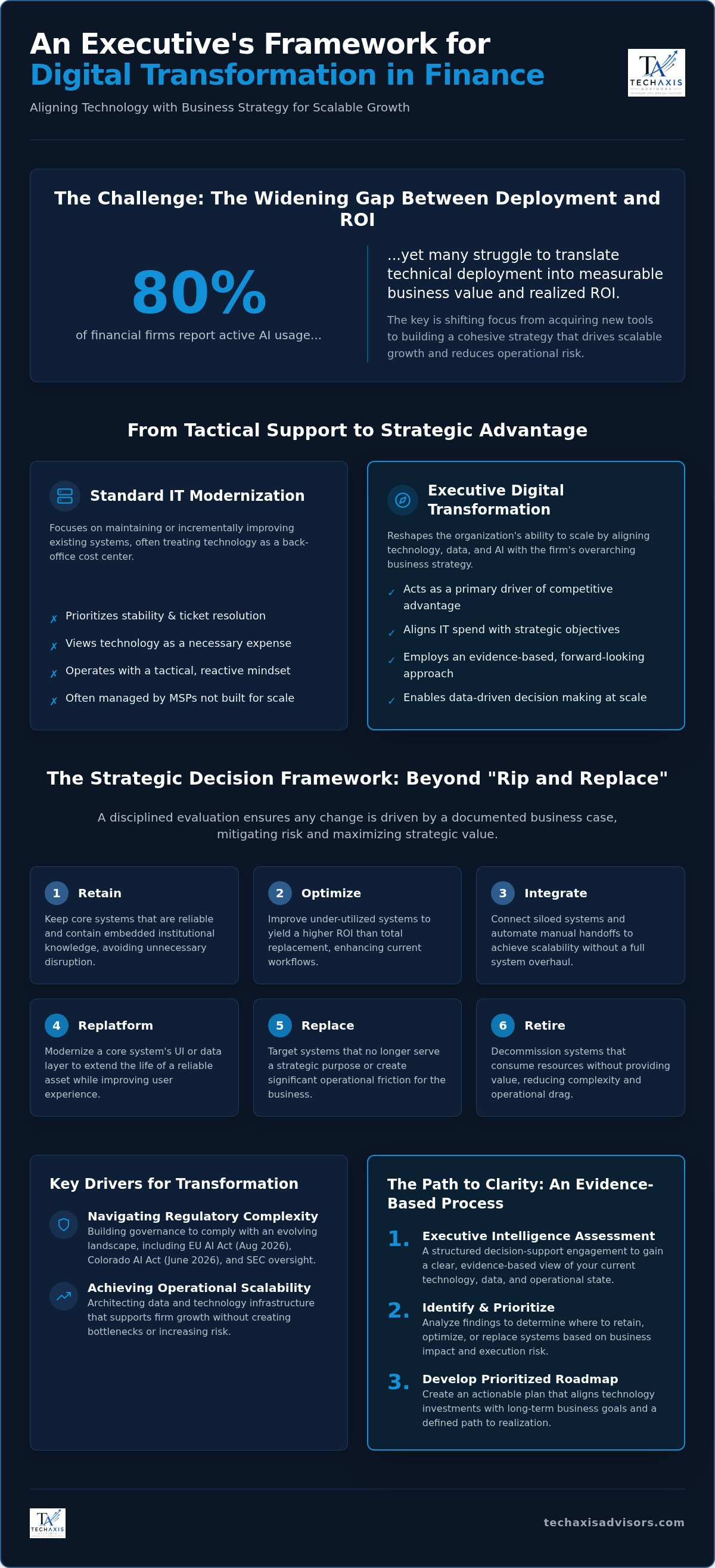
Executive leadership often views legacy systems as liabilities to be removed. This "rip and replace" mentality is one of the most significant risks in financial services technology. It ignores the institutional knowledge embedded in existing workflows and risks massive operational disruption. A disciplined digital transformation consultant for finance evaluates modernization through a broader lens: retain, optimize, integrate, replatform, replace, or retire. This framework ensures that any change is driven by a documented business case rather than a desire for new tools. Engaging a digital transformation consultant for finance allows leadership to identify which path offers the lowest risk and highest strategic value.
Optimization and integration frequently yield a higher ROI than total replacement. By connecting siloed systems or automating manual handoffs, firms can achieve scalability without the multi-year timeline of a core system overhaul. The objective is to move toward a state where technology supports the business strategy without creating unnecessary friction. This pragmatic approach respects the intelligence of the current organization while identifying the specific mechanical improvements needed to scale.
Evaluating Legacy Ecosystems
Technical debt assessment must go beyond generic audits. You need to identify which systems are truly legacy and which are merely under-optimized. Retaining a core system while replatforming its user interface or data layer can extend the life of a reliable asset while improving the advisor experience. Conversely, identifying candidates to retire is essential for reducing operational drag. If a system no longer serves a strategic purpose, maintaining it consumes resources that should be allocated elsewhere. To explore how these tradeoffs apply to your specific environment, you may wish to start with a confidential executive conversation.
Prioritizing the Transformation Roadmap
A successful roadmap balances immediate operational needs with long-term structural integrity. We utilize an action register to track specific, evidence-based next steps. This avoids the trap of "analysis paralysis" that often plagues large consulting engagements. By leveraging a proprietary Executive Intelligence Platform, leadership can prioritize initiatives based on actual data rather than subjective opinions. This methodology ensures that short-term wins reinforce the foundational stability required for future growth. Every step on the roadmap must have a clear owner, a defined metric for success, and a direct link to the firm's strategic objectives.
Navigating Regulated Complexity: Data, AI, and Cybersecurity Risk
The gap between AI hype and organizational readiness is a significant execution risk for asset managers. While 80% of financial firms report active AI use in 2026, many lack the governance frameworks required to satisfy tightening oversight. Regulators are increasing scrutiny. The U.S. Treasury released a Financial Services Artificial Intelligence Risk Management Framework in February 2026 to address these specific vulnerabilities. Engaging a digital transformation consultant for finance allows firms to navigate these complexities without stalling innovation. It's about building a structure that supports agentic AI while maintaining strict adherence to SEC and FINRA requirements.
Governance-Driven AI Strategy
Moving from experimentation to structured AI readiness requires identifying high-impact use cases that align with your risk tolerance. For example, AI-based fraud detection systems now catch 40-60% more fraudulent transactions than legacy rule-based systems. However, the Consumer Financial Protection Bureau (CFPB) has warned that inaccurate AI chatbots can lead to UDAAP violations. Your roadmap must prioritize transparency and human oversight. This ensures compliance with the EU AI Act's August 2026 transparency requirements for high-risk systems. A disciplined strategy ensures that innovation remains within the bounds of "reasonable care" as defined by the Colorado AI Act.
Data Architecture as a Scalable Foundation
Data integrity is the prerequisite for any successful AI or automation initiative. Siloed reporting structures create blind spots that increase operational risk and hinder executive decision support. Modernizing your architecture allows for a transition to real-time business intelligence. This foundation is essential for wealth firms managing complex portfolios. For a deeper look at these requirements, see our Data Strategy for Asset Managers framework. Structural integrity in your data layer is what allows for the mechanics of scaling without increasing manual reconciliation errors.
Cybersecurity risk management must be integrated into the transformation lifecycle rather than treated as a separate IT function. As of 2026, financial institutions have moved away from the sunsetted FFIEC CAT toward the NIST Cybersecurity Framework 2.0. This framework emphasizes board-level accountability and governance. A digital transformation consultant for finance helps bridge the gap between technical security measures and executive oversight. This ensures that your modernization efforts don't create new material risks that require 8-K disclosures under SEC rules. By focusing on structural integrity, you replace organizational anxiety with a sense of controlled, disciplined progress.
From Strategy to Execution: The Role of Fractional Technology Leadership
Strategy without execution is merely overhead. Traditional consulting often leaves firms with an ambitious roadmap but no experienced driver to navigate the complexities of implementation. A digital transformation consultant for finance bridges this divide by providing fractional technology leadership. This model offers the wisdom of a veteran CIO or CTO without the burden of a full-time executive salary. It's a pragmatic solution for wealth management and private equity-backed firms that need senior-level access to scale their operations effectively. These leaders operate as fractional partners, bringing the disciplined approach of a seasoned professional to your existing team.
Bridging the Leadership Gap
Embedded leadership ensures that strategic goals aren't lost during the transition from planning to action. A fractional CTO provides the necessary oversight for custom software builds and platform migrations, ensuring transparency and accountability across all delivery partners. They don't just manage tickets; they mentor your internal IT teams to elevate their operational maturity. This hands-on approach replaces organizational confusion with a disciplined path toward mastery. By providing a leadership bridge, they ensure that vendor promises translate into functional business tools. For a detailed look at when to transition to this model, consult The Executive Guide to Fractional CTO Services.
Reducing Technical Execution Risk
There's a fundamental difference between project management and executive leadership. Project managers track tasks and timelines. Executive leaders manage the full lifecycle of digital transformation initiatives, focusing on business-aligned outcomes and systemic risk mitigation. Engaging a digital transformation consultant for finance provides the governance required to oversee third-party vendors and ensure that IT spend remains strictly aligned with the firm's long-term strategy. This level of oversight is critical for maintaining structural integrity during periods of rapid growth. It ensures that technology decisions are made with a clear understanding of the business impact rather than just technical feasibility. You can explore our Improving Operational Maturity Framework to understand how this leadership stabilizes your growth trajectory.
Selecting a Finance Transformation Partner for Long-Term Scalability
Selecting a digital transformation consultant for finance is a high-stakes decision that dictates your firm's operational trajectory. While global strategy firms provide broad benchmarking and "integrated offerings," they often lack the senior-level access required to navigate specific technical friction. Growth-stage firms require "former practitioner" advisors who understand the mechanics of scaling because they've managed those environments themselves. You need a partner who prioritizes evidence-based methodologies over generic reporting. This ensures that every recommendation is grounded in the actual state of your architecture rather than abstract industry trends. The right partner shouldn't just deliver a slide deck; they should provide a leadership bridge that supports execution through advisory governance and vendor oversight.
A disciplined evaluation of potential partners must focus on their ability to align technology with your specific risk appetite. Generic consulting often results in "consultant fatigue" when actionable roadmaps are replaced by high-level theory. A digital transformation consultant for finance must demonstrate a deep understanding of the regulatory landscape, including the specific implications of the EU AI Act and recent SEC cybersecurity disclosure rules. Your choice should reflect a commitment to structural integrity. This ensures that your technology architecture can support long-term scalability without increasing operational risk or creating technical debt that hampers future innovation.
The TechAxis Perspective on Advisory
We approach these engagements through a structured Executive Intelligence Assessment. By utilizing our proprietary Executive Intelligence Platform, we provide board-ready findings that emphasize clarity, accountability, and traceability. This evidence-based approach is particularly valuable for regulated clients who must demonstrate high levels of oversight to external auditors and internal stakeholders. Our SBA WOSB and NJ MWBE certifications reflect a commitment to professional excellence and structural integrity. We focus on deliverables that provide a clear audit trail for every technology decision. This replaces organizational anxiety with a sense of controlled, disciplined progress, allowing leadership to move from identification to mastery with confidence.
Next Steps for Executive Leadership
Your path forward depends on the current maturity of your technology stack and the complexity of your modernization needs. You may require a structured assessment to identify gaps, strategic advisory for AI readiness, or fractional leadership to oversee a complex implementation. Review Our Services and Engagement Models to determine which level of support aligns with your immediate priorities. Preparing the board for a technology-led growth phase requires a documented business case and a prioritized roadmap. Each initiative must have a clear owner and a defined metric for success. By aligning your transformation with the firm's specific strategic objectives, you ensure that every technology investment acts as a primary driver of competitive advantage.
Achieving Operational Mastery Through Strategic Technology Decisions
Digital transformation is not a singular project but a continuous alignment of technology with business strategy. By utilizing a disciplined framework to evaluate legacy systems and navigating the complexities of AI and data governance, your firm can achieve sustainable growth. Engaging a digital transformation consultant for finance provides the necessary senior oversight to move from organizational anxiety to controlled, disciplined progress. This transition ensures that your technology investments act as primary drivers of competitive advantage rather than operational drag.
TechAxis Advisors replaces generic consulting with structured Executive Intelligence Assessments. Our advisors are former CIOs, CTOs, and CISOs who prioritize evidence-based findings via our proprietary platform. As a certified Women-Owned Small Business (WOSB), we provide the senior-level access and accountability required for regulated financial environments. We're ready to help you bridge the gap between strategic intent and operational reality.
We look forward to supporting your firm's next phase of disciplined growth.
Frequently Asked Questions
What is the difference between a digital transformation consultant and an IT provider?
A digital transformation consultant for finance focuses on strategic alignment and executive decision support, whereas an IT provider typically manages tactical maintenance. TechAxis Advisors does not sell Managed IT Services (MSP). Instead, we architect the technology operating model and provide vendor oversight to ensure IT spend directly supports business growth. This shift moves technology from a back-office cost center to a primary driver of competitive advantage and value creation.
How long does a typical executive technology assessment take?
While duration varies based on organizational complexity, a structured diagnostic typically produces evidence-based findings within a few weeks. Our proprietary Executive Intelligence Platform streamlines this process, moving from initial assessment to intelligence synthesis efficiently. This methodical pace respects your cognitive load while maintaining a sense of calm urgency. The result is a prioritized strategic roadmap that provides immediate clarity for important technology decisions and long-term scalability.
Do you help with the actual implementation of software and AI tools?
We support execution through advisory leadership, governance, and vendor oversight rather than direct technical builds. While TechAxis does not perform cloud migrations or software engineering internally, we manage the full lifecycle through qualified delivery partners and white-label development models. This ensures that the implementation remains strictly aligned with the original strategy. We reduce execution risk by providing the disciplined executive presence required to oversee complex technical projects.
What are the common signs that a wealth management firm needs a transformation consultant?
Primary indicators include execution risk in large-scale projects, lack of clarity on AI ROI, and a gap between technical capacity and business growth. If your leadership team is experiencing exhaustion from generic slide decks that lack actionable roadmaps, a digital transformation consultant for finance can provide the necessary structural integrity. Other signs include manual data reconciliation errors and difficulty meeting the transparency requirements of the EU AI Act.
How does a fractional CTO differ from a full-time hire in a finance firm?
A fractional CTO provides senior-level technology leadership and executive-grade insight without the significant expense of a full-time hire. This model allows growth-stage firms to access the wisdom of a veteran CIO or CTO on a part-time or project basis. It's a pragmatic solution for firms that need strategic architecture and vendor management but aren't yet ready to scale their permanent C-suite headcount. You gain executive clarity without long-term overhead.
Can a digital transformation consultant help with M&A technology integration?
Technology due diligence and M&A integration are core capabilities within our advisory portfolio. We identify hidden technical debt and integration risks that could impact the valuation or post-merger operational performance. By aligning disparate technology ecosystems under a single strategic roadmap, we help private equity portfolios and acquiring firms stabilize the new entity. This ensures that the combined organization has a scalable operating foundation and reduced operational risk from day one.
How do you handle cybersecurity risk during a digital transformation?
Cybersecurity risk management is integrated directly into the transformation lifecycle rather than treated as a separate function. We utilize the NIST Cybersecurity Framework 2.0 to ensure board-level accountability and governance. This approach replaces organizational anxiety with disciplined progress, ensuring that modernization efforts meet SEC cybersecurity disclosure rules. We focus on structural integrity and transparency to mitigate material risks during periods of rapid change and technology adoption.
What kind of board-ready deliverables should I expect from a consulting engagement?
Deliverables focus on clarity, accountability, and traceability for the C-suite. You'll receive concise board-ready briefs, prioritized strategic roadmaps, and an action register with clear next steps. Unlike traditional consulting reports that remain static, these artifacts are designed for executive review and board meetings. They provide a documented audit trail for every technology decision, ensuring that leadership can demonstrate evidence-based oversight to investors, auditors, and regulators.



Comments