

Tech Consulting for Wealth Management: 2026 Framework
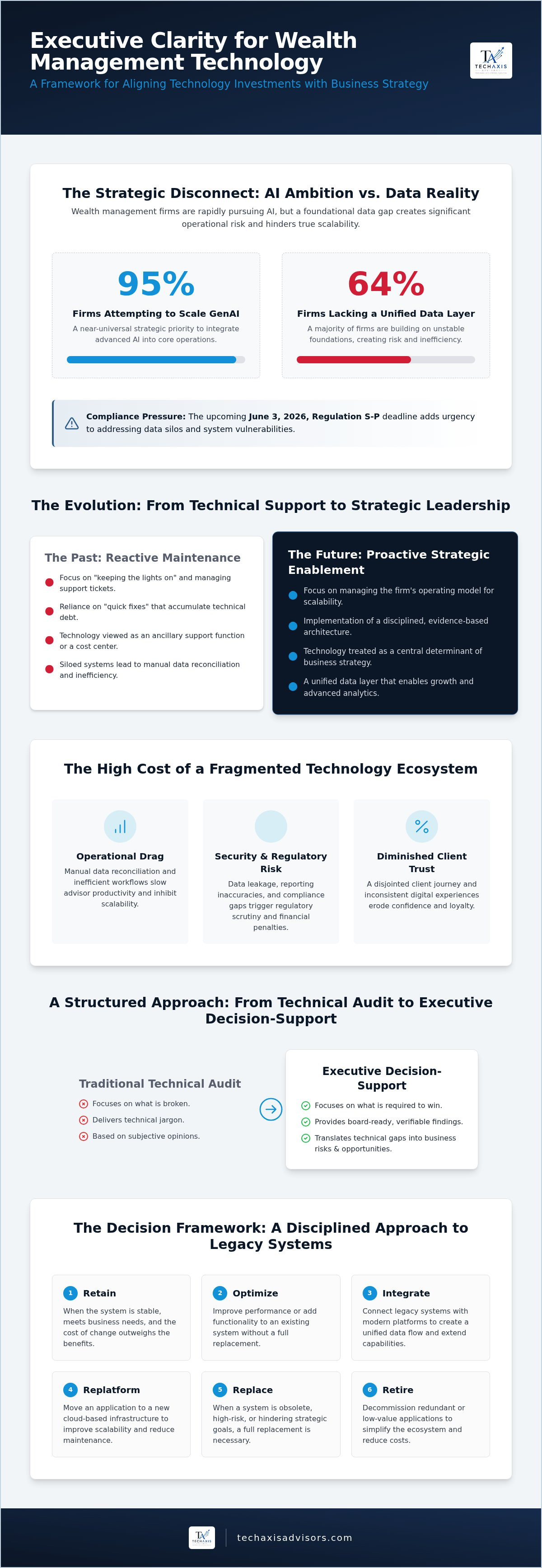
Sixty-four percent of wealth management firms still lack a unified data layer, yet ninety-five percent have already attempted to scale generative AI into their core operations. This disconnect creates a significant gap between strategic ambition and technical reality. Effective technology consulting for wealth management firms must now prioritize structural integrity over superficial features. You're likely managing the pressure of the June 3, 2026, Regulation S-P compliance deadline while legacy systems continue to silo the very data your firm needs to grow.
It's difficult to lead with confidence when technical debt slows down every new initiative. You need a strategy that moves beyond reactive fixes and toward a disciplined, evidence-based architecture. This guide provides a pragmatic framework for C-suite leaders to align technology investments with operational maturity and business goals. We'll explore a prioritized roadmap designed to reduce technology risk and provide the clear, verifiable findings you need to present to the board.
Table of Contents
The Shift from Technical Support to Strategic Technology Leadership
Technology is no longer an ancillary support function. For growth-stage wealth managers, the transition from "keeping the lights on" to strategic technology leadership is a requirement for scaling. Many firms hit a plateau where legacy architecture prevents the ingestion of new assets or the adoption of modern tools. Professional technology consulting for wealth management firms shifts the focus from managing tickets to managing the firm's operating model. It's the difference between reactive maintenance and proactive strategic enablement.
Identifying the Gap Between Growth Goals and Technical Debt
Technical debt in wealth management manifests as manual data reconciliation between siloed CRM and portfolio management systems. It's the accumulation of "quick fixes" that eventually slow down advisor productivity. These inefficiencies often remain hidden until a firm attempts to scale or integrate an acquisition. Technical debt acts as a direct discount on firm valuation during M&A or exit planning, as acquirers price in the cost and risk of immediate modernization. There is a direct correlation between a firm's technology maturity and its ability to scale client assets without a linear increase in headcount. Leaders must recognize that every manual workaround is a tax on future growth.
The Risks of Fragmented Technology Ecosystems
Fragmentation leads to more than just advisor frustration. It creates substantial operational risks, including data leakage and reporting inaccuracies that can trigger regulatory scrutiny. With the SEC's 2026 focus on cybersecurity and data loss prevention, these gaps are no longer just inconveniences. The evolution of Financial technology (FinTech) has raised client expectations for seamless digital experiences. When platforms don't communicate, the "hidden cost" is a disjointed client journey that erodes trust. Firms must address these Problems We Solve by moving toward a unified data layer. Strategic technology consulting for wealth management firms provides the executive clarity needed to bridge this gap. This ensures that AI adoption rests on a stable foundation rather than a fragmented one. High-performing firms treat their technology stack as a central determinant of strategy, ensuring that every tool serves a documented business outcome.
A Structured Approach to Executive Technology Assessments
A technical audit often focuses on what is broken. An executive decision-support engagement focuses on what is required to win. Effective technology consulting for wealth management firms replaces subjective opinions with evidence-based findings. This shift is critical for board-level reporting, where clarity must override technical jargon. By utilizing a proprietary intelligence platform, firms ensure diagnostics are repeatable and data-driven rather than reliant on the variable expertise of a single consultant. The result is a prioritized action register that translates technical gaps into business risks and opportunities.
Board-ready reporting requires more than a list of software versions. It demands an assessment of structural integrity. We evaluate the technology operating model through a business-first lens, ensuring that every finding is mapped to an organizational outcome. This structured approach moves the conversation from "what does this cost" to "what does this enable." It provides the necessary leadership bridge that growth-stage companies often lack during periods of rapid scale.
Evaluating AI Readiness and Data Foundations
Assessments must prioritize data foundations before chasing AI pilot programs. Industry research indicates that 64% of wealth management firms still lack a unified data layer; by late 2026, this infrastructure gap has become a primary bottleneck for agentic AI adoption. We evaluate whether your current architecture can support high-impact use cases like automated rebalancing or client sentiment analysis. Without a stable data foundation, AI creates operational noise rather than efficiency. For a deeper dive into these requirements, explore our AI in Financial Services: 2026 Strategic Framework.
Cybersecurity Risk and Regulatory Alignment
Cybersecurity is a business continuity issue, not an IT task. The SEC's 2026 examination priorities emphasize that firms must demonstrate active oversight of third-party service provider breaches. Following the June 3, 2026, Regulation S-P compliance deadline, the focus has moved to auditable, written incident response programs. Evidence-based risk assessments replace vague assurances with documented controls. This rigor ensures that the technology operating model aligns with FINRA expectations and protects firm valuation. You can start with a confidential executive conversation to evaluate your current risk posture against these evolving standards.
The Decision Framework: Retain, Optimize, or Replace?
Wealth management leaders face a multi-million dollar question: when is it time to scrap legacy technology? Maintaining the status quo carries a documented cost in lost productivity and increased operational risk. However, replacing a core system is a high-stakes endeavor that can disrupt firm operations for months. Effective technology consulting for wealth management firms applies a business-first lens to this dilemma. We use a disciplined model to evaluate whether you should retain, optimize, integrate, replatform, replace, or retire specific components of your stack. This approach prevents the trap of "new for the sake of new" and ensures every dollar spent serves a documented strategic goal.
Modernization isn't always about wholesale replacement. Often, the highest ROI comes from optimizing existing workflows or integrating siloed systems to create a unified data layer. The risk of maintaining outdated infrastructure includes more than just slow performance; it includes the inability to leverage AI and the potential for compliance failures. A structured framework allows you to weigh these risks against the capital expenditure and operational friction of a new implementation. It's about finding the path of least resistance to the highest level of maturity.
Beyond Vendor Selection: Assessing Operational Impact
Picking a new CRM or portfolio management tool is only twenty percent of the solution. The remaining eighty percent is where most firms fail. Success depends on how well the new technology aligns with your existing processes and people. The "Integrate vs. Replace" debate is central here. Managing complexity without breaking current workflows requires a deep understanding of your firm's operational DNA. You can learn more about how we navigate these complexities by reviewing How We Work. Our methodology ensures technical changes support, rather than hinder, advisor productivity.
Calculating Total Cost of Ownership and Execution Risk
Technology budgets often underestimate the true cost of change. You must factor in training, data migration, and the inevitable operational downtime that accompanies a transition. Execution risk is the gap between strategic intent and operational reality. When this gap is wide, even the most sophisticated tools fail to deliver value. Structured Executive Intelligence Assessments help CEOs justify technology budgets to the board by providing evidence-based findings. This clarity replaces organizational anxiety with a controlled, disciplined roadmap for progress.
Implementation and Governance: From Roadmap to Result
Execution is where strategic intent often fails. Governance provides the structural integrity required to ensure multi-quarter digital transformation initiatives remain aligned with business goals. It's not enough to have a plan; you must have the mechanisms to enforce it. Professional technology consulting for wealth management firms provides the leadership bridge that prevents strategic drift. This involves establishing a disciplined rhythm of progress where technical milestones are translated into tangible business reports for the board. Without an active oversight model, complex projects tend to prioritize technical features over advisor productivity.
Building a Prioritized Strategic Roadmap
A roadmap must be more than a chronological list of tools. It requires categorization based on urgency and organizational impact. We structure initiatives into three distinct tiers: Immediate Risk Mitigation, Operational Efficiency, and Growth Acceleration. This hierarchy ensures that foundational issues, such as Regulation S-P compliance and data security, are addressed before investing in advanced automation. For a deeper analysis of this progression, see our framework on Improving Operational Maturity Through Technology. Every item on the roadmap must be traceable to a specific business outcome, such as reduced overhead or improved client retention. This transparency allows C-suite leaders to justify technology budgets with evidence-based findings.
Managing Implementation Through Qualified Partners
Strategic technology consulting for wealth management firms does not necessarily involve direct software development. Instead, it provides the advisory leadership and governance required to oversee delivery partners. The role of the Strategic Architect is to hold implementation teams and vendors accountable for timelines, budgets, and technical deliverables. This independent oversight ensures that third-party providers remain focused on your firm's operating model rather than their own internal product roadmaps. Establishing an action register with clear accountability owners prevents project stagnation and keeps the focus on tangible results. This model is particularly effective for growth-stage RIAs and private equity-backed firms that need executive-grade leadership without the overhead of a full-time hire. You can determine if this level of oversight matches your organizational needs by reviewing Who It's For.
The Strategic Case for Fractional Technology Leadership
Growth-stage wealth managers often reach a critical inflection point. Their technical requirements have surpassed the capabilities of a standard IT provider, yet the business isn't ready for the significant overhead of a full-time Chief Technology Officer. This leadership gap is where technology consulting for wealth management firms provides a necessary bridge. Fractional leadership offers the wisdom of a veteran executive with the agility of a modern innovator. It allows the CEO to focus on high-level strategy while a dedicated partner manages the mechanics of technical execution and structural integrity.
It's vital to distinguish between a Managed Service Provider (MSP) and a Fractional CTO. An MSP is a tactical partner; they manage hardware, resolve help-desk tickets, and maintain network uptime. A Fractional CTO is a strategic partner; they align technology with business goals, manage vendor risk, and ensure operational scalability. One keeps the lights on. The other builds the engine that drives firm valuation. By embedding executive leadership into the organization, firms can reduce the execution gap that often derails digital transformation initiatives.
Aligning Technology with Long-Term Business Outcomes
Every technology investment must directly support your client acquisition and retention goals. Without executive alignment, firms often overspend on tools that advisors don't use or that fail to integrate with the core operating model. An independent, fractional advisor provides the objective perspective needed to evaluate these investments. Because they aren't incentivized by vendor commissions, their loyalty remains entirely with the firm's success. This objectivity is critical when deciding When Does a Growth Company Need a Fractional CTO?. Leadership at this level ensures that your technology stack is a strategic asset rather than a growing liability.
Transitioning from Diagnostic to Execution
A structured Executive Intelligence Assessment provides the roadmap, but fractional leadership ensures the journey is completed. Transitioning from a diagnostic phase to ongoing advisory leadership maintains the momentum necessary for complex projects. Momentum is often lost when firms attempt to manage implementation using only junior staff or overburdened COOs. A Fractional CTO keeps the strategic roadmap on track by providing continuous governance and vendor oversight. This disciplined approach replaces organizational confusion with controlled progress. You can start with a confidential executive conversation to explore your current priorities and determine if fractional leadership is the right bridge for your firm's growth.
Building a Resilient Operating Model for 2026
The 2026 regulatory and technical environment requires a shift from managing tools to governing a strategic operating model. Success no longer depends on picking the right software; it depends on building a unified data foundation that supports both compliance and AI-driven growth. By utilizing structured executive decision-support engagements, leaders can replace organizational anxiety with a disciplined roadmap. Professional technology consulting for wealth management firms provides the necessary leadership bridge to close the execution gap between vision and reality.
Our approach is led by a founder with over 25 years of experience as a CIO, CTO, and CISO. We utilize a proprietary Executive Intelligence Platform to deliver evidence-based findings that are board-ready and actionable. As a certified Women-Owned Small Business (WOSB), we provide the objective, senior-level oversight required for high-stakes technology decisions. You don't have to navigate these complexities without a seasoned partner at your side.
Start with a confidential executive conversation
Frequently Asked Questions
What is the difference between an IT consultant and an executive technology advisor?
An IT consultant typically manages technical support, hardware maintenance, or specific software installations. In contrast, an executive technology advisor focuses on strategic alignment and risk management. They provide the leadership bridge between your business goals and your technical teams. This role involves translating complex technical ecosystems into clear decisions for the board, ensuring that technology acts as a value driver rather than a cost center.
How long does a typical Executive Technology Assessment take for a wealth management firm?
The duration of an Executive Technology Assessment depends on the firm's size and complexity. Most engagements take between four and eight weeks to complete. During this period, we use our proprietary Executive Intelligence Platform to gather data, conduct stakeholder interviews, and synthesize findings. The process concludes with a board-ready report, a prioritized strategic roadmap, and an action register that defines clear next steps for your leadership team.
Does TechAxis Advisors perform direct software implementation or cloud migrations?
TechAxis Advisors doesn't perform direct software builds or infrastructure migrations. Instead, we support execution through advisory leadership, vendor management, and qualified delivery partners. We also offer custom software development through a specialized white-label partnership model. This independence ensures our guidance remains objective, as we focus on governance and oversight rather than being incentivized to recommend specific hardware or managed service contracts.
Why should we choose a boutique advisory firm over a global strategy firm like the Big Four?
Boutique firms provide direct, ongoing access to senior advisors with over 25 years of experience. Global strategy firms often rely on standardized templates and may assign less experienced staff to mid-market engagements. Our technology consulting for wealth management firms prioritizes evidence-based findings and custom roadmaps tailored to your specific risk tolerance. You receive the wisdom of a veteran executive who operates with the agility required for growth-stage organizations.
What are the key components of an AI Readiness Assessment for financial services?
A structured AI Readiness Assessment evaluates your data architecture to ensure it can support automated workflows. It identifies high-impact use cases, such as automated rebalancing or client sentiment analysis, while establishing auditable governance frameworks. We focus on "Governed AI" to meet 2026 regulatory standards. This process ensures your firm has a stable foundation before scaling generative AI, reducing the risk of operational noise or compliance failures.
How does fractional leadership differ from a traditional consulting engagement?
Traditional consulting engagements are usually project-based and focused on a specific diagnostic or roadmap. Fractional leadership is an embedded model where an advisor operates as a part-time member of your executive team. A Fractional CTO provides continuous oversight, managing vendor relationships and governing implementation over several quarters. This approach is ideal for growth-stage firms that need senior-level technology leadership without the expense of a full-time executive hire.
Can an assessment help us prepare for an upcoming M&A transaction or exit?
Yes, a structured assessment is a critical component of pre-transaction preparation. Identifying and remediating technical debt before an exit protects your firm's valuation. Acquirers often discount prices when they discover fragmented data or legacy systems that require immediate modernization. Our evidence-based findings demonstrate to potential buyers that your technology operating model is scalable, compliant, and ready for integration, significantly reducing the perceived execution risk.
How do you ensure technology investments align with regulatory compliance requirements?
We ensure alignment by mapping every technology decision to current regulatory requirements, such as the June 3, 2026, Regulation S-P deadline. Our methodology focuses on "evidence-based stewardship," where we document how technical controls support cybersecurity and data loss prevention. By integrating compliance into the strategic roadmap, we help firms demonstrate active oversight to SEC and FINRA examiners, ensuring that technology investments protect both the firm and its clients.



Comments