

PE Operational Maturity Model: 2026 Executive Framework
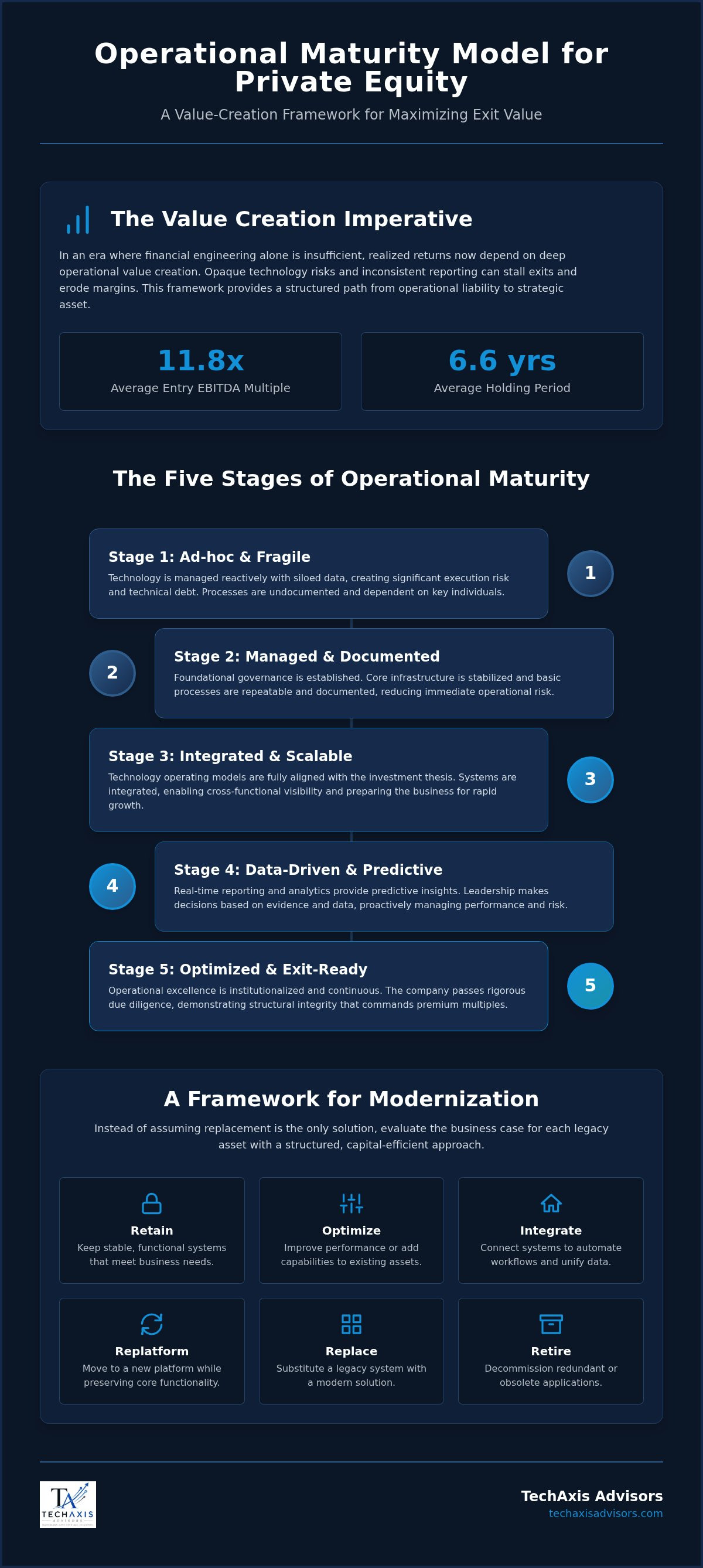
With average entry multiples reaching 11.8x EBITDA and holding periods stretching to 6.6 years, the era of relying on financial engineering alone has ended. Today's private equity leaders recognize that realized returns now depend on deep operational value creation. You've likely seen how opaque technology risks or inconsistent reporting can stall a promising exit. It's frustrating when technical debt becomes a late-stage hurdle that erodes your hard-won margins. This article introduces a structured operational maturity model for private equity designed to replace organizational anxiety with disciplined progress. You'll learn how to assess and advance the maturity of your portfolio companies to reduce execution risk and maximize exit value. We'll explore a repeatable 2026 executive framework that moves beyond technical audits to provide clear visibility into the data and systems driving your investment thesis. By the end of this guide, you'll have a roadmap to evaluate whether to retain, optimize, or replace legacy infrastructure to ensure your portfolio is ready for a high-multiple exit.
Table of Contents
Defining the Operational Maturity Model for Private Equity Portfolios
An operational maturity model for private equity is a structured framework used to evaluate the effectiveness of a portfolio company's technology, data, and human capital. While a standard maturity model provides a baseline for organizational growth, private equity requires a more aggressive, results-oriented approach. It isn't just about whether the systems work; it's about whether those systems can withstand the pressure of a rapid growth phase or a complex integration. This framework serves as a diagnostic tool to ensure that every technical asset is actively contributing to the investment thesis.
We must distinguish between technical maturity and operational maturity. Technical maturity focuses on uptime, security patches, and tool selection. Operational maturity, however, measures how well those tools align with the investment thesis and the company's ability to scale. High maturity scores directly correlate with lower execution risk. When processes are repeatable and data is transparent, leadership can make decisions based on evidence rather than intuition. This clarity is vital in a market where average entry multiples have reached 11.8x EBITDA, leaving little room for operational inefficiency.
The Business Impact of Low Operational Maturity
Low maturity creates invisible technical debt that often stays hidden until the pressure of due diligence. Ad-hoc processes and siloed data sets might work for a small, founder-led firm, but they break under the strain of a rapid growth phase. This "Operational Gap" often leads to stalled exits or reduced valuations. Buyers in 2026 are prioritizing realized returns and cash distributions over unrealized gains. They won't pay a premium for a company with opaque technology risks or inconsistent reporting across its business units. Structural integrity is now a prerequisite for a successful exit.
Why Generic Models Fail Private Equity Investors
Generic models often overlook the unique constraints of a private equity hold period. Large consulting firms may offer broad, predictive frameworks, but these often lack the pragmatic, senior-level focus required for rapid value creation within a six-year window. An operational maturity model for private equity must be evidence-based and tightly coupled with the specific goals of the fund. Whether the strategy is a buy-and-build or a pure margin expansion play, the maturity framework should provide a prioritized roadmap. It must act as the bridge between board-level strategy and operational execution, ensuring that technology serves as a strategic lever rather than a cost center.
The Five Stages of PE Operational Maturity: A Value-Creation Framework
The 2026 investment landscape demands more than just financial engineering. To capture premium multiples, firms must move portfolio companies through a deliberate progression of capability. This operational maturity model for private equity provides a roadmap for that journey. It categorizes growth into five distinct stages, each representing a shift from technical liability to strategic asset.
Stage 1: Ad-hoc & Fragile – Reactive technology management and siloed data that creates significant execution risk.
Stage 2: Managed & Documented – Foundational governance and basic process repeatability that stabilizes the business.
Stage 3: Integrated & Scalable – Technology operating models that are fully aligned with the investment thesis.
Stage 4: Data-Driven & Predictive – Real-time reporting and AI-enabled decision support for proactive management.
Stage 5: Optimized & Exit-Ready – Institutionalized excellence that commands premium multiples and passes rigorous due diligence.
Stage 1 to 2: Building the Foundation
Growth-stage acquisitions often arrive in Stage 1. Systems are fragile. Technology is managed reactively. Data exists in siloes. Moving to Stage 2 requires stabilizing core infrastructure and establishing executive technology governance. This transition is critical for organizations transitioning from founder-led to institutional management. Prioritize vendor management and cybersecurity risk assessments. These foundational steps ensure that basic processes are repeatable and documented, reducing the immediate risk of operational failure.
Stage 3 to 4: Scaling for Growth
Once stable, the focus shifts to alignment. Stage 3 integrates technology operating models with the broader business strategy. This is where firms evaluate various Operating Models for Private Equity Firms to drive scalable value. Transitioning to Stage 4 involves implementing a modern data strategy. Asset managers need real-time reporting and AI-enabled decision support to maintain margins. This shift from legacy systems to a cloud-based technology operating model is explored further in our guide on improving operational maturity through technology.
Stage 5: Preparing for the Exit
Stage 5 focuses on institutionalized excellence. The tech stack is no longer just functional; it's optimized for high-stakes due diligence. Documentation must be thorough to reduce key-man risk. A mature company at this stage commands a premium multiple because the buyer sees a low-risk, highly scalable engine. Utilizing a technology due diligence checklist can help identify remaining gaps before a formal process begins. If your current portfolio assets feel stuck in a reactive phase, you might consider how fractional leadership could accelerate your timeline.
Core Dimensions of Maturity: Aligning Technology with Investment Theses
A robust operational maturity model for private equity evaluates more than just server uptime or software versions. It measures how effectively technology supports the specific investment thesis of the fund. We focus on four core dimensions that determine an asset's ability to scale and exit. When these dimensions are misaligned, technical debt accumulates and execution risk rises.
Executive Governance: This moves technology from a back-office cost center to a strategic lever. It ensures the board has clear oversight of the technology roadmap.
Data and Reporting Strategy: This creates a single version of the truth for portfolio performance. Reliable data is essential for accurate margin analysis and buyer confidence.
AI and Automation Readiness: We focus on the pragmatic application of AI to drive operational efficiency. It's about practical margin expansion, not chasing technical trends.
Cybersecurity and Risk Management: This protects the asset from catastrophic execution risk. Security must be viewed as a component of structural integrity rather than a standalone IT task.
Aligning Tech Spend with Growth Goals
Every dollar spent on technology must directly support the growth goals of the hold period. We evaluate the business case for each asset using a framework to retain, optimize, integrate, replatform, replace, or retire existing systems. Over-engineering is a frequent trap for growth-stage companies. You don't need a custom-built platform if a disciplined integration of existing tools meets the investment goal. Our technology advisory services help leadership teams prioritize spend that drives the highest exit multiples. The goal is to build a scalable engine that passes the most rigorous buyer due diligence.
AI Governance in Regulated Environments
In financial services and wealth management, AI adoption requires strict governance to meet compliance standards. You can't sacrifice regulatory integrity for the sake of rapid automation. We help firms develop AI roadmaps that focus on high-impact use cases, such as automated reporting or data synthesis, while maintaining clear audit trails. This disciplined approach is explored further in our 2026 strategic framework for AI in financial services. By focusing on governance first, portfolio companies can leverage AI as a tool for mastery rather than a source of organizational anxiety.
Implementing the Model: From Assessment to Action
Implementing an operational maturity model for private equity requires more than a checklist. It demands a structured diagnostic that bridges the gap between technical reality and investment goals. We use the TechAxis Executive Intelligence Platform to gather evidence-based findings across all technology domains. This isn't a surface-level technical audit. Instead, it's a deep evaluation of how systems, data, and leadership align with your exit strategy. The process synthesizes complex data into board-ready deliverables that provide clarity for the C-suite. It replaces organizational confusion with a controlled, disciplined path forward.
The Executive Intelligence Assessment
The Executive Intelligence Assessment is the diagnostic phase of our engagement. It involves an objective, expert-led evaluation of your portfolio company's digital health. We focus on business-aligned outcomes rather than just technical metrics like uptime or patch frequency. By understanding the current state of infrastructure and governance, we can identify the specific risks that might hinder a growth phase. You can learn more about our specific diagnostic steps in our guide on how we work. We aim to provide the necessary leadership bridge that a growing company might be missing.
Navigating the "McKinsey vs. Boutique" Decision
Large strategy firms often deliver dense, theoretical reports that look impressive but lack a practical path to execution. These engagements can leave portfolio companies with a heavy burden of junior-level staff turnover and abstract advice. In contrast, a boutique executive advisory provides senior access and fractional leadership. We focus on executive clarity and tangible results that a board can act upon immediately. This approach ensures that the strategic architect who designs the roadmap is also invested in the mechanics of the client's success. It's about practical application over abstract theory.
The final output is a prioritized strategic roadmap. It outlines clear action registers for modernization. We help leadership navigate the difficult tradeoffs of the 2026 landscape. We evaluate whether to retain, optimize, integrate, replatform, replace, or retire legacy assets based on the investment thesis. This decision support ensures that capital is deployed efficiently, focusing only on what drives value. This methodical flow suggests a reliable process for business transformation.
Strategic Technology Leadership: The Role of Fractional CTOs
Identifying gaps through an operational maturity model for private equity is only the first step. The real challenge lies in the execution. Many portfolio companies struggle to move up the maturity curve because they lack the senior-level leadership required for complex transformation. A mid-level IT manager often lacks the strategic perspective to align technology with a specific investment thesis. This leadership gap creates organizational anxiety and stalls progress during the critical hold period. It's the primary reason why many well-intentioned roadmaps fail to deliver tangible results.
Fractional leadership offers a pragmatic solution. A Fractional CTO acts as the bridge between board-level strategy and operational execution. They bring the experience of a seasoned veteran without the overhead of a full-time executive hire. This model allows growth-stage firms to scale their technology operating models efficiently. It ensures that the structural integrity of the asset is prioritized, reducing technical execution risk before it impacts the exit valuation. This senior-level oversight is vital for maintaining a steady, disciplined pace of progress.
Embedded Executive Presence
A Fractional CTO provides more than just high-level advice. They offer an embedded executive presence that drives the strategic roadmap identified during the diagnostic phase. This includes rigorous vendor oversight and governance-driven transformation. They ensure that technical decisions are made based on business value rather than technical trends. You can explore the specific indicators for this need in our article on when a growth company needs a Fractional CTO. This hands-on approach brings order to chaos and provides the necessary leadership bridge that a growing company might be missing.
Conclusion: Building a Scalable Operating Foundation
Achieving operational excellence is a deliberate process. By utilizing a structured operational maturity model for private equity, firms can replace confusion with a clear, evidence-based roadmap. This framework reduces execution risk and ensures the portfolio is ready for a high-multiple exit. Technology shouldn't be an opaque risk; it should be a strategic lever that drives margin expansion. We specialize in helping growth-stage firms resolve the complex problems that hinder scalability. Focus on structural integrity today to secure the exit value of tomorrow. Start with a confidential executive conversation to evaluate your portfolio's maturity.
Maximizing Exit Value Through Operational Excellence
In the 2026 private equity landscape, operational excellence isn't a luxury; it's a prerequisite for realized returns. Implementing a structured operational maturity model for private equity ensures your portfolio assets are built on structural integrity rather than hidden technical debt. We've detailed how aligning technology with your investment thesis and utilizing fractional leadership can significantly reduce execution risk during the hold period.
TechAxis Advisors provides an evidence-based methodology powered by our Executive Intelligence Platform. Our advisors are former CIOs, CTOs, and CISOs with over 25 years of experience navigating high-stakes corporate transitions. As a certified Women-Owned Small Business (WOSB), we deliver the executive clarity required for your most important technology decisions.
Securing your exit value starts with a disciplined approach to your technology and data foundations. We're ready to help you move your portfolio companies up the maturity curve with confidence and precision.
Frequently Asked Questions
What is the primary difference between a technical audit and an operational maturity assessment?
An operational maturity assessment focuses on strategic alignment and structural integrity rather than just technical uptime or software versions. While a technical audit might verify if a system is functional, the operational maturity model for private equity evaluates how well that system supports the investment thesis. It identifies whether technology acts as a strategic lever or a liability. This evidence-based diagnostic provides executive clarity on how technology and data foundations impact the company's ability to scale.
How long does it typically take for a portfolio company to move from Stage 1 to Stage 3 maturity?
Moving from Stage 1 to Stage 3 typically requires twelve to twenty-four months depending on the complexity of the organization. Stage 1 is characterized by reactive management and siloed data, while Stage 3 represents an integrated technology operating model aligned with business strategy. This progression involves stabilizing infrastructure, establishing executive governance, and modernizing data architecture. It's a deliberate process that requires consistent leadership to move from fragile, ad-hoc processes to a repeatable, scalable engine.
Can a company achieve operational maturity without replacing its legacy tech stack?
Replacement isn't the only path to maturity; instead, leadership should evaluate the business case to retain, optimize, integrate, or replatform existing systems. Many portfolio companies achieve high maturity by integrating legacy tools with modern data layers or optimizing current workflows to reduce technical debt. The goal is to align the tech stack with growth goals without unnecessary capital expenditure. A mature operation is defined by the integrity of its processes and data, not just the age of its software.
How does operational maturity directly impact the exit multiple for a Private Equity firm?
Operational maturity directly impacts exit multiples by reducing execution risk and demonstrating a scalable operating foundation to potential buyers. In 2026, buyers prioritize realized returns and are willing to pay a premium for companies with transparent reporting and institutionalized excellence. A high maturity score suggests that the business can sustain growth without immediate, massive reinvestment in technology. This structural integrity removes late-stage hurdles during due diligence, ensuring a smoother transaction and a higher valuation.
What role does AI play in a modern operational maturity model for 2026?
AI serves as a catalyst for margin expansion through pragmatic automation and sophisticated data synthesis. In a modern operational maturity model for private equity, AI readiness is measured by the organization's ability to implement governance-led roadmaps that meet regulatory compliance. It isn't about chasing trends; it's about identifying high-impact use cases that drive operational efficiency. By 2026, mature firms use AI to create a single version of the truth for portfolio performance and predictive decision support.
Is a Fractional CTO better than a full-time hire for a portfolio company in Stage 2?
A Fractional CTO is often more effective for a Stage 2 company because it provides senior executive leadership without the cost of a full-time hire. Companies at this stage need a strategic architect to build the foundation, not necessarily a permanent executive for daily maintenance. Fractional leaders bring the wisdom of former CIOs and CTOs to drive governance and vendor oversight. This model provides the necessary leadership bridge to move the company toward a more scalable, integrated operating state.
How do you measure the ROI of an operational maturity initiative?
ROI is measured through tangible improvements in operational efficiency, reduced technical debt, and lower execution risk. Leadership should track metrics like reduced time-to-market for new features, improved data accuracy, and lower costs associated with vendor management. Beyond internal metrics, the ultimate ROI is realized at exit, where a mature technology operating model results in higher multiples and fewer deal-eroding findings during due diligence. It's an investment in the long-term structural integrity of the asset.



Comments