

Technology Due Diligence for Growth-Stage Companies: An Executive Framework
Can the company’s technology and operating model support its next growth milestone, or could critical dependencies constrain execution when the business needs to move? For leaders evaluating expansion, investment, or a transaction, technology due diligence for growth stage companies should answer that business question, not simply catalogue technical observations.
The challenge is connecting technology risks to revenue, continuity, and execution. A long findings list can leave executives unsure what needs attention now, what can wait, and what the organization can realistically address.
A disciplined assessment starts with the decision at hand. It examines the systems, data, vendors, governance, and operating capabilities most relevant to the company’s next milestone, then weighs findings by business impact and supporting evidence. The goal is not to eliminate every imperfection. It is to clarify which risks or opportunities could change the decision and what action is practical.
This article presents an executive framework for setting scope, assessing material issues, and turning findings into prioritized actions. It explains how to connect technology evidence to business consequences and give leadership and the board a clear basis for decisions and follow-through.
Table of Contents
Why Technology Due Diligence Matters When a Growth-Stage Company Scales
A company preparing for its next milestone needs more than a list of systems. Executives need to know whether technology, data, vendors, and operating practices can support the business plan, and where limitations could affect execution. Technology due diligence is an evidence-based evaluation of these capabilities in the context of a specific business decision. It draws on the broader practice of due diligence, but its scope should reflect the decision leaders need to make.
That makes it different from a narrow code review, security test, or routine technical audit. Those activities can provide useful evidence, but an executive decision-support engagement connects evidence to business priorities. It asks what the company must be able to do next, which dependencies or constraints matter, and what leadership should address, monitor, or investigate further. The result is decision clarity, not a guarantee of future performance.
What does technology due diligence answer for executives?
The assessment tests whether current systems and practices support planned growth and operating priorities. If a company expects to enter new markets or serve more clients, for example, leaders may need to understand whether its platforms can support new workflows, whether its data supports operating decisions, and whether teams and vendors can manage added complexity. The review should identify material dependencies, execution constraints, and opportunities that warrant leadership attention, rather than treating every technical observation as equally important.
When should a growth-stage company consider an assessment?
Consider an assessment when evidence could change a decision or the sequence of work. A major growth milestone, financing or investment decision, acquisition, modernization initiative, or operating-model change can all create a reason to examine technology readiness. Leaders may also need a clearer view when they lack visibility into critical dependencies, have questions about scalability, or are uncertain whether the organization has the capacity to execute its priorities.
Technology due diligence for growth stage companies is most useful when its scope follows the question at hand. An investment decision may call for focused evidence about continuity and key dependencies; an operating change may require closer attention to systems, ownership, and delivery capacity. The review need not cover every technical domain in equal depth. Executives evaluating whether this approach fits their organization can learn more about the organizations TechAxis Advisors serves.
What Technology Due Diligence Should Examine in a Growth-Stage Company
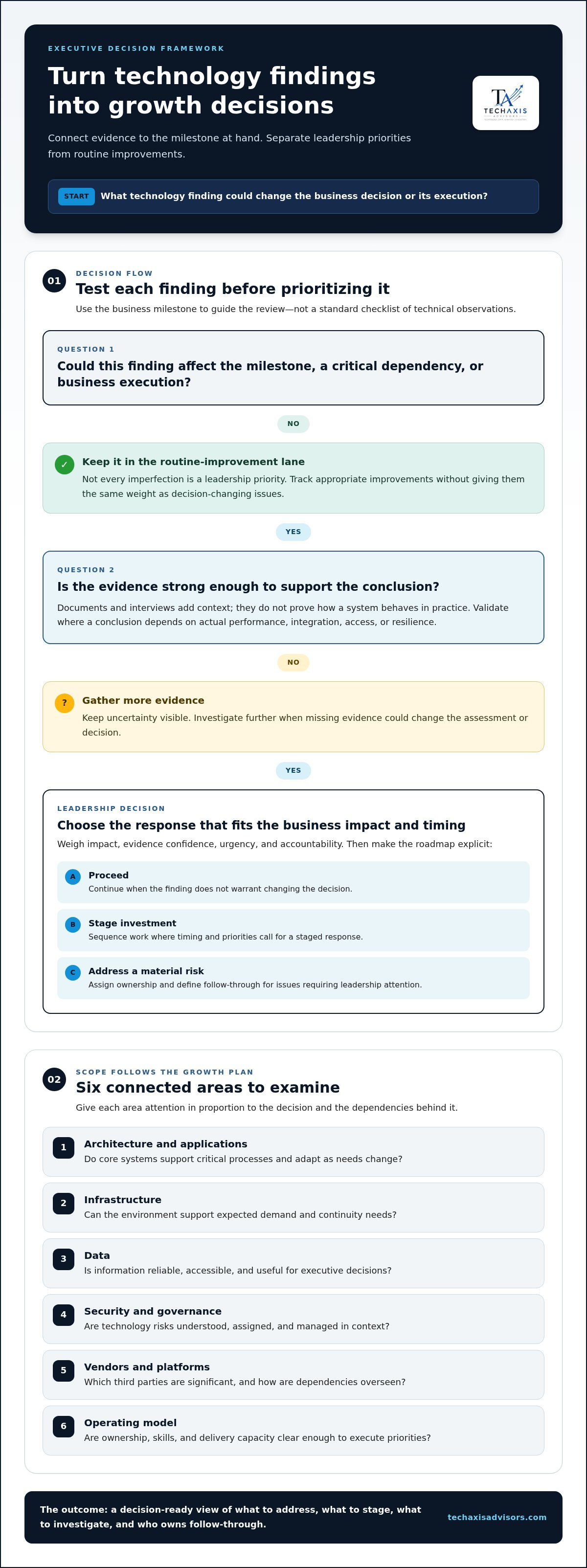
The right scope begins with the growth plan, then follows the technology dependencies that could enable or constrain it. A company opening a new service line, for example, may need to understand whether its applications support new workflows, whether its data can inform operating decisions, and whether teams or vendors can manage the added complexity. This decision-led approach keeps the review focused on business capacity rather than a standard checklist.
Technology due diligence for growth stage companies can map six connected areas:
Architecture and applications: Do core systems support critical processes, and can they adapt as needs change?
Infrastructure: Can the underlying environment support expected demand and continuity needs?
Data: Is information reliable, accessible, and useful for executive decisions?
Security and governance: Are technology risks understood, assigned, and managed in line with the organization’s context?
Vendors and platforms: Which third parties are operationally significant, and how are their dependencies overseen?
Operating model: Are ownership, skills, and delivery capacity clear enough to execute priorities?
Examine each area in proportion to the decision. An overview of what technology due diligence can assess can help frame the work, but a growth-stage company still needs a scope tailored to its operating model and priorities.
How do systems, data, and vendors affect the growth plan?
Trace the applications and dependencies behind the business processes that matter most to the decision. A system inventory shows what management believes is in place; interviews, architecture materials, contracts, and operating records add context. Documents alone, however, do not prove how a system behaves in practice. Where a conclusion depends on actual performance, integration, access, or resilience, technical validation may be needed.
Apply the same discipline to data and vendors. Review whether reporting supports the decisions leaders need to make, who owns important data, and where access or quality issues could limit its use. For significant vendors, consider which services they support, how dependent the company is on them, and how management oversees those relationships. The goal is to identify business consequences and evidence gaps, not merely count platforms.
How should security, governance, and AI enter the scope?
Security and technology governance should reflect the company’s risk profile, operating context, and decision. Examine how responsibilities and controls work in practice, not only whether policies exist. Include AI when it is material to strategy, operations, or risk. Consider how its use is governed, who is accountable, and what oversight supports responsible decision-making. If AI is not relevant to the decision, it need not become a default workstream.
Leadership teams defining a decision-led scope can use a confidential executive conversation to clarify which evidence matters most.
How to Prioritize Technology Findings by Business Impact
A findings list becomes useful when leaders can see what each issue means for the business and what decision it requires. Assess every item through four lenses: business impact, evidence confidence, urgency, and ownership. Keep impact qualitative when the evidence does not support a precise estimate. Avoid false precision. A clear description of the affected business process is more useful than an unsupported financial figure.
Business impact: Could the finding affect continuity, growth capacity, control, or delivery?
Evidence confidence: Is the conclusion supported by direct validation, documented evidence, interviews, or an untested assumption?
Urgency: Does action need to precede a business milestone, or can it be planned later?
Ownership: Who can decide, fund, and carry out the next step?
Then classify findings as material risks, capacity constraints, strategic opportunities, or routine improvements. A dependency that could interrupt a critical process may warrant leadership attention. A reporting limitation that slows expansion may be a capacity constraint. A system with reusable capabilities may present an opportunity. A low-impact usability issue may remain a routine improvement. Classification helps executives distinguish what needs a decision now from what belongs in normal planning.
How can leaders distinguish material risk from technical debt?
Technical debt is context-dependent. Connect each item to its effect on service continuity, delivery capacity, control, or growth objectives. Record what is known separately from what remains uncertain. For example, note a documented system dependency as evidence, and label an untested concern about its capacity as an assumption requiring validation. Debt does not automatically require replacement. The relevant question is whether it materially limits the business or raises risk beyond the organization’s tolerance.
Should a company retain, optimize, integrate, replatform, replace, or retire?
Compare options against the business need, risk tolerance, available capabilities, and capacity to execute. No option is right in every situation.
Retain: Keep the current approach when it meets the need and its risks are acceptable.
Optimize or integrate: Improve performance or connect systems when targeted changes address the constraint.
Replatform or replace: Consider a different foundation when evidence shows existing limitations are material and the organization can manage the transition.
Retire: Remove a system or capability when it no longer supports a business need and dependencies are understood.
For each finding, record the decision, accountable owner, and proportionate next step, such as validating an assumption, managing a risk, or sequencing an improvement. This turns technology due diligence for growth stage companies into an actionable management tool. Apply the same discipline to connect technology and operational improvements to business priorities.
How to Run Diligence Without Losing Executive Focus
A focused process protects leadership time and keeps evidence tied to the decision. Technology due diligence for growth stage companies can follow five steps:
Define the decision: State what leadership needs to decide and by when.
Agree the scope: Select the systems, processes, and risks relevant to that decision.
Review evidence: Examine records and interview people with direct knowledge of the work.
Synthesize findings: Distinguish supported conclusions from assumptions and evidence gaps.
Align on actions: Confirm decisions, owners, and practical next steps with leadership.
Name an executive sponsor who can resolve priorities and bring the right people into the process. Depending on the scope, that may include technology, operations, finance, and business leaders. Their participation connects technical observations to operating realities, investment choices, and organizational capacity.
What information and participation support a useful assessment?
Request materials that directly support the agreed scope, such as architecture and application records, infrastructure information, vendor agreements, security and governance documentation, data and reporting materials, and operating-model descriptions. Focused interviews can clarify how systems support key processes, who owns critical decisions, where dependencies sit, and what changes are planned. Keep requests proportionate to the decision and timeline rather than asking teams to assemble an exhaustive inventory.
Records may be incomplete, access may be limited, or stakeholders may describe a process differently. Treat these as evidence conditions, not proof of a specific weakness. Document what was reviewed, what could not be validated, and how those gaps affect confidence in each conclusion. If a decision depends on an unresolved point, identify the further evidence needed before leadership acts.
How do findings become an accountable roadmap?
Translate conclusions into a concise set of decisions and actions. A useful roadmap connects each priority to its business rationale, accountable owner, sequencing considerations, and next decision point. An action register can track follow-through, while board-ready findings communicate material conclusions without burying executives in technical detail. Clearly label assumptions and unresolved questions so they remain visible as work progresses.
This approach turns the assessment into an operating tool, not simply a report. TechAxis’s structured Executive Intelligence Assessments connect evidence with prioritized roadmaps and accountable actions.
To discuss how an assessment could support a specific decision, start with a confidential executive conversation.
From Due Diligence to Executive Decisions and Follow-Through
Findings matter only when leaders use them to make and carry out decisions. Depending on the evidence, executives may proceed as planned, stage investment until key capabilities are ready, assign actions to address material risks, or gather more evidence before committing. The assessment informs the choice; leadership remains accountable for it.
The right support depends on the question and what happens after findings are delivered:
Defined assessment: Use an executive decision-support engagement to evaluate a specific technology or operating question and provide evidence-based findings, a prioritized roadmap, and an action register.
Retained advisory: Use continuing executive counsel when leaders need ongoing guidance across technology, data, AI, or governance decisions.
Fractional leadership: Consider embedded executive-level support when the organization needs sustained technology leadership, oversight, and coordination to advance priorities.
These options address different needs. A defined assessment clarifies the decision and recommended next steps. Advisory provides continuity across evolving priorities. Fractional leadership adds ongoing executive capacity and oversight. Technology due diligence for growth stage companies can be a discrete engagement or a starting point for continued support, depending on the work ahead.
What should executives expect after findings are delivered?
Assign an accountable owner to each agreed action, confirm which decisions require executive or board input, and set a review cadence that fits the organization’s priorities. A roadmap should help leaders sequence work according to business need and capacity, while the action register tracks decisions, owners, dependencies, and unresolved questions. Revisit priorities as evidence or operating conditions change.
Follow-through may involve advisory leadership, governance, vendor oversight, or coordination with qualified delivery partners. The role depends on the action required; assessment findings do not mean every recommendation should proceed at once. An executive advisory leadership model can provide continuity where ongoing oversight or executive capacity is needed.
Use a technology due diligence checklist to organize evidence requests and open questions, then adapt it to the decision, scope, and information available. A checklist supports the process, but it does not replace leadership judgment about impact, ownership, or next steps.
Make the Next Technology Decision with Confidence
Effective technology due diligence for growth stage companies starts with the business decision, not a generic checklist. Scope the review around the milestone ahead, connect findings to business impact and evidence, then assign owners and practical next steps. The aim is clear choices: proceed, stage investment, address a material risk, or gather more evidence.
Follow-through matters as much as assessment. Structured Executive Intelligence Assessments provide board-ready findings and prioritized roadmaps to support leadership decisions. TechAxis founder Aarati Dikshit brings more than 25 years of CIO, CTO, and CISO experience to this work, helping executives evaluate technology in the context of business priorities.
With a clear view of the decision, evidence, and organizational capacity, leaders can move forward with greater discipline and accountability.
Frequently Asked Questions
What is technology due diligence for a growth-stage company?
Technology due diligence for a growth-stage company is an evidence-based evaluation of whether its technology and operating practices support a defined business decision. That decision might involve a growth milestone, investment, acquisition, modernization, or operational change. The assessment connects findings about systems, data, vendors, security, and ownership to business implications, helping executives understand what is material, what remains uncertain, and where further action or evidence may be needed.
What does technology due diligence assess?
It assesses the technology capabilities and dependencies relevant to the business question. Scope may include architecture and applications, infrastructure, data and reporting, cybersecurity and governance, vendors, and the operating model. The review considers how these areas affect capacity, continuity, decision quality, and execution ownership. It need not examine every domain equally; leaders should prioritize areas that could influence the decision or the company’s ability to carry out its plans.
How is technology due diligence different from a technical audit?
Technology due diligence is designed to inform a business decision, while a technical audit, code review, or security test typically examines a narrower subject or control area. Those activities may contribute evidence, but executive decision support connects relevant evidence to business priorities, risks, and organizational capacity. The assessment should clarify material findings, assumptions, and next steps. It provides decision clarity, not a guarantee of future performance or a substitute for every specialized test.
When should a growth-stage company conduct technology due diligence?
Consider an assessment when technology evidence could affect an important decision or its timing. Examples include preparing for a major growth milestone, evaluating an investment or acquisition, planning modernization, or changing the operating model. It may also be useful when leaders lack visibility into critical dependencies, have questions about scalability, or need to understand whether teams have the capacity to deliver planned changes. Scope the work to the decision and timeline.
How do you assess technical debt without assuming systems must be replaced?
Assess technical debt by connecting each issue to business impact, such as continuity, delivery capacity, control, or growth objectives. Separate verified evidence from assumptions, and identify where additional validation is needed. Then compare practical responses: retain, optimize, integrate, replatform, replace, or retire. Debt alone does not determine the answer. The appropriate option depends on the business need, risk tolerance, and the organization’s ability to execute and manage change.
Can technology due diligence evaluate AI readiness and cybersecurity risk?
Yes. The scope can include cybersecurity and technology risk in relation to the organization’s operating context and risk tolerance. AI can also be assessed when its use is material to strategy, operations, or risk. Relevant questions include who is accountable for AI decisions, how use is governed, and what oversight is in place. AI should not be an automatic workstream; include it when evidence about AI could affect the decision being evaluated.
What should executives receive from a technology due diligence assessment?
Executives should receive concise, evidence-based findings that distinguish material issues from lower-priority improvements and make uncertainty visible. Useful deliverables include board-ready materials, a prioritized strategic roadmap, an action register, and an executive presentation. The roadmap should connect recommendations to decision points and accountable owners. These outputs support leadership discussion and follow-through, but executives remain responsible for deciding which actions to approve, sequence, fund, or validate further.



Comments