

Technology Due Diligence for Growth-Stage Companies: An Executive Checklist
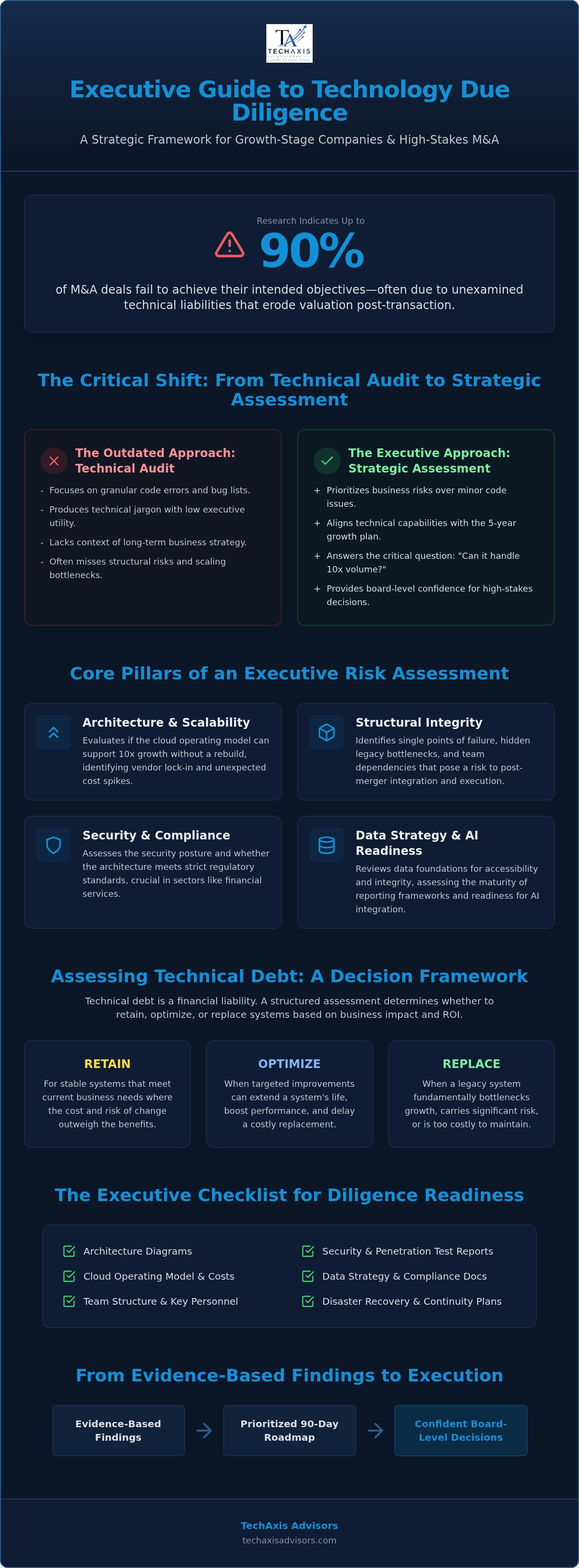
Research indicates that up to 90% of mergers and acquisitions fail to achieve their intended objectives, frequently because of unexamined technical or operational liabilities. For many CEOs and investors, the underlying infrastructure of a target remains a black box. This creates a persistent fear that hidden technical debt or scalability bottlenecks will erode valuation shortly after a transaction. Effective technology due diligence for growth stage companies is not a routine technical audit; it is a strategic assessment of execution risk and structural integrity.
You likely recognize that a company's growth potential is only as strong as its technical foundation. We understand the pressure to validate an operating model while navigating the complexities of AI integration and evolving security risks. This article provides a pragmatic framework to assess technical risk and operational maturity during high stakes growth phases. You will gain an executive checklist designed to produce evidence based findings, offering a clear roadmap for modernization and the validation your board requires to move forward with confidence. We will examine the mechanics of scaling, the quantification of technical debt, and the necessary leadership bridge to ensure long term success.
Table of Contents
Why Technology Due Diligence Defines Growth-Stage Valuation
Growth stage companies often view technology as a utility until it becomes a liability. The broader concept of due diligence serves as the foundation for this specialized assessment, which is frequently misunderstood as a simple review of code quality or server uptime. In reality, technology due diligence for growth stage companies serves as a strategic diagnostic of operational maturity. It determines whether the current infrastructure can support the aggressive scaling required to hit revenue targets or if the platform will buckle under increased pressure.
Technical debt isn't just a development hurdle; it's a financial liability. When an acquisition target has significant legacy issues, savvy investors often apply valuation haircuts. These adjustments reflect the capital required to modernize systems or the opportunity cost of execution delays. If the technology cannot scale, the growth strategy is fundamentally at risk. Moving beyond a checkbox mentality allows leadership to identify structural risks that automated tools often miss. Evidence based findings from a structured Executive Intelligence Assessment build the board level confidence necessary to authorize high stakes transactions.
Shifting from Technical Audits to Strategic Assessments
A standard technical audit might produce a list of bugs. While useful for developers, this lacks executive utility. A strategic assessment prioritizes business risks over granular code errors. It aligns technical capabilities with the five year growth strategy. You need to know if the platform can handle ten times the current volume, not just if the current code is clean. Independent, senior led advisory ensures these findings remain objective. This approach replaces organizational anxiety with a disciplined plan for progress, focusing on how technical health impacts the bottom line.
Identifying Execution Risks Before They Impact the Deal
Growth stage companies often harbor hidden blind spots. Single points of failure, such as a lone developer holding the keys to the entire architecture, can derail a post merger integration. Legacy bottlenecks often remain hidden until a company attempts to enter a new market or launch a new product line. Quantifying the cost of "doing nothing" regarding technical debt is essential for accurate financial modeling. Understanding these risks early allows you to negotiate from a position of strength. To see how we structure this exploration, you can learn more about how we work to deliver executive clarity. By identifying these gaps before the deal closes, you gain the leverage to adjust terms or set aside reserves for immediate remediation.
Core Pillars of an Executive Technology Risk Assessment
Conducting technology due diligence for growth stage companies requires a shift from technical discovery to risk quantification. An executive assessment focuses on four foundational pillars: scalability, structural integrity, security, and data maturity. These pillars determine whether a company’s valuation is supported by a robust engine or a fragile prototype. If the technology operating model cannot sustain rapid expansion, the investment thesis is fundamentally flawed. Leaders must look for evidence of disciplined engineering and operational oversight rather than just a functional product.
Architecture, Scalability, and the Cloud Operating Model
Growth stage firms often face a scaling wall where their initial architecture fails to support increased transaction volumes. We evaluate the cloud operating model to determine if the infrastructure can handle 10x growth without a complete rebuild. This involves stress testing the current environment and identifying vendor dependencies that could lead to platform lock-in or unexpected cost spikes. Many of the problems we solve involve correcting these infrastructure misalignments before they impede market expansion. A thorough review ensures that the platform is built for elastic growth rather than fixed capacity.
Data Strategy and AI Readiness in Regulated Environments
In wealth management and financial services, data architecture must satisfy both performance requirements and strict regulatory standards. A detailed Technology Due Diligence Guide emphasizes that data foundations should be reviewed for accessibility and compliance. We assess the maturity of reporting frameworks to ensure the board receives accurate, real-time insights. AI readiness is the intersection of data quality and executive governance. Without a clear governance framework, emerging AI implementations risk creating significant legal and operational liabilities. We look for structured data pipelines that support automation while maintaining auditability.
Beyond these pillars, cybersecurity must be viewed through a risk management lens rather than a purely technical one. We evaluate the posture of proprietary software and SaaS platforms to identify vulnerabilities that could lead to data breaches or service interruptions. If you're preparing for a high stakes transaction, you can start with a confidential executive conversation to ensure your assessment covers these critical areas. This disciplined approach replaces uncertainty with a prioritized roadmap for long term stability.
Assessing Technical Debt: Retain, Optimize, or Replace?
Identifying technical debt is only half the battle. The true executive burden lies in the decision: what do we fix, what do we scrap, and what do we live with? Technical debt acts as a lien on your growth strategy. It's not just about messy code; it's about the speed of your next feature launch and the stability of your operations. Successful technology due diligence for growth stage companies moves beyond discovery into strategic decision support, providing a framework to categorize every system into one of six actions: retain, optimize, integrate, replatform, replace, or retire.
Evaluating the ROI of these choices requires a disciplined approach. Replatforming is often the most expensive option, yet it becomes necessary when "unpayable" technical debt exists. This occurs when the cost of maintaining a system exceeds the cost of replacing it, or when the system creates a hard ceiling on scalability. Effective technology due diligence for growth stage companies provides the evidence needed to make these high stakes choices. You must balance the need for innovation with the requirement for operational stability, ensuring that modernization efforts don't derail current revenue streams.
The Business Case for Modernization
Presenting modernization costs to the board requires a shift in language. Don't frame it as a technical necessity; frame it as an investment in scale. Use evidence based findings to justify why a "replace" decision is more cost effective over a three year horizon than a "retain" decision. When deciding between different advisory models to support these findings, exploring various technology advisory options can help clarify the value of boutique expertise over generic consulting reports. A focused, senior led approach ensures that modernization roadmaps are grounded in business reality rather than abstract theory.
Evaluating Security Posture and Governance Maturity
Cybersecurity is a business risk, not just an IT problem. During an assessment, you must evaluate how a target manages its security posture through a risk management lens. In wealth management and financial services, this includes strict compliance with industry specific standards and data privacy laws. Governance maturity is a leading indicator of long term operational excellence. A company with documented policies, regular penetration testing, and clear accountability is far more likely to scale without catastrophic failure. We look for a disciplined bridge between technical controls and executive oversight to ensure the organization is protected against evolving threats.
The Executive Checklist for Diligence Readiness
Preparation for technology due diligence for growth stage companies involves more than gathering files. It requires the consolidation of complex operational data into a transparent, executive-ready format. Investors seek evidence of structural discipline and a repeatable delivery model. A lack of preparation suggests a lack of oversight, which can lead to extended timelines or deal fatigue. Readiness is a competitive advantage. It signals to potential partners that the organization is managed with the same rigor applied to its financial statements.
The following areas require immediate executive attention:
Critical Documentation: Current architecture diagrams, API documentation, and all material vendor contracts.
Security and Compliance: Recent SOC2 reports, penetration test results, and documented BCP/DR plans.
Financial Transparency: R&D tax credit documentation and a detailed cloud spend analysis. Research suggests the maintenance phase of the software development lifecycle can consume 60 to 80 percent of total lifetime costs, making efficiency here a key metric.
Operational Metrics: Evidence-based data on deployment frequency, system uptime, and incident response times.
Talent and Culture: Clear identification of key person risk and historical engineering team turnover rates.
Documentation and Infrastructure Transparency
A single source of truth for technical assets is non-negotiable. This includes mapping how systems interact and where third-party dependencies lie. Undocumented tribal knowledge is a significant red flag for investors. It suggests that critical institutional intelligence resides in the heads of a few individuals rather than in the organization's systems. If a lead engineer leaves, the value of the acquisition could plummet. Deep-dive interviews with senior technology leadership should reveal a team that understands the business impact of their architectural choices.
Engineering Culture and Talent Retention Risks
The strength of a technology company is its people, yet talent remains one of the hardest assets to quantify. We evaluate the alignment between the tech team and broader business objectives to ensure development efforts aren't siloed. High turnover rates can derail post-acquisition growth and signal underlying cultural issues. Assessing the maturity of the software development lifecycle (SDLC) provides insight into how the team handles scale. If a leadership gap is identified during this process, it may be necessary to evaluate when a growth company needs a fractional CTO to stabilize the organization and bridge the gap between assessment and execution.
Beyond the Findings: Leveraging Advisory for Execution
The completion of technology due diligence for growth stage companies marks the beginning of the most critical phase: transformation. A report containing evidence-based findings only holds value if it translates into measurable progress. Many organizations struggle to move from the diagnostic phase to implementation, often due to a lack of senior-level oversight or a distracted internal team. We bridge this gap by turning a prioritized roadmap into a disciplined 90-day execution plan. This transition requires a focus on maintaining operational continuity while simultaneously addressing the structural risks identified during the assessment.
Execution is where the investment thesis is either realized or lost. We support this process through rigorous vendor oversight and the implementation of governance structures that hold delivery partners accountable. By establishing clear lines of authority and transparency, we ensure that the technology operating model evolves in alignment with business objectives. This disciplined approach replaces organizational confusion with a sense of controlled, methodical progress. It provides the leadership bridge necessary to move from a state of identified risk to a state of mastered execution.
Implementing the Strategic Roadmap
Success in the post-diligence period depends on momentum. We prioritize "quick wins" that address immediate security or scalability concerns to build confidence across the executive team and the board. Establishing clear KPIs for technology modernization initiatives is essential for tracking ROI. These metrics often include improvements in system uptime, reduced incident response times, and increased deployment frequency. For organizations requiring ongoing support to manage these complexities, our advisory leadership models provide the necessary governance to keep long-term projects on schedule and within budget.
The Role of Fractional CTO Leadership in Post-Diligence Success
Growth-stage companies often face a leadership gap where they need veteran wisdom but don't yet require a full-time executive hire. A fractional CTO provides senior-level guidance with the agility of a modern innovator. This role is instrumental in ensuring the "retain, optimize, or replace" strategy is executed with discipline and objectivity. By serving as a fractional partner, we help you manage the mechanics of scaling without the full-time cost. We act as a strategic architect, overseeing vendor selections and technical transitions to ensure that every decision supports the broader growth strategy.
Securing Post-Acquisition Performance through Strategic Oversight
Effective technology due diligence for growth stage companies serves as a strategic diagnostic that protects deal value. It requires moving beyond a simple list of bugs to evaluate the structural integrity and scalability of the entire operating model. You've seen how quantifying technical debt allows for evidence-based decisions on whether to retain, optimize, or replace legacy systems to ensure long-term stability.
TechAxis Advisors provides the executive clarity needed for these high-stakes decisions. Our advisors are former CIOs, CTOs, and CISOs who utilize the proprietary Executive Intelligence Platform to deliver prioritized roadmaps. As a Certified Women-Owned Small Business (WOSB), we focus on replacing organizational anxiety with a disciplined path toward operational excellence and controlled growth.
The right framework ensures your growth strategy isn't derailed by hidden technical liabilities. We look forward to supporting your journey toward a resilient and scalable technical foundation.
Frequently Asked Questions
What is the difference between IT due diligence and technology due diligence?
IT due diligence focuses on back-office infrastructure and corporate systems like email, ERP, and general networking. Technology due diligence evaluates the proprietary product, software architecture, and the team's ability to scale. While IT diligence ensures the lights stay on, technology diligence assesses the core value driver of the acquisition.
How long does a typical technology due diligence process take for a growth-stage company?
A standard assessment typically spans three to six weeks depending on the complexity of the organization and the availability of documentation. Accelerated timelines of three weeks are possible for urgent transactions, though these often require a higher degree of readiness from the target company. Planning for a four week window ensures a thorough diagnostic without compromising deal momentum.
Why should a growth-stage company perform sell-side due diligence before an exit?
Sell-side assessments allow leadership to identify and remediate liabilities before they become negotiation leverage for a buyer. By conducting technology due diligence for growth stage companies early, you can quantify technical debt and present a prioritized roadmap for improvement. This proactive approach builds buyer confidence and helps protect the final valuation during the closing process.
What are the most common red flags found during technology due diligence?
Common red flags include high key person risk, a lack of documented architecture, and unaddressed technical debt that creates a scaling ceiling. We also look for stagnant deployment frequencies or a high volume of manual workarounds in the software development lifecycle. These indicators suggest a fragile operating model that may fail under the pressure of rapid post-acquisition growth.
How does technical debt impact the valuation of a SaaS company?
Technical debt acts as a future financial obligation that can lead to significant valuation haircuts during a deal. Investors view high debt as a drain on future capital, because funds must be diverted from innovation to remediation. Quantifying this debt early allows for more accurate financial modeling and ensures that the purchase price reflects the actual cost of future operations.
Can a fractional CTO lead the technology due diligence process?
Yes, a fractional CTO is uniquely positioned to lead this process because they provide senior-level oversight and executive clarity. They act as a strategic partner to bridge the gap between technical findings and business objectives. This leadership ensures that technology due diligence for growth stage companies results in an actionable 90-day execution plan rather than just a list of technical bugs.
What role does AI governance play in modern technology due diligence?
AI governance evaluates the legal and operational risks associated with emerging automation tools and data usage. Modern diligence must verify that data used for AI training is compliant with privacy laws and that models don't introduce security vulnerabilities. It's a critical review of the ethical and structural framework surrounding the company's data assets and automated decision-making processes.
How do we choose between a boutique advisory firm and a Big Four firm for diligence?
Big Four firms offer global scale and broad brand recognition, while boutique advisory firms provide senior-level access and specialized industry expertise. Boutique firms typically deliver more pragmatic, evidence-based findings tailored to the specific mechanics of a growth-stage business. The choice depends on whether you require a standardized corporate audit or a partner-led strategic assessment focused on execution.



Comments