

Technology Advisory Board Services: A Governance Framework for Growth-Stage Executives
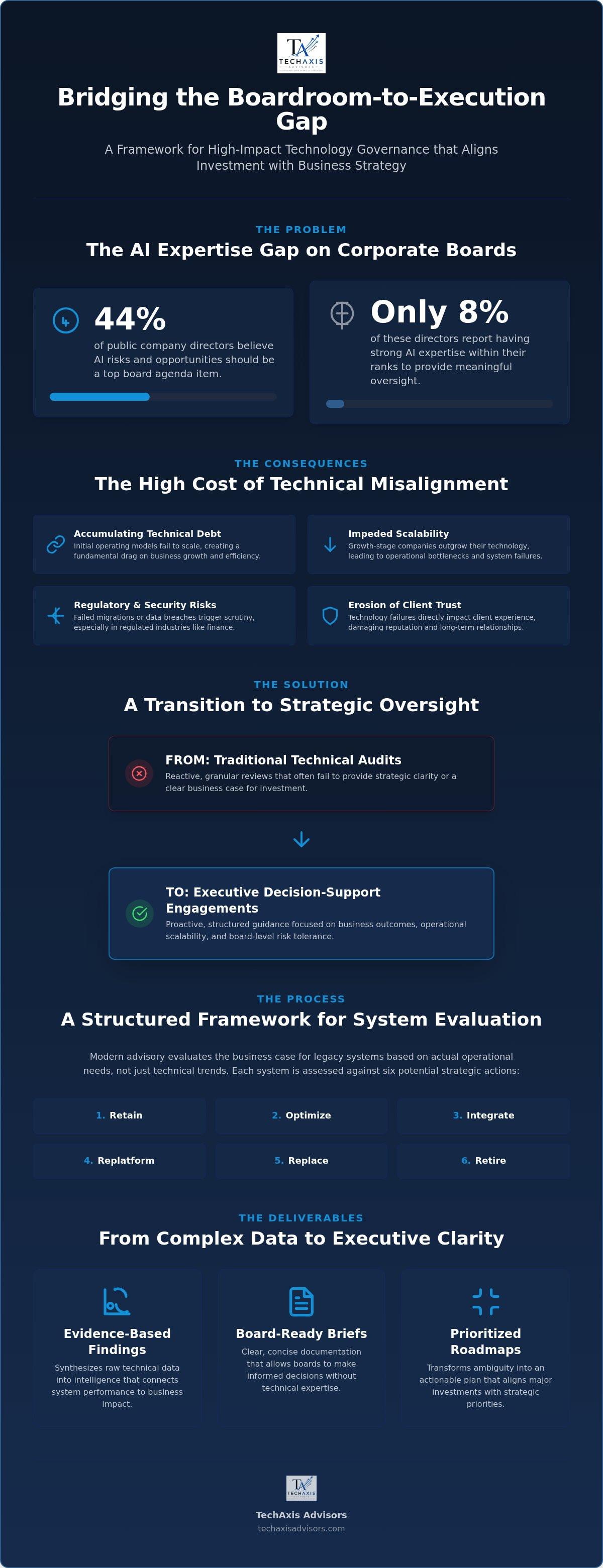
While 44% of public company directors believe AI risks and opportunities should be a top board agenda item, only 8% report having strong AI expertise within their ranks. This expertise gap often leaves growth-stage executives caught between aggressive innovation goals and the reality of technical execution risk. You recognize that traditional technical audits often fail to provide the strategic clarity needed at the board level. It's difficult to approve major investments when the bridge between the C-suite and technical teams feels broken. Utilizing professional technology advisory board services provides the necessary executive-level oversight to bridge this divide.
This guide demonstrates how to establish a high-impact advisory layer that aligns technical execution with business strategy and board-level risk tolerance. We'll examine how to build board-ready technology roadmaps, utilize evidence-based decision support for AI initiatives, and create a reliable mechanism for vendor oversight that protects your organization's long-term scalability. By the end, you'll have a clear framework for reducing execution risk and making informed technology investments that drive measurable business value.
Table of Contents
The Governance Gap: Why Growth-Stage Boards Require Technology Advisory Services
Many growth-stage companies suffer from a structural disconnect. The board sets high-level strategic objectives while the technical team manages daily execution. These two groups often lack a common language, which creates technical execution risk that threatens long-term growth. While a full-time CTO is vital for operational management, they're often too close to internal politics and legacy systems to provide objective governance. For PE-backed organizations, professional technology advisory board services reduce the execution gap that often appears between the investment thesis and the actual technical capability of the portfolio company. This independent oversight ensures that technical roadmaps remain aligned with business outcomes.
Identifying Technical Execution Risk
Technical debt is more than a line item on a developer's checklist. It's a fundamental drag on business scalability. Growth-stage companies frequently outgrow their initial technology operating models as they scale. What worked for a small startup fails when the organization reaches hundreds of employees. In regulated industries like wealth management, the cost of misaligned technology is particularly high. A failed platform migration or a data breach triggers regulatory scrutiny and erodes client trust. Evidence-based decision support ensures that tech investments align with the organization's risk tolerance. A Technology Advisory Board focuses on the long-term strategic implications of these shifts, providing a level of scrutiny that internal teams can't always maintain.
The Limitations of Traditional Board Oversight
Generalist boards often struggle to evaluate complex AI and cybersecurity roadmaps. Research from 2026 shows that while 44% of public company directors believe AI should be a top agenda item, only 8% report having strong AI expertise. This gap makes it nearly impossible to conduct meaningful oversight without external support. Boards need more than anecdotal technical updates from internal management. They require structured findings that translate technical metrics into business impact. This approach mirrors the function of a Technical Advisory Council, which provides specialized expertise to guide complex governance decisions. Utilizing technology advisory board services is a critical step toward improving operational maturity. These services ensure the board has the specific intelligence needed to manage material risks, such as the SEC requirement to report material cybersecurity incidents within four business days.
Defining Modern Technology Advisory Board Services
Executive clarity doesn't emerge from dense technical reports. It's the result of modern technology advisory board services that prioritize business outcomes over technical trends. This framework represents a transition from reactive technical troubleshooting to proactive, structured executive guidance. It aligns technical execution with the overarching business strategy, ensuring that every dollar spent on infrastructure directly supports organizational goals. Unlike traditional technical audits that often get bogged down in granular code reviews, these services function as executive decision-support engagements. They provide the board with the clarity needed to approve major investments without requiring directors to become technical experts themselves.
Executive Assessment Portfolio
The assessment phase focuses on synthesizing complex data into actionable intelligence. For wealth management and financial services firms, this involves evaluating AI readiness and automation potential against current 2026 governance standards. A structured assessment identifies where data silos prevent informed decision-making and where cybersecurity gaps create material risk. We evaluate the business case for whether to retain, optimize, integrate, replatform, replace, or retire legacy systems based on actual operational needs. As noted in the discussion of Next Generation Advisory Boards, these bodies are essential for bridging the talent gap that exists between the boardroom and the server room. Deliverables include board-ready briefs and prioritized strategic roadmaps that replace ambiguity with evidence-based findings.
Ongoing Strategic Counsel
Effective governance requires more than a one-time diagnostic. Retained advisory services provide a steady hand during long-term digital transformations, offering vendor and platform management that functions as a strategic governance layer. This oversight ensures that third-party partners and white-label development teams remain accountable to the original project scope and budget. Utilizing a proprietary Executive Intelligence Platform allows for the synthesis of disparate technical data into a single, unified view of operational health. This continuous loop of feedback and adjustment ensures the technology roadmap remains flexible enough to adapt to market shifts while remaining disciplined in execution. If your current oversight model lacks this level of structured clarity, you may want to start with a confidential executive conversation to explore your specific governance needs.
Strategic Options: Comparing Advisory Models and Tradeoffs
Executives evaluating technology governance often face a choice between global strategy firms and specialized boutique partners. While the Big Four offer significant brand recognition and extensive resources, their delivery models often rely on highly standardized templates and layered staffing structures. For growth-stage firms in wealth management or private equity, this approach can lack the nuance required for complex digital transformations. Boutique technology advisory board services offer a different value proposition. These firms prioritize direct access to veteran leadership and provide evidence-based findings that align specifically with your organization's risk tolerance and operational maturity.
The Boutique Advisory Advantage
The primary differentiator for boutique partners is the seniority of the advisors involved in the engagement. You work directly with former CIOs, CTOs, and CISOs who have managed similar scaling challenges in regulated environments. This approach ensures that your strategic guidance comes from leaders with decades of hands-on experience rather than generalist delivery teams. These advisors use structured intelligence synthesis to identify gaps in your current technology operating model. Instead of generic industry benchmarks, they provide a prioritized roadmap based on your specific business objectives. This model values tangible execution over abstract theory, ensuring that every recommendation is practical and achievable within your current resource constraints.
Decision Framework: Fractional vs. Full-Time Leadership
Choosing between a full-time executive hire and fractional advisory depends on your current growth trajectory. A permanent CTO is often necessary for managing large internal engineering teams and long-term product development. However, during periods of rapid growth, M&A activity, or major platform migrations, the specialized oversight of an advisory board provides a broader perspective. You can access high-level expertise without the long-term overhead of an additional C-suite salary. This is particularly effective when the board requires independent verification of technical progress that an internal leader might be too close to report objectively.
Evaluating the financial implications is a critical part of this decision. We've developed a detailed Fractional CTO vs Full Time CTO: An ROI Analysis to help you determine which model fits your current budget and strategic needs. For many growth-stage firms, the agility of fractional technology advisory board services provides the necessary leadership bridge until the organization reaches the scale required for a permanent, high-level technical hire. This approach allows you to maintain disciplined progress while managing execution risk during critical transitions.
A Framework for Establishing Technology Governance
Effective technology advisory board services rely on a repeatable process rather than ad hoc interventions. Governance demands consistent discipline to ensure technical roadmaps don't drift from the original business case. This framework provides a structured path for executives to regain control over complex technical ecosystems. It moves the organization from a state of reactive firefighting to one of proactive, evidence-based decision-making.
Structured Diagnostic: Identify current operational maturity levels. This baseline assessment reveals where technical debt limits your ability to scale.
Intelligence Synthesis: Define specific gaps between current capabilities and future needs. Use structured data to provide the board with a clear view of technical risk.
Strategic Roadmap: Develop a prioritized plan aligned with business goals. Focus on initiatives that offer the highest ROI and lowest execution risk.
Action Register: Implement a formal tracking system for executive accountability. Every technical milestone must have a clear business owner and deadline.
Fractional Leadership: Maintain ongoing governance through external oversight. This ensures that internal teams remain focused on long-term strategy rather than daily technical minutiae.
AI Strategy and Governance for Regulated Firms
Wealth management and financial services firms face unique challenges when deploying automated systems. A pragmatic AI roadmap balances innovation with strict compliance requirements. We assess whether to retain, optimize, or replace legacy platforms to support new data architectures. Governance ensures that these investments are transparent and defensible to regulators. For a deeper look at these requirements, see our AI in Financial Services: 2026 Strategic Framework.
M&A Technology Integration
Private equity-backed firms must prioritize technology due diligence during high-stakes acquisitions. Hidden technical debt in a portfolio company can quickly erode the value of the deal. A Technology Advisory Board provides the independent oversight needed to evaluate a target's infrastructure and team capability. This process identifies integration risks before they become material liabilities. Refer to our Technology Due Diligence for Growth-Stage Companies for a structured approach to assessing new acquisitions.
Executive Decision Support: The TechAxis Advisory Model
TechAxis Advisors operates as a fractional partner, providing the senior oversight required to turn technical complexity into executive clarity. We use a proprietary Executive Intelligence Platform to deliver structured assessments that go beyond standard technical audits. This platform synthesizes disparate data points into evidence-based findings tailored specifically for board review. As a Strategic Architect, we don't just identify problems; we design the structural integrity required for your next phase of growth. This approach ensures that technology advisory board services provide a tangible return on investment by reducing execution risk across the entire portfolio. By focusing on business value rather than technical trends, we help you maintain a disciplined path toward operational mastery.
Expertise-Driven Leadership
Founder Aarati Dikshit brings more than 25 years of experience as a CIO, CTO, and CISO within wealth management, financial services, and retail sectors. This veteran perspective is reinforced by our SBA WOSB and NJ MWBE certifications, which provide additional credibility for regulated clients seeking independent governance. We understand the mechanics of scaling because we've led those transformations from the inside. Every deliverable we produce focuses on three core pillars: clarity, accountability, and traceability. We move beyond generic consulting templates to provide a leadership bridge that connects the investment thesis with technical reality. This ensures that every technology decision is backed by verifiable data and prioritized according to its impact on your bottom line.
Next Steps for Executive Leadership
Initiating a higher level of technology governance doesn't require a massive upfront commitment. Most engagements begin with a confidential executive conversation to identify your most pressing technical risks and business objectives. We'll help you evaluate whether your organization requires a one-time Executive Intelligence Assessment to define your current state or ongoing fractional advisory support to manage a specific transformation. These low-pressure entry points allow you to explore how technology advisory board services can stabilize your operations and provide the decision support your board requires. Our goal is to provide the wisdom of a veteran executive with the agility of a modern innovator, ensuring your technology roadmap remains aligned with your long-term vision.
Start with a confidential executive conversation to explore whether your priority requires an assessment, strategic advisory, or fractional leadership.
Establishing Strategic Oversight for Sustainable Growth
Growth stage firms must bridge the gap between high level board strategy and the mechanical reality of technical execution. Professional technology advisory board services provide the structured oversight needed to manage material risks while maintaining the agility required for digital transformation. By moving from anecdotal reporting to evidence based assessments, executives gain the clarity necessary to approve major investments with confidence. This transition ensures that technical roadmaps remain aligned with the organization's risk tolerance and long term business objectives.
TechAxis Advisors facilitates this process through a proprietary Executive Intelligence Platform and over 25 years of CIO and CTO experience. As an SBA Women Owned Small Business (WOSB), we provide independent, senior level counsel tailored for regulated organizations in wealth management and private equity. We're committed to replacing organizational anxiety with a sense of controlled, disciplined progress.
You don't have to navigate complex AI and data governance challenges in isolation. A methodical approach to technology leadership ensures that your organization remains resilient, compliant, and positioned for mastery in your market.
Frequently Asked Questions
What is the difference between a technology advisory board and a Board of Directors?
A technology advisory board serves as a non-fiduciary body that provides specialized technical expertise, whereas the Board of Directors holds fiduciary responsibility and legal oversight. The advisory board offers deep technical intelligence that generalist directors often lack, specifically regarding AI strategy or cybersecurity risk. This structure allows the Board of Directors to make informed decisions without being involved in granular technical management. It functions as a strategic layer that translates technical execution into business risk.
How often does a technology advisory board typically meet?
Meeting frequency depends on the organization's current growth phase and complexity. Most established technology advisory board services recommend quarterly formal sessions to align technical roadmaps with long term business objectives. During periods of rapid scaling, M&A integration, or major platform migrations, monthly sessions or ad hoc executive briefings are common. This cadence ensures that governance remains proactive rather than reactive, providing continuous oversight as market conditions or regulatory requirements shift.
What are the primary responsibilities of a fractional CTO on an advisory board?
A fractional CTO provides embedded executive leadership and objective governance. Their primary responsibilities include aligning technology investments with business strategy, overseeing vendor performance, and managing technical execution risk. They act as a Strategic Architect, translating complex technical data into clear, board-ready briefs. This role ensures that the technology operating model scales efficiently while maintaining high standards for accountability and transparency across all digital transformation initiatives.
How do technology advisory board services help with AI governance?
Advisory services help organizations establish formal AI governance frameworks that meet 2026 standards for financial services and other regulated industries. This process includes identifying material risks, establishing oversight protocols, and creating a pragmatic roadmap for automation. By utilizing evidence-based findings from an Executive Intelligence Platform, advisors help leadership teams evaluate the business case for AI investments. This ensures that AI adoption is disciplined, defensible to regulators, and anchored to organizational goals.
Can a technology advisory board replace a full-time CTO?
A technology advisory board doesn't replace a full-time CTO but rather complements or bridges the role during specific growth stages. For organizations with an existing CTO, the board provides independent verification and strategic support. For companies without a permanent technical executive, fractional leadership offers high-level guidance without the overhead of a full-time hire. This model allows growth-stage firms to access veteran expertise while they build the internal team capacity required for long-term operations.
What industries benefit most from structured technology advisory services?
Wealth management, financial services, lending, and retail organizations benefit most from structured advisory services due to their complex regulatory environments. Private equity-backed firms also gain significant value, particularly during technology due diligence and portfolio integration. These industries face high stakes regarding data privacy, cybersecurity, and operational scalability. Structured governance provides the necessary leadership bridge to manage these material risks while accelerating digital transformation in highly competitive markets.
How is the ROI of technology advisory board services measured?
ROI is measured through reduced technical execution risk, improved operational maturity, and better alignment between technology spend and business outcomes. Organizations often see tangible returns through the avoidance of failed platform migrations and more effective vendor management. Additionally, the ability to provide board-ready roadmaps reduces organizational anxiety and accelerates decision-making. These improvements create a scalable operating foundation that supports long-term growth and increases the overall valuation of the business.
What deliverables should I expect from an executive technology assessment?
An executive technology assessment delivers a suite of artifacts designed for C-suite and board review. These include a prioritized strategic roadmap, an action register with clear next steps, and a concise board-ready brief. Every deliverable focuses on clarity, accountability, and traceability, moving beyond generic consulting reports. These documents provide evidence-based findings that support major investment decisions, ensuring that the board has a documented and traceable record of their technology oversight activities.


Comments