

Tech Operational Excellence: 2026 Executive Guide
- 24 hours ago
- 10 min read
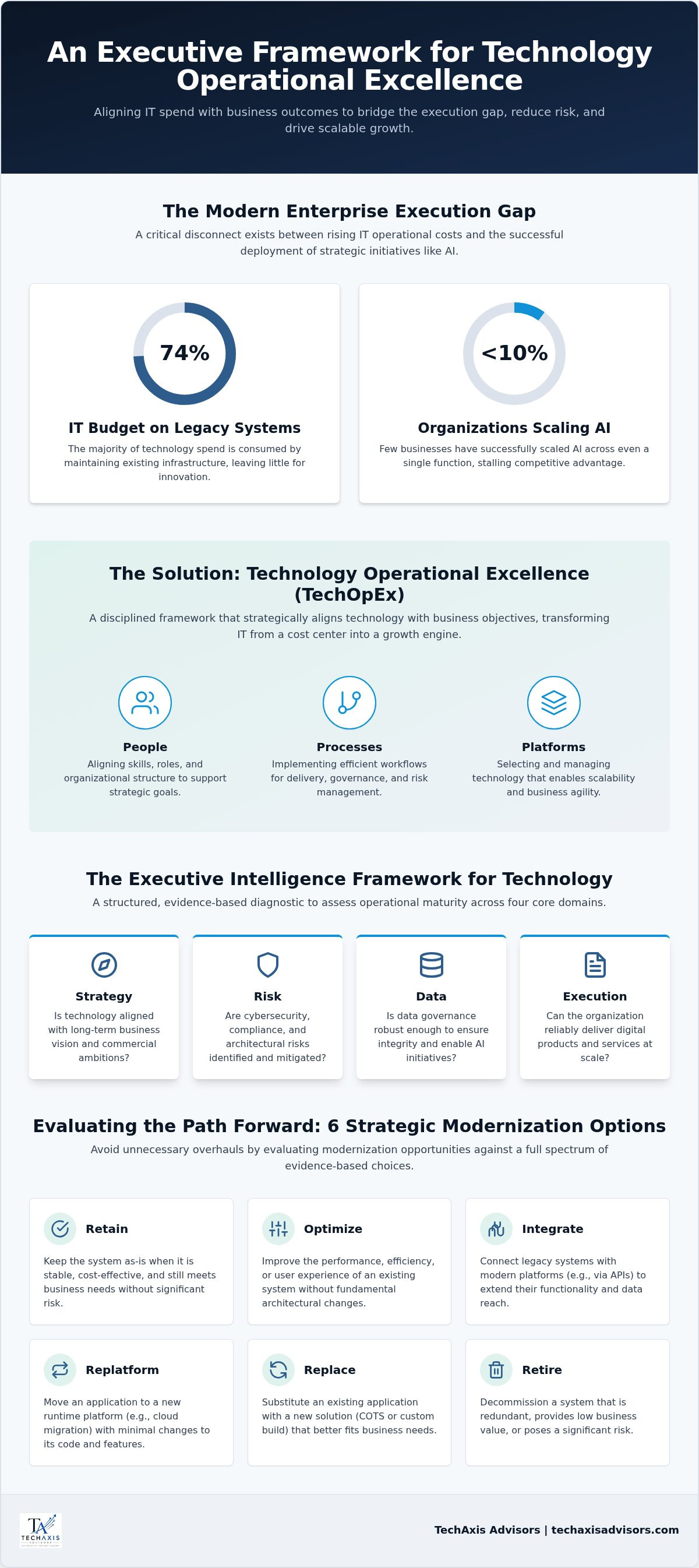
In 2026, legacy systems consume up to 74% of the total IT operational budget for many enterprises; meanwhile, fewer than 10% of organizations have successfully scaled AI across a single business function. This disconnect creates a significant execution gap that stalls growth and inflates technical debt. Adopting a structured operational excellence framework for technology is the most effective way to bridge the divide between complex technical requirements and clear strategic objectives.
It's a common struggle to see IT spending rise while business outcomes remain stagnant. We'll show you how to align your technology operating model with your business strategy to reduce execution risk and drive scalable growth. This guide examines the latest 2026 developments, including the release of ITIL 5 and the enforcement of the EU AI Act, to provide a clear roadmap for improving your organizational maturity. You'll gain the confidence to make technology investment decisions that prioritize structural integrity over short-term fixes. By the end of this guide, you'll have a disciplined approach to managing digital products and services as a unified portfolio.
Table of Contents
Defining Operational Excellence for the Modern Technology Ecosystem
Technology Operational Excellence, or TechOpEx, is the disciplined alignment of an organization's people, processes, and platforms with its overarching business strategy. While many look to the foundational definition of operational excellence rooted in Lean manufacturing, those models often fail in software-driven environments. Manufacturing focuses on reducing variance in physical output. In contrast, an operational excellence framework for technology must prioritize the velocity of digital product delivery and the integrity of data governance.
Execution risk occurs when your firm's technical maturity lags behind its commercial ambitions. This gap creates a friction that slows down product launches and complicates post-merger integrations. Many leaders mistake IT maintenance, which is simply keeping the lights on, for operational excellence. True excellence is a strategic accelerator. It transforms technology from a cost center into a reliable engine for growth. Without this framework, organizations often find themselves reacting to technical crises rather than executing on their long-term vision.
The Shift from IT Management to Strategic Operating Models
For growth-stage firms, the traditional outsourced IT provider model often reaches a breaking point. These providers focus on tickets and uptime, yet they lack the executive clarity needed to identify technical bottlenecks that hinder scaling. In wealth management and private equity, operational maturity is no longer a secondary concern. It directly impacts enterprise valuation during M&A scenarios. A firm with a documented, transparent operating model is a lower-risk asset than one burdened by opaque technical debt and fragmented systems. Investors look for structural integrity that can withstand rapid expansion.
Core Principles of the TechAxis Perspective
Effective leadership requires a shift from following technology trends to evidence-based decision making. Every technical investment must pass the test of business-first alignment. If a platform upgrade doesn't clearly reduce execution risk or improve client outcomes, it's a distraction. Our approach emphasizes transparency and traceability. This provides board members with the data they need to feel confident in capital allocation. By implementing a structured operational excellence framework for technology, you ensure that every dollar spent on IT is an investment in your firm's future scalability. You can explore how these principles apply to your specific challenges through our strategic advisory services. This disciplined approach replaces organizational anxiety with a sense of controlled, professional progress.
The TechAxis Executive Intelligence Framework for Technology
The foundation of a reliable operational excellence framework for technology is not found in generic advice but in structured, evidence-based diagnostics. We utilize a proprietary Executive Intelligence Platform to drive this process. This engine allows us to move beyond subjective opinions and identify the specific mechanics required for growth. By focusing on four core domains—Strategy, Risk, Data, and Execution—we create a comprehensive view of your current state. This structured approach is detailed further in our guide on Improving Operational Maturity Through Technology: An Executive Framework.
The workflow follows a deliberate progression from diagnostic to roadmap. We don't start with solutions; we start with identification. This ensures that every recommendation is rooted in the reality of your firm's operational needs. It's about building a bridge between where your technology stands and where your business strategy needs to go. This methodical flow suggests a well-defined process, reinforcing our identity as a reliable partner in business transformation.
The Executive Technology Operating Model Assessment
An executive-grade diagnostic differs fundamentally from a standard technical audit. While an audit checks boxes, an Executive Technology Operating Model Assessment evaluates your organization's readiness for rapid scaling. It identifies unseen risks in cybersecurity and legacy architecture that could derail modernization efforts. We look at the structural integrity of your systems to ensure they can support increased volume and complexity without failing under pressure. This assessment provides the leadership bridge that a growing company might be missing.
Translating Complex Ecosystems into Board-Ready Findings
Technology ecosystems are inherently complex. Leadership teams often struggle with fragmented information that lacks business context. Our framework translates these complexities into board-ready findings and prioritized strategic roadmaps. We replace technical jargon with clear, actionable business intelligence. This clarity builds consensus among leadership teams, turning technology from a source of anxiety into a disciplined asset. Evidence-based findings allow for faster capital allocation decisions and reduced execution risk. If you are ready to move from technical confusion to strategic oversight, consider reaching out for a confidential executive conversation. Each section of our reporting builds upon the previous one, creating a sense of comprehensive coverage and strategic alignment.
Evaluating the Path Forward: Retain, Optimize, or Replace?
The impulse to rip and replace legacy systems is often a reaction to organizational frustration rather than a calculated business decision. Many digital transformations fail because leadership views technology as a standalone product rather than a component of an operational excellence framework for technology. At TechAxis, we challenge this mentality. A full replacement is rarely the only path; it's often the most expensive and risky one. We evaluate the path forward through six strategic options: Retain, Optimize, Integrate, Replatform, Replace, or Retire. This decision framework allows CEOs to navigate high-stakes choices with evidence-based clarity.
Every option is weighed against its projected ROI and its potential for execution risk. By choosing the right lever, you can achieve strategic alignment without the disruption of a total overhaul. This methodical evaluation ensures that your technology operating model remains agile enough to support your commercial goals while maintaining structural integrity.
Assessing Technical Debt and Execution Risk
Technical debt is not just a coding issue. For a CFO, it's a balance sheet liability that drains operational capital and slows down market responsiveness. It represents the future cost of rework caused by choosing an easy solution now instead of a better approach later. Balancing immediate speed with long-term scalability requires a structured review. Our Technology Due Diligence for Growth-Stage Companies provides a clear checklist for identifying these liabilities before they compromise your growth. Identifying these unseen risks early allows you to address them before they become systemic failures.
Strategic Modernization Without Business Disruption
Modernization doesn't always mean moving to a new platform. Often, the most pragmatic move is to optimize existing assets or integrate disparate systems to improve data flow. For example, a wealth management firm might find that their core system is sound, but their reporting layer is fragmented. By optimizing the data pipeline rather than replacing the entire system, they can achieve better visibility at a fraction of the cost. Retiring legacy systems is equally vital. It reduces your attack surface and eliminates the cost of maintaining obsolete tools. A disciplined operational excellence framework for technology ensures that every decision serves the business case, not the latest trend. This focused approach replaces organizational confusion with a sense of controlled, professional progress.
Building Governance-Driven Foundations for AI and Data
AI initiatives often stall because leadership treats them as isolated technical projects. In reality, a successful AI strategy is built on a foundation of rigorous data governance. Within an operational excellence framework for technology, data is the primary asset that dictates the efficacy of automation. Without a robust data strategy, AI deployments can become liabilities that produce inaccurate outputs or compromise security protocols. For financial services firms, these risks are not just technical; they're regulatory.
By mid-2026, enforcement of the EU AI Act and the U.S. Treasury's Financial Services AI Risk Management Framework has made human oversight and data traceability mandatory. AI readiness is therefore a governance challenge. It requires a disciplined approach to risk mitigation that protects the firm from biased outputs or data leaks. This alignment is explored in depth in our AI in Financial Services: 2026 Strategic Framework. Proper governance replaces organizational anxiety over AI with a sense of controlled, professional progress.
The Executive AI Readiness Assessment
An executive-grade assessment goes beyond checking software compatibility. It evaluates data quality, privacy compliance, and organizational ethics. You must identify high-impact AI use cases that align with specific business goals, such as automating client reporting in wealth management or enhancing due diligence in private equity. A pragmatic roadmap ensures these initiatives meet 2026 regulatory standards while delivering measurable ROI. We focus on identifying where AI can provide the most structural value without introducing unnecessary execution risk.
Modernizing Data Architecture for Decision Support
Legacy data silos are the enemy of operational excellence. To support AI, you must move toward a "Single Source of Truth." This ensures leadership has access to accurate, real-time business intelligence rather than fragmented reports that contradict one another. Data governance isn't a one-time project; it's a permanent function of an operational excellence framework for technology. It maintains the structural integrity of your information ecosystem, allowing for confident, data-driven decisions at the board level. When your data architecture is modernized, technology stops being a bottleneck and starts being a strategic accelerator.
Executing the Roadmap: The Role of Fractional Leadership
Executing a robust operational excellence framework for technology requires more than a documented plan. It requires leadership presence that can navigate the friction of implementation. Many growth-stage firms find that their internal teams are focused on daily operations, leaving a vacuum for strategic oversight. This is where the execution gap forms. Fractional CTO leadership provides a scalable solution by embedding a seasoned professional into your team without the long-term overhead of a full-time hire. This model allows you to access senior-level strategic guidance for transformation and modernization exactly when it's needed.
In mid-2026, demand for fractional technology leadership grew by 9% over a single 90-day period. This shift reflects a broader recognition that tactical IT management is insufficient for managing complex digital transformations. To understand if this model fits your current trajectory, you should evaluate when a growth company needs a fractional CTO. Having an embedded executive ensures that technology decisions remain aligned with business risk tolerance and long-term goals.
From Diagnostic to Transformation Delivery
The TechAxis methodology moves deliberately from diagnostic and assessment to synthesis, roadmap development, and execution. We don't just provide a document; we support the mechanics of success. Fractional leaders act as the necessary bridge between your business goals and your delivery partners. They provide vendor oversight and governance to ensure that third-party platforms deliver on their promises. When specialized builds are required, we facilitate execution through qualified delivery partners and custom software development via white-label partnerships. This ensures your operational excellence framework for technology is translated into tangible business value without the risk of project drift.
Achieving Long-Term Operational Maturity
Maturity isn't a destination. It's a state of continuous improvement. We help you set specific KPIs for technology operational excellence that track structural integrity and execution risk. These metrics move beyond simple uptime to measure how effectively technology supports your commercial roadmap. In a landscape where AI governance and data security requirements evolve monthly, continuous executive advisory is essential. This disciplined approach replaces organizational anxiety with a sense of controlled, professional progress. Explore whether your priority requires an assessment, strategic advisory, or fractional leadership.
Mastering the Technology Operating Model for 2026
Achieving structural integrity in your technology ecosystem is a continuous executive discipline. You've seen that success depends on more than technical upgrades; it requires a documented operational excellence framework for technology that connects every investment to a specific business outcome. By moving from reactive maintenance to evidence-based diagnostics, you can effectively manage technical debt and navigate the complexities of 2026 AI governance.
TechAxis Advisors supports this transition through structured Executive Intelligence Assessments and fractional leadership. We provide the senior-level oversight necessary to bridge the gap between strategic intent and operational reality. Our team brings over 25 years of executive technology experience and utilizes a proprietary Executive Intelligence Platform to deliver prioritized roadmaps for growth-stage firms. As a certified Women-Owned Small Business, we're committed to providing the executive clarity required for your most important technology decisions.
Establishing a disciplined operating model today ensures your firm remains agile and secure in an increasingly complex digital landscape. You can move forward with the confidence that your technology is a driver of scalable growth.
Frequently Asked Questions
What is an operational excellence framework for technology?
It is a structured alignment of people, processes, and platforms with business strategy. An operational excellence framework for technology reduces execution risk by replacing reactive IT management with disciplined oversight. This ensures technology serves as a strategic accelerator for growth rather than a cost center.
How does TechAxis differentiate itself from the Big Four consulting firms?
We provide senior-level access and agility. Our advisors are former CIOs and CTOs with over 25 years of experience, avoiding the junior consultant model. We use a proprietary platform for evidence-based findings rather than generic reports, ensuring board-ready clarity and actionable business intelligence.
What are the core pillars of technology operational maturity?
Maturity rests on four domains: Strategy, Risk, Data, and Execution. Strategy aligns IT with goals, while Risk identifies liabilities. Data ensures reporting integrity, and Execution manages transformation. This structure provides leadership with the transparency needed for confident capital allocation and scalable growth.
How long does an Executive Technology Assessment typically take?
Timing depends on organizational complexity and scope. Our structured Executive Intelligence Assessments are designed for efficiency, delivering prioritized action registers and strategic roadmaps without disrupting operations. This allows leadership to pivot or modernize with speed and evidence-based confidence.
Does TechAxis Advisors perform direct software implementation?
We support execution through advisory leadership, governance, and vendor oversight. While we don't perform direct software builds or cloud migrations, we manage qualified delivery partners and white-label development to ensure project success remains aligned with your overarching business strategy.
Why is governance critical for AI adoption in financial services?
Governance ensures AI initiatives meet 2026 regulatory standards like the EU AI Act. In financial services, it mitigates risks related to biased outputs and security leaks. This disciplined approach replaces organizational anxiety with controlled, professional progress and human oversight.
What is the difference between a technical audit and an executive assessment?
Technical audits check current compliance minimums. Executive assessments are decision-support engagements that evaluate how technology impacts enterprise valuation and execution velocity. We translate complex technical data into clear business intelligence for C-suite and board-level decision-making.
Can a fractional CTO help with technology due diligence for acquisitions?
Yes, fractional CTOs provide the executive clarity needed to identify technical risks during M&A. They evaluate architectural scalability and technical debt to ensure an acquisition aligns with your risk tolerance. This senior oversight is essential for growth-stage due diligence and integration.


Comments