

PE Tech Due Diligence: 2026 Executive Framework
In 2026, 26% of private equity firms reported that a cyber incident directly led to a reduced valuation or exit price for a portfolio company. This data underscores the risk of treating technology as a secondary concern during the deal cycle. Most investors recognize the anxiety of discovering hidden technical debt only after the capital is deployed. You need more than a standard IT audit. You require a due diligence technology checklist for PE that translates technical jargon into quantifiable business risk.
We understand that inconsistent diligence reports and unbudgeted capital expenditures can jeopardize a five-year growth plan. This article provides a pragmatic, evidence-based framework designed to align technical maturity with your specific investment thesis. We'll move beyond generic checklists to offer a structured roadmap of risks and opportunities. This framework ensures your technology operating model is resilient and scalable, providing the executive decision-support findings you need to support deal negotiations with confidence.
Table of Contents
From IT Audit to Executive Intelligence: Redefining Technology Due Diligence
The Core Systems Checklist: Scalability, Technical Debt, and Data Foundations
The 2026 Value Levers: AI Readiness and Cybersecurity Governance
The Technology Operating Model: People, Process, and Vendor Governance
Executing the Post-Close Roadmap: From Assessment to Value Realization
From IT Audit to Executive Intelligence: Redefining Technology Due Diligence
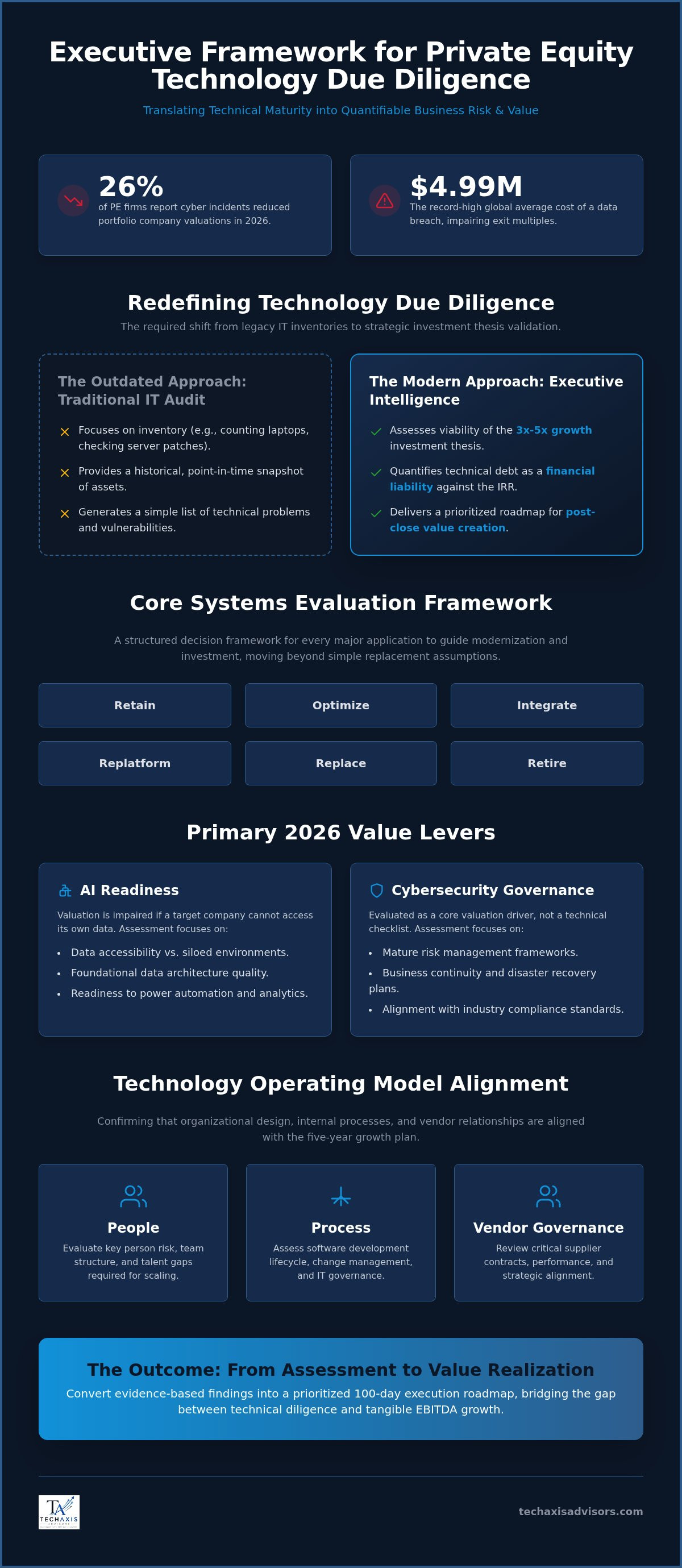
Technology due diligence is often misunderstood as a technical audit. In a private equity context, it's actually a strategic assessment of investment thesis viability. Traditional IT audits focus on inventory. They count laptops and check server patches. In 2026, these metrics are secondary. Investors need to understand if the target's technical architecture can sustain a 3x or 5x growth trajectory. Technical maturity is directly tied to EBITDA growth. A siloed data environment or a legacy monolith isn't just a technical hurdle; it's a drag on the exit multiple.
The 2026 landscape demands a shift in focus. With the global average cost of a data breach reaching a record $4.99 million this year, cybersecurity and AI readiness are now core valuation drivers. If a target company cannot access its own data to power automation, its valuation is impaired. Executive Intelligence focuses on the future state. It provides the clarity needed to determine if the technology is a growth engine or a hidden liability. A robust due diligence technology checklist for PE must prioritize these strategic outcomes over simple hardware inventories.
The Investment Thesis Alignment
Moving Beyond the Infrastructure Checklist
Modern diligence ignores laptop ages to focus on platform elasticity. We use a structured framework to evaluate core systems: retain, optimize, integrate, replatform, replace, or retire. This approach provides a clear path for every major application. It ensures that the Executive Technology Assessment delivers more than just a list of problems. It provides a roadmap for value creation. By focusing on how systems integrate and scale, investors gain confidence that the technology operating model supports the long-term exit strategy. This transition from audit to intelligence is what separates successful acquisitions from those burdened by technical drag.
The Core Systems Checklist: Scalability, Technical Debt, and Data Foundations
A comprehensive due diligence technology checklist for PE must prioritize the structural integrity of core business applications. Systems that function at current volumes often fracture when subjected to the rapid scaling required by a private equity investment thesis. We look for architectural bottlenecks that could prevent the company from handling increased transaction loads or entering new markets. This assessment moves beyond uptime statistics to evaluate the underlying mechanics of how software is built and maintained.
Infrastructure reliability is the baseline. Whether the company utilizes on-premise servers or a cloud-native approach, the focus remains on business continuity and the ability to recover from system failures without significant operational disruption. We evaluate the performance of these environments to ensure they don't become a drag on future growth or require immediate, unbudgeted capital outlays.
Software Architecture and Technical Debt
Technical debt is a deferred capital expenditure. It represents the cost of past shortcuts that must eventually be repaid to maintain operational stability. When reviewing a target, we evaluate the software architecture to determine if it's a rigid monolith or a modular system designed for scale. High technical debt often manifests as excessive key person risk, where a single developer holds the proprietary knowledge of the system's inner workings. Identifying these risks early allows investors to factor remediation costs into the deal model.
Investors should look for clear documentation and automated testing protocols that suggest a disciplined development culture. For a deeper dive into these metrics, see our guide on Assessing Technical Debt: A Guide for PE Investors. Quantifying these liabilities through a structured due diligence technology checklist for PE ensures that technical risks are translated into financial impacts.
Data Strategy and Reporting Frameworks
Data is either a strategic asset or a siloed liability. In wealth management and financial services, the ability to drive data-driven decisions is often hampered by fragmented data sources. We assess whether the organization has a single source of truth for its business intelligence or if it relies on manual, error-prone reconciliations. A modern data architecture is essential for transparency and reporting accuracy during the holding period. If you're concerned about the integrity of a target’s reporting, you might consider how a confidential executive conversation can help clarify the risks.
Data Quality: Are there automated validation rules to ensure accuracy?
Accessibility: Can leadership access real-time KPIs without manual intervention?
Governance: Is there a clear ownership structure for data privacy and security?
Modern data strategies in 2026 must also account for the accessibility of data for automated processes. If data is locked in siloed legacy systems, the company’s ability to leverage automation or advanced analytics is severely limited. This impairment can directly affect the exit multiple if not addressed early in the investment lifecycle.
The 2026 Value Levers: AI Readiness and Cybersecurity Governance
In 2026, AI and cybersecurity have transitioned from technical line items to primary valuation drivers. A modern due diligence technology checklist for PE must evaluate these areas through the lens of risk management and value creation. If a target company lacks a structured data environment, its AI potential is effectively zero. We focus on whether the organization has the data availability and talent to support the automation use cases defined in your investment thesis. This assessment determines if the company can drive the operational efficiency required to hit aggressive EBITDA targets.
Regulatory compliance is another critical factor. The EU AI Act reached a major implementation milestone on August 2, 2026, creating new obligations for high-risk systems. Failure to identify these gaps pre-close can lead to significant post-acquisition fines. We review the business case for automation to ensure it's grounded in practical application rather than speculative theory. This ensures that any planned technology spend is directly linked to measurable business outcomes.
Executive AI Readiness Assessment
Evaluating AI readiness starts with governance. We examine the target's policies regarding ethical use, data security, and intellectual property protection. A company’s "AI-native" potential depends on its ability to integrate automated workflows into its core products without compromising data integrity. This requires a disciplined look at the underlying architecture. For a deeper analysis of these requirements, review our AI in Financial Services: 2026 Strategic Framework. We assess if the current team can execute an AI roadmap or if significant talent acquisition will be necessary post-close.
Cybersecurity and Technology Risk
Cybersecurity is now a board-level governance issue. The NIST Cybersecurity Framework 2.0, published in 2024, introduced a dedicated "Govern" function that we prioritize during diligence. With the average cost of a data breach in the U.S. reaching $11.5 million in 2026, the financial stakes are absolute. We move beyond simple penetration testing to evaluate executive risk management and incident response maturity. A target company that takes the industry average of 247 days to identify and contain a breach represents a significant liability to the portfolio.
Compliance costs in regulated industries like wealth management can be substantial. We evaluate the target's adherence to SEC cybersecurity disclosure rules, which require reporting material incidents within four business days. Our due diligence technology checklist for PE includes a rigorous review of business continuity planning. We ensure the target can maintain operations during a disruption, protecting the exit multiple from the volatility of modern cyber threats. This disciplined approach replaces organizational anxiety with evidence-based confidence in the target's resilience.
The Technology Operating Model: People, Process, and Vendor Governance
A robust due diligence technology checklist for PE must look beyond the software to the engine room of the organization. The technology operating model defines how people, processes, and vendors interact to create value. If the organizational design is misaligned with the investment thesis, technical excellence won't matter. We evaluate whether the current team is structured for rapid growth or if it's merely maintaining a steady state. Execution risk often hides in the gaps between a visionary roadmap and a team that lacks the specialized skills to deliver it.
Assessing the execution risk of the current roadmap requires an objective look at past performance and future capacity. We analyze if previous milestones were met on time and within budget. This historical data provides a realistic view of what the team can achieve during the critical first 100 days post-close. By identifying these operational friction points before the deal is finalized, investors can establish the necessary governance structures to oversee a technology transformation.
Leadership and Talent Assessment
Strategic alignment between the CTO and the CEO is a primary indicator of future success. We assess if the technology leadership understands the business drivers behind the 5-year growth plan. Gaps in critical areas like DevOps, data science, or security can derail post-close initiatives. When these gaps exist, investors must decide if the current leadership can scale or if Fractional CTO Leadership is required to bridge the transition. This isn't just about headcount; it's about having the right executive oversight to ensure disciplined progress.
Vendor Management and Platform Governance
Third-party dependencies represent a significant risk to operational scalability. We evaluate vendor contracts for lock-in risks and scalability constraints that could inflate costs as the business expands. A comprehensive due diligence technology checklist for PE includes a review of SaaS spend and license optimization. Many growth-stage companies lack mature IT procurement processes, leading to redundant toolsets and wasted capital. We look for evidence of structured platform governance that ensures every vendor relationship is optimized for the company’s long-term objectives.
Executing the Post-Close Roadmap: From Assessment to Value Realization
The transition from diligence to value realization is the most vulnerable phase of the investment lifecycle. A well-executed due diligence technology checklist for PE provides the raw data; however, translating that data into EBITDA growth requires a disciplined 100-day roadmap. We prioritize findings based on their immediate impact on the investment thesis. This ensures that the most critical risks are addressed before they can impair operational stability. Establishing executive governance at the board level provides the oversight necessary to keep technology transformation on track without getting bogged down in granular technical details.
Value creation in technology is not a passive outcome. It requires defining specific KPIs that align with the 5-year growth plan. We track metrics such as technical debt reduction, vendor spend as a percentage of revenue, and the ROI of automation initiatives. These indicators provide the transparency needed to ensure that the technology operating model is evolving alongside the business. Fractional leadership often serves as the essential bridge during this phase, providing the senior expertise needed to guide the internal team through complex changes without the long-term commitment of a full-time hire.
The 100-Day Technology Action Register
The first phase of the roadmap focuses on remediation. We address high-risk security and stability gaps immediately to protect against the $11.5 million average cost of a data breach for U.S. organizations. Once stability is secured, we move to optimization. This involves a rigorous review of vendor contracts and SaaS spend to eliminate redundancies and free up capital for growth. The final step is initiating high-impact AI and data projects. These are not experimental pilots; they are targeted automation use cases designed to drive measurable efficiency gains within the first two quarters post-acquisition.
Ongoing Strategic Advisory and Governance
Private equity boards need independent technology counsel to maintain objectivity during a transformation. Internal teams often struggle to report on their own friction points, creating a visibility gap for the board. We use structured Executive Intelligence diagnostics for portfolio monitoring, providing a consistent framework across multiple investments. This evidence-based approach ensures that the technology roadmap remains aligned with the exit strategy. By understanding How TechAxis Works with Investors, you can establish a governance model that replaces organizational anxiety with a sense of controlled, disciplined progress. This ongoing oversight is what ultimately converts a technical assessment into realized enterprise value.
Securing the Investment Thesis Through Technical Clarity
Successful private equity investments in 2026 require a shift from basic technical inventory to strategic executive oversight. A comprehensive due diligence technology checklist for PE ensures that technical debt and architectural bottlenecks don't impair your long-term EBITDA targets. By prioritizing AI readiness and cybersecurity governance as core valuation drivers, you replace organizational anxiety with evidence-based confidence. This structured approach allows you to identify deal breakers early and factor remediation costs into your acquisition model.
Our advisors bring more than 25 years of executive technology experience to every engagement. We utilize a proprietary Executive Intelligence Platform to deliver structured diagnostics and board-ready findings. These assessments provide the clarity needed to bridge the gap between initial assessment and post-close value realization. This disciplined process ensures your technology operating model is fully aligned with the five-year growth plan, protecting your exit multiples from technical drag. We're ready to help you turn technical risk into a clear, prioritized roadmap for growth.
Frequently Asked Questions
What is the difference between a technical audit and technology due diligence?
A technical audit is a compliance-focused inventory, while technology due diligence is a strategic assessment of investment thesis viability. Audits check if systems are "on"; diligence checks if they're capable of scaling to support a five-year growth plan. We use a structured Executive Technology Assessment to move beyond simple server counts. It focuses on how technical maturity impacts EBITDA and future exit multiples.
How long does a comprehensive technology due diligence assessment typically take?
A standard engagement usually spans two to four weeks, depending on the complexity of the target's ecosystem. The process begins with a structured diagnostic phase followed by deep-dive interviews and data analysis. We prioritize speed without sacrificing depth by using a proprietary Executive Intelligence Platform. This timeline allows for the delivery of board-ready findings and a prioritized action register well before the final deal negotiations conclude.
What are the most common "deal-breaker" technology risks in mid-market acquisitions?
High-impact risks include severe technical debt, unmitigated cybersecurity vulnerabilities, and extreme key person risk within the development team. If a target's core platform requires a full replatforming to handle projected transaction volumes, the unbudgeted capital expenditure can break the deal model. A robust due diligence technology checklist for PE identifies these liabilities early. This ensures that hidden costs are factored into the acquisition price or remediation plan.
Should we replace legacy systems immediately after an acquisition?
Immediate replacement is rarely the only solution; we evaluate the business case for "retain, optimize, integrate, replatform, replace, or retire." Many legacy systems provide stable foundations that only require optimization or better integration to support growth. The decision depends on whether the system creates an operational bottleneck or security risk. We prioritize high-impact changes that drive value creation during the first 100 days post-close.
How does AI readiness impact the valuation of a growth-stage company?
AI readiness is a primary valuation lever because it dictates a company's future operational efficiency. If a target lacks structured data foundations or talent, its ability to leverage automation is impaired. In 2026, 47% of Limited Partners are monitoring how AI is adopted in portfolio operations. A company with high AI maturity often commands a higher exit multiple due to its scalability and data-driven decision-making capabilities.
Can technology due diligence help in price negotiations?
Yes, evidence-based findings provide significant leverage during deal negotiations. By quantifying technical debt and identifying unbudgeted capital requirements, investors can argue for a purchase price adjustment or an escrow holdback. Our structured assessments deliver an action register that translates technical risks into financial impacts. This transparency ensures that the buyer isn't overpaying for a target burdened by significant hidden operational liabilities.
What role does a fractional CTO play during the M&A lifecycle?
A fractional CTO provides strategic leadership from the pre-close assessment through the post-close integration. They bridge the gap between technical findings and executive execution, ensuring the roadmap is followed. This role offers board-level clarity and vendor oversight without the cost of a full-time hire. It isn't just about headcount; embedding senior expertise reduces execution risk and ensures the technology operating model supports the investment thesis.
How do we evaluate the technology operating model of a carve-out?
Evaluating a carve-out requires identifying which people, processes, and systems will remain and which must be built from scratch. We assess the execution risk of separating shared services and the cost of establishing independent vendor contracts. A due diligence technology checklist for PE is essential here to map out the transition services agreement. This ensures the new entity has a scalable operating foundation that is not dependent on the parent company.



Comments