

Business-Aligned Technology Strategy: An Executive Framework for 2026
With the average cost of a data breach in the United States reaching a record $10.22 million in 2026, the margin for technical error has effectively vanished. Most executives feel a growing disconnect between board-level objectives and the actual output of their technical teams. You've likely realized that technical debt isn't just an IT nuisance; it's a structural barrier to scaling and AI readiness. This friction creates a sense of organizational anxiety that often leads to reactive, rather than strategic, decision making.
This article provides a framework to bridge that gap through a business-aligned technology strategy that transforms technical execution into a predictable driver of value. You'll learn how to replace technical confusion with executive clarity, ensuring that every dollar of tech spending supports your long-term growth objectives. We'll examine an evidence-based roadmap that investors and boards can trust, focusing on how to reduce execution risk during periods of rapid expansion. By shifting from a reactive posture to a disciplined governance model, you can ensure your technology architecture finally matches your strategic intent.
Table of Contents
Defining Business-Aligned Technology Strategy for the Modern Executive
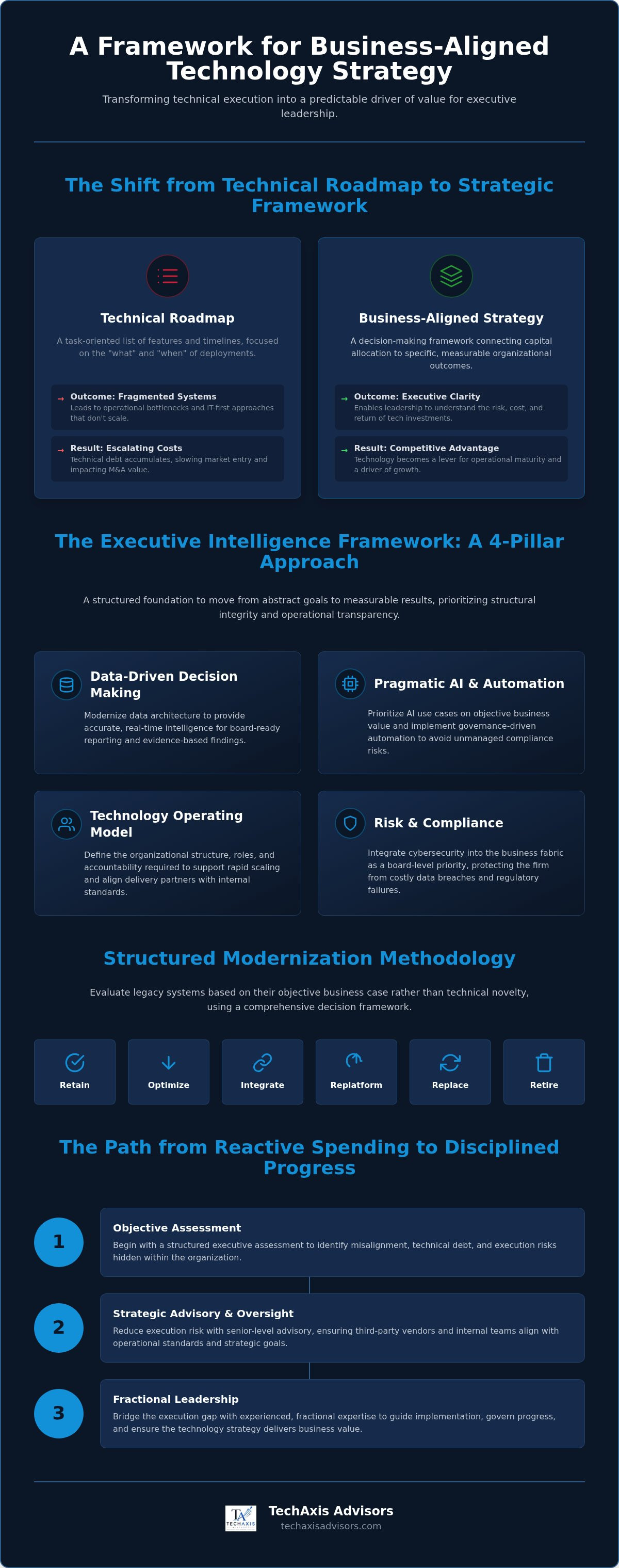
A technical roadmap is essentially a list of features and timelines. It tracks the "what" and "when" of software deployments and hardware upgrades. Conversely, a business-aligned technology strategy is a decision-making framework that connects capital allocation to specific organizational outcomes. It moves beyond simple task management to address the fundamental question of how technology supports the firm's growth trajectory and long-term stability.
For executives in wealth management and private equity-backed firms, traditional IT-first approaches often result in fragmented systems and escalating costs. These organizations require a higher standard of Corporate governance of information technology to ensure technical choices don't create operational bottlenecks. The primary output of this strategic alignment is executive clarity; the ability for leadership to understand the risk, cost, and return of every technical investment without getting lost in granular jargon.
The Shift from Cost Center to Growth Engine
Technology shouldn't be viewed as an unavoidable expense. It's a lever for operational maturity. When a CEO sets the "North Star" for the organization, technical investments must align with that vision to manage risk and increase throughput. Business-aligned technology strategy is the systematic application of technology to achieve specific strategic goals. This transition requires a shift in perspective where technical decisions are evaluated based on their contribution to the firm's competitive advantage rather than just their functional utility.
Identifying the Alignment Gap
Misalignment often manifests as a widening gap between board expectations and technical output. You might notice that your tech stack feels increasingly rigid, or that technical debt is slowing down your ability to enter new markets. This drift isn't just an internal friction point; it significantly impacts M&A value and investor confidence. A lack of strategic oversight allows for the accumulation of legacy systems that no longer serve the current business model. Without a structured assessment, these inefficiencies remain hidden until they become critical failures during a rapid growth phase.
The Executive Intelligence Framework: A 4-Pillar Approach
A business-aligned technology strategy needs a structured foundation to move from abstract goals to measurable results. We utilize a four-pillar framework designed to provide the oversight required for scaling growth-stage firms. This framework prioritizes structural integrity and operational transparency over technical novelty.
Data-Driven Decision Making at the C-Suite Level
Leadership can't operate effectively without accurate, real-time intelligence. Modernizing your data architecture is the first step toward board-ready reporting. When data remains siloed, manual reporting overhead increases and the risk of error grows. A centralized data foundation ensures that the CEO and CFO are looking at the same evidence-based findings. For those in specialized sectors, our Data Strategy for Asset Managers provides a deeper look at industry-specific reporting requirements. Reliable data isn't just a convenience; it's a prerequisite for operational maturity.
Pragmatic AI Readiness and Automation
In 2026, 76% of CIOs expect to deploy agentic AI into production. However, successful implementation requires moving beyond the noise. We use a structured Executive AI Readiness Assessment to prioritize use cases based on their objective business value. In regulated finance and wealth management, governance-driven AI is the only defensible path forward. This approach ensures that automation doesn't introduce unmanaged risks or compliance failures. By focusing on high-impact areas, you can capture efficiency gains without compromising the firm’s regulatory standing.
The remaining pillars focus on the mechanics of delivery and protection. The Technology Operating Model defines the organizational structure needed to support rapid scaling. It clarifies accountability and ensures that your internal teams or delivery partners are aligned with your standards. Finally, Risk and Compliance integrates cybersecurity into the business fabric. With the average cost of a U.S. data breach reaching $10.22 million in 2026, security is no longer an IT concern; it's a board-level risk. If you're uncertain about how these pillars apply to your current structure, you can start with a confidential executive conversation to identify your primary gaps.
Modernization Tradeoffs: Retain, Optimize, or Replace?
Modernization is often misconstrued as a binary choice between total replacement or stagnation. A disciplined business-aligned technology strategy rejects this premise. Instead, it treats every technical asset as a financial instrument with a specific lifecycle. You must evaluate the business case for each path: retain, optimize, integrate, replatform, replace, or retire. Defaulting to replacement is frequently an expensive mistake that ignores the value of stable, albeit older, infrastructure.
Retaining a legacy system is often the most pragmatic choice if it remains secure and performs its core function. Conversely, retirement is necessary when a system no longer supports your strategic objectives. Between these extremes, optimization and integration offer a middle ground. You can often extend the life of core assets by adding modern API layers. This allows older systems to communicate with newer automation tools without the disruption of a full migration. Replacement should be reserved for instances where technical debt becomes a hard barrier to scaling or creates unacceptable regulatory risk.
Assessing Technical Debt in Acquisitions
In the context of M&A, technical debt is a hidden liability that can significantly erode transaction value. Fragmented systems and "dirty" data often hide behind a functional user interface. Using an evidence-based Technology Due Diligence for Growth-Stage Companies framework allows investors to quantify these risks before closing. This assessment ensures that the true cost of post-merger integration is understood and factored into the valuation. Protecting investor value requires looking past the software demos to the underlying structural integrity of the target firm's tech stack.
The ROI of Operational Scalability
Operational scalability isn't just about hiring more people to manage manual tasks. It's about refining your operating model to handle increased volume without a linear increase in headcount. Manual workarounds carry a heavy long-term cost in terms of human error and lost productivity. Calculating the ROI of modernization requires comparing these recurring costs against the one-time investment in automated workflows. Fractional CTO leadership provides the senior oversight needed to manage these complex projects. This leadership ensures that technical teams prioritize structural integrity over short-term fixes, creating a foundation that supports rapid growth without increasing execution risk.
Mitigating Execution Risk in Growth-Stage Environments
Execution risk is the primary threat to a business-aligned technology strategy during rapid expansion. Many growth-stage firms attempt to solve complex architectural challenges using generalist staff or junior-level resources. This often leads to fragmented systems that fail under the pressure of increased volume. Access to veteran leadership is not a luxury; it's a structural requirement for maintaining delivery standards. Senior advisors bring the experience necessary to anticipate scaling bottlenecks before they impact your bottom line. They provide the steady hand required to navigate technical debt while maintaining the pace of innovation.
Technology Governance for Financial Services
In regulated sectors like wealth management and lending, governance is a core business function. You must meet stringent compliance and risk requirements that typical IT departments aren't equipped to manage. A fractional CISO can provide the necessary cybersecurity oversight without the expense of a full-time executive hire. This role ensures your risk profile remains within board-approved limits while you focus on client acquisition and market expansion. You can explore our framework for improving operational maturity through technology to see how governance supports long-term stability.
Vendor Management Strategy for Leadership
Strategic partnerships must replace the traditional "outsourced IT" model. Vendors should be treated as extensions of your internal team, held to the same standards of accountability and transparency. Establishing clear SLAs and performance metrics is the only way to ensure your partners are delivering on their promises. Effective vendor oversight directly impacts the bottom line by identifying and eliminating platform sprawl. Without this discipline, organizations often find themselves paying for redundant software licenses and underutilized services that offer no strategic value.
Building a scalable operating foundation allows your firm to survive rapid headcount growth without losing operational control. This foundation relies on structured governance and rigorous vendor oversight to create a predictable delivery environment. By implementing these controls, you ensure that technical execution remains strictly aligned with the board's strategic intent. A business-aligned technology strategy reduces the friction that typically accompanies growth, allowing for a smoother transition from a mid-market firm to a market leader.
The Path Forward: From Assessment to Fractional Leadership
Strategic progress cannot rely on assumptions. Every successful business-aligned technology strategy begins with an objective, evidence-based assessment. This "Diagnostic-First" approach replaces organizational guesswork with structured executive intelligence. By conducting an executive decision-support engagement, leadership gains a clear view of technical debt, security gaps, and operational bottlenecks. This provides the necessary baseline for building board-ready roadmaps and action registers that investors can trust. These deliverables synthesize complex data into prioritized findings, allowing the board to make informed capital allocation decisions without getting bogged down in technical minutiae.
Advisory alone is often insufficient for growth-stage firms facing complex transitions. Fractional executive leadership bridges the gap between high-level strategy and technical execution. Unlike traditional consulting models that offer advice from the sidelines, a fractional partner operates within your organization to provide senior-level oversight. This ensures that your delivery partners and internal teams remain focused on the mechanics of scaling. It's about having a veteran executive who is deeply invested in the mechanics of your success without the full-time cost of a permanent hire. This model provides the necessary leadership bridge that a growing company might be missing during periods of intense transformation.
When to Engage a Fractional CTO
Identifying the right time for senior intervention is critical for maintaining growth momentum. You should consider when a growth company needs a fractional CTO based on specific organizational indicators. Signs that you've outgrown your current leadership include persistent delivery delays, a lack of technical transparency at the board level, or anxiety over AI readiness and data security. Embedded, senior-level guidance provides the structural integrity required during periods of intense change, such as M&A integration or rapid operational scaling. These advisors bring the wisdom of veteran executives to bring order to chaos and ensure your technical architecture finally matches your strategic intent.
Conclusion: Confidence in Technology Decisions
The transition from reactive IT management to a proactive, business-aligned technology strategy is a fundamental shift in operational maturity. It requires moving away from "gut feeling" decisions toward evidence-based findings that prioritize long-term value and risk mitigation. By implementing a structured framework, you replace technical confusion with executive clarity. This disciplined approach ensures that your technology architecture finally serves as a reliable engine for growth. You can explore TechAxis Advisors' Advisory Leadership and full range of Services to determine how to align your technical assets with your strategic intent. Start with a confidential executive conversation to explore whether your priority requires a structured Executive Intelligence Assessment, strategic advisory, or fractional leadership.
Securing Operational Maturity through Strategic Technical Oversight
Achieving a business-aligned technology strategy isn't a one-time project; it's a commitment to continuous alignment between your capital investments and your growth objectives. You've explored how a structured framework replaces organizational anxiety with executive clarity. By prioritizing evidence-based assessments over gut feelings, you ensure that your technical roadmap supports scaling rather than creating bottlenecks. This transition requires a disciplined focus on governance, data integrity, and pragmatic AI readiness.
Our team consists of veteran advisors who've served as CIOs, CTOs, and CISOs in high-stakes environments. We use our proprietary Executive Intelligence Platform to provide the data-driven insights your board requires for informed decision-making. As a certified WOSB and NJ MWBE/SBE, we're dedicated to providing the senior-level leadership that growth-stage firms often miss. It's time to move past reactive IT spending and build a foundation that investors and boards can trust. You can reclaim control over your technical direction and focus on the mechanics of your success.
The path toward a more mature operating model is within reach. We're ready to help you bridge the gap between advisory and execution with the steady hand of an experienced partner.
Frequently Asked Questions
What is the difference between a technology strategy and an IT roadmap?
A technology strategy defines the business case for investments by aligning technical assets with organizational goals. In contrast, an IT roadmap is a tactical schedule of specific software deployments and hardware upgrades. A business-aligned technology strategy ensures that every technical decision supports a board-level objective. While a roadmap tracks timelines, a strategy evaluates risk, cost, and ROI, providing the executive clarity required to turn technology into a growth engine rather than a cost center.
How often should a growth-stage company refresh its technology strategy?
Growth-stage companies should perform a comprehensive strategy refresh annually, with quarterly reviews to adjust for market shifts. Rapid headcount growth or M&A activity often necessitates more frequent updates to ensure the operating model remains scalable. As business objectives evolve, your technical infrastructure must keep pace. A stagnant strategy leads to unmanaged technical debt and operational bottlenecks. Regular assessments through an Executive Intelligence Platform provide the data-driven insights needed to maintain alignment during periods of intense transformation.
Can a Fractional CTO help with AI readiness assessments?
A Fractional CTO is specifically equipped to lead an Executive AI Readiness Assessment. They move beyond the noise of speculative automation to identify high-impact use cases that align with your risk tolerance. By evaluating your data architecture and governance protocols, a fractional leader ensures that AI implementation meets the compliance requirements of regulated industries. This senior-level oversight helps leadership teams avoid the hype cycle while building a defensible foundation for pragmatic, regulated automation.
What are the common pitfalls of a business-aligned technology strategy?
The most frequent pitfall is adopting an "IT-first" approach that prioritizes technical novelty over business value. Other common errors include ignoring the long-term costs of technical debt and failing to establish clear accountability for vendor performance. Misalignment often occurs when technical teams operate in a vacuum without board-level oversight. Without a structured business-aligned technology strategy, organizations suffer from platform sprawl and fragmented data, which ultimately erodes investor confidence and slows down operational scaling.
How do I justify technology strategy costs to a board or private equity firm?
Justification should focus on risk mitigation and the protection of investor value. Highlighting the record high $10.22 million average cost of a U.S. data breach in 2026 demonstrates the financial necessity of robust governance. Additionally, you should frame strategy costs as an investment in operational scalability. Quantifying how automated workflows reduce manual reporting overhead provides a clear ROI. Evidence-based findings from an Executive Intelligence Assessment offer the transparency boards require to approve capital allocation for technology.
Is a full-time CTO always necessary for implementing a technology strategy?
A full-time CTO is not always necessary, especially for growth-stage or mid-market firms. The fractional executive leadership model provides access to veteran expertise without the six-figure salary and equity requirements of a permanent hire. This approach allows organizations to gain senior-level guidance for specific transformation projects or governance initiatives. It bridges the leadership gap during periods of change, ensuring technical execution remains aligned with business goals until the organization reaches a scale that justifies a full-time executive.
What role does data strategy play in overall business alignment?
Data strategy is the foundation of overall business alignment. It ensures that leadership has access to accurate, real-time intelligence for board-ready reporting. Without a centralized data architecture, decision-making relies on "gut feelings" rather than verifiable facts. A structured data strategy also prepares the organization for AI adoption by ensuring information is clean, accessible, and secure. It reduces the manual effort required for intelligence synthesis, allowing the C-suite to focus on strategic execution rather than data reconciliation.
How do I manage cybersecurity risk within a business-aligned framework?
Cybersecurity risk is managed through an integrated governance framework rather than just technical tool implementation. By conducting an Executive Cybersecurity and Technology Risk Assessment, you align security protocols with your organization's specific risk tolerance. This approach ensures that protection measures are woven into the business fabric, meeting the compliance needs of wealth management and lending. A strategic framework treats security as a board-level risk, prioritizing structural integrity and vendor oversight to defend against evolving threats.



Comments