

Portfolio Company Technology Assessment: An Executive Guide to Operational Maturity
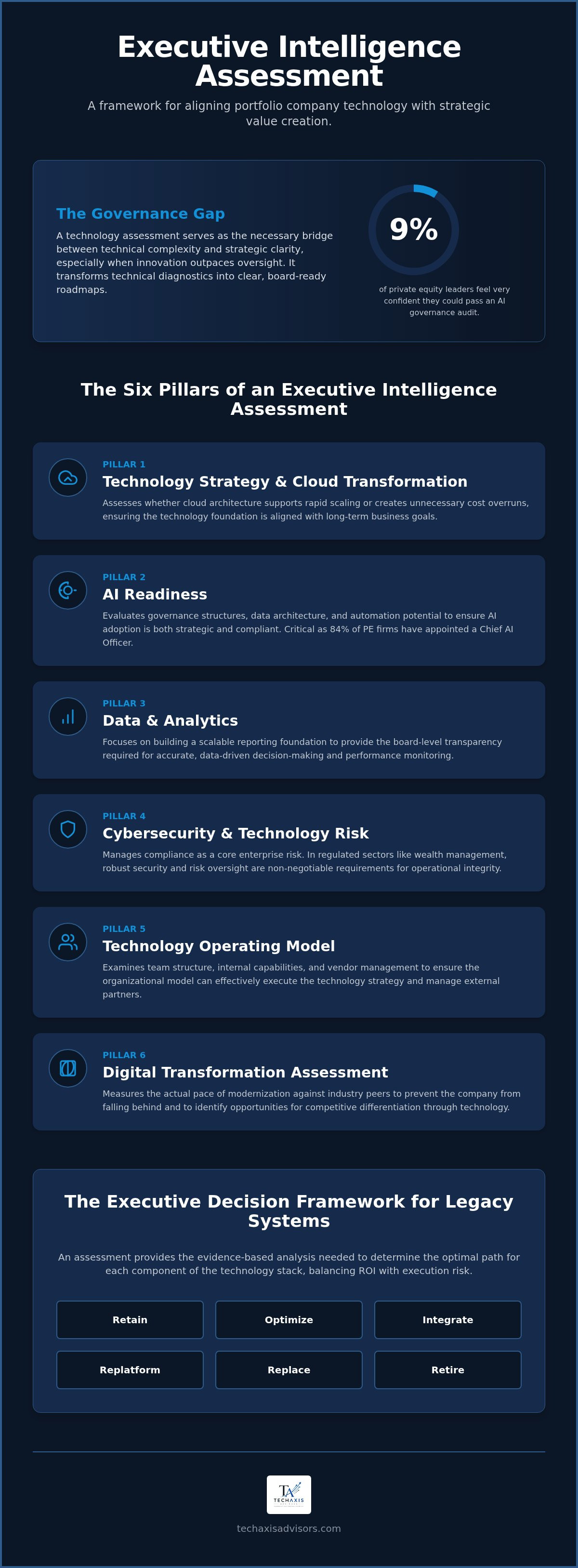
Only 9% of private equity leaders feel very confident they could pass an AI governance audit within 90 days. This data point from Grant Thornton underscores a significant gap between the pace of innovation and the reality of executive oversight. You likely recognize that technology should serve as a primary engine for value creation, yet it often manifests as a fragmented liability that obscures true operational health. A rigorous portfolio company technology assessment serves as the necessary bridge between technical complexity and strategic clarity.
It's common to feel that technology spend isn't consistently aligned with business outcomes, especially when technical debt complicates valuation. This guide will show you how to transform technical diagnostics into clear, board-ready roadmaps that reduce execution risk. We'll examine how to validate AI readiness and build a prioritized investment strategy that supports scalable growth and maximizes portfolio value.
Table of Contents
The Strategic Role of Portfolio Company Technology Assessment
A portfolio company technology assessment is often misunderstood as a routine technical audit. In reality, it functions as a high-level executive diagnostic designed to align a firm's digital infrastructure with its long-term investment strategy. While traditional audits focus on a binary "pass or fail" mentality regarding security or software versions, an executive assessment evaluates operational maturity. It provides the necessary transparency to ensure that technology serves as a growth catalyst rather than a hidden bottleneck during the holding period.
The shift from pre-acquisition due diligence to ongoing operational monitoring is a response to longer holding periods. According to PitchBook, the median hold period for portfolio companies reached six years by 2025. This extended timeline requires a continuous focus on Technology Assessment to prevent technical debt from eroding margins for the private equity-backed organizations that need this oversight most. There are typically three primary triggers for this engagement: rapid scaling that outpaces existing systems, the strategic mandate for AI adoption, or the urgent need for platform modernization. Each scenario demands a clear understanding of the current state to avoid costly missteps.
Moving Beyond the Traditional Technical Audit
Generic IT audits frequently fail to provide the executive clarity required by a board of directors. These audits often produce dense technical reports that lack business context. In contrast, an executive decision-support engagement translates technical findings into strategic roadmaps. It aligns technology spend with the firm's specific risk tolerance and business objectives. This approach replaces organizational confusion with a disciplined framework for progress, ensuring that leadership understands the trade-offs involved in every major investment. Boards don't need more data; they need actionable intelligence that supports governance and oversight.
Identifying the Cost of Inaction
Ignoring technical debt has a direct, negative impact on exit valuation and operational efficiency. When technology stacks remain fragmented, leadership loses the ability to perform accurate, board-level reporting. This lack of transparency prevents data-driven decision-making and creates friction during periods of rapid growth. Technical debt isn't just an IT issue; it's a financial liability that compounds over time. Technical execution risk is the gap between strategic intent and technical delivery. Addressing this gap early ensures that the company remains attractive to future buyers and capable of sustaining its growth trajectory without the weight of legacy constraints.
The Six Pillars of an Executive Intelligence Assessment
The TechAxis Executive Intelligence Platform provides the structural foundation for a portfolio company technology assessment. It transitions the diagnostic process from subjective opinion to evidence-based findings. By utilizing a consistent methodology, we ensure that every finding is grounded in data rather than anecdotal evidence. This platform categorizes organizational health across six distinct pillars to ensure no blind spots remain during periods of intense growth.
Pillar 1 focuses on Technology Strategy and Cloud Transformation maturity. We assess whether the cloud architecture supports rapid scaling or creates unnecessary cost overruns. Pillar 2 evaluates AI Readiness. This includes a deep dive into governance and automation potential, which is critical as 84% of private equity firms have already appointed a Chief AI Officer. Pillar 3 addresses Data & Analytics. A scalable reporting foundation is essential for board-level transparency. Pillar 4 covers Cybersecurity & Technology Risk. In regulated sectors like wealth management, compliance isn't optional; it's a core enterprise risk that requires constant oversight.
Operating Models and Digital Transformation
Pillar 5 examines the Technology Operating Model. We evaluate team structure and vendor management to ensure that internal capabilities align with external service providers. Pillar 6 is the Digital Transformation Assessment. This measures the actual pace of modernization to ensure the company doesn't fall behind its peers. A holistic view across all six pillars is required. Without this breadth, leadership risks solving a technical problem while ignoring the underlying operational friction that caused it. You can explore how these executive decision-support engagements provide the clarity your board requires.
Evidence-Based Deliverables for the Board
The primary output of this process is a prioritized roadmap. These roadmaps are vital for successful digital deals as they translate complex needs into sequenceable projects. Action registers provide additional accountability for leadership teams. They document specific owners and timelines for every recommendation. This structured approach effectively links earlier technology due diligence to the broader assessment portfolio. It ensures that the insights gathered during the deal phase aren't lost but are instead converted into a functional plan for value creation.
Evaluating AI Readiness and Data Architecture for Scalable Growth
AI adoption in private equity has reached a critical inflection point. By 2026, two-thirds of firms expect to invest over a quarter of their budget in AI. However, for a portfolio company technology assessment to be effective, it must treat AI as a core governance issue rather than a standalone technical experiment. This is especially true in financial services; where regulations like the Texas Responsible AI Governance Act and CCPA requirements, effective as of January 1, 2026, mandate rigorous oversight of automated decision-making systems.
Effective automation readiness depends entirely on the maturity of the underlying data architecture. Many growth-stage companies struggle with fragmented data that prevents accurate board-level reporting. We evaluate the path from raw data collection to informed, data-driven decision-making. High-impact AI use cases only deliver value when they align with existing operational maturity goals. Without clean data foundations, even the most sophisticated AI tools will produce unreliable results, increasing technical execution risk.
Building a Pragmatic AI Roadmap
Avoiding the hype cycle requires a commitment to evidence-based AI applications. We focus on practical automation that solves specific operational bottlenecks. Implementing AI governance frameworks is essential for regulated entities to manage risk while pursuing innovation. This involves evaluating vendor and platform management to ensure third-party tools meet your security standards. As outlined in the modern M&A Playbook, failing to address these technical foundations early often leads to integration failures and value erosion.
Modernizing Data Reporting Frameworks
Asset managers increasingly use sophisticated data architecture to drive competitive advantage. Modernizing legacy data systems allows these firms to support real-time business intelligence, replacing manual spreadsheets with automated dashboards. This transition requires a scalable data foundation. A scalable data foundation is an architecture that supports growth without exponential cost. By assessing data maturity through a structured portfolio company technology assessment, we help leadership teams identify where legacy constraints hinder the pace of modernization and where targeted investment will yield the highest return.
The Executive Decision Framework: Retain, Optimize, or Replace?
A portfolio company technology assessment must provide more than just a list of technical vulnerabilities. It should offer a clear decision framework for modernization that aligns with the investment lifecycle. Executives need a structured approach to evaluate legacy systems beyond the binary choice of keeping or discarding them. This framework categorizes every major system into one of six strategic options: Retain, Optimize, Integrate, Replatform, Replace, or Retire.
Every option carries a different profile for ROI and risk. Retaining a system might be the correct business decision if the cost of replacement outweighs the potential efficiency gains. Conversely, retiring redundant platforms can immediately reduce licensing costs and simplify the technical landscape. A structured portfolio company technology assessment provides the evidence needed to make these difficult calls. It balances the urgent need to reduce technical debt with the requirement for continuous operational execution. Leadership must ensure that modernization efforts do not stall the very growth they are intended to support.
Analyzing Tradeoffs and Execution Risk
Replacement is a high-stakes endeavor. It often requires a multi-year commitment and carries a significant risk of operational disruption. Executives should prioritize the optimization path when existing systems still meet core business requirements but lack modern connectivity or performance. Optimization allows a firm to extract more value from previous investments without the upheaval of a total system overhaul. Managing the transition period requires a disciplined approach to vendor oversight and internal change management. The goal is to minimize friction while moving toward a more mature operational state.
Vendor and Platform Selection Criteria
Vendor selection should be an evidence-based exercise rather than a reaction to marketing trends. Platform choices must align with the long-term technology strategy defined during the assessment process. The decision to buy a commercial solution or build a custom application depends heavily on how a firm is improving operational maturity through its technology stack. If a specific function provides a unique competitive advantage, custom development might be justified. For standard back-office operations, a proven vendor platform is usually the more pragmatic choice. This alignment ensures that every dollar spent on technology directly supports the mechanics of scaling.
Beyond the Diagnostic: Turning Assessments into Value Creation
The completion of a portfolio company technology assessment marks the beginning of the value creation phase, not its conclusion. While many consulting firms deliver a report and exit, this diagnostic only provides the baseline for improvement. True operational maturity requires a transition from identification to mastery. This shift demands a disciplined approach to execution that bridges the gap between high-level advisory and daily technical operations. Without active leadership, even the most detailed roadmap risks becoming a collection of unmet objectives.
Ongoing strategic counsel ensures that technology investments remain aligned with the firm's growth trajectory. As market conditions shift or new regulations emerge, the roadmap must adapt without losing its core focus on structural integrity. This continuous alignment prevents the accumulation of new technical debt and ensures that the mechanics of scaling remain efficient. It replaces organizational anxiety with a sense of controlled, disciplined progress. We focus on the practical application of strategy to ensure that every technical decision supports a tangible business outcome.
Embedded Executive Leadership
Growth-stage companies often lack the senior-level technical leadership required to oversee complex transformations. Utilizing fractional CTO services allows a firm to access veteran expertise without the cost of a full-time executive hire. This model ensures continuity from the assessment phase through to transformation delivery. An embedded leader provides the necessary governance to manage delivery partners and ensure that technical execution matches the board's strategic intent. They serve as a trusted advisor who brings order to technical chaos.
Measuring Operational Performance Post-Assessment
Accountability is maintained through the establishment of specific KPIs that track the progress of the technology roadmap. Quarterly executive reviews serve as a critical checkpoint to maintain alignment between technology spend and business outcomes. These reviews allow the board to evaluate progress against the prioritized action register and adjust priorities as needed. We support this execution through rigorous vendor oversight and governance. This structured approach ensures that every modernization project remains on schedule and within the defined risk parameters, protecting the investment's long-term value.
Aligning Operational Maturity with Investment Strategy
A structured portfolio company technology assessment replaces technical uncertainty with executive clarity. It transforms fragmented data and legacy constraints into prioritized, board-ready roadmaps. By focusing on the six pillars of operational maturity, leadership teams ensure their digital infrastructure supports rapid growth rather than hindering it. It's not just about identifying technical risks; it's about defining a pragmatic path toward sustainable value creation. Our advisors are former CIOs, CTOs, and CISOs who bring veteran experience to every engagement. We utilize our proprietary Executive Intelligence Platform to provide evidence-based findings specifically tailored for regulated financial services and wealth management environments.
Scaling a business requires a disciplined approach to both strategy and execution. When technology aligns with your long-term investment goals, it becomes a predictable engine for progress. You don't have to navigate these complexities without a seasoned partner who understands the mechanics of your industry.
Frequently Asked Questions
What is the difference between a technology assessment and an IT audit?
A portfolio company technology assessment is an executive decision-support engagement focused on strategic alignment and operational maturity. Traditional IT audits typically function as binary evaluations of security controls or software versions. While audits identify technical gaps, our assessments translate complex technology ecosystems into board-ready roadmaps. This approach provides the executive clarity needed to align technology investments with long-term business outcomes and investment lifecycles.
How long does a typical portfolio company technology assessment take?
The timeline for an engagement is determined by the scope of the six pillars and the complexity of the portfolio. We follow a consistent workflow that begins with a structured diagnostic and moves through intelligence synthesis to a strategic roadmap. This methodical pace respects the cognitive load of leadership while ensuring comprehensive coverage. Every assessment concludes with board-ready deliverables, including an action register and a presentation deck tailored for executive review.
Do you perform the actual software implementation or cloud migration?
TechAxis Advisors supports execution through advisory leadership, governance, and vendor oversight rather than performing direct cloud migrations. We provide custom software development and implementation services through a specialized white-label partnership model. This structure allows us to maintain objective executive guidance while ensuring delivery partners meet specific business requirements. We serve as the leadership bridge that ensures technical delivery matches your strategic intent and operational goals.
Why should a financial services firm prioritize an AI readiness assessment now?
Financial services firms face an intensifying regulatory environment regarding AI governance and automated decision-making. Laws like the Texas Responsible AI Governance Act and CCPA requirements, effective as of January 1, 2026, mandate rigorous oversight. An assessment identifies high-impact use cases while ensuring your AI strategy meets compliance requirements. 100% of Limited Partners report using generative AI tools to evaluate General Partners, making technical sophistication a core requirement for successful fundraising.
How do you handle technical debt in growth-stage acquisitions?
We address technical debt by evaluating the business case for every legacy system through a structured decision framework. We don't assume replacement is the only solution; instead, we analyze whether to retain, optimize, integrate, replatform, replace, or retire. A portfolio company technology assessment provides the evidence-based methodology needed to balance debt reduction with continuous operational execution. The goal is to maximize exit valuation while ensuring the digital infrastructure supports rapid growth.
Can a fractional CTO help implement the findings of an assessment?
Fractional CTO leadership provides the execution and governance necessary to turn assessment findings into tangible results. These embedded executives offer senior-level guidance to manage transformation delivery without the expense of a full-time hire. They oversee the prioritized roadmap and manage vendor relationships to ensure accountability. This continuity ensures that the insights gathered during the diagnostic phase are successfully converted into operational maturity and long-term value creation.
What industries do you specialize in for technology advisory?
Our firm specializes in regulated and complex enterprise environments, with a primary focus on wealth management and financial services. We also partner with growth-stage companies in the lending, retail, and asset management sectors. Our advisors are former CIOs, CTOs, and CISOs with more than 25 years of experience in these fields. This specialized expertise allows us to provide guidance that respects the unique risk tolerance and compliance needs of your industry.
How does the Executive Intelligence Platform improve assessment accuracy?
The proprietary TechAxis Executive Intelligence Platform ensures that findings are objective, repeatable, and data-driven. It serves as the foundation for our evidence-based methodology, replacing subjective consulting opinions with structured diagnostics across six pillars. The platform categorizes organizational health to provide a holistic view of the technology stack. This structured approach produces artifacts focused on clarity and accountability, ensuring that every recommendation is traceable to a specific operational need.



Comments