

Strategic Technology Planning for CEOs: A 2026 Executive Framework
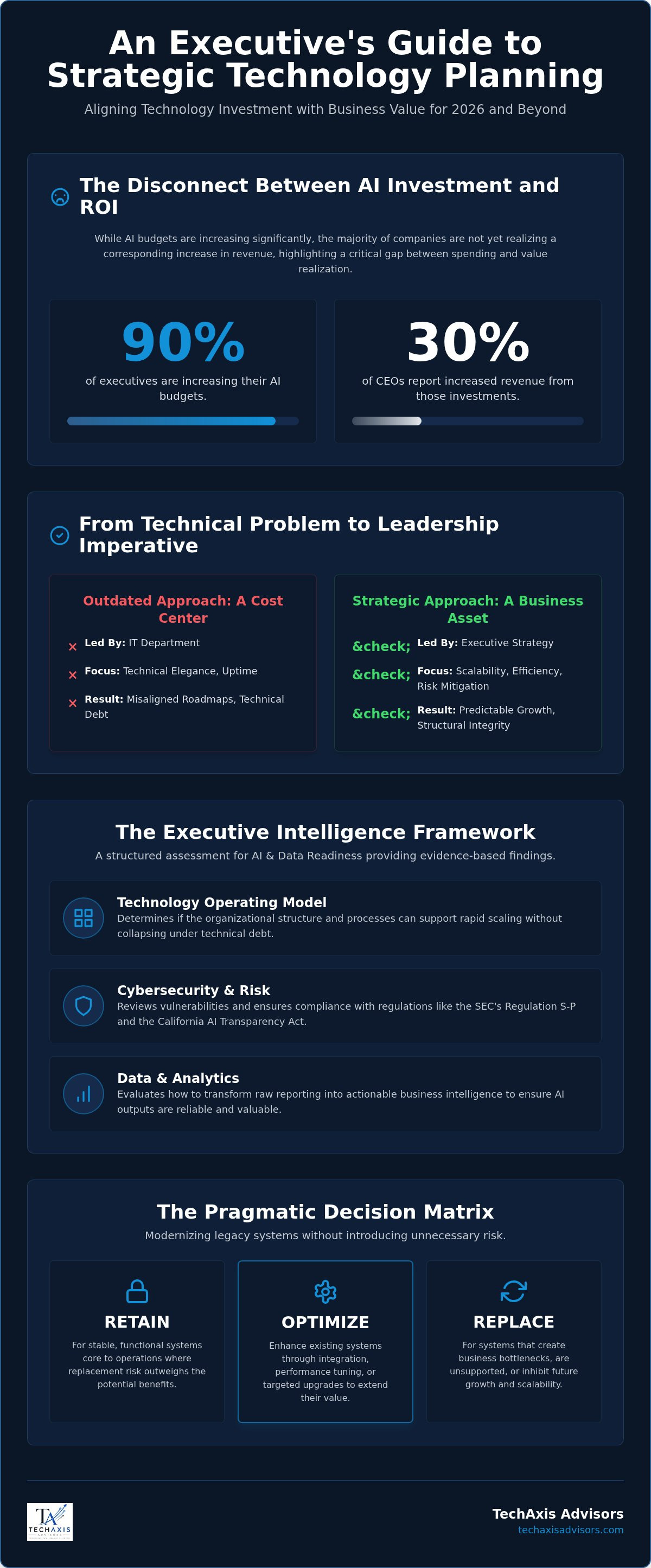
While nine out of ten executives are increasing their AI budgets this year, only 30% of CEOs report that these investments have led to increased revenue over the last 12 months. This gap highlights why strategic technology planning for CEOs has become a top-three strategic priority, now ranking just behind growth and finance. You likely recognize that your current IT spend doesn't always translate into the operational scale or competitive advantage you expected. It's frustrating when technical debt and misaligned roadmaps create organizational anxiety instead of progress.
Effective planning is no longer about chasing the latest trend. It's about disciplined governance and structural integrity. This guide provides an evidence-based framework to help you align technology investments with your business objectives while reducing execution risk. We'll explore how to navigate the 2026 regulatory environment, including the California AI Transparency Act and updated SEC safeguards, to provide your board with the decision support they require. By moving from experimentation to value realization, you can transform your technology stack into a predictable engine for growth.
Table of Contents
The Business Case for Executive-Led Technology Strategy
Technology planning fails when CEOs treat it as a technical problem rather than a leadership one. When strategy is delegated solely to IT departments, the resulting roadmap often prioritizes technical elegance or "uptime" over commercial viability. This misalignment creates a disconnect between IT spend and business ROI. In 2026, technology is no longer a support function. It's the business itself. For growth-stage organizations, the shift from viewing technology as a cost center to treating it as a strategic asset is mandatory for survival.
Executive Clarity is the antidote to the organizational anxiety caused by rapid technical change. In the context of 2026 market volatility, this clarity means having a precise understanding of how every technical investment supports a specific business outcome. It requires a robust technology strategy that moves beyond technical checklists to focus on structural integrity. The CEO's role isn't to understand the code; it's to set the risk tolerance for AI adoption and data initiatives. You must decide where the organization will lead and where it will wait, ensuring that technical risk doesn't outpace your operational capacity.
Bridging the Gap Between Strategy and Execution
Growth-stage technology operating models often break down during periods of rapid scaling. Common failure points include fragmented data silos, aging legacy systems, and a lack of governance. These issues aren't just IT headaches. They're business bottlenecks that prevent you from responding to market shifts. To fix them, you need evidence-based findings rather than anecdotal reports from internal teams who may be too close to the problems to see the solutions clearly. This level of objective oversight is essential for the specialized needs of the financial services and private equity firms Who TechAxis serves.
Moving Beyond Generic Consulting Jargon
Hype-driven planning is the fastest way to accumulate technical debt. When organizations chase trends without a structured framework, they end up with a "frankenstein" stack of incompatible tools. Real strategic technology planning for CEOs ignores the marketing noise and focuses on three core metrics: scalability, efficiency, and risk mitigation. It's about building a foundation that can support your five-year vision without requiring a total overhaul in year three. Strategic technology planning for CEOs is a disciplined risk-management exercise designed to protect the organization's operating foundation while enabling scalable growth. By focusing on these fundamentals, you replace confusion with a controlled, professional roadmap for execution.
The Executive Intelligence Framework: Assessing AI and Data Readiness
In 2026, AI is no longer a pilot project. It's a core operational requirement for firms in wealth management and private equity. However, a successful AI strategy is impossible without a disciplined data foundation. Strategic technology planning for CEOs must begin with a structured Executive AI Readiness Assessment to ensure your reporting architecture can actually support automation. If your data is fragmented, your AI outputs will be unreliable. Technical teams often focus on "uptime," but executives need to focus on "outcomes."
The Core Domains of Executive Assessment
A professional Executive Intelligence Assessment evaluates three critical domains to provide a clear picture of your current state. First, the Technology Operating Model determines if your organizational structure can support rapid scaling without collapsing under technical debt. Second, Cybersecurity and Risk reviews vulnerabilities without the typical technical fluff. This includes ensuring compliance with the SEC’s June 2026 Regulation S-P deadline and the four-day materiality disclosure rule. Finally, Data and Analytics evaluates how to transform raw reporting into actionable business intelligence. These domains provide the structural integrity needed to meet modern standards like the California AI Transparency Act (CAITA). This level of scrutiny ensures that your strategy remains defensible during a board review or a private equity exit.
Evidence-Based Decision Support
Moving from "gut feel" to a data-driven roadmap requires an objective, third-party perspective. This process mirrors the government framework for IT strategic planning, which emphasizes performance measurement and disciplined investment over speculative spending. By using a proprietary intelligence platform, you can generate findings that justify your budget to stakeholders and investors. This evidence-based approach is a hallmark of high-level Executive Advisory services. It replaces organizational anxiety with a sense of controlled, disciplined progress.
Investors and board members increasingly demand this level of transparency. They don't want technical audits; they want decision support that highlights tradeoffs and ROI. If you're unsure where your current infrastructure stands, you might start with a confidential executive conversation to define your assessment priorities. Strategic technology planning for CEOs replaces technical noise with a prioritized roadmap for long-term stability. Each finding should build toward a comprehensive coverage of your strategic alignment, moving you from identification to mastery of your technical landscape.
Navigating the Decision Matrix: Retain, Optimize, or Replace?
One of the most expensive mistakes in strategic technology planning for CEOs is the assumption that modernization requires immediate replacement. In growth-stage organizations, the urge to "rip and replace" often stems from frustration with legacy systems rather than a calculated business case. However, wholesale replacement carries significant execution risk and operational disruption. A disciplined executive framework evaluates technology assets through a pragmatic lens: Retain, Optimize, Integrate, Replatform, Replace, or Retire.
Technical debt is not merely a technical concern; it's a direct tax on your operational maturity. It slows down product launches, complicates data reporting, and increases your vulnerability to security breaches. When calculating the cost of modernization, the software license is often the smallest variable. You must account for the total cost of ownership, which includes data migration, staff retraining, process re-engineering, and the temporary dip in productivity during the transition. A successful roadmap identifies which systems are "good enough" to support current growth and which are actively blocking your five-year strategy.
The Six Pillars of Technology Evaluation
Strategic evaluation requires categorizing every major asset into one of six buckets. Retain and Optimize focus on extracting more value from existing investments through better configuration or training. Integrate and Replatform involve moving systems to more scalable environments without changing the core logic. Finally, Replace or Retire are reserved for assets where the cost of maintenance and the risk of failure exceed the value the system provides. This structured approach prevents the "Frankenstein" stack mentioned earlier by ensuring every tool has a defined lifecycle and exit strategy.
Vendor and Platform Management for CEOs
Effective oversight prevents the common trap of vendor lock-in, where your business strategy becomes subservient to a provider's roadmap. CEOs must ensure that technology platforms align with long-term commercial goals rather than short-term technical convenience. This requires maintaining a high level of accountability and transparency from your delivery partners. By mastering this decision matrix, you can focus your capital on high-impact initiatives that drive measurable ROI. For more on how these decisions impact your bottom line, see our guide on Improving Operational Maturity Through Technology. This transition from identifying technical issues to mastering their business impact is the hallmark of a seasoned executive leader.
Building an Actionable Strategic Roadmap for Scale
A static five-year plan is often obsolete before the ink dries. In 2026, strategic technology planning for CEOs requires a dynamic 12-to-24 month roadmap that balances immediate performance with long-term structural stability. This roadmap serves as the bridge between your high-level business strategy and the daily execution of your technical teams. It provides the clarity needed to ensure that every dollar spent is a deliberate step toward operational scalability. By focusing on a shorter, rolling horizon, you maintain the agility to respond to market shifts without abandoning your foundational goals.
Accountability is the most common failure point in technology initiatives. Without a clear owner and measurable milestones, projects drift into perpetual implementation cycles that drain resources without delivering value. This is where Executive Intelligence Synthesis becomes critical. It's the process of continuously merging technical progress reports with business outcome data to provide an accurate view of your trajectory. This synthesis ensures that the roadmap remains a living document, allowing for quarterly course corrections based on evidence rather than speculation.
Prioritizing Initiatives Based on ROI and Risk
Not all projects carry equal weight. High-impact initiatives that reduce execution risk or automate core revenue-generating processes must take precedence over secondary features. Ranking technology projects by business impact requires a cold, analytical look at how each initiative supports your most urgent commercial priorities. The Action Register is the CEO's primary tool for accountability, serving as a live inventory of prioritized tasks with assigned owners and hard deadlines. By addressing execution risk early in complex digital transformations, you protect the organization from the cascading costs of failed delivery.
Board-Ready Deliverables and Communication
Board members don't need to understand the mechanics of a cloud migration or a data architecture overhaul. They need to understand how these investments protect the firm's fiduciary duties and enhance its long-term market value. Effective communication relies on concise briefs and visual decks that translate complex technical findings into business-aligned decision support. These deliverables drive executive alignment and provide the evidence needed to justify significant capital allocations during board reviews. Learn more about how we work with leadership to bridge this communication gap and ensure your technology strategy is fully understood at the highest levels.
Executing the Strategy: Advisory vs. Fractional Leadership
A well-defined roadmap is only as valuable as the leadership driving its execution. For many growth-stage organizations, the gap between board-level strategy and technical delivery is where most initiatives fail. Strategic technology planning for CEOs requires a dedicated "Strategic Architect" who can translate commercial goals into technical requirements while maintaining strict oversight. This leadership bridge ensures that your technical teams and delivery partners remain aligned with the business outcomes defined in your Action Register. Without this senior-level governance, execution risk increases, and the structural integrity of your operating foundation begins to erode.
Execution is not a passive activity. It requires active vendor oversight and a commitment to disciplined progress. Whether you're managing a cloud migration or integrating new AI automation, your leadership must hold qualified delivery partners accountable to your specific standards. This level of independent advisory protects you from being led by a vendor's roadmap rather than your own. It replaces organizational confusion with a methodical, highly organized approach to transformation.
The Fractional CTO Model for Growth Companies
Many firms in wealth management and private equity reach a stage where they require senior-level expertise but don't yet need the expense of a full-time executive hire. The fractional model solves this dilemma by providing access to seasoned advisors with over 25 years of C-suite experience. This allows you to gain high-level strategic counsel and operational maturity on a flexible basis. It's a pragmatic way to gain the wisdom of a veteran executive while operating with the agility of a modern innovator. If you're weighing these options, you might explore When Does a Growth Company Need a Fractional CTO? to determine the best fit for your current scale.
Reducing Execution Risk Through Governance
Governance is the primary mechanism for reducing execution risk during complex digital transformations. Advisory leadership provides the necessary framework for managing software development, platform migrations, and data strategy. It ensures that technical decisions are evidence-based and aligned with the long-term business case. By embedding senior leadership into your transformation projects, you establish a culture of accountability and transparency. This level of Advisory Leadership and Decision Support is essential for maintaining control over your technology stack. Strategic technology planning for CEOs ultimately succeeds when it is supported by a disciplined process of identification, improvement, and mastery.
Transitioning from Technical Debt to Operational Scalability
Success in 2026 depends on your ability to treat technology as a core business asset rather than a departmental cost center. By implementing a disciplined framework for strategic technology planning for CEOs, you replace organizational anxiety with a structured roadmap for growth. This approach ensures that every technical investment is backed by evidence and aligned with your long-term commercial objectives. Whether you're navigating legacy system modernization or setting AI governance standards, the focus must remain on structural integrity and risk mitigation.
TechAxis Advisors provides the executive clarity needed to make these high-stakes decisions. Our work is led by former CIOs and CTOs with over 25 years of experience, utilizing a proprietary Executive Intelligence Platform to deliver board-ready findings. As an SBA WOSB and NJ MWBE/SBE Certified firm, we offer the senior-level oversight necessary to bridge the gap between strategy and execution. You don't have to navigate these complexities alone.
Taking control of your technology stack is the first step toward building a scalable, resilient organization. We look forward to helping you turn technical challenges into measurable business advantages.
Frequently Asked Questions
What is the difference between an IT audit and an Executive Technology Assessment?
An IT audit typically focuses on technical compliance and security checklists, whereas an Executive Technology Assessment evaluates the alignment between your technology stack and business strategy. These assessments provide board-ready findings and a prioritized roadmap for scaling. By using a proprietary Executive Intelligence Platform, leadership gains clarity on how technical assets drive commercial outcomes. This evidence-based approach replaces granular technical logs with decision-support materials designed for C-suite review and long-term planning.
How do I know if my company needs a Fractional CTO?
Your company likely needs a Fractional CTO if you're experiencing rapid growth or AI adoption but lack the senior leadership to govern these initiatives. This model provides access to advisors with over 25 years of C-suite experience without the full-time executive expense. It's an ideal solution for firms requiring strategic technology planning for CEOs to bridge the gap between high-level vision and technical execution. Embedded leadership ensures your operating foundation remains stable during change.
What are the common signs of technology misalignment in a growth-stage firm?
Common signs of misalignment include rising technology costs that don't translate into measurable ROI, fragmented data silos, and a growing backlog of technical debt. You might notice that your IT department's priorities don't reflect your commercial goals, leading to organizational anxiety. If product launches are consistently delayed or reporting is unreliable, your technology operating model is likely failing to support your scale. These bottlenecks indicate that your strategy requires an executive-led reset.
How can a CEO evaluate AI readiness without deep technical knowledge?
A CEO can evaluate AI readiness by focusing on business outcomes and data integrity rather than underlying algorithms. You should ask if your current data architecture is structured to support automation and if you have a governance framework to manage regulatory risks. An Executive AI Readiness Assessment translates these technical factors into clear, board-ready findings. This allows you to set risk tolerances and prioritize AI initiatives based on their potential for quantifiable value realization.
What should be included in a board-ready technology roadmap?
A board-ready roadmap must include a prioritized action register, a 12-to-24 month strategic horizon, and clear links between investments and business ROI. It should address execution risk and provide concise briefs for non-technical stakeholders. By summarizing complex technical findings into strategic deliverables, you ensure the board can fulfill its fiduciary duties. This documentation must focus on structural integrity, scalability, and how the technology strategy protects the firm's long-term market value and stability.
How does strategic technology planning impact M&A and due diligence?
Strategic technology planning for CEOs significantly improves the quality of M&A due diligence by uncovering hidden technical debt and security vulnerabilities. It provides a clear picture of integration readiness and the true cost of modernization post-acquisition. Having a structured technology strategy increases the valuation of a firm by demonstrating operational maturity and a scalable operating foundation. Investors gain confidence when they see evidence-based findings that justify the technology roadmap and mitigate potential integration risks during the transition.
Can TechAxis Advisors help with vendor selection and platform management?
TechAxis Advisors provides independent advisory leadership to manage vendor selection and platform governance. We ensure that your technology partners align with your long-term business goals rather than their own product roadmaps. This oversight prevents vendor lock-in and ensures that delivery standards are met during implementation. By acting as a strategic partner, we help you evaluate the business case for whether to retain, optimize, or replace specific platforms to maintain the structural integrity of your stack.
How often should a strategic technology plan be reviewed and updated?
You should review your strategic technology plan quarterly to account for market shifts and technical progress, with a comprehensive reset every 12 to 18 months. This rolling horizon allows for continuous course correction while maintaining long-term stability. Given the rapid pace of AI regulation and cybersecurity threats in 2026, a static annual plan is no longer sufficient. Regular updates ensure that your technology investments remain aligned with your evolving risk tolerance and specific commercial priorities.



Comments