

Tech Governance for Finance: 2026 Executive Guide
Does your technology oversight provide a clear view of execution risk, or are you flying blind into 2026? For many wealth management and private equity leaders, the gap between technical execution and board-level visibility is widening. You likely feel the pressure of evolving SEC and FINRA expectations while trying to integrate AI without compromising data integrity. It's a difficult balance. You understand that maintaining rigorous technology governance for financial services is essential; however, the complexity of modern stacks often makes oversight feel like a moving target.
This guide provides a pragmatic framework to bridge that leadership gap. We'll move past abstract theory to offer a roadmap for scaling your operations safely while satisfying the most stringent regulatory requirements. You'll find a structured approach to reporting, a clear decision framework for AI adoption, and the mechanics of building a sustainable oversight model. By the end, you'll have the executive clarity needed to align your technical roadmap with your firm's long-term growth objectives.
Table of Contents
Defining Technology Governance for Financial Services Executives
Technology governance for financial services is not a technical audit or a compliance checklist. It is a critical decision-support mechanism for the board and C-suite. In growth-stage firms, the focus must shift from traditional IT oversight to Executive Technology Governance. This transition ensures that every technical investment directly supports a business objective. While IT management handles day-to-day operations, governance provides the structural integrity required to scale without introducing systemic vulnerabilities. It replaces organizational anxiety with a disciplined, evidence-based approach to risk.
Financial services require a specialized governance model due to the high stakes of data integrity and the intensity of regulatory scrutiny. For wealth management and private equity firms, governance is the leadership bridge between ambitious growth targets and operational reality. It allows leaders to quantify execution risk and ensure that technical roadmaps remain aligned with investor expectations. Without this bridge, technical teams often operate in a vacuum, leading to a disconnect between technical output and business value.
Governance vs. Management: Clarifying the Executive Role
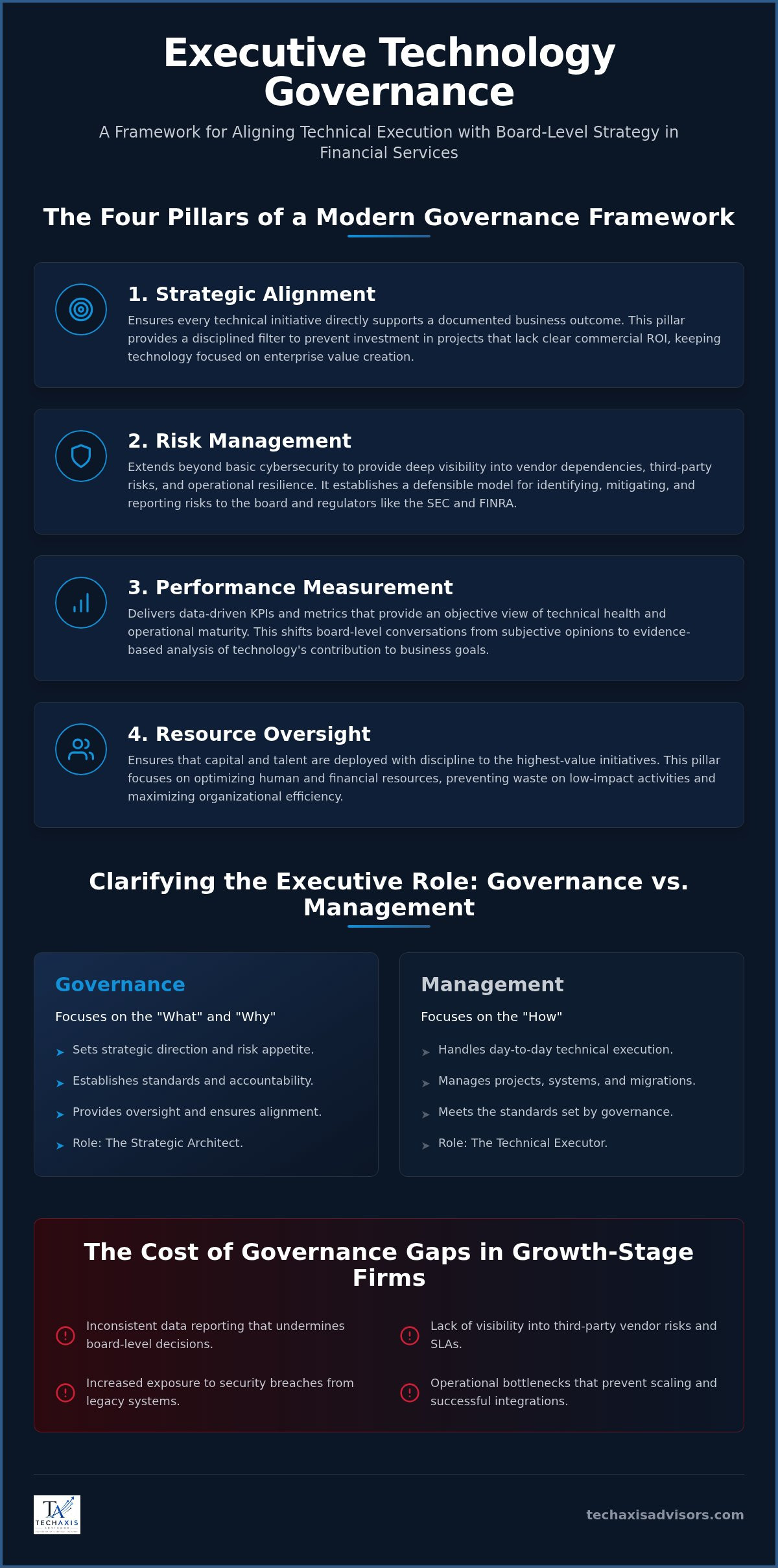
Distinguishing between management and governance is essential for maintaining executive focus. Management is concerned with the "how" of technical execution, such as software selection or system migrations. Governance focuses on the "what" and "why," ensuring that these activities align with the firm's risk appetite and strategic goals. By adopting a formal framework for the Corporate Governance of IT, boards can establish accountability without descending into micromanagement. This approach allows the executive team to act as Strategic Architects, setting the standards that technical teams must meet.
The Cost of Governance Gaps in Growth-Stage Firms
Gaps in oversight often manifest as hidden technical debt. These risks remain invisible until they stall a critical initiative or trigger a regulatory inquiry. In the context of private equity, these gaps directly impact firm valuation. Acquirers increasingly prioritize technical maturity as a key metric of enterprise health. A lack of documented oversight is a significant liability during Technology Due Diligence for Growth-Stage Companies. Without a clear governance framework, firms face several specific risks:
Inconsistent data reporting that undermines board-level decision-making.
Lack of visibility into third-party vendor risks and service level agreements.
Increased exposure to security breaches due to unpatched or legacy systems.
Operational bottlenecks that prevent rapid scaling or successful integrations.
Effective governance mitigates these risks by providing a prioritized roadmap for remediation. It ensures that the firm remains audit-ready while maintaining the agility needed to compete in a 2026 market.
The Core Pillars of a Modern Governance Framework
A robust framework for technology governance for financial services isn't a static document; it's an active operational discipline. It requires a commitment to four core pillars that ensure technology serves the enterprise rather than the other way around. These pillars transform technical debt into strategic assets by providing a structured path toward operational maturity.
First, strategic alignment ensures every technical initiative supports a documented business outcome. Without this, technical teams often drift toward projects that lack commercial ROI. Second, risk management must extend beyond basic cybersecurity. It requires deep visibility into vendor dependencies and operational resilience. Third, performance measurement provides the board with data-driven KPIs. These metrics move the conversation from subjective opinions to objective maturity levels. Finally, resource oversight ensures capital and talent are deployed where they create the most value. This disciplined approach prevents the waste of human capital on low-impact activities.
Regulatory Compliance and Oversight (SEC, FINRA, and Beyond)
The regulatory landscape for 2026 demands more than just policy documents. SEC and FINRA expectations have shifted toward evidence-based compliance. Regulators now look for proof of active oversight and clear traceability in technology decisions. Your governance model must produce a defensible audit trail that demonstrates how risks are identified, mitigated, and reported to the board. This level of transparency provides the internal clarity needed to scale operations without fear of non-compliance or unexpected enforcement actions.
AI Strategy and Data Governance
AI adoption presents unique challenges for regulated firms. You can't simply deploy AI tools without establishing rigorous guardrails. Effective governance treats data as the foundation, focusing on accuracy, privacy, and access controls. This necessity is detailed in the GAO Report on AI in Financial Services, which highlights the importance of managing algorithmic bias and data security at the executive level.
Integrating these guardrails into your broader AI Strategy for Wealth Management ensures that innovation doesn't outpace your risk management capabilities. Governance provides the structure to test, validate, and deploy AI models safely. It ensures that data remains an asset rather than a liability. If you're struggling to define these parameters for your firm, you may want to start a confidential executive conversation about your specific technology roadmap.
Evaluating Governance Frameworks: COBIT, NIST, and Pragmatic Alternatives
Selecting a model for technology governance for financial services requires a balance between rigorous standards and operational agility. COBIT 2019 remains the enterprise benchmark for aligning technical activities with business value. It's comprehensive but often dense. The NIST Cybersecurity Framework provides a more concentrated focus on risk management and asset protection. For firms operating globally, ISO/IEC 38500 offers a high-level structure for corporate oversight. These frameworks aren't "plug-and-play" solutions. They require thoughtful adaptation to avoid creating unnecessary administrative friction. A framework should serve your strategy, not dictate it.
Most mid-market firms don't need every component of these massive libraries. Instead, a pragmatic approach involves selecting the specific domains that address your firm's primary risks. This targeted implementation ensures that governance remains a facilitator of growth rather than a bottleneck. It allows you to maintain institutional-grade oversight while keeping your technical teams focused on delivery.
Standard Frameworks vs. Growth-Stage Needs
Growth-stage wealth management and private equity firms don't need the overhead of a global conglomerate. Engaging the Big Four often results in a "prestige tax" where you pay for a brand name but receive a generic, bloated framework. These models can stall progress by introducing layers of bureaucracy that don't match your firm's speed. Choosing a Bain technology consulting alternative allows for a more specialized approach. You gain the necessary rigor without sacrificing the agility that defines your competitive advantage. Pragmatic governance focuses on high-impact areas like vendor oversight and data integrity first.
Selecting the Right Framework for Your Maturity Level
Framework selection should be driven by size, complexity, and specific regulatory pressures. You must avoid the "junior consultant problem" common in large advisory firms. This occurs when a senior partner sells the engagement, but the actual implementation is left to inexperienced staff who lack executive context. Instead, prioritize evidence-based diagnostics that reveal your actual maturity level. A structured assessment identifies the specific governance gaps that matter most to your board. This ensures your framework implementation is a value-add exercise, not just a compliance checkbox. Key evaluation criteria include:
Regulatory Exposure: Does the framework satisfy 2026 SEC and FINRA expectations?
Operational Complexity: Can your current team manage the framework's requirements?
Scalability: Will this structure support your firm as you double in size?
Risk Profile: Does it address your specific vulnerabilities in AI and data security?
A mature selection process moves from identifying needs to implementing a roadmap that delivers immediate visibility to the board.
Implementing a Governance Roadmap: From Assessment to Execution
Moving from theory to execution requires a fundamental shift in leadership perspective. You can't treat technology governance for financial services as a one-time project or a static binder on a shelf. It's a continuous operational discipline. Successful implementation follows a methodical progression that replaces guesswork with evidence-based decision-support. This roadmap ensures that your technical infrastructure remains a resilient foundation for growth rather than a source of unforeseen risk.
The execution phase begins with four disciplined steps:
Step 1: Executive Technology Assessment. Utilize structured diagnostics to identify where current systems fail to support business objectives.
Step 2: Prioritized Roadmap. Rank initiatives based on their potential for risk mitigation and business value. This prevents resource dilution on low-impact technical debt.
Step 3: IT Steering Committee. Establish a governance board that includes C-suite representation to ensure technical decisions remain business-aligned.
Step 4: Continuous Monitoring. Implement reporting loops that provide the board with real-time visibility into execution risks and compliance status.
The TechAxis Executive Intelligence Platform Approach
Traditional governance often relies on static reports that are outdated by the time they reach the board. Our approach utilizes a proprietary Executive Intelligence Platform to deliver dynamic, board-ready findings. This allows leaders to move beyond simple "pass/fail" audits. We employ a rigorous framework to evaluate every technical asset: should you retain, optimize, integrate, replatform, replace, or retire? This structured evaluation is essential for improving operational maturity. It ensures that capital is only deployed when there's a clear business case for change.
Vendor and Platform Management Strategy
In 2026, your governance model must extend deep into your SaaS and cloud ecosystems. Wealth management and private equity firms increasingly rely on third-party integrations, which can introduce significant execution risk if left unmanaged. Governance requires structured oversight of vendor accountability and service level agreements. You need a centralized view of how these platforms interact with your proprietary data. By establishing clear standards for vendor performance, you reduce the likelihood of operational bottlenecks and ensure that your external partners meet your firm's internal compliance standards.
Executive Leadership and the Role of Advisory Governance
Governance fails when it's treated as a back-office audit. It requires executive presence because the decisions involve capital allocation and risk appetite. C-suite leaders must translate technical execution risks into business clarity for the board. Effective technology governance for financial services provides this translation layer. It ensures that technical debt or platform vulnerabilities are discussed in terms of operational resilience and valuation impact; it moves the conversation away from software patches toward enterprise health.
Long-term organizational value is built on the structural integrity of your technology stack. Governance acts as a stabilizer during periods of rapid growth or during the integration of a new acquisition. It provides the disciplined framework needed to evaluate new opportunities, such as AI integration, without compromising the firm's regulatory standing. By professionalizing this function, you move from reactive crisis management to proactive strategic oversight. This shift is essential for firms that want to maintain a competitive edge without increasing their risk profile.
Fractional Executive Leadership in Governance
Many growth-stage firms find themselves in a leadership gap. They've outgrown basic IT management but aren't ready for the overhead of a full-time, permanent CTO. This is when you should consider fractional CTO services. An advisory leader provides the necessary executive presence to chair steering committees and drive vendor accountability. They act as a bridge between high-level strategy and technical execution, ensuring that governance standards are maintained without the cost of a full-time executive hire.
Next Steps: Professionalizing Your Governance Structure
Professionalizing your oversight model requires an independent, evidence-based approach. Relying solely on internal teams or generalist consultants often leads to biased findings or generic frameworks that lack practical utility. You need a partner who understands the specific pressures of the 2026 financial landscape. Transitioning from reactive fixes to a structured governance roadmap is a critical step in maturing your operations. It protects your firm's valuation and ensures you're ready for the next phase of growth. Independent advisory provides the objective lens necessary to identify risks that internal teams might overlook.
If you're ready to bring executive clarity to your technology decisions, start with a confidential executive conversation at TechAxis Advisors. We can help you determine whether your current priorities require a structured assessment, strategic advisory, or fractional leadership to achieve your goals.
Securing Your Firm's Operational Future
Operational maturity in 2026 requires more than technical competence. It demands a disciplined framework that aligns technology oversight with your firm's risk appetite and growth targets. We've explored how technology governance for financial services transitions from a back-office burden to a strategic asset. By adopting pillars of alignment and risk management, you ensure every technical decision supports board-level objectives. This structured approach replaces organizational anxiety with the confidence of controlled progress.
TechAxis Advisors provides the leadership bridge needed to navigate these complexities. Our team is composed of former CIO, CTO, and CISO executives who understand the nuances of wealth management and private equity environments. We use our proprietary Executive Intelligence Platform to deliver board-ready findings and prioritized roadmaps that focus on tangible execution. You don't have to manage these technical risks in isolation.
Establishing a professional governance structure is the most effective way to protect your firm's valuation and operational integrity. You've identified the gaps; now you can begin the work of building a more resilient, scalable organization.
Frequently Asked Questions
What is the difference between IT management and technology governance?
IT management focuses on the daily operations and tactical execution of technology services. Technology governance provides the strategic framework for decision-making and risk oversight. While management handles system uptime and software updates, governance ensures these activities align with the firm's commercial goals and regulatory obligations. It's the difference between running the engine and steering the ship toward a specific destination.
How does technology governance impact regulatory compliance for financial firms?
Effective technology governance for financial services provides the evidence-based documentation required by regulators like the SEC and FINRA. It creates a defensible audit trail for technology decisions, data privacy controls, and vendor oversight. Instead of scrambling during an audit, firms with mature governance have real-time visibility into their compliance status. This proactive approach reduces the risk of enforcement actions and reputational damage.
Is a formal governance framework necessary for mid-market wealth managers?
Yes, a formal framework is essential for mid-market firms aiming to scale without increasing operational risk. Mid-market wealth managers often face the same regulatory scrutiny as larger institutions but with fewer internal resources. A structured framework like NIST or a pragmatic alternative provides the necessary guardrails. It prevents technical debt from accumulating and ensures that technology investments deliver measurable business value as the firm grows.
What are the most common governance failures in growth-stage companies?
The most common failure is the lack of executive oversight over technical execution. This often leads to fragmented data silos, unmanaged vendor risks, and significant technical debt. Another frequent issue is failing to align technical roadmaps with the actual business strategy. These gaps often remain hidden until a firm undergoes due diligence or faces a major system outage that impacts client services or regulatory reporting.
How can a Fractional CTO help with technology governance?
A Fractional CTO provides the executive presence needed to establish and lead a governance board without the cost of a full-time hire. They act as a Strategic Architect, bridging the gap between high-level business goals and technical implementation. By professionalizing vendor oversight and data strategy, they ensure the firm maintains institutional-grade technology governance for financial services. This allows the CEO to focus on growth while the CTO manages technical risk.
What should be included in a technology report for a board of directors?
A board-level report should focus on business risk and strategic alignment rather than granular technical metrics. Key inclusions are a summary of execution risks, status updates on major technical initiatives, and a clear view of regulatory compliance. It should also highlight vendor performance and data security posture. The goal is to provide board members with the clarity needed to make informed decisions about capital allocation and risk management.
How do we govern AI implementations in a highly regulated environment?
AI governance requires establishing clear guardrails around data privacy, algorithmic bias, and model transparency. You must integrate AI oversight into your existing risk management framework rather than treating it as a standalone technical project. This involves conducting impact assessments for new tools and ensuring that all AI-driven decisions remain traceable. Governance provides the structure to innovate safely while satisfying the stringent requirements of financial regulators.
Does technology governance slow down digital transformation?
No, effective governance actually accelerates transformation by reducing the need for reactive fixes and rework. It provides a clear roadmap that prevents teams from pursuing conflicting technical paths. While it introduces initial structure, this discipline ensures that digital initiatives are scalable and secure from the start. By clarifying decision-making authority, governance removes the bottlenecks often caused by organizational confusion or lack of technical direction.



Comments