

Tech Department KPIs: An Executive Guide
A technology scorecard can look healthy while business risk is rising. The key performance indicators for a technology department matter when they show how service reliability, delivery, risk, and investment affect business performance. Counting tickets closed or projects launched describes activity, but it does not tell executives whether critical services are dependable or technology spending is advancing business priorities.
Leaders need a concise view across these areas, plus enough context to interpret it. A single target can reward the wrong behavior: faster delivery, for example, should not come at the expense of resilience or user experience. Effective measures connect operational results to business impact, show trends over time, and make ownership clear.
This guide explains how to select a small, balanced set of technology KPIs and use them to support executive decisions. It covers service, risk, delivery, and investment measures, along with practical ways to define targets, interpret results, and establish a review cadence that leads to accountable follow-through.
Table of Contents
What technology department KPIs should tell executive leaders
Key performance indicators for a technology department by outcome
How to choose a balanced technology department KPI scorecard
How executives should interpret KPI trends, tradeoffs, and exceptions
Turn technology department KPIs into an operating and advisory rhythm
What technology department KPIs should tell executive leaders
Technology reporting is useful when it helps leaders make a decision. A technology KPI is a measure tied to a business objective, service commitment, risk, or investment choice. It shows whether technology is supporting an outcome the organization values, not simply whether a team is busy. A Key Performance Indicator (KPI) provides a general foundation, but executive measures need to reflect the organization’s strategy, operating model, risk tolerance, and the quality of its evidence.
That is why key performance indicators for a technology department should not be reduced to one headline figure. Service continuity, delivery capacity, risk exposure, user experience, and financial stewardship each reveal a different part of performance. A strong result in one area can conceal pressure elsewhere. A useful scorecard balances these views and connects each measure to a business question.
How KPIs differ from technology metrics and service reports
System measurements and team activity help technology teams diagnose and manage work. Server response time, tickets closed, and project milestones can be useful, but none proves on its own that the business is receiving the outcome it needs.
For example, a hypothetical firm might report that a critical system was available for most of the month. That measure becomes more useful when leaders can see the agreed availability target, who owns the service, which business processes depend on it, and what action follows if performance falls short. A KPI connects measurement to oversight and a decision.
Which executive decisions should the scorecard support?
An executive scorecard should inform decisions about continuity, investment priorities, risk oversight, and whether delivery capacity matches business commitments. Board-level reporting should focus on material outcomes and exceptions. Technology teams can use more detailed operational data to investigate causes and manage day-to-day work.
An executive technology KPI is a business-relevant measure that helps leaders judge performance, exposure, or investment and decide what action is needed. The scorecard should reflect who relies on technology and which outcomes matter to them, a perspective also relevant to TechAxis Advisors’s executive audience.
Key performance indicators for a technology department by outcome
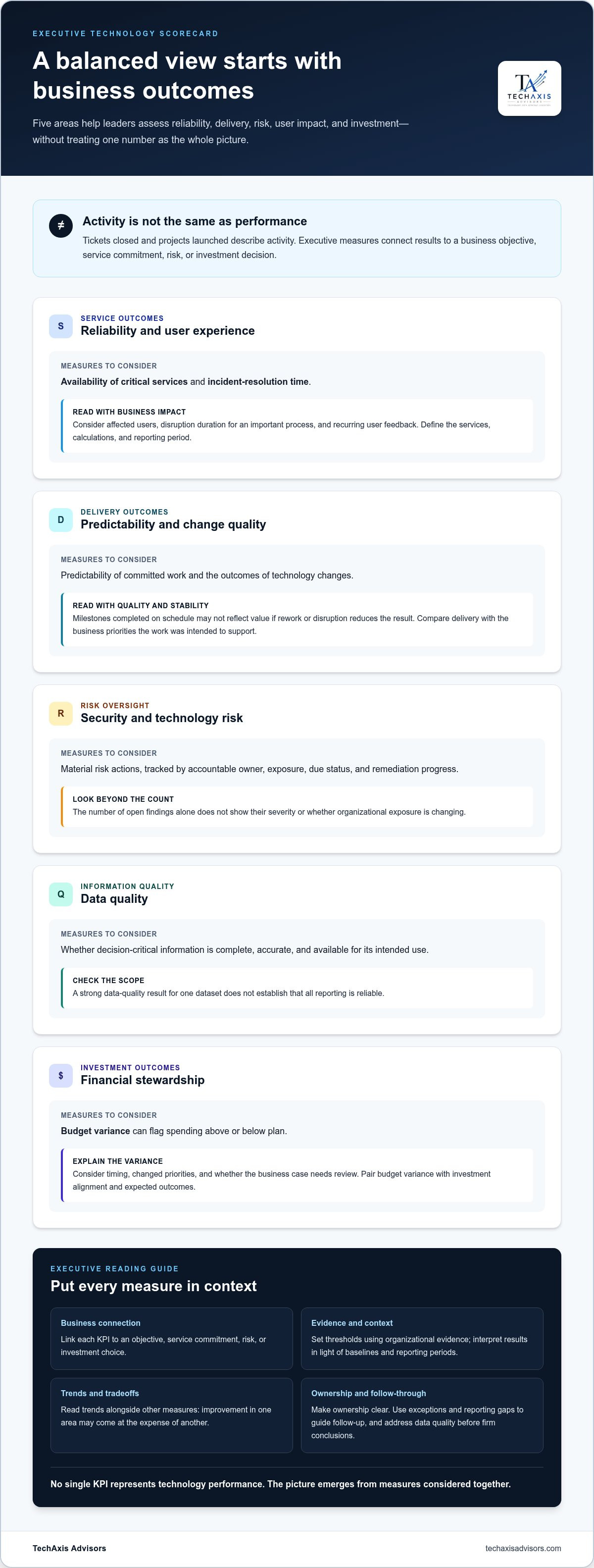
A useful scorecard groups measures by the business outcome they inform. These categories help executives assess technology performance without treating a single number as a complete picture. Select and interpret the key performance indicators for a technology department in context: baselines, thresholds, and reporting periods depend on critical services, the operating model, and risk tolerance.
Service reliability, incidents, and user experience
Availability of critical services can show whether systems are accessible when the business needs them. Incident-resolution time can indicate how quickly service is restored. Neither measure explains the full business impact on its own. Define which services matter, how availability and resolution time are calculated, and the reporting period.
Pair operational measures with evidence of user or business impact, such as the number of affected users, the duration of disruption to an important process, or recurring user feedback. Ticket volume and closure rates can help teams manage workload, but they do not establish that a service is reliable or that user needs are being met.
Delivery, risk, data, and investment indicators
Delivery measures can include the predictability of committed work and the outcomes of technology changes. A team may complete planned milestones on schedule, for example, while rework or disruption reduces the value of that result. Read delivery measures alongside quality, stability, and the business priorities the work was intended to support.
Security and technology risk: Track material risk actions by accountable owner, exposure, due status, and remediation progress. A count of open findings alone does not show their severity or whether organizational exposure is changing.
Data quality: Monitor whether decision-critical information is complete, accurate, and available for its intended use. A strong data-quality score for one dataset does not establish that all reporting is reliable.
Financial stewardship: Budget variance can flag spending above or below plan. It does not explain whether the difference reflects timing, changed priorities, or a business case that needs review. Pair it with investment alignment and expected outcomes.
No single KPI represents technology performance; the picture emerges from measures that balance reliability, delivery, risk, user impact, and investment. Set thresholds using organizational evidence rather than adopting a universal target. If leaders need help aligning measures with strategy and risk, discuss executive technology priorities.
How to choose a balanced technology department KPI scorecard
Build the scorecard around decisions, not simply the data that is easiest to collect. A practical selection process keeps the key performance indicators for a technology department relevant to leadership while limiting reporting effort.
Define the decisions. Identify what leaders need to decide, such as whether to prioritize service resilience, adjust investment, or address a delivery constraint.
Map the outcomes. Translate strategic priorities into observable technology outcomes before choosing measures. If continuity is a priority, define which services and business processes must remain available.
Select complementary measures. Combine leading indicators, lagging outcomes, and operational diagnostics. Leading indicators can flag developing issues, lagging measures show what has happened, and diagnostic measures help teams investigate causes. Each has a distinct purpose.
Assign owners. Name a business or technology owner who can interpret the result, explain exceptions, and coordinate follow-through.
Set definitions and review cadence. Decide how often leaders need the information to make timely decisions, then define how each measure is calculated and reviewed.
Keep the executive view focused on measures that support those decisions. A longer inventory may belong in team-level reporting, but it can dilute leadership attention if every measure receives equal prominence. Give each KPI a decision or action attached to it. If a measure prompts no discussion, escalation, or adjustment, reconsider whether it belongs in the executive scorecard.
Start with business priorities and accountable owners
Define the outcome first, then determine whether reliable evidence exists to measure it. For example, a priority around dependable client service might require both a service measure and a business owner who can explain which processes are affected when performance changes. Executive advisory can help establish ownership and connect measurement to technology decisions, as described in this executive technology advisory approach.
Set definitions, baselines, and review rules
For every selected KPI, document its formula, data source, reporting period, owner, and limitations. Establish a baseline using internal evidence, then set thresholds that reflect service commitments and the organization’s risk tolerance. Avoid generic targets until you have assessed whether they fit your operating context.
Where relevant, ITIL terminology or a service-level agreement can help clarify how a service measure is defined. Neither provides a universal target for every organization. A focused executive discussion can help clarify which reporting decisions matter most; discuss your scorecard priorities.
How executives should interpret KPI trends, tradeoffs, and exceptions
A KPI is a signal, not a verdict. Interpret changes against prior periods, business events, scope changes, data quality, and the criticality of the service involved. A shift may reflect a genuine performance change, a changed definition, or a change in what is being measured. The key performance indicators for a technology department are most useful when leaders examine related measures and ask what decision the evidence supports.
Read combinations of indicators, not isolated numbers
Pair availability with user impact, recurring incidents, and recovery context. Read project predictability alongside scope changes, dependencies, and the outcomes the work was intended to support. If two measures move together, treat that as a prompt to investigate, not proof that one caused the other.
Tradeoffs matter. Faster delivery may coincide with more change-related disruption. A reduction in reported incidents may reflect a change in reporting practices rather than improved service. Review both the intended benefit and the possible cost before judging performance.
Make dashboards useful for board and C-suite discussions
Lead with the decision, trend, material risk, and accountable owner, not the number of charts. Separate exceptions that require executive attention from routine operational detail managed by technology teams. If an acquisition changes the organization’s systems, dependencies, or risk profile, leaders can also review relevant technology problems leaders address as part of that discussion.
A focused review can connect KPI exceptions to business priorities and accountable follow-through.
Turn technology department KPIs into an operating and advisory rhythm
A scorecard creates value when its findings lead to decisions, assigned actions, and follow-up. Set the review rhythm according to how quickly a measure can affect the business. A material service exception may require prompt escalation, while investment alignment or longer-term delivery trends may suit a regular leadership review. The right cadence keeps key performance indicators for a technology department connected to action without turning every operational update into an executive meeting.
Move from KPI findings to prioritized action
For each exception or decision, record the issue, evidence, accountable owner, next step, and review point in an action register. This clarifies whether leadership accepted a risk, assigned remediation, changed a priority, or needs better information before deciding. Review open actions alongside new results so the scorecard tracks follow-through, not just fresh reporting.
When several issues compete for attention, sequence improvements according to business priorities, dependencies, and risk tolerance. A structured assessment can clarify the evidence and options before leaders commit resources. TechAxis’s Executive Intelligence Assessments provide evidence-based findings, prioritized roadmaps, and action registers to support executive decisions.
Choose the right level of executive support
The support needed depends on the gap. A focused executive decision-support assessment can help when KPI definitions, data quality, or reporting ownership are unclear. Ongoing advisory can help leaders interpret trends and align technology decisions with business priorities. Fractional leadership may fit when the organization needs sustained executive ownership of governance, review, and execution.
Do not set firm targets or draw conclusions from inconsistent data. First establish what the measure captures, where its evidence comes from, and what limitations apply. That groundwork helps distinguish a genuine performance concern from a reporting gap.
For related operating-model context, explore operational maturity through technology.
Make technology performance actionable
A useful technology scorecard connects service, delivery, risk, and investment to business priorities. Choose a balanced set of measures, interpret trends with context, and assign an owner and follow-up action to material exceptions. Activity counts can inform the picture, but they should not stand in for outcomes.
The right key performance indicators for a technology department give executives a clearer basis for decisions, not a larger dashboard. If reporting gaps make targets or conclusions uncertain, address the evidence before relying on the numbers. TechAxis founder Aarati Dikshit brings more than 25 years of CIO, CTO, and CISO experience. Structured Executive Intelligence Assessments provide board-ready findings, strategic roadmaps, and action registers to support decision-making.
With clear measures, accountable owners, and a disciplined review rhythm, technology reporting can become a practical tool for oversight and informed action.
Frequently Asked Questions
What are key performance indicators for a technology department?
Key performance indicators for a technology department measure whether technology is meeting a business objective, service commitment, risk priority, or investment goal. For example, availability for a revenue-critical system can help leaders assess service continuity, while a raw server reading alone may not show business impact. Define each measure’s data source, owner, and decision purpose. Targets should reflect strategy, operating model, risk tolerance, and data reliability.
Which KPIs should a technology department report to executives?
Executives need a balanced view of service reliability, incident impact, delivery predictability, technology risk, user experience, data quality, and investment alignment. The right mix depends on the decisions leaders need to make. A delivery measure, for instance, is more useful when paired with scope changes and business outcomes. Present trends with context, name an accountable owner, and clarify the follow-up required when results fall outside expectations.
How many KPIs should a technology department have?
There is no universal number that fits every organization. Keep the executive scorecard focused on measures leaders can understand and act on, while maintaining detailed operational metrics for technology teams. Each executive KPI should have a clear decision purpose, an owner, and a role in the review process. If a measure does not inform discussion, escalation, or action, reconsider whether it belongs in the leadership view. The aim is decision clarity, not dashboard volume.
How do you measure IT department performance effectively?
Start with business priorities and identify the technology outcomes that support them. For each measure, document its definition, data source, reporting period, owner, and limitations. Review changes alongside relevant incidents, scope shifts, user impact, and risk context. Then record decisions and follow-up actions. Movement in one metric does not prove that business performance improved; leaders need to understand what changed and whether the evidence supports that conclusion.
What is the difference between a technology KPI and an IT metric?
An IT metric records an operational fact, such as incident volume or system availability. A KPI connects a measure to a business priority or decision, such as whether a critical service is meeting an agreed need. A metric can support a KPI, but it becomes decision-useful only when leaders understand its definition, context, and implications. Availability alone, for example, may not show how an interruption affected users or business processes.
How often should technology department KPIs be reviewed?
Set review frequency according to decision urgency, the measure’s reporting cycle, and governance needs. Technology teams may monitor operational indicators more frequently than executives review strategic trends. Establish a consistent leadership cadence and define which exceptions require escalation. Avoid meetings that simply repeat dashboard figures. Each review should clarify material changes, decisions, accountable actions, and when those actions will be revisited.



Comments