

Tech Advisor Guide for Growth-Stage Companies
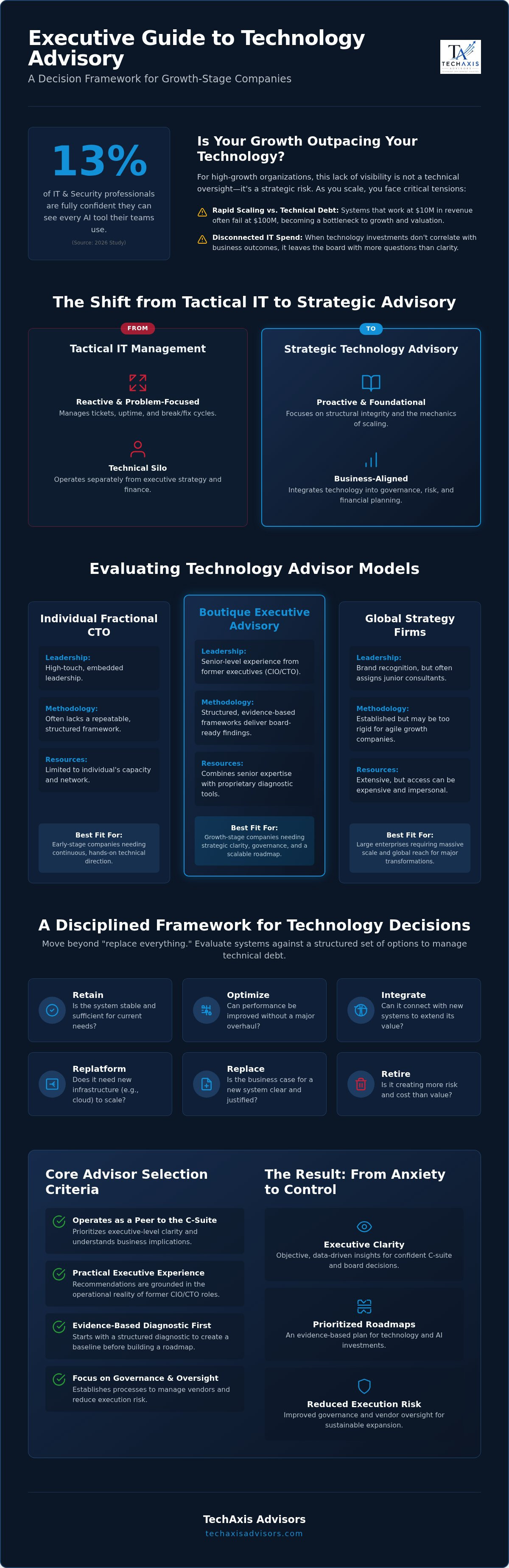
A 2026 study found that only 13% of IT and security professionals are fully confident they can see every AI tool their teams use. For an organization in a high-growth phase, this lack of visibility isn't just a technical oversight; it's a strategic risk. You're likely managing the tension between rapid scaling and the accumulation of technical debt that threatens to stall your next product release. Finding a technology advisor for growth stage companies becomes essential when IT spend feels disconnected from actual business outcomes, leaving the board with more questions than clarity.
You'll learn how to identify an advisor who prioritizes executive-level clarity and structural integrity over tactical fixes. We'll examine how to evaluate advisory partners based on their ability to deliver evidence-based roadmaps, navigate complex state-level AI regulations, and implement the governance required for sustainable expansion. This guide provides the framework necessary to move from organizational anxiety to a state of disciplined, controlled progress.
Table of Contents
The Shift from Tactical IT to Strategic Technology Advisory
Growth creates complexity. Complexity creates noise. For a CEO or CFO, this noise often manifests as IT spending that doesn't correlate with business growth. A strategic technology advisor for growth stage companies operates as a peer to the executive team. They translate technical requirements into business outcomes. Unlike a technical vendor focused on tickets and uptime, an advisor focuses on structural integrity and the mechanics of scaling. They provide the leadership bridge that a growing organization often lacks during rapid expansion.
Specific trigger points often force this shift. Your organization might be navigating a merger, facing board pressure to implement AI governance, or struggling with operational silos that slow down product delivery. These moments require more than technical skill. They require a specialized form of technology consulting that understands the financial implications of technical debt. While Managed Service Providers (MSPs) are essential for day-to-day maintenance, they rarely possess the strategic perspective required to lead a company through high-stakes organizational change.
When Growth Outpaces Your Current Technology Foundation
As companies scale, technical debt becomes a significant liability. Systems that served the organization at $10 million in revenue often fail at $100 million. This failure isn't always a total crash. Instead, it's a slow decay in efficiency. Product releases take longer. Data becomes unreliable. You must move from a mindset of survival to one of improving operational maturity through technology. This transition ensures that your foundation is a value driver rather than a bottleneck. It's about building a structure that supports your valuation during a capital raise or an exit.
The Role of Technology in Executive Governance
Modern executive leadership demands objective data for risk management. A technology advisor provides the board with the clarity needed for effective oversight. This isn't about technical jargon. It's about evidence-based findings that quantify risk and prioritize investment. When technology is integrated into governance, it aligns with your long-term business strategy and risk tolerance. You stop making decisions based on anecdotal technical advice. Instead, you utilize a structured framework that provides transparency into how technology spend impacts the bottom line. This approach replaces organizational confusion with a disciplined path forward.
Evaluating Technology Advisor Models for Growth-Stage Needs
Selecting a technology advisor for growth stage companies is a strategic decision that dictates the trajectory of your operational scale. The market offers three primary engagement models. Individual fractional CTOs provide high-touch leadership but often lack a repeatable methodology or the resources of a larger firm. Global strategy firms offer brand recognition but frequently assign junior consultants to growth-stage accounts. Boutique executive advisory firms provide a middle path. They combine senior-level experience with structured, evidence-based frameworks to deliver board-ready findings.
Effective advisory requires a move away from gut-feeling consulting. Growth-stage leaders need objective data to justify technology spend. Utilizing a proprietary platform ensures findings are reproducible and transparent. This structured diagnostic process replaces ambiguity with a clear roadmap for execution. It allows the executive team to see the mechanics of their organization's technical health without getting bogged down in granular jargon. Transparency is the foundation of trust between an advisor and the C-suite.
A structured diagnostic process is the foundation of effective advisory. It moves the conversation from anecdotal opinions to evidence-based findings. Growth-stage companies cannot afford to waste capital on technology that doesn't scale. By leveraging a proprietary Executive Intelligence Platform, advisors provide board-ready clarity on technology and AI investments. This visibility is essential for maintaining accountability and ensuring that IT spend directly supports business outcomes. If you are evaluating your current leadership needs, you can start with a confidential executive conversation to determine which model fits your growth trajectory.
Fractional CTO Leadership vs. Project-Based Consulting
Embedded leadership provides continuity. Fractional CTO services allow an organization to access executive intelligence without the overhead of a full-time hire. This model is effective during rapid scaling where technology governance must be integrated into daily operations. While a one-off audit identifies problems, a retained partnership ensures those problems are solved through consistent vendor oversight and platform management. It provides a steady hand to guide the organization through the chaos of expansion.
The "Big Four" vs. Boutique Advisory: Options and Trade-offs
Scale often comes at the cost of agility. Global strategy firms bring significant resources, yet a technology advisor for growth stage companies within a boutique firm offers more direct access to veteran executives. This senior involvement is critical in regulated industries like wealth management or financial services. Organizations like Maryland SBDC's Technology and AI team demonstrate the value of specialized support for scaling organizations. Boutique advisors focus on practical application, ensuring technical execution remains aligned with business strategy.
Core Selection Criteria for an Executive Technology Consultant
Selecting the right leadership requires looking beyond a resume of consulting projects. You should prioritize individuals who've held accountable executive roles, such as CIO, CTO, or CISO. These professionals understand the weight of operational responsibility. They've managed budgets, led large teams, and answered to boards. This experience ensures their advice is grounded in reality rather than abstract theory. A technology advisor for growth stage companies must possess industry-specific depth, particularly if your organization operates in regulated environments like finance, lending, or wealth management.
Deliverables must meet a high standard of executive intelligence. Don't settle for advisors who provide dense, jargon-heavy reports that lack clear direction. Instead, look for concise, board-ready documents that highlight specific tradeoffs and business impacts. Actionable insights are more valuable than comprehensive lists of technical flaws. Your advisor's work should directly support decision-making, providing the clarity needed to approve capital expenditures or adjust strategic roadmaps. If the findings aren't evidence-based and repeatable, they're merely opinions.
Evidence-Based Methodology and Executive Platforms
A structured Executive Technology Assessment serves as the foundation for any successful engagement. This isn't a subjective audit; it's a data-driven process that utilizes a repeatable methodology to establish an operational baseline. Many firms fall into the trap of receiving a static report that quickly becomes obsolete. To avoid this, ensure your advisor uses an executive platform to maintain a live action register and a prioritized roadmap. This approach ensures ongoing accountability and allows for the continuous synthesis of intelligence as your business scales and market conditions shift.
Governance-Driven AI and Data Strategy
AI implementation requires more than just selecting a vendor. It demands a governance-driven strategy that addresses risk, ethics, and compliance. Your advisor should evaluate AI readiness through the lens of structural integrity and existing regulations. They must ensure your data architecture modernization supports data-driven decision-making without compromising security or privacy. A robust strategy aligns automation with your organization's risk tolerance. It ensures that technology investments deliver tangible business value while maintaining the mechanics of a secure, scalable enterprise.
Managing the Risks of Technical Implementation and Scale
Technical execution is the point where strategic roadmaps often fail. For a scaling organization, the risk isn't just picking the wrong software; it's the failure to manage the mechanics of implementation. A technology advisor for growth stage companies provides independent oversight to ensure that technical execution remains aligned with business strategy. This role involves platform management and vendor oversight rather than direct software builds. By maintaining this professional distance, the advisor provides an objective layer of governance that reduces execution risk and ensures accountability across the entire technology ecosystem.
Modernization shouldn't be a default reaction to legacy systems. Instead, every asset must be evaluated through a pragmatic framework: retain, optimize, integrate, replatform, replace, or retire. This decision-support approach ensures that capital is only deployed where it generates a measurable return. It prevents the common mistake of replacing functional systems when a simpler integration or optimization would suffice. This disciplined methodology protects the organization's cash flow while building a foundation capable of supporting rapid scale.
Technology Due Diligence and M&A Integration
During acquisitions or capital raises, technology risks can significantly impact valuation. Advisors identify these liabilities, such as security gaps or undocumented technical debt, before they become post-close crises. Utilizing an Executive Checklist for Technology Due Diligence allows leadership to quantify these risks. Managing post-acquisition integration requires more than just connecting servers; it demands a structured approach to merging data architectures and operational workflows without disrupting business continuity.
Execution Leadership and Vendor Management
Accountability is often lost when multiple vendors are involved in a project. The advisor acts as the central point of governance, aligning IT infrastructure with specific business goals. They oversee qualified delivery partners and white-label development services to ensure the strategic roadmap is executed as intended. This leadership bridge ensures that vendors are held to evidence-based standards. It replaces the anxiety of unmanaged technical projects with a sense of controlled, professional progress.
Structuring the Advisory Engagement for Long-Term Success
A successful partnership with a technology advisor for growth stage companies begins with a clear definition of the engagement's scope and desired outcomes. You shouldn't enter an advisory relationship based on vague promises of improvement. Instead, the process must start with a structured diagnostic to establish an evidence-based baseline of your current state. This baseline allows for the creation of a prioritized strategic roadmap that aligns technical execution with your specific business goals. Establishing clear KPIs based on business outcomes, such as reduced execution risk or improved board-ready clarity, ensures that the advisory relationship remains focused on value.
After the initial assessment, the organization must determine the appropriate level of ongoing support. The choice between a one-time engagement and a long-term partnership depends on the complexity of your growth trajectory and the internal leadership gaps you need to fill. This decision dictates how deeply the advisor is integrated into your operational mechanics and executive decision-making processes.
The Executive Assessment Workflow
Efficiency in advisory is driven by a methodical approach. The TechAxis How We Work model follows a logical progression: Diagnostic, Assessment, and Roadmap. This workflow ensures that every recommendation is supported by data and documented findings. Board-ready briefs and findings summaries are essential deliverables in this phase. They provide the executive team with the intelligence needed to make informed decisions without wading through technical minutiae. Traceability is maintained throughout the process, ensuring that the initial diagnostic findings directly inform the final execution strategy.
Ongoing Strategic Counsel vs. Fractional Leadership
Choosing the right level of embeddedness is a critical decision for your leadership team. Retained advisory provides continuous decision support for organizations that have technical teams but lack high-level strategic oversight. It offers a steady hand for ongoing governance and vendor management. Conversely, fractional leadership provides a more integrated role. It delivers executive-grade governance and leadership without the substantial cost of a full-time executive hire. This model is particularly effective for organizations needing a technology advisor for growth stage companies to bridge the gap between technical teams and the board during periods of rapid expansion.
Establishing a Foundation for Sustainable Scale
Scaling an organization requires more than just adding technical headcount. It's a transition from reactive maintenance to disciplined, strategic oversight. Selecting a technology advisor for growth stage companies who prioritizes evidence-based findings ensures that every IT investment supports your long-term business strategy. This approach replaces organizational anxiety with a structured roadmap for progress.
Effective leadership in this phase involves managing technical debt through a pragmatic framework and establishing board-ready clarity on AI. TechAxis Advisors brings over 25 years of executive experience to this challenge. We use a proprietary Executive Intelligence Platform to deliver the transparency required for wealth management and financial services firms to scale with confidence.
You have the opportunity to turn your technology foundation into a primary driver of valuation and operational maturity.
Frequently Asked Questions
What is the difference between an IT consultant and an executive technology advisor?
The primary difference lies in the level of organizational alignment and accountability. An IT consultant typically focuses on tactical project delivery or specific technical implementations. In contrast, an executive technology advisor for growth stage companies operates as a peer to the C-suite, focusing on how technical execution impacts business strategy. They provide governance, risk oversight, and board-ready clarity rather than just managing tickets or system uptime. This strategic layer ensures technology spend directly supports long-term operational maturity.
How much does a fractional CTO typically cost for a growth-stage company?
Costs for fractional leadership vary significantly based on the organization's current stage, complexity, and the level of embeddedness required. Engagement models range from lighter strategic retainers to more intensive fractional executive roles. While market rates for these services fluctuate, growth-stage companies typically find that this model provides significant cost efficiency compared to the total compensation package of a full-time, permanent CTO. You should evaluate the investment based on the value of reduced execution risk and strategic alignment.
Does a technology advisor perform the actual software development?
A technology advisor does not typically perform direct software development or cloud migrations. Their role is to provide leadership, governance, and vendor oversight to ensure these projects succeed. They maintain professional independence to evaluate the best path forward without being biased toward a specific build. Execution is supported through advisory leadership and qualified delivery partners. This structure allows the advisor to hold implementation teams accountable to the evidence-based roadmap and business objectives.
How do we know if our company is ready for an AI assessment?
Your company is ready for an AI assessment if there's a lack of visibility into existing tool usage or pressure from the board to implement automation. A 2026 study highlighted that only 13% of professionals are fully confident in their AI visibility. If technical debt is slowing your product releases or if you face complex state-level regulations, an assessment is necessary. It provides a structured framework to evaluate readiness before committing significant capital to automation or data architecture modernization.
Can a technology advisor help with M&A due diligence?
Yes, an executive technology advisor is critical during M&A to identify risks that could impact valuation. They conduct structured assessments to uncover undocumented technical debt, security gaps, and data architecture inconsistencies. This process provides the board with a clear understanding of the mechanics required for post-acquisition integration. By quantifying these risks before the deal closes, leadership can make informed decisions regarding purchase price adjustments or required capital expenditures. This oversight reduces the anxiety of high-stakes acquisitions.
What deliverables should we expect from a technology assessment?
Deliverables from a technology assessment include evidence-based findings, a prioritized strategic roadmap, and board-ready executive briefs. You should expect a clear action register that categorizes systems into a framework of retain, optimize, integrate, replatform, replace, or retire. These documents are designed for the C-suite to facilitate rapid decision-making. Utilizing a proprietary Executive Intelligence Platform ensures that these findings are repeatable and provide a transparent baseline for tracking your organization's operational maturity over time.
How long does a typical executive technology engagement last?
The duration of an engagement depends on the specific needs of the organization. A structured executive decision-support engagement, such as an assessment, typically lasts several weeks to establish an evidence-based baseline. Following this, many growth-stage companies transition into a retained advisory or fractional leadership model that lasts for several months or years. This continuity provides the embedded governance required to manage ongoing vendor oversight and ensure the long-term success of the technology roadmap as the organization scales.
Is a technology advisor necessary if we already have a VP of Engineering?
A technology advisor for growth stage companies often complements a VP of Engineering by providing an external layer of governance and board-level strategy. While a VP of Engineering typically focuses on internal team management and product delivery, an advisor focuses on enterprise risk, vendor oversight, and aligning IT spend with business outcomes. This partnership allows the internal team to stay focused on execution while the advisor ensures that the broader technology foundation supports the company's scaling goals and valuation.



Comments