

Strategic Tech Roadmap for Scale-Ups: 2026 Template
Is your technology roadmap a strategic asset or a compounding liability? Many CEOs find that as they scale, their technical infrastructure begins to work against them rather than for them. You've likely experienced the friction of fragmented systems that don't talk to each other; it's a state that increases execution risk and slows down the delivery of critical features just when you need them most.
This article provides a pragmatic, decision-focused framework to align your technical investments with rapid business growth. By following this template, you'll gain a board-ready plan that reduces the risk of technical failure and ensures your spend reflects your true business priorities. We've designed this technology roadmap for scale-ups to help you navigate the specific challenges of 2026, including the 307% surge in DDR5 memory costs and the stabilization of modern frameworks like Angular 22.1.0.
We will examine the essential components of a high-growth tech strategy, from managing cloud pricing volatility to bridging the gap between high-level vision and daily execution. You'll learn how to move from organizational anxiety to a state of disciplined, controlled progress.
Table of Contents
Why Growth-Stage Technology Roadmaps Often Fail
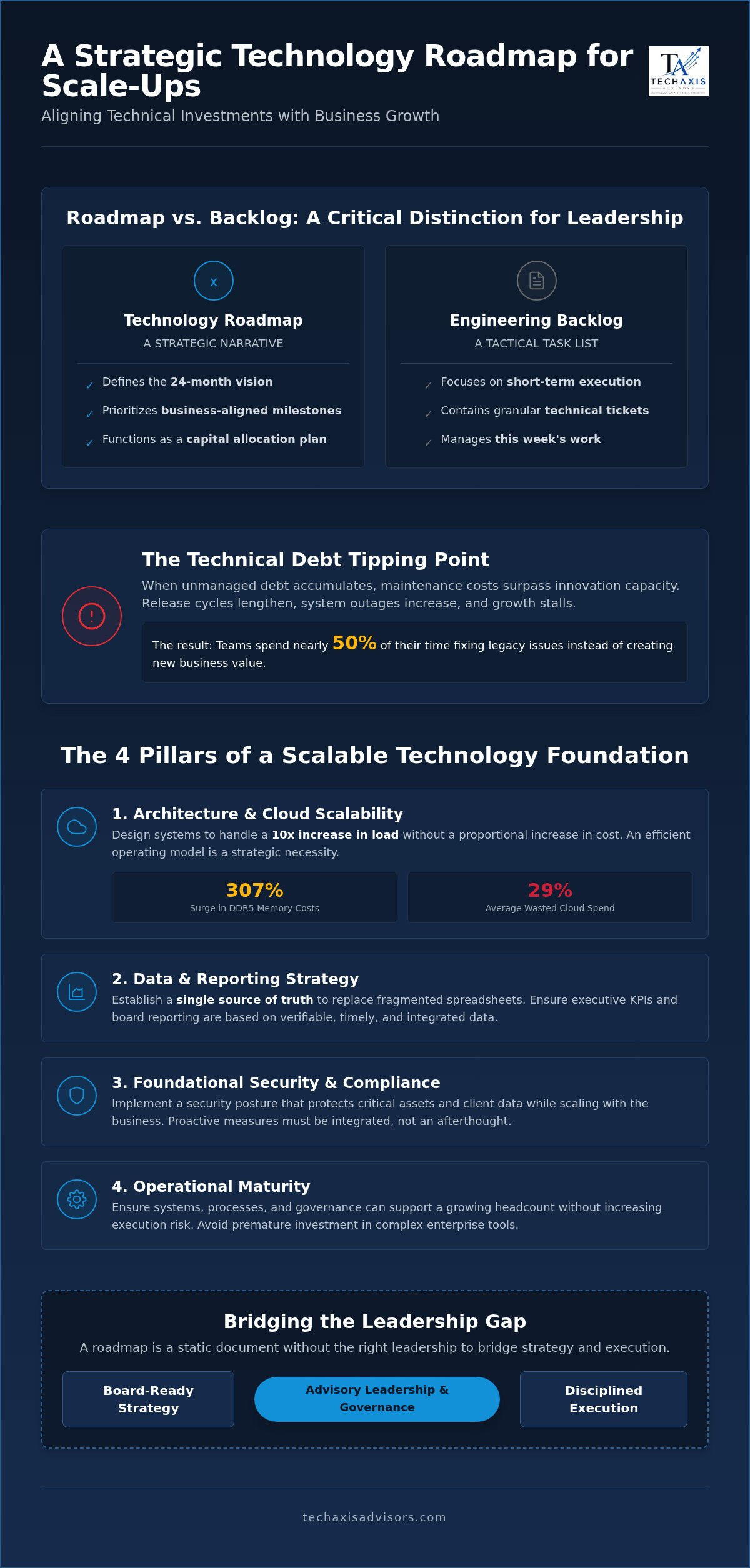
A technology roadmap for scale-ups is not a feature wish list. It's a strategic document that aligns technical architecture with specific business growth milestones. Many leadership teams mistake a list of software requirements for a strategy. This confusion leads to a fragmented tech stack that fails under the pressure of rapid expansion. A true roadmap functions as a capital allocation plan; it ensures that every dollar spent on technology directly supports the CEO’s three year vision.
Execution risk often stems from the "feature-first" trap. Companies prioritize immediate market demands over the underlying infrastructure. This approach creates a fragile foundation. While it may satisfy short term sales goals, it builds a structural deficit that eventually halts progress. Leadership teams must also avoid over-investing in complex enterprise tools before the organization has the operational maturity to manage them. This premature complexity drains capital and adds unnecessary layers of governance that slow down delivery.
Misalignment between the C-suite and engineering is a primary driver of failure. The boardroom expects agility and rapid scaling. Engineering struggles with the reality of technical debt and system stability. Aligning these expectations requires seasoned advisory leadership to bridge the gap between strategic intent and technical execution.
The Technical Debt Tipping Point
Rapid scaling requires speed, but speed often necessitates technical compromises. These compromises are technical debt. If left unmanaged, this debt reaches a tipping point where the cost of maintenance exceeds the capacity for innovation. You'll recognize this stage when release cycles grow longer and system outages become frequent. The cost of inaction is quantifiable. When teams spend nearly half their time fixing legacy issues rather than building new value, operational efficiency collapses. A disciplined technology roadmap for scale-ups identifies these bottlenecks before they become catastrophic hurdles to growth.
Roadmap vs. Backlog: A Critical Distinction
Your engineering team’s Jira backlog is not a strategy. A backlog is a tactical list of tasks designed for short term execution. A roadmap is a strategic narrative designed for long term alignment. One focuses on what is being built this week; the other focuses on where the business must be in 24 months. Effective roadmaps prioritize business-aligned milestones, such as the ability to support a 10x increase in transaction volume or the integration of automated reporting for a private equity board. It moves the conversation away from technical tickets and toward organizational outcomes.
The 4 Pillars of a Scalable Technology Foundation
Scaling a business demands more than increased headcount. It requires a structural backbone that transforms technical complexity into operational leverage. A technology roadmap for scale-ups must address four non-negotiable pillars to ensure that rapid growth doesn't lead to systemic failure. These pillars—Architecture Scalability, Data Integrity, Security, and Operational Maturity—act as the foundation for every strategic investment. When these are aligned, technology becomes an accelerator. When they are ignored, technical debt becomes an anchor.
Pillar 1: Architecture and Cloud Scalability
Infrastructure costs are no longer a static line item. With DDR5 memory prices rising by 307% since late 2025, cost-efficiency is a strategic necessity. An estimated 29% of cloud spend is currently wasted. Leaders must evaluate their technology operating model to ensure systems can handle a 10x increase in load without a 10x increase in cost. Transitioning to microservices and API-first designs allows for modular scaling, which is essential for growth-stage firms. You can assess your technology operating model to identify where inefficiencies are draining your capital.
Pillar 2: Data and Reporting Strategy
Fragmented spreadsheets are the enemy of scale. Asset managers and growth-stage firms require a single source of truth to provide executive clarity. A modernized data architecture ensures that KPIs are based on verifiable facts rather than manual aggregation. This is particularly critical for firms reporting to private equity boards or navigating complex financial markets. Moving from siloed data to an integrated warehouse reduces the risk of making high-stakes decisions based on outdated information. For a deeper look at these requirements, refer to our data strategy for asset managers: 2026 framework.
Pillar 3: Security, Governance, and Risk
In regulated industries like wealth management and fintech, security cannot be an afterthought. Retrospective fixes for compliance failures are significantly more expensive than building security by design. As your third-party ecosystem expands, vendor risk management becomes a boardroom priority. Governance frameworks must scale alongside your technical architecture to protect both firm reputation and client assets. Proactive governance ensures that as you add new platforms, you aren't also adding unmanaged vulnerabilities. If you are unsure if your current governance matches your growth trajectory, it may be time to start an executive dialogue about your risk profile.
The Executive Roadmap Template: A Decision-First Approach
A successful technology roadmap for scale-ups follows a methodical progression from assessment to execution. It's a structured Executive Intelligence Assessment that replaces organizational guesswork with evidence-based strategy. This process ensures that your capital is deployed where it generates the highest return on growth. It moves the conversation away from technical specifications and toward business outcomes.
Phase 1 begins with a Diagnostic. We assess your current state across the four pillars: architecture, data, security, and maturity. This creates a baseline of technical capability. Phase 2 moves to Alignment. Here, we map your specific business goals, such as expanding into new markets or preparing for a liquidity event, to technical requirements. Phase 3 involves Prioritization. We use a matrix to evaluate initiatives based on Business Value versus Technical Effort. Finally, Phase 4 delivers the Strategic Roadmap. This is a multi-year investment plan that provides the board with a clear path forward.
The Retain vs. Replace Decision Framework
One of the most difficult decisions for a CEO is whether to scrap existing systems or build upon them. Replacing software is expensive and disruptive. Retaining it can increase technical debt. Our framework evaluates the business case for six distinct paths: retain, optimize, integrate, replatform, replace, or retire. You should retain and optimize systems when they still provide a competitive advantage or when the cost of replacement outweighs the efficiency gains. Identifying the "point of no return" requires a cold, analytical look at maintenance costs and scalability limits. For a detailed breakdown of these choices, read our guide on how to modernize legacy technology for growth.
The TechAxis Executive Intelligence Platform Approach
We don't provide generic consulting reports. Our approach utilizes the TechAxis Executive Intelligence Platform to deliver board-ready findings. This methodology provides a prioritized action register that links every technical task to a business outcome. It offers the executive clarity needed for high-stakes decisions. By focusing on evidence-based findings, we help you bridge the gap between abstract strategy and tangible results. You can see how we work with executive leadership to bring order to complex growth environments. This structured process ensures that your technology roadmap for scale-ups is a living strategy, not a static document.
Navigating Technical Debt and Execution Risk
Technical debt is often misunderstood as a purely engineering concern. In reality, it's a financial and operational liability. For a CEO, technical debt represents the future cost of rework caused by choosing an easy solution now instead of a better approach that takes longer. As you scale, these quick fixes accumulate interest. Eventually, you hit a "Debt Ceiling." This is the point where your team can no longer deliver new features because 80% of their time is spent maintaining legacy code or fixing bugs. A technology roadmap for scale-ups must explicitly account for this ceiling to prevent a total stall in business momentum.
Vendor management is another critical area of execution risk. Rapidly growing firms often fall into the trap of platform lock-in. They adopt tools that are easy to implement today but impossible to migrate away from tomorrow. This risk is compounded by the current volatility in infrastructure costs. For instance, data egress fees in 2026 can exceed $90 per terabyte for inter-cloud transfers, creating a "walled garden" that is expensive to exit. Effective governance ensures you maintain flexibility as your third-party ecosystem expands.
Managing Technical Debt in High-Growth Environments
Leaders must treat technical debt with the same rigor as financial debt. We recommend allocating a "Debt Budget"—typically 15% to 20% of every engineering sprint—to address foundational issues. This isn't wasted time; it's a necessary investment to maintain the velocity of your technology roadmap for scale-ups. When presenting to the board, frame these investments in terms of risk mitigation and long-term ROI. Infrastructure stability directly correlates to your ability to support 3x or 5x growth without a corresponding 5x increase in headcount. You can explore the specific problems we solve for growth-stage firms to see how we help teams balance innovation with stability.
Reducing Technical Execution Risk
Execution failure is rarely a result of poor coding. It's usually a failure of governance and vendor oversight. While global strategy firms or the Big Four offer prestige, their models often lack the senior-level agility required by a mid-market scale-up. Independent advisory leadership provides a bridge between the board's vision and the vendor's delivery. This oversight ensures that software implementations don't just "go live" but actually align with the strategic roadmap. By maintaining a professional distance from implementation partners, an advisor can provide the objective evidence needed to hold vendors accountable.
Bridging the Leadership Gap: From Roadmap to Operational Maturity
A strategic document is only as effective as the leadership driving its execution. Without consistent oversight, a technology roadmap for scale-ups quickly becomes a static artifact, disconnected from the daily realities of engineering sprints and market shifts. Many CEOs find themselves in a leadership gap. Their original technical team is excellent at building products but lacks the executive experience to manage a multi-year investment plan or a complex vendor ecosystem. Closing this gap is the difference between a company that scales and one that stalls under its own weight.
Operational maturity requires moving from a state of "firefighting" to one of "strategic oversight." In the early stages of growth, reacting to immediate technical crises is often the norm. However, as the organization matures, the focus must shift toward governance, risk mitigation, and long-term architectural stability. This transition demands a leader who can speak the language of the boardroom while understanding the mechanics of the tech stack. Finding a "right-sized" leader who possesses this dual capability is one of the most significant challenges for growth-stage firms.
When to Consider a Fractional CTO
Not every organization requires a full-time, high-salaried CIO or CTO from day one. Many firms benefit from the wisdom of a veteran executive without the overhead of a permanent hire. This is where fractional executive leadership provides a critical execution bridge. A fractional CTO brings the experience of someone who has managed 10x growth cycles before, providing the steady hand needed to navigate high-stakes technical decisions. You can learn more about this transition in our guide on when a growth company needs a Fractional CTO. These executive advisory and leadership services ensure your roadmap remains aligned with your business goals as you scale.
Building the Foundation for Long-Term Maturity
The startup mindset values speed above all else. The scale-up operating model values speed, but it prioritizes structural integrity and predictability. Your technology roadmap for scale-ups must evolve as your business milestones change. It isn't a one-time project; it's a living framework that requires regular evidence-based assessments to remain relevant. In the volatile environment of 2026, where cloud costs and framework stabilities shift rapidly, executive clarity is your ultimate competitive advantage. By establishing a disciplined process for technology governance, you replace organizational anxiety with a sense of controlled, professional progress. This disciplined approach ensures that your technology remains a tool for growth rather than a source of execution risk.
Ensuring Your Technical Foundation Supports 10x Growth
A technology roadmap for scale-ups is a strategic capital allocation plan that transforms technical complexity into business leverage. You've learned how to identify the "Debt Ceiling" and why aligning your architecture with business milestones is non-negotiable. Moving from a startup mindset to a mature scale-up operating model requires a disciplined approach to governance and risk management. Success in 2026 demands that you move beyond tactical firefighting to a state of controlled, strategic oversight.
TechAxis Advisors provides the executive clarity required for these high-stakes decisions. Our evidence-based assessments are powered by the TechAxis Executive Intelligence Platform and led by a team of former CIOs, CTOs, and CISOs. As a Certified Women-Owned Small Business (WOSB), we're committed to helping growth-stage firms replace organizational anxiety with professional progress. We provide the senior-level oversight needed to bridge the gap between your board's expectations and your technical execution.
Scaling your business is a complex journey, but you don't have to navigate the technical hurdles alone. With a clear framework and the right advisory partner, your technology becomes the primary driver of your success.
Frequently Asked Questions
What is a technology roadmap for a scale-up?
A technology roadmap for a scale-up is a strategic document that aligns technical architecture with specific business growth milestones. It acts as a capital allocation plan rather than a simple feature list. This document ensures that every technical investment directly supports the CEO's long term vision. It provides the board with clarity on how technology will enable the firm to handle increased transaction volumes or headcount.
How often should a growth-stage company update its tech roadmap?
Growth-stage companies should review their roadmap quarterly and perform a deeper update annually. Rapid market shifts and technical volatility require frequent adjustments to remain relevant. For example, the 307% increase in DDR5 memory prices in 2026 significantly impacts infrastructure budgeting. Regular updates ensure your technology roadmap for scale-ups reflects current operational costs and business priorities.
How do you prioritize tech investments when resources are limited?
Prioritization requires evaluating every initiative through a "Business Value vs. Technical Effort" matrix. You must focus on projects that provide the highest strategic leverage or mitigate the greatest risks. Initiatives that improve data integrity or architectural stability often take priority over new features. This disciplined approach ensures limited resources are spent on foundational items that prevent execution failure.
What is the difference between a tech roadmap and a product roadmap?
A product roadmap outlines customer facing features and market expansion goals. A technology roadmap focuses on the underlying infrastructure, security, and data architecture required to deliver those features. While the product roadmap describes what the customer sees, the tech roadmap describes the structural integrity needed to support those promises. Both must be aligned to avoid building on a fragile foundation.
How do we manage technical debt without stopping new feature development?
Manage technical debt by allocating a dedicated "Debt Budget" of 15% to 20% for every engineering sprint. This allows your team to address foundational issues while maintaining the delivery of new features. It's a pragmatic way to ensure that technical debt doesn't reach a tipping point where innovation stops. Communicating the ROI of these infrastructure fixes to the board helps justify the spend.
Should we build custom software or buy off-the-shelf platforms?
The decision to build or buy should be based on competitive advantage. Buy off-the-shelf platforms for standard business functions like CRM or accounting to preserve capital and speed up implementation. Build custom software only when the functionality provides a unique, proprietary advantage that cannot be replicated by competitors. This approach minimizes technical debt and focuses your engineering talent on high value innovation.
How can a Fractional CTO help with our technology roadmap?
A Fractional CTO provides the senior level leadership needed to bridge the gap between strategy and execution. They offer veteran expertise in vendor oversight, governance, and architectural scaling without the cost of a full time executive. This role is particularly valuable for growth stage firms that need to move from startup firefighting to professional strategic oversight. They ensure the roadmap is executed with discipline.
What are the key components of a board-ready technology roadmap?
A board-ready roadmap must include a current state diagnostic, clear business-aligned milestones, and a prioritized action register. It should also feature financial projections that account for infrastructure costs and technical debt management. The document must be evidence-based and focused on organizational outcomes. It replaces executive anxiety with a structured plan for disciplined progress and risk mitigation.



Comments