

Scaling Tech Teams for the Growth Stage: An Executive Operating Framework (2026)
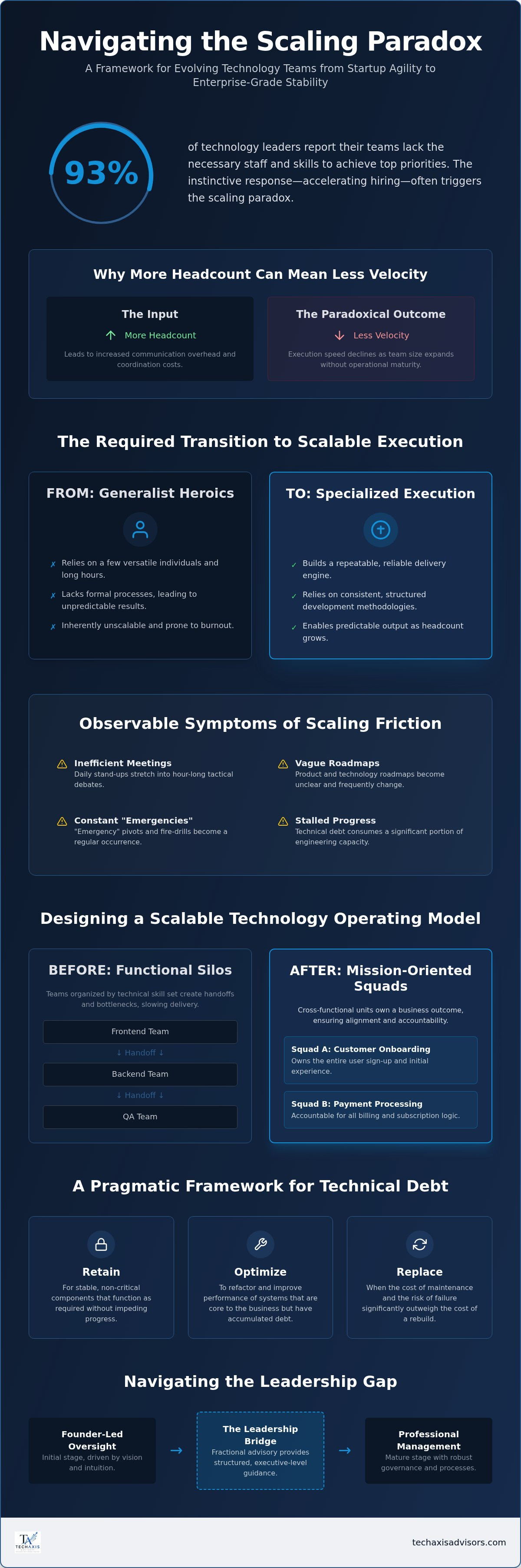
93% of technology leaders report that their teams lack the staff and skills required to achieve their top priorities in 2026. For many CEOs, the instinctive response is to accelerate hiring. However, simply adding headcount often triggers the scaling paradox; development velocity declines even as the engineering payroll expands. You've likely felt this friction as technical debt stalls new features and the direct link between technology spend and business growth begins to blur.
Scaling tech teams for growth stage is not a recruitment challenge; it's an operational maturity milestone. This article provides a pragmatic guide for executives and investors who need to evolve their organizations from startup agility to enterprise-grade stability without losing execution speed. We'll replace organizational anxiety with a disciplined framework for growth.
You'll learn how to implement a repeatable model for organizational design, reduce execution risk through senior oversight, and ensure your technology roadmap remains strictly aligned with your commercial objectives.
Table of Contents
The Scaling Paradox: Why More Headcount Often Results in Less Velocity
The Scaling Paradox is a well-documented phenomenon in organizational design. It occurs when communication overhead begins to exceed production gains. Simply adding engineers to a project doesn't automatically decrease the delivery timeline; it often increases coordination costs, leading to a net loss in execution velocity. When scaling tech teams for growth stage, the objective isn't merely to expand payroll. It's to architect a system where output increases predictably as headcount grows.
Early-stage success often relies on "Generalist Heroics." A few versatile individuals work long hours to overcome a lack of formal process. This model is inherently unscalable. Growth requires a transition to "Specialized Execution." Your technology strategy must shift from building isolated features to building a repeatable delivery engine. This engine relies on consistent software development methodologies that prioritize reliability over individual brilliance.
Identifying Growth-Stage Friction Points
Friction in a growing organization manifests through specific, observable symptoms. You might notice daily stand-ups stretching into hour-long tactical debates. Roadmaps often become vague, and "emergency" pivots occur with increasing frequency. These are not just cultural issues; they are architectural flaws. Technical debt also plays a role. It consumes a significant portion of engineering capacity, which frustrates high-performing talent and increases attrition. During rapid hiring cycles, the connection between technical tasks and business outcomes often breaks. Engineers focus on technical puzzles while executive leadership focuses on market share. Without alignment, the organization moves in conflicting directions.
The Executive Intelligence Approach to Talent
Resumes provide a historical record, but they rarely predict business-impact readiness. You need individuals who understand how technology investments translate into enterprise value. Operational maturity is the ability to deliver predictable results at scale. Relying on gut feeling during interviews is a high-risk strategy. Objective data, gathered through structured advisory leadership assessments, allows you to identify structural gaps before they become crises. These assessments provide the clarity needed to hire for the future organization, not just the current fire.
Designing a Scalable Technology Operating Model
Growth often exposes the limitations of functional silos. When teams are organized by skill set, such as separate departments for frontend development and quality assurance, handoffs become inevitable bottlenecks. Scaling tech teams for growth stage demands a shift toward mission-oriented squads. These cross-functional units own a specific business outcome, like customer onboarding or payment processing, rather than a technical layer. This structure ensures that every engineer understands the commercial value of their code.
Accountability requires a clear framework. A growth-stage RACI matrix prevents the diffusion of responsibility that often accompanies rapid expansion. It defines exactly who makes the final call on architectural standards versus feature prioritization. Without this clarity, decision-making slows, and the execution engine begins to idle. You must balance squad autonomy with centralized standards to maintain structural integrity across the platform.
Mission-Oriented vs. Functional Structures
Organizing by product mission increases delivery speed. It aligns developers directly with user needs and business metrics. However, this model can create "knowledge islands" where one squad solves a problem that another has already addressed. To mitigate this risk, establish cross-squad "Chapters" that maintain technical standards and shared best practices. Integrating your data strategy into these units is vital. Data shouldn't be an afterthought; it must be a core component of every squad's mission. This ensures that reporting and analytics remain consistent across the enterprise as you scale. Consistency in data allows for evidence-based decisions at the board level.
Building the Governance Layer
Effective governance provides the guardrails that allow teams to move faster with less risk. Executive clarity in technical decision-making comes from establishing a consistent cadence for reporting technology risks and progress. This transparency ensures the board isn't surprised by technical debt or roadmap delays. This structured approach is essential for improving operational maturity. By linking technology KPIs directly to board-level outcomes, such as customer acquisition cost or platform uptime, you turn the tech organization into a transparent value driver. If your current structure feels fragmented, you might consider an Executive Technology Operating Model Assessment to identify specific bottlenecks and realign your resources with your growth objectives.
The Hybrid Talent Strategy: Balancing Speed, Cost, and Control
Relying solely on full-time recruitment is often the slowest path to market. When scaling tech teams for growth stage, you must distinguish between your "core brain" and your "execution hands." Your core team should retain the institutional knowledge and strategic architecture that defines your competitive advantage. Everything else is a candidate for strategic sourcing. This hybrid approach allows you to access specialized skills without the long-term overhead of a massive permanent payroll.
Managing this mix requires executive-level vendor oversight. It's not enough to hire a delivery partner; you must ensure their output aligns with your platform standards. Without this governance, you risk inheriting a patchwork of technical debt that will eventually stall your roadmap. You need an objective framework to evaluate when to build in-house and when to leverage external expertise.
Strategic Sourcing for High-Impact Roles
Focus your internal hiring on "force multiplier" roles. These include Lead Architects, DevOps Specialists, and Data Leads who set the standards for everyone else. Avoid the common pitfall of hiring junior engineers to "save money" during rapid expansion. In a growth environment, the coordination cost of managing junior staff often outweighs their technical output. Using Fractional CTO services provides the necessary seniority to manage these complex talent ecosystems. A fractional leader ensures that specialized vendors deliver against your business objectives rather than their own internal metrics.
Comparison: Leadership Options for Growth
Choosing the right leadership model depends on your current revenue milestones and the complexity of your technology stack. The primary differentiator is the level of executive decision support each role provides.
IDC estimates that by 2026, 90% of organizations will face major skill shortages. A hybrid strategy isn't just about saving money. It's a risk mitigation tactic to ensure your roadmap survives a volatile talent market.
Managing Technical Debt and Governance During Rapid Expansion
Rapid growth often forces a trade-off between speed and structural integrity. When scaling tech teams for growth stage, the accumulation of technical debt is an inevitable byproduct of moving quickly. If left unmanaged, this debt becomes a permanent drag on your delivery engine. Technical debt is the deferred cost of choosing an easy solution today over a better one tomorrow. Verified industry data suggests that technical debt consumes between 20% and 40% of engineering time on average. For an executive, this represents a significant portion of your payroll that isn't contributing to new market value.
Governance shouldn't be a bureaucratic hurdle. It must function as a set of pragmatic guardrails that support execution velocity. During infrastructure shifts, cybersecurity and data integrity often become vulnerable. You need a structured approach to oversight that ensures compliance without stifling the agility of your mission-oriented squads. This requires a transition from manual reviews to automated governance workflows that provide real-time visibility into technology risk. By establishing these standards early, you prevent the organizational chaos that typically follows a hiring surge.
The Executive Decision Framework for Modernization
Prioritizing technical debt repayment against new feature requests is a common board-level tension. To resolve this, we utilize a "Retain, Optimize, Replace" framework. You must evaluate the business case for each legacy component based on its commercial impact. Retain systems that provide stable value; optimize those where performance is a bottleneck; and replace only when the maintenance cost exceeds the ROI of a new build. This disciplined approach is detailed in our guide on modernizing legacy technology. By treating debt as a financial liability, you can make evidence-based decisions about where to allocate your engineering capital.
Scaling with AI and Automation Readiness
AI integration is a primary focus for many organizations in 2026, but adoption requires caution. Research indicates that 42% of companies abandoned most of their AI initiatives in 2025 due to poor alignment or lack of structural readiness. Before scaling your headcount to support these initiatives, you must conduct a thorough assessment of your AI readiness. Automation can significantly increase team capacity, potentially reducing the need for aggressive hiring in generalist roles. By automating governance and testing workflows, you maintain high standards of quality while allowing your high-leverage builders to focus on high-impact commercial features.
Navigating the Leadership Gap: The Role of Fractional Advisory
CEOs in the growth stage often face a unique form of isolation. They have engineers to build features and managers to track tasks, yet they lack a strategic peer to evaluate technical trade-offs against commercial risks. This leadership gap often results in reactive decision-making that prioritizes short-term fixes over long-term stability. Scaling tech teams for growth stage requires more than just technical proficiency; it requires a "Leadership Bridge" that moves the organization from founder-led agility to professional management.
A fractional advisor provides this bridge. They offer the wisdom of a veteran executive without the immediate commitment or cost of a full-time C-suite hire. This role isn't about direct implementation. It's about providing the board with evidence-based findings that translate complex infrastructure needs into clear business value. By professionalizing the technology function early, you reduce execution risk and ensure that your technical roadmap remains a servant to your commercial objectives.
Bridging the Executive Void
There is a fundamental difference between technical management and executive advisory. Management focuses on the "how" of delivery, such as sprints, tickets, and immediate feature releases. Advisory focuses on the "why," specifically the alignment of tech spend with revenue growth and the mitigation of long-term operational risk. By integrating advisory leadership into your structure, you gain insights that clarify the roadmap for investors and stakeholders. This professionalization prepares the organization for an eventual long-term executive hire, ensuring that when you do bring on a permanent CTO, they inherit a disciplined engine rather than a chaotic rescue mission.
Next Steps for Growth-Stage Leaders
Your first priority should be identifying where your current structure is failing to support your growth targets. Most scaling friction stems from a single, identifiable bottleneck, whether it's unmanaged technical debt, poor vendor oversight, or a lack of clear accountability. Conducting a structured Executive Technology Operating Model Assessment provides the evidence needed to realign your resources with your business goals. This assessment replaces organizational anxiety with a prioritized roadmap for maturity, allowing you to scale with confidence.
Realizing Operational Maturity in the Growth Phase
Successful expansion requires a fundamental shift from individual heroics to a structured, mission-oriented operating model. By organizing around specific business outcomes and treating technical debt as a strategic financial liability, you maintain execution velocity while reducing risk. Our Proprietary Executive Intelligence Platform provides the evidence-based findings necessary to guide these transitions within complex, regulated sectors like wealth management and private equity. It's the difference between a technology team that reacts to fires and one that drives predictable results.
Transitioning from startup agility to enterprise-grade maturity is an essential milestone for any expanding firm. It's important to remember that scaling tech teams for growth stage is a deliberate architectural choice, not a natural byproduct of increased headcount. With the right governance and senior oversight, your organization can achieve its commercial targets without sacrificing the agility that built its initial success.
With a disciplined framework in place, you can lead your technology organization through its next phase of evolution with clarity and confidence.
Frequently Asked Questions
When is the right time to move from a Lead Engineer to a CTO?
Transition when technical decisions begin to carry significant commercial risk or require representation at the board level. A Lead Engineer focuses on the mechanics of delivery, while a CTO focuses on how technology investments support the broader business strategy. This shift usually occurs when the company moves beyond a single product line or enters a highly regulated market requiring formal governance.
How do we balance hiring for speed versus hiring for long-term culture?
Prioritize high-leverage builders who possess both technical proficiency and alignment with your operational standards. Hiring purely for speed often leads to generalist heroics that eventually break as the organization matures. Instead, use structured technical assessments to ensure candidates can operate within mission-oriented squads without requiring constant oversight or extensive cultural realignment after they join the team.
What is the industry average for technical debt in growth-stage companies?
Research indicates that technical debt consumes between 20% and 40% of engineering time on average for growth-stage firms. This deferred cost often stems from prioritizing rapid feature delivery over structural integrity. Addressing this debt is a critical component of scaling tech teams for growth stage to prevent a total collapse of development velocity as the codebase becomes more complex.
Can a fractional CTO actually manage a full-time engineering team?
Yes, a fractional CTO provides executive leadership and governance rather than daily tactical management. They establish the operating model, set architectural standards, and oversee vendor performance. This allows full-time engineering managers to focus on delivery while the fractional leader ensures that the technology roadmap remains aligned with board-level business outcomes and commercial targets.
How does scaling a tech team differ in regulated industries like wealth management?
Scaling in regulated industries requires integrating compliance and data governance into the core development lifecycle. In wealth management or financial services, moving fast cannot compromise data integrity or regulatory reporting. You must implement automated governance workflows that provide a clear audit trail without slowing down the mission-oriented squads or creating unnecessary bureaucratic friction for the developers.
What are the most common mistakes CEOs make when scaling tech teams?
The most frequent error is assuming that increasing headcount automatically increases production output. CEOs often fall into the scaling paradox, where communication overhead slows down execution. Another common mistake is neglecting the leadership gap, leaving technical decisions to managers who lack the executive experience to evaluate long-term commercial trade-offs or manage complex vendor relationships effectively.
How do we maintain development velocity while implementing new governance?
Maintain velocity by automating the governance layer so it supports rather than stifles the engineering team. Shift from manual, bureaucratic reviews to programmatic guardrails like automated testing and compliance checks. This ensures that scaling tech teams for growth stage results in predictable, high-quality output instead of organizational friction that stalls your product roadmap and frustrates talent.
Should we use an agency or build an in-house recruitment team?
Use specialized agencies for rapid, high-impact hiring while building an in-house team for long-term talent strategy. Contingency recruiter fees in 2026 typically range from 20% to 25% of a candidate's first-year salary. For a $130,000 engineering hire, this is a significant investment that should be balanced against the long-term cost of a dedicated internal recruiter who understands your culture.



Comments