

Scaling Business Operations for Growth: An Executive Framework
Growth rarely stalls because every process needs automation. It stalls when a specific operational constraint limits capacity, visibility, or control. Scaling business operations for growth starts with identifying that constraint, not adding tools or complexity by default.
As a business expands, processes that once relied on individual knowledge and manual workarounds can become harder to manage. Leadership may also lack reliable information to sequence investments, while technology, data, and vendor decisions accumulate without clear ownership. These pressures are familiar, but they do not all require the same response.
This framework will help you identify which operational constraints are most likely to impede your growth plan, then prioritize changes by business value, risk, and execution capacity. It also shows how to establish ownership, measures, and leadership oversight so decisions translate into disciplined action.
The focus is practical: assess where growth is straining the operating model, determine whether to improve a process, integrate systems, or consider another option, and sequence the work around business goals. The objective is to expand capacity while maintaining control, without treating automation or technology investment as the answer to every problem.
Table of Contents
Scaling business operations for growth starts with finding the binding constraint
Map processes, decision rights, data, and technology before expanding capacity
Choose operational changes by business value, risk, and readiness
Build a growth operating plan with measures, owners, and governance
When executive advisory can help turn a scaling plan into execution
Scaling business operations for growth starts with finding the binding constraint
Growth puts pressure on the operating model. A process that worked through informal coordination may now depend on one person’s memory, while a new system may add steps without resolving who can approve an exception. The executive task is to identify the constraint that limits capacity, not simply the most visible source of friction. That distinction is central to scaling business operations for growth.
What operational scalability means to an executive team
Operational scalability is the ability to increase business capacity while maintaining decision quality, accountability, and consistent service. It depends on repeatable work, clear ownership, and decision rights that remain effective as volume and complexity rise. This is consistent with the broader idea of Scalability: growth should not require an equivalent increase in the effort or resources needed to deliver outcomes.
For executives, capacity must be judged against the growth plan and the organization’s tolerance for risk. A firm pursuing more clients, transactions, or locations needs to know which workflows must absorb additional demand and which controls cannot be weakened. The organizations TechAxis Advisors serves are described on its audience and industry page.
Repeatable work reduces reliance on individual workarounds. Clear accountability makes it easier to see who owns a result, who can make a decision, and when an issue needs escalation. Without these conditions, adding staff or technology can increase activity while leaving responsibility and service quality uncertain.
How to recognize a constraint before adding capacity
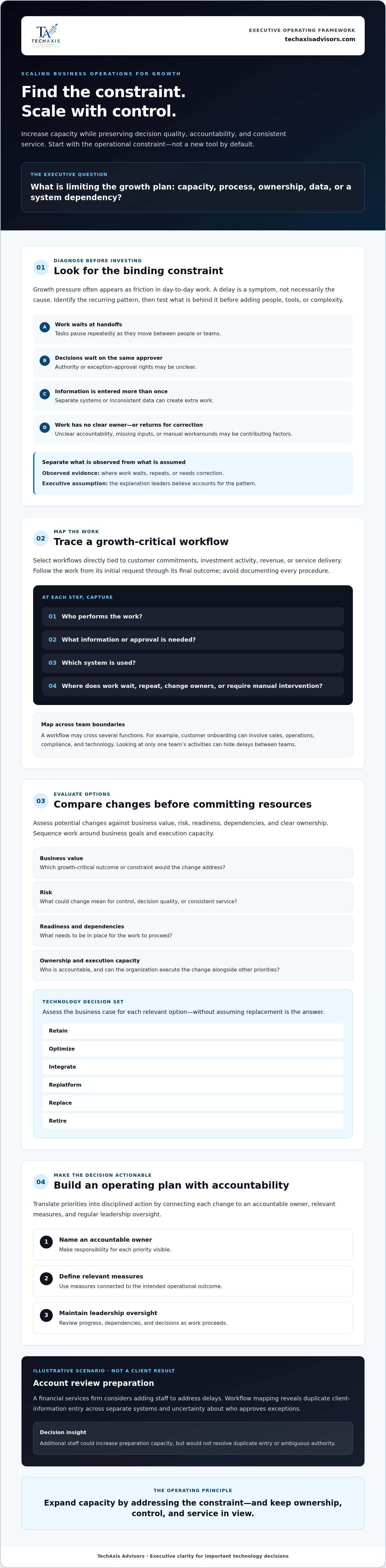
Start with recurring evidence: handoffs that repeatedly pause, decisions that wait for the same approver, duplicate data entry, or tasks with no clear owner. A delay is a symptom, not necessarily the cause. The underlying constraint might be an unclear decision right, inconsistent source data, a process designed around one specialist, or a system dependency that creates extra work.
Illustrative scenario, not a TechAxis client result: A financial services firm sees delays in preparing account reviews and considers adding staff. Mapping the workflow reveals that teams re-enter client information from separate systems, then wait for clarification about who approves exceptions. More staff could increase preparation capacity, but it would not resolve duplicate entry or ambiguous authority.
Compare the pattern across functions before assigning blame. Operations may report missing inputs, technology may point to system limitations, and finance may see late or inconsistent figures. These observations can all be true while describing different points in the same workflow.
Observed evidence: where work waits, repeats, or returns for correction.
Executive assumption: the explanation leaders believe accounts for that pattern.
Test the assumption against process records, data sources, and conversations with the people doing the work. This helps distinguish a capacity shortage from a process, ownership, data, or technology constraint, giving leadership a sound basis for deciding what to address first.
Map processes, decision rights, data, and technology before expanding capacity
Once a growth constraint is suspected, map the work that depends on it. Keep the scope narrow: choose a small number of workflows directly tied to customer commitments, investment activity, revenue, or service delivery. The aim is not to document every procedure. It is to understand where added demand could affect outcomes, controls, or execution.
Trace the work and locate friction across handoffs
Follow each selected workflow from the initial request through its final outcome. At each step, record who performs the work, what information or approval is needed, which system is used, and where the work waits, repeats, changes owners, or requires manual intervention. A customer onboarding workflow, for example, may cross sales, operations, compliance, and technology. Looking at only one team’s activities can hide delays created between teams.
Use the map to distinguish among process design, capability, capacity, technology, and governance issues. A well-designed process may still be constrained by insufficient capacity. A team with capacity may be slowed by missing skills, disconnected systems, or unclear authority. Guidance on Building Scalable Operations also emphasizes process and tool choices as part of preparing work to support growth.
Keep the review proportional to the decision. Redesign only after evidence shows which friction materially affects the growth plan. Improving every workflow at once can divert attention from the constraint that matters most.
Clarify accountability, information, and system dependencies
For each critical step, identify the accountable decision-maker separately from the person completing the task. Task ownership answers who does the work; decision rights establish who can approve, resolve an exception, or accept risk. If those roles are unclear, work may wait even when the right people and tools are available.
Then trace the information and technology dependencies. Does a leader rely on a consistent source for a key performance indicator, or do teams reconcile conflicting figures manually? Does a customer relationship management (CRM) system pass information to an enterprise resource planning (ERP) system, or does a person re-enter it? Note the controls and data checks needed to trust the information used for oversight and prioritization.
Process: Where does work wait, repeat, or require manual intervention?
Accountability: Who owns the outcome, and who has authority to decide?
Information and systems: Which sources, controls, and dependencies support the workflow?
This map gives leaders a shared basis for deciding whether to change the process, build capability, add capacity, address a technology dependency, or clarify governance. TechAxis Advisors’ executive advisory and assessment work can help structure this review and translate findings into leadership decisions.
Choose operational changes by business value, risk, and readiness
A mapped constraint does not automatically justify a new platform or a major transformation. The right response may be a clearer approval path, better use of existing tools, or a system change. For scaling business operations for growth, compare interventions against the business outcome they support and the organization’s ability to execute them.
Compare operational and technology options without defaulting to replacement
Use the evidence from the workflow to test alternatives. If information is sound but approvals stall, clarify decision rights before buying software. If teams enter the same information in multiple systems, integration may address the friction more directly than replacement. Consider a new platform only when evidence shows that existing systems cannot reasonably support the required outcome.
This decision discipline also applies to technology budgets. A review of scaling for profitable growth can help frame choices around the connection between people, processes, and an actionable plan, rather than treating technology as an isolated investment.
Prioritize initiatives the organization can actually execute
Assess each option against business value, execution risk, readiness, dependencies, and a named owner. Readiness includes leadership time, staff capacity, data quality, and the impact of changing work. A high-value initiative may need to wait if a prerequisite decision is unresolved or the organization cannot manage the transition responsibly.
Executives should prioritize changes that deliver meaningful business value, have a credible owner and sequence, and keep execution risk within the organization’s capacity.
Use that lens when reviewing technology spend: compare the expected business contribution with the full operational change required, then sequence work around dependencies. If leaders need a structured view of technology priorities, they can discuss the decision with an advisor.
Build a growth operating plan with measures, owners, and governance
A priority becomes executable when leaders can see the intended outcome, who is accountable, what must happen first, and how progress will be assessed. For scaling business operations for growth, convert the selected changes into a plan that connects operational work to business objectives, rather than treating a roadmap as a list of projects.
Turn priorities into an accountable operating plan
Start by defining the business objective, then validate the constraint the initiative is meant to address. Assign an executive sponsor and an accountable owner for each priority. Record the intended outcome, dependencies, key assumptions, material risks, decisions required, and next actions in a concise action register.
Use a roadmap to show sequence and decision points, not to suggest that every date or assumption is certain. For example, a data integration initiative may depend on agreement about which system is authoritative. Make that decision visible as a prerequisite, with an owner and a point at which leaders will confirm readiness. A technology roadmap for a scale-up should similarly connect business priorities to dependencies, sequencing, and accountable decision-makers.
Maintain oversight as the organization and its needs change
Choose a review cadence that matches the pace and risk of the work. In each review, examine progress against agreed measures, resolve blockers, and revisit assumptions when evidence changes. Keep measures limited and tied to outcomes leaders can act on, such as service consistency, throughput, quality, risk exposure, or decision timeliness.
Define each measure before reporting it: specify what it counts, where the data comes from, who validates it, and how often it is reviewed. Separate leading indicators, which signal whether necessary work is progressing, from outcome measures, which show whether the intended business result is occurring. A completed training milestone, for instance, may indicate readiness; it does not by itself demonstrate improved service or quality.
Named ownership makes progress observable by establishing who is responsible for updating status, explaining variances, and raising decisions that need leadership attention. When vendors support critical execution, include their deliverables, dependencies, risks, and escalation paths in the same governance process. This keeps accountability with the organization while making third-party contributions visible.
For support connecting priorities, ownership, and oversight, explore executive advisory leadership.
When executive advisory can help turn a scaling plan into execution
Internal leaders may be well positioned to deliver a scaling plan when priorities are clear, decision rights are established, and the team has enough capacity to manage change alongside day-to-day responsibilities. Outside perspective may help when leaders lack shared evidence, competing priorities are unresolved, or technology and operating decisions cross functions without a clear executive owner.
The right support depends on the gap. An assessment helps leadership make a decision when the facts, constraints, or options need structured evaluation. Ongoing advisory provides senior counsel as decisions arise across technology, data, AI, or governance. Fractional executive leadership may fit when the organization needs sustained technology leadership but is not adding a full-time executive role.
What an executive decision-support engagement should produce
An assessment should help executives decide what to do next, not simply catalogue technical findings. A structured process can move from diagnostic inquiry to evidence review and synthesis, then translate conclusions into board-ready findings, a prioritized strategic roadmap, an action register, and an executive presentation. These deliverables make the reasoning, sequence, ownership, and decisions visible.
The roadmap should reflect business priorities and implementation capacity. It can identify decisions that leadership must resolve, dependencies that affect sequencing, and areas requiring further validation. This is decision support, not a guarantee of results or a commitment that the advisor will perform every implementation task.
Execution support may include advisory leadership, governance, vendor oversight, and coordination with qualified delivery partners. The organization retains decision-making accountability, while defined oversight helps keep work aligned with the agreed objectives. TechAxis describes its advisory leadership approach as support for governance and execution.
Match the engagement to the decision or execution gap
Choose the form of support based on what leadership needs to resolve. If the direction is uncertain, begin with structured evidence. If priorities are established but complex decisions continue, ongoing advisory can provide senior counsel. If sustained technology leadership is missing, fractional leadership can provide that executive function without a full-time hire.
Effective scaling business operations for growth depends on keeping the operating plan connected to accountable decisions and business goals. If internal leaders have the capacity and authority to own that work, external support may not be necessary. If evidence, senior oversight, or execution governance is missing, consider which engagement fits the gap. A confidential conversation can help clarify whether an assessment, advisory, or fractional leadership is appropriate.
Move from growth priorities to disciplined execution
Scaling business operations for growth is not a mandate to automate or replace everything. It begins with identifying the constraint that matters, examining the process and technology around it, then choosing changes the organization can execute and measure.
Keep the operating plan tied to business objectives. Assign owners, clarify dependencies, and use a focused set of measures to make progress and emerging risks visible. If leadership needs more evidence or capacity to move from priorities to oversight, the right support may be an executive assessment, retained advisory, or fractional executive leadership.
TechAxis Advisors’ founder, Aarati Dikshit, brings more than 25 years of executive experience as a CIO, CTO, and CISO. Structured assessments provide board-ready findings, prioritized roadmaps, and action registers to support leadership decisions.
With clear priorities and accountable execution, growth can become more manageable. Begin with the constraint that matters most, then build from there.
Frequently Asked Questions
How do you scale business operations without adding unnecessary complexity?
Scale by addressing the constraint that limits the business, rather than adding tools or procedures by default. Start with a growth-critical workflow, identify where work waits or repeats, and clarify ownership and decision rights. Then compare process changes with technology options. For scaling business operations for growth, expand only the controls, systems, and capacity that support defined business objectives, and review whether each change improves service or decision quality.
What should a company scale first as it grows?
Scale the capability or workflow most directly limiting the growth plan. That may be customer onboarding, investment operations, reporting, or another process tied to a business commitment. Use evidence such as recurring delays, rework, or decisions awaiting approval to locate the constraint. Avoid assuming that the busiest department is the source. Confirm the underlying cause before adding staff, changing systems, or increasing process volume.
Is technology enough to solve operational bottlenecks?
No. Technology can support capacity, consistency, and access to information, but it will not resolve unclear ownership, conflicting priorities, or decision rights on its own. Before investing, determine whether the constraint is caused by process design, capability, capacity, a system limitation, or governance. For example, integrating two systems may reduce duplicate entry, while a stalled approval may require clearer authority rather than a new platform.
How can executives measure whether operations are scaling effectively?
Choose a limited set of measures connected to the intended business outcome, such as throughput, service consistency, quality, risk, or decision timeliness. Define each measure before reporting it, including its data source, calculation, and accountable owner. Separate leading indicators, which show whether prerequisites are progressing, from outcome measures, which show whether business performance is changing. Review both so leaders can distinguish activity from results.
When should a growing company bring in a fractional technology executive?
Consider fractional technology leadership when the organization needs sustained senior-level direction but is not adding a full-time executive role. It may be appropriate when technology decisions span business functions, governance needs attention, or leadership requires ongoing oversight of priorities and execution. If the main need is evidence to choose a direction, an executive assessment may be a better starting point. Match the engagement to the decision or leadership gap.
What happens if a company automates a process that is not ready?
Automation can make a weak process faster without making it reliable. Unclear approvals, inconsistent inputs, or frequent exceptions may be reproduced at greater volume, creating more rework or reducing visibility into errors. First clarify the process outcome, ownership, controls, and exception paths. Then assess whether automation addresses the actual constraint. Keep appropriate human review where judgment or escalation remains necessary.
How can leaders prioritize operational improvements when resources are limited?
Compare candidate changes by business value, execution risk, readiness, dependencies, and accountable ownership. Prioritize work that supports a stated growth objective and can be delivered with available leadership attention and capacity. Sequence prerequisites first, such as resolving data ownership before building reporting changes. Defer initiatives with unclear outcomes or unresolved dependencies, and revisit them when assumptions, resources, or business needs change.


Comments