

Scalable Technology Infrastructure for Growth: An Executive Framework
Growth often exposes the structural weaknesses that a smaller organization could afford to ignore. For many executives, the very systems designed to facilitate expansion become the primary source of execution risk as technical debt accumulates. You likely recognize the friction: product releases are delayed by legacy constraints, and technology costs fluctuate unpredictably exactly when you need stability. This creates a state of organizational anxiety where every new market entry or acquisition feels like a gamble against your own internal capacity.
It's a common frustration, but it isn't an inevitable tax on success. You can transition from a reactive IT posture to a deliberate, scalable technology infrastructure for growth that aligns your capital allocation with specific business outcomes. This article provides a clear framework to modernize your foundation while maintaining the rigorous security and compliance standards required in financial services and private equity. We'll outline a roadmap to reduce execution risk and replace operational chaos with a disciplined, scalable operating model that supports rapid business expansion.
Table of Contents
The Business Imperative: Scalability vs. Growth
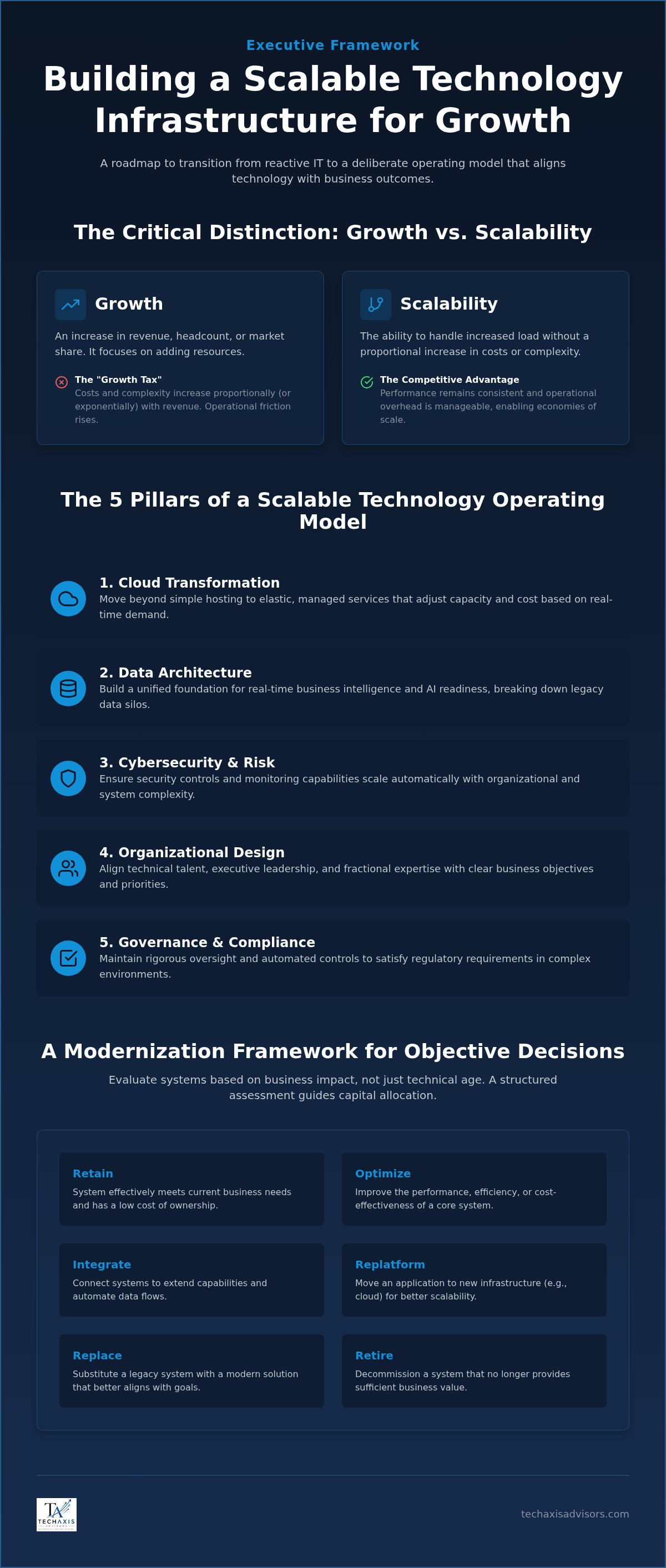
Growth and scalability are distinct concepts that executives often conflate. Growth refers to an increase in revenue, headcount, or market share. In contrast, Scalability is the specific property of a system to handle increased load without a proportional increase in costs or complexity. When a system scales, performance remains consistent while operational overhead remains manageable. For organizations in financial services, building a scalable technology infrastructure for growth isn't just a technical requirement. It's a financial necessity.
Many firms fall victim to what we call the "Growth Tax." This occurs when non-scalable systems create exponential technical debt as the business expands. Every new client or transaction requires more manual oversight and custom coding. Instead of benefiting from economies of scale, the organization suffers from diminishing returns. Operational friction increases. Execution risk rises. The result is a state of constant reactive IT where leadership spends more time fixing legacy issues than pursuing new opportunities.
Achieving executive clarity requires distinguishing between urgent technical fixes and the strategic foundation. A reactive model prioritizes the immediate patch. A proactive technology operating model focuses on the structural integrity of the entire ecosystem. This transition is essential for any firm intending to scale without compromising its security posture or service quality. You can explore how this transition is managed through specialized Operational Scalability Consulting.
The Consequences of Non-Scalable Infrastructure
Infrastructure that cannot scale creates significant execution risk. Projects stall because the underlying systems aren't flexible enough to support new features. Organizations often over-invest in expensive software suites without a strategic framework, hoping tools will solve structural problems. This approach leads to high costs without corresponding value. Technical debt eventually becomes a barrier to entry for new markets. It complicates acquisitions and slows down the integration of new assets during M&A activity.
Scalability as a Competitive Advantage
Scalable systems provide the agility needed to adopt emerging technologies like AI. They allow for predictable cost structures, which improves the accuracy of financial forecasting. When your technology spend aligns with business outcomes, you can allocate capital more effectively. Improving operational maturity also makes the organization more attractive to investors. A disciplined foundation demonstrates that the firm is ready for the next level of expansion. It's a signal of professional management.
The 5 Pillars of a Scalable Technology Operating Model
Scalability is not a technical feature of your software. It is an operational discipline of your entire organization. A scalable technology infrastructure for growth requires more than just adding server capacity; it demands a structured operating model that integrates people, processes, and platforms. Without this holistic approach, technical debt will eventually outpace your ability to innovate. Executives must focus on five core pillars to ensure their technology foundation remains an asset rather than a liability.
Cloud Transformation: Moving beyond simple hosting to elastic, managed services that adjust based on demand.
Data Architecture: Building a foundation for real-time business intelligence and AI readiness.
Cybersecurity & Risk: Ensuring security controls scale automatically with organizational complexity.
Organizational Design: Aligning technical talent and fractional leadership with business goals.
Governance & Compliance: Maintaining oversight in regulated environments like wealth management.
Cloud and Data Foundations
Legacy data silos are the primary enemy of scalability. They prevent a unified view of the business and complicate the adoption of advanced automation. Modernizing your data architecture involves transitioning from these silos to structured reporting frameworks. This shift is a prerequisite for AI-driven decision-making. Before making significant investments, a structured Executive Data & Analytics Assessment can identify where your current data integrity issues reside. This ensures your foundation can support the high-volume processing required for modern business intelligence.
Governance and Execution Leadership
Effective governance reduces execution risk by creating clear accountability. In regulated industries, this includes adhering to the latest standards, such as the NIST Cybersecurity Framework 2.0, which emphasizes the "Govern" function for board-level oversight. Managing vendors and platforms through a centralized strategy prevents the fragmentation that often occurs during rapid expansion. By improving operational maturity through technology, you create a predictable environment where technology spend aligns with strategic outcomes. This discipline allows the organization to absorb growth without the typical friction of scaling. If you're unsure where your current model stands, you might consider a confidential executive conversation to evaluate your roadmap.
Evaluating Your Current State: The Modernization Framework
Modernization is not a synonym for total replacement. For many organizations, the urge to replace every legacy system leads to unnecessary capital expenditure and heightened execution risk. An objective Executive Technology Assessment serves as the initial step in any growth initiative. It provides the clarity needed to distinguish between systems that are functional and those that represent a liability. Identifying hidden technical debt is crucial; these are the structural weaknesses that threaten operational stability but remain invisible during standard IT maintenance. Establishing a scalable technology infrastructure for growth requires a business-first lens that balances ROI against organizational risk.
The TechAxis Modernization Framework
We evaluate technology through a nuanced lens: retain, optimize, integrate, replatform, replace, or retire. Retaining a system is appropriate when it remains sufficient to support the next growth phase without creating a bottleneck. Optimization and integration focus on improving existing assets through automation and streamlined data flow. Replatforming or replacement becomes necessary only when the cost of maintenance and the risk of failure exceed the cost of transition. Finally, retiring legacy systems that no longer align with the business strategy reduces complexity and narrows the attack surface for potential security breaches.
Evidence-Based Decision Support
C-suite leaders require evidence-based findings to justify technology spend to the board. Structured Executive Intelligence Assessments move beyond generic consulting reports by providing data-driven insights into the current ecosystem. These assessments generate board-ready findings that map directly to business outcomes. By using a prioritized action register, leadership can focus resources on modernization efforts that provide the highest impact. This methodical approach ensures that every dollar spent on technology is a deliberate investment in the firm's future capacity. You can learn more about how these findings are structured by exploring our Executive Intelligence Assessments.
The Executive Roadmap for Scalable Implementation
A scalable technology infrastructure for growth is built through a disciplined, phased approach. Execution fails when organizations attempt to solve every technical issue simultaneously without a prioritized sequence. A structured roadmap ensures that technology investments are synchronized with business expansion. This reduces the risk of over-provisioning or system failure at critical moments. By following a methodical progression, leadership can maintain control over both the budget and the technical complexity of the organization.
Phase 1: Diagnostic & Assessment: Map the existing ecosystem to identify gaps in performance, security, and operational capacity.
Phase 2: Strategic Roadmap: Design a prioritized sequence of initiatives based on business impact and technical dependencies.
Phase 3: Intelligence Synthesis: Align the proposed roadmap with the firm's specific risk tolerance and capital budget to ensure financial sustainability.
Phase 4: Execution Leadership: Transition from planning to managed implementation through rigorous governance, vendor oversight, and delivery management.
Designing for Modular Growth
Modularity is the cornerstone of scaling in financial services and wealth management. It allows you to update or replace specific components without disrupting the entire operational flow. Managing this transition requires a "change-over" strategy that protects current business operations while building new capacity. During periods of rapid expansion, performing thorough technology due diligence is essential. This ensures that any new platforms or acquisitions integrate seamlessly into your established framework without introducing unforeseen technical debt. A modular approach ensures that your scalable technology infrastructure for growth can adapt to new regulatory requirements or market shifts without requiring a complete overhaul.
Maintaining Executive Oversight
Board-level alignment is maintained through concise, evidence-based briefs that focus on business outcomes rather than technical minutiae. Executives should monitor specific scalability metrics to ensure the infrastructure is performing as intended. Key indicators include system resilience during peak loads, performance latency, and the cost-per-transaction as volume increases. A truly scalable roadmap remains flexible. It should allow for adjustments as business goals evolve or market conditions shift. This flexibility ensures that technology remains a growth enabler rather than a static constraint on the organization's potential.
Managing Execution Risk with Fractional Leadership
Strategy often fails at the point of implementation. For firms building a scalable technology infrastructure for growth, the bottleneck isn't usually the vision; it's the operational oversight. High-growth organizations frequently outpace their internal technical management. This creates a leadership vacuum where vendors are left unmanaged and technical debt is allowed to accumulate unchecked. Embedded executive leadership provides the necessary governance to bridge this gap. It ensures that technical decisions remain aligned with business objectives throughout the scaling process.
Many growth-stage companies don't require a permanent, full-time CTO but desperately need the experience of a veteran executive. This is where Fractional CTO services provide a pragmatic solution. You gain access to high-level strategic confidence without the long-term overhead of a permanent hire. These professionals provide the advisory leadership required to oversee delivery partners and ensure that your scalable technology infrastructure for growth is implemented correctly the first time. This oversight reduces execution risk by enforcing accountability across all technical workstreams.
The Role of a Strategic Technology Advisor
A strategic advisor translates complex technical landscapes into clear, confident business decisions. Unlike a Managed Service Provider (MSP), an independent advisor provides objective findings without the bias of selling specific tools or licenses. They bridge the communication gap between the C-suite and implementation teams. This ensures that the board understands the business impact of technology spend while the technical teams understand the requirements of the growth strategy. This clarity replaces organizational anxiety with a sense of disciplined progress.
Next Steps for Executive Leadership
Determining your next move depends on the maturity of your current roadmap. If you lack a clear picture of your technical debt, a structured Executive Intelligence Assessment is the appropriate starting point. If you have a roadmap but lack the capacity to manage its execution, ongoing advisory or fractional leadership is more suitable. You can review our client profiles at Who Its For to see how similar organizations have navigated these transitions. Starting a confidential executive conversation allows you to evaluate your specific growth goals against your current technical capacity without the pressure of a traditional sales cycle.
Establishing Executive Control Over Technology
Building a scalable technology infrastructure for growth is an operational necessity for any firm navigating rapid expansion. It demands a transition from reactive technical debt management to a proactive operating model that aligns technology spend with business outcomes. Success depends on a structured roadmap, evidence-based assessments, and the right leadership to oversee complex implementations. By focusing on modularity and governance, you ensure that your systems support expansion rather than hindering it.
TechAxis Advisors brings the wisdom of veteran executives to your growth challenges. Our advisors are former CIOs, CTOs, and CISOs with more than 25 years of experience. We utilize our proprietary Executive Intelligence Platform to deliver board-ready findings and roadmaps designed for absolute clarity and accountability. This approach provides the evidence you need to make confident investment decisions that protect your organization's future.
Scaling a business is complex, but your technology foundation doesn't have to be a source of anxiety. With a disciplined framework and expert guidance, you can turn your infrastructure into a reliable engine for expansion. Your organization is ready for the next level; we help ensure your technology is ready to meet it.
Frequently Asked Questions
What is the difference between scalable and elastic infrastructure?
Scalability is the capacity to handle growth through architectural design; elasticity is the ability to automatically expand or shrink resources based on real-time demand. A scalable technology infrastructure for growth provides the structural foundation, while elasticity ensures you only pay for what you use during peak loads. Both are critical for financial services firms that experience seasonal transaction spikes but need to maintain predictable long-term cost structures.
When should a growth-stage company hire a Fractional CTO vs. a full-time executive?
A Fractional CTO is ideal when an organization needs strategic leadership and governance but doesn't yet require a permanent, high-cost executive hire. This often occurs during rapid expansion phases or specific modernization projects. If your primary need is high-level oversight of vendors and delivery partners rather than daily technical management, fractional leadership provides the necessary expertise without the long-term compensation commitments of a full-time C-suite position.
How does technical debt impact the valuation of a company during an acquisition?
Technical debt directly reduces valuation by increasing integration costs and creating heightened execution risk. Investors view legacy systems as a liability that requires immediate capital expenditure to modernize. In private equity transactions, significant debt can lead to price concessions or extended escrow periods. A clean, scalable foundation signals operational maturity and reduces the perceived risk for the buyer, often resulting in a more favorable multiple.
What are the most common signs that our current infrastructure is limiting our growth?
Frequent delays in product releases and unpredictable technology costs are primary indicators of a bottleneck. If your team spends more time on maintenance than innovation, your systems have likely reached their limit. Other signs include performance degradation during high-volume periods and an inability to integrate new data sources for real-time reporting. These friction points suggest your current architecture doesn't support a scalable technology infrastructure for growth without significant intervention.
How long does a typical Executive Technology Assessment take to complete?
A structured Executive Intelligence Assessment typically spans four to six weeks, depending on the complexity of the organization's ecosystem. This timeframe allows for a deep diagnostic of legacy systems, interviews with key stakeholders, and a thorough analysis of current vendor performance. The process concludes with a board-ready report that provides evidence-based findings and a prioritized roadmap. This methodical pace ensures clarity without disrupting the daily operations of the business.
Can we scale our infrastructure while maintaining compliance in a regulated industry?
Yes, scaling and compliance must be integrated through automated governance and security controls. Using frameworks like NIST CSF 2.0 allows organizations to build security into the foundation of their architecture. In wealth management and financial services, this means ensuring that data residency and audit trails scale automatically alongside transaction volume. Compliance becomes a byproduct of a well-designed operating model rather than a manual hurdle that slows down expansion.
What is the role of AI in building a scalable technology foundation?
AI serves as a catalyst for operational efficiency by automating routine governance and data processing tasks. A scalable foundation ensures that your data architecture is ready for AI adoption by centralizing fragmented silos into a unified reporting framework. This readiness allows for real-time business intelligence and automated risk monitoring. Without a scalable infrastructure, AI initiatives often fail because the underlying systems cannot handle the required data throughput or processing intensity.
How do we balance the cost of scalability with the need for immediate ROI?
Balancing these needs requires a framework that prioritizes investments based on risk and business impact. Immediate ROI is often found in optimizing existing assets through automation rather than full-scale replacement. By focusing on modular growth, you can implement scalable components in phases. This approach allows you to achieve quick wins in operational efficiency while building the long-term foundation. Your technology roadmap doesn't have to sacrifice short-term gains for long-term scalability.



Comments