

Scalability Consulting for Private Equity Portfolio Companies: An Executive Framework (2026)
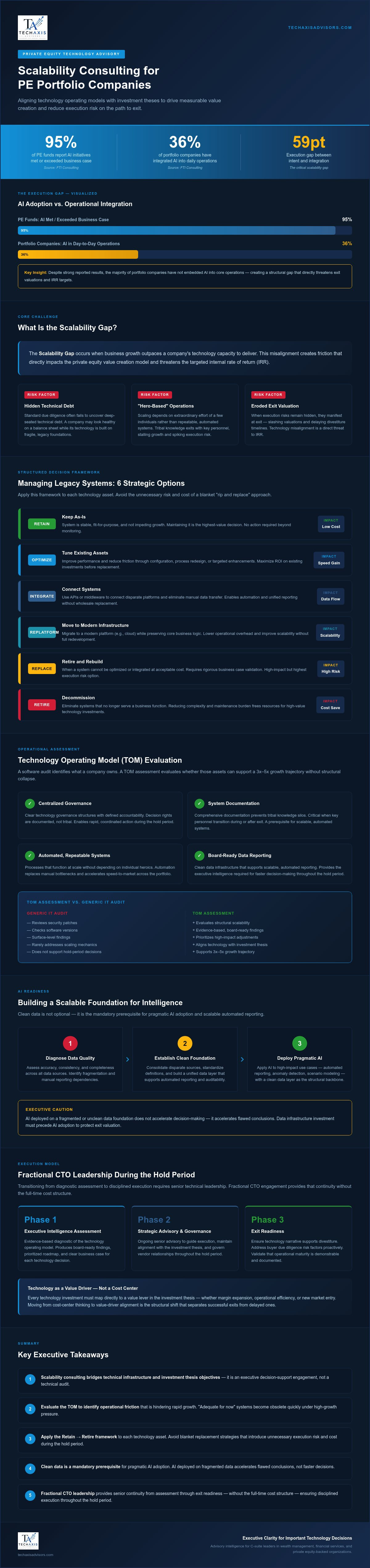
What if the technology stack you inherited is the primary obstacle to your 2026 exit strategy? According to research from FTI Consulting, 95% of private equity funds report that their AI initiatives have met or exceeded the original business case, yet only 36% of portfolio companies have integrated AI into day-to-day operations. This disconnect highlights a critical need for scalability consulting for private equity portfolio companies that prioritizes structural alignment over technical jargon.
You understand that misaligned technology spend and senior leadership gaps create unnecessary friction during the hold period. It's a common challenge where technical debt slows speed-to-market and obscures the data clarity required for informed decision-making. This guide offers a pragmatic framework to align technology operating models with your investment thesis to drive measurable value creation. We'll outline a roadmap for operational maturity, strategies for scalable data reporting, and methods to reduce execution risk to ensure a disciplined path to exit.
Table of Contents
The Scalability Gap in Private Equity Value Creation
Scalability consulting for private equity portfolio companies represents the strategic alignment of a firm's technology infrastructure with its long-term growth objectives. It isn't a simple technical audit; it's a structural assessment of whether the current operating model can handle the stress of rapid expansion. Many firms experience a "Scalability Gap" when their business growth outpaces their technology's capacity to deliver. This misalignment creates friction that directly impacts the private equity value creation model and threatens the targeted internal rate of return (IRR).
Standard technology due diligence for growth stage companies often fails to uncover the deep-seated technical debt that hinders agility. While a company might look healthy on a balance sheet, its technology may be built on fragile, legacy foundations that can't support high-volume transactions or sophisticated data reporting. When these issues remain hidden, they manifest as execution risks that can slash exit valuations and delay divestiture timelines.
Identifying Technical Execution Risk
Technical execution risk in a private equity context is the probability that an organization's existing technology architecture and operational processes will fail to support its stated growth objectives. When a company relies on manual processes or legacy architecture, it creates operational bottlenecks that slow speed-to-market. These bottlenecks often lead to "hero-based" operations, where scaling depends on the extraordinary effort of a few individuals rather than repeatable, automated systems. This reliance on tribal knowledge introduces significant risk during the hold period. If those key individuals leave, or if the volume of work exceeds their capacity, growth stalls and execution risk spikes.
Aligning Technology with the Investment Thesis
Every technology investment must support specific value levers identified in the investment thesis, such as margin expansion or new market entry. Moving from a mindset of technology as a cost center to technology as a value driver requires evidence-based diagnostics. These diagnostics identify modernization areas with the highest impact on the bottom line. By using structured assessments, sponsors can ensure that technology spend isn't just a maintenance expense but a deliberate investment in the company's exit valuation. This alignment ensures the technical roadmap directly supports the financial milestones required for a successful divestiture.
Evaluating the Technology Operating Model for Rapid Growth
A technology operating model (TOM) is the structural foundation of a company's ability to execute its strategy. It determines how technology resources are allocated, governed, and measured to deliver business outcomes. While a software audit identifies what a company owns, scalability consulting for private equity portfolio companies evaluates how those assets perform under the stress of rapid expansion. It's the engine for value creation, and if it's misaligned with the investment thesis, it becomes a primary source of friction.
Generic IT audits often focus on security patches or software versions, but they rarely address the mechanics of scaling. Improving operational maturity through technology reduces the friction that typically occurs when a mid-market firm attempts to scale without upgrading its delivery mechanisms. Scalability consulting for private equity portfolio companies ensures that the technology organization can support a 3x or 5x growth trajectory without collapsing under its own weight.
We leverage the TechAxis Executive Intelligence Platform to move beyond subjective opinions. This platform analyzes the underlying mechanics of the technology organization, providing evidence-based, board-ready findings that prioritize high-impact adjustments over minor technical fixes. It transforms complex technical data into actionable executive intelligence, allowing for faster decision-making during the hold period.
Assessing Operational Maturity
High-growth targets render "adequate for now" systems obsolete almost immediately. Evaluating the current state against a desired future state requires a disciplined framework that looks at more than just code. Key indicators of a mature technology organization include:
Centralized technology governance and clear accountability.
Comprehensive system documentation that prevents tribal knowledge silos.
Rigorous vendor management and platform oversight.
Without these pillars, a company lacks the structural integrity to support rapid expansion. "Adequate for now" is a significant risk for companies targeting aggressive growth, as it often leads to emergency replatforming at the exact moment when the business should be accelerating.
Evidence-Based Decision Support
Executive clarity replaces organizational anxiety when decisions are backed by data-driven diagnostics. Many leadership teams struggle with a lack of alignment between technology spend and the investment thesis, leading to wasted capital and missed milestones. A prioritized roadmap allows leadership to manage their bandwidth effectively, focusing only on the changes that move the needle for the investment thesis. These findings are formatted for board-level review, ensuring that stakeholders have a clear, evidence-based view of the path forward. If your portfolio company is facing a critical growth milestone, you may want to start with a confidential executive conversation to evaluate your current trajectory.
Decision Frameworks for Scaling Technology Infrastructure
Effective scalability consulting for private equity portfolio companies moves beyond the binary choice of "keep it" or "kill it." We utilize a disciplined framework to evaluate every core system: Retain, Optimize, Integrate, Replatform, Replace, or Retire. This methodology ensures that capital is deployed only where it directly supports the investment thesis. Sponsors often fall into the "rip and replace" trap, assuming that legacy systems are inherently unscalable. In reality, optimizing an existing system or integrating middleware is often the more pragmatic path to immediate speed-to-market.
Justifying modernization costs requires a business-case lens rather than a technical one. Every dollar spent on remediation must be weighed against its impact on margin expansion or revenue acceleration. Balancing technical debt reduction with the need for rapid growth is a constant trade-off. While total technical purity is rarely the goal, reducing execution risk to a manageable level is a prerequisite for a successful exit. This approach replaces organizational anxiety with a structured, prioritized plan for capital allocation.
Options and Tradeoffs for Growth-Stage Firms
Choosing between replatforming and integration depends on the remaining hold period and the complexity of the existing stack. Replatforming offers high long-term ROI but carries significant short-term execution risk. Conversely, integrating middleware can bridge the gap for legacy systems, providing the necessary data visibility without the disruption of a full migration. The "Retire" option is frequently overlooked; decommissioning redundant or non-core applications can simplify the environment and reduce the operational overhead of maintaining unnecessary software. When deciding between custom development and off-the-shelf platforms, the criteria should always be whether the software provides a competitive advantage or merely supports a commodity business process.
Modernizing Legacy Technology for Scalability
Cloud transformation is a primary lever for application modernization, yet it must be executed with precision to avoid cost overruns. High-stakes migrations require a phased approach to minimize business disruption and ensure data integrity. Vendor management becomes a strategic tool in this context, allowing portfolio companies to scale their capabilities through specialized partners without a proportional increase in internal headcount. This oversight ensures that third-party platforms remain aligned with the firm's governance standards and scalability requirements. By focusing on these structured modernization paths, leadership can drive value without the organizational trauma often associated with large-scale technical change.
AI and Data: Building a Scalable Foundation for Intelligence
AI success is not a matter of technical luck; it is a matter of architecture. Effective scalability consulting for private equity portfolio companies recognizes that data strategy is the mandatory prerequisite for any pragmatic AI roadmap. Without a clean, accessible data foundation, even the most sophisticated automation initiatives will fail to produce measurable value. Leadership must prioritize a disciplined data strategy for asset managers to ensure that technology spend translates into informed decision-making and operational efficiency.
The gap between potential and reality is stark. While 95% of private equity funds report that their AI initiatives have met or exceeded the original business case, only 36% of portfolio companies currently use AI in their day-to-day operations (FTI Consulting, 2026). Closing this gap requires an Executive AI Readiness Assessment to identify high-impact use cases that align with the investment thesis. This assessment filters out technical distractions and focuses resources on automation that directly supports margin expansion and revenue growth.
Scalable Data Architecture
Modernizing data reporting frameworks is essential for real-time business intelligence. A scalable architecture ensures data integrity and accessibility across the entire portfolio, removing the silos that often hinder growth. For PE sponsors, this foundation supports automated reporting, providing the transparency needed for rigorous oversight. When data is structured correctly, it stops being a liability and becomes a strategic asset that fuels both human and artificial intelligence.
AI Governance and Implementation
Governance is the bridge between AI hype and practical digital transformation. With the EU AI Act requiring compliance for high-risk systems by August 2, 2026, and the Colorado AI Act taking effect on June 30, 2026, a "governance-first" approach is no longer optional. These regulations impose strict requirements on developers and users of high-risk AI systems, particularly in financial services. Managing the risks of AI adoption involves a disciplined focus on cybersecurity, data privacy, and regulatory compliance to protect the firm's reputation and its eventual exit valuation.
Fractional Leadership: Executing the Scalability Roadmap
Fractional CTO services provide the executive leadership necessary to execute a transformation without the overhead of a permanent hire. For many mid-market firms, a full-time senior technology executive is a significant expense that doesn't always align with the 3-5 year hold period common in the current market. Scalability consulting for private equity portfolio companies becomes truly effective when it transitions from identifying gaps to actively managing the remediation process. This model allows sponsors to insert veteran leadership exactly where it's needed, bridging the gap between high-level strategy and technical delivery partners. It's a pragmatic solution for organizations that need senior-level guidance to navigate growth but don't yet require a permanent C-suite technologist.
By leveraging fractional leadership, portfolio companies gain access to the same level of expertise found at global strategy firms but with a focus on hands-on execution. This approach ensures that technology decisions remain business-aligned and evidence-based throughout the investment lifecycle. The fractional model provides a flexible, scalable leadership bridge that can be dialed up or down based on the complexity of the current roadmap.
Governance and Vendor Oversight
The Fractional CTO acts as a Strategic Architect, providing independent oversight for platform management and custom software development projects. They ensure that technical execution remains transparent and accountable to the board, removing the "black box" often associated with IT departments. By managing third-party delivery partners and white-label developers, the fractional leader prevents vendor lock-in and ensures that all technical builds align with the firm's long-term exit strategy. This independent layer of governance protects the investment from the risks of unchecked technical sprawl and ensures that every dollar spent on technology is a deliberate investment in value creation.
Moving from Diagnostic to Execution
Turning a strategic roadmap into an actionable register is where most transformations fail. A fractional partner supports the C-suite by translating complex technical findings into clear business decisions, allowing CEOs and CFOs to lead with confidence during growth stages. This transition ensures that the prioritized roadmap isn't just a static document but a living guide for operational improvement and technical debt reduction. Retained executive advisory provides the ongoing counsel required to navigate the inevitable technical challenges that arise during rapid growth, ensuring the organization stays on its disciplined path to exit. It's about replacing organizational anxiety with a structured, methodical approach to technical mastery.
Securing the Path to Divestiture
Aligning technology with the investment thesis is a prerequisite for driving measurable value and reducing execution risk. You've seen how hidden technical debt and misaligned operating models can stall growth at critical moments. Effective scalability consulting for private equity portfolio companies ensures that every technical decision supports the eventual exit strategy. By moving from diagnostic assessments to fractional execution, firms can bridge the gap between high-level strategy and tangible results. This disciplined approach replaces organizational anxiety with a structured path toward operational maturity.
TechAxis Advisors provides this clarity through our proprietary Executive Intelligence Platform. Led by a founder with over 25 years of experience as a CIO, CTO, and CISO, we deliver board-ready diagnostics that focus on the mechanics of scaling. As a certified WOSB and MWBE, we're dedicated to helping sponsors and leadership teams navigate the complexities of growth with confidence. Maintaining a results-oriented commitment to execution is the only way to protect your IRR in an increasingly complex market.
The transition from a growth-stage company to a mature, exit-ready organization requires more than just capital; it requires senior-level oversight and technical integrity. We're here to provide the leadership bridge your portfolio needs to succeed.
Frequently Asked Questions
What is the difference between scalability consulting and a standard IT audit?
Scalability consulting focuses on the strategic alignment of technology with the investment thesis and growth capacity. A standard IT audit typically examines compliance, security patches, and asset inventory. Scalability consulting for private equity portfolio companies evaluates the technology operating model to ensure it can handle a 3x or 5x expansion without failure. It provides a prioritized roadmap for value creation rather than just a checklist of technical vulnerabilities.
How does technical debt impact private equity exit valuations?
Technical debt acts as a hidden liability that can significantly reduce exit valuations by increasing the perceived execution risk for the buyer. If a portfolio company relies on fragile legacy systems or manual processes, the buyer may discount the price to account for future modernization costs. Reducing this debt during the hold period improves operational efficiency and ensures the technical infrastructure is a value driver rather than a drag on divestiture.
When should a portfolio company consider a Fractional CTO over a full-time hire?
A company should consider a Fractional CTO when it needs senior-level strategic guidance but doesn't yet require the overhead of a full-time executive. This model is particularly effective during the typical hold period of a private equity investment. It provides the necessary governance and vendor oversight to execute a scalability roadmap without the search time or long-term compensation commitments associated with a permanent C-suite hire.
How do you assess AI readiness in a regulated financial services environment?
Assessing AI readiness requires a governance-first approach that prioritizes data integrity and regulatory compliance. We evaluate whether the current data architecture can support automated decision-making while meeting requirements like the EU AI Act or state-level data privacy laws. The assessment identifies high-impact use cases that drive margin expansion without compromising the organization's risk tolerance or cybersecurity posture in complex, regulated environments where transparency is mandatory.
What are the core components of a scalable technology operating model?
A scalable technology operating model includes centralized governance, structured documentation, and rigorous vendor management. It requires a clean data foundation that supports real-time reporting and automated workflows. These components ensure that as the business grows, the technology organization can scale its delivery capacity without a proportional increase in headcount or operational friction. This structural integrity is essential for meeting the aggressive growth milestones set by private equity sponsors.
How does TechAxis Advisors differ from Big Four consulting firms for PE portfolios?
TechAxis Advisors provides direct access to senior operators who have served as CIOs, CTOs, and CISOs for over 25 years. Unlike global strategy firms where junior consultants often perform the heavy lifting, our engagements are led by veteran executives. We utilize a proprietary Executive Intelligence Platform to deliver evidence-based diagnostics. This model offers the agility and hands-on execution leadership that mid-market portfolio companies require during rapid transformation.
What is the "Retain, Optimize, Replace" framework for legacy systems?
This framework is a disciplined decision-support tool used to evaluate the business case for existing technical assets. Retain applies to systems meeting current needs; Optimize involves improving performance or integrating middleware; Replace is reserved for systems that create significant execution risk. By avoiding the rip and replace trap, leadership can allocate capital more effectively and focus on modernization efforts that directly impact the bottom line and exit readiness.
How long does a typical Executive Technology Assessment take to complete?
A structured Executive Technology Assessment typically takes four to six weeks to complete, depending on the complexity of the portfolio company's infrastructure. This timeframe allows for a deep diagnostic phase, intelligence synthesis, and the development of a board-ready strategic roadmap. The goal is to provide executive clarity quickly, allowing leadership teams to move from identification to execution without losing momentum during the critical early stages of the hold period.



Comments