

Risks of Implementing AI in Business: An Executive Governance Guide
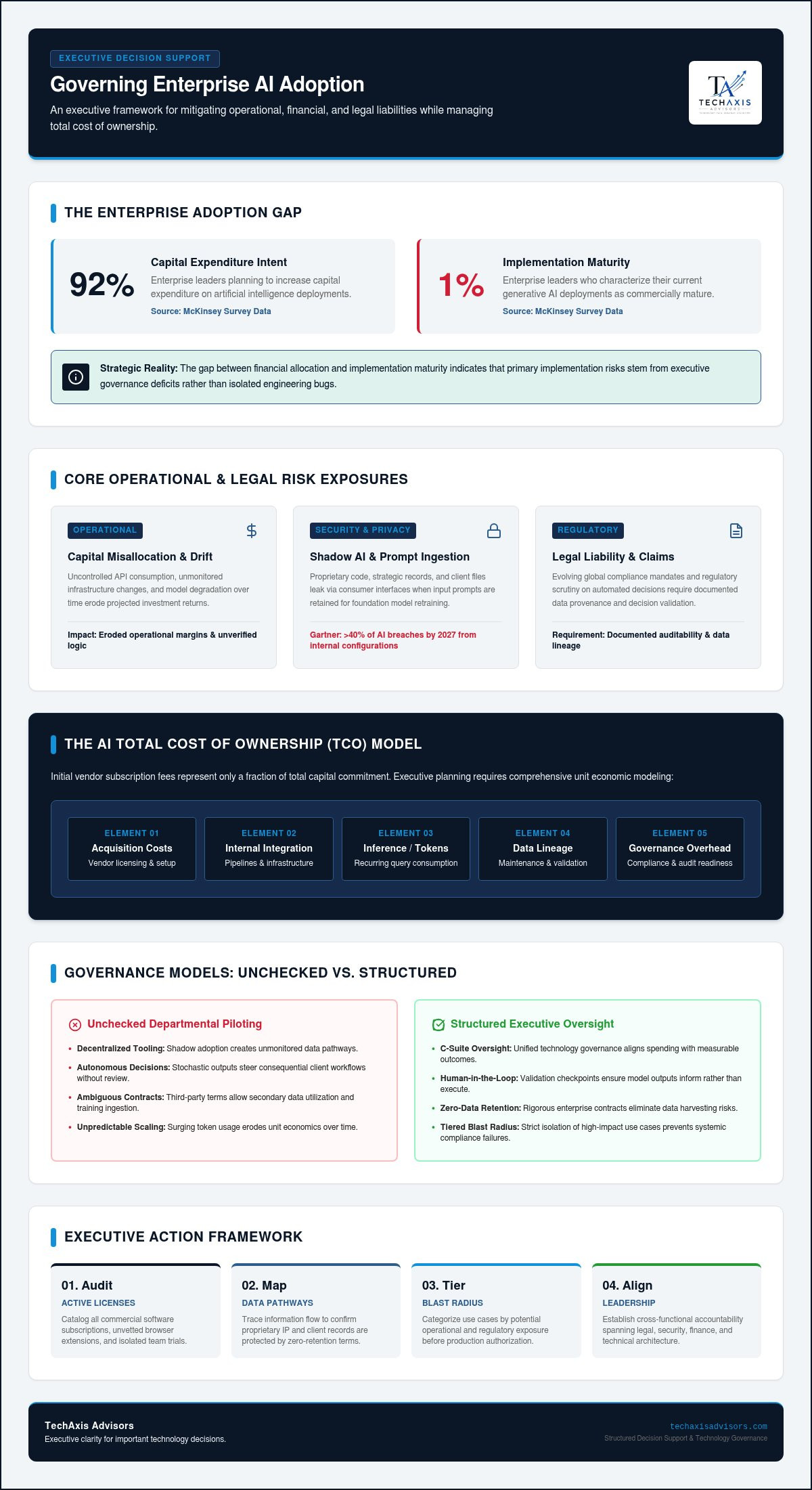
According to McKinsey, only 1% of enterprise leaders describe their generative AI implementations as mature, even while 92% plan to increase capital expenditure. That operational tension highlights a fundamental truth: the primary risks of implementing AI in business stem not from engineering bugs, but from executive governance deficits. When departments adopt tools independently, unvetted platforms and unmonitored data flows quietly transform promising pilot projects into systemic enterprise liabilities.
You already understand the commercial pressure to modernize, but you also recognize the danger of deploying technology without technical validation or regulatory alignment. Innovation shouldn't come at the expense of intellectual property rights, data privacy, or fiduciary oversight. This guide examines the critical operational, financial, and legal vulnerabilities introduced by artificial intelligence, delivering an objective executive framework to govern enterprise adoption safely.
Ahead, we analyze core risk exposures across the deployment lifecycle, outline emerging compliance mandates, and detail a structured oversight model that maintains executive control without stalling business performance.
Table of Contents
Core Operational and Strategic Risks of Implementing AI in Business
Data Privacy, Intellectual Property, and Regulatory Liabilities
Evaluating Tradeoffs: Unchecked Experimentation vs. Structured Oversight
An Executive Decision Framework to Mitigate AI Implementation Risks
Establishing Leadership Accountability and Sustainable AI Governance
Core Operational and Strategic Risks of Implementing AI in Business
Adopting automated tools without architectural alignment creates immediate operational friction. While software vendors often promote plug-and-play simplicity, enterprise leaders quickly discover that the actual risks of implementing AI in business center on misdirected capital, unvetted workflows, and unmonitored decision paths. When platforms operate in organizational silos, technical capabilities fail to deliver measurable business outcomes.
Strategic Misalignment and Capital Misallocation
Pilot projects frequently stall before generating returns. Organizations often fund isolated experiments across departments without defining baseline unit economics. Initial software subscription fees rarely capture the true financial commitment; leaders must also account for recurring infrastructure integration, custom data pipeline adjustments, and ongoing vendor licensing.
To accurately evaluate economic viability before deployment, executive teams can apply a baseline Total Cost of Ownership (TCO) evaluation formula:
TCO = Acquisition Costs + Internal Integration + Ongoing Inference/Tokens + Maintenance & Data Lineage + Governance & Compliance Overhead
Without this discipline, API consumption rates scale unpredictably, locking the enterprise into rigid architectures that erode projected profit margins.
Algorithmic Drift and Unreliable Decision Outputs
Stochastic models calculate probability, not factual certainty. In analytical or transactional workflows, large language models and predictive algorithms regularly generate plausible hallucinations. Algorithmic drift poses an equally serious operational challenge. Over time, as consumer behaviors, market conditions, or internal operating procedures shift, model accuracy deteriorates unless underlying data sets undergo continuous validation.
When unverified outputs steer client-facing advisory functions, pricing mechanisms, or credit decisions, the enterprise assumes severe operational liabilities. Establishing human-in-the-loop validation checkpoints on consequential workflows ensures that algorithmic outputs inform decisions rather than executing them autonomously.
Mitigating these exposure points requires disciplined technology governance and compliance that connects executive oversight directly to technical execution. As the global regulation of artificial intelligence intensifies across jurisdictions, organizations that align technical deployments with clear board-level accountability retain operational agility while safeguarding core business assets.
Data Privacy, Intellectual Property, and Regulatory Liabilities
Legal exposures multiply rapidly when machine learning platforms interact with proprietary enterprise information. Gartner projects that by 2027, over 40% of enterprise AI-related data breaches will stem from improper configurations, unvetted prompt inputs, or unmonitored shadow AI rather than external attacks. Understanding the regulatory and legal risks of implementing AI in business requires examining how corporate data traverses commercial platforms.
Unsanctioned Data Exposure and IP Ingestion
Proprietary data frequently leaks through routine employee prompts. When operational teams input source code, strategic plans, or client portfolio records into consumer-grade interfaces, that information may be ingested into external foundation models. This practice compromises proprietary intellectual property and voids client confidentiality guarantees.
To eliminate these exposure vectors, enterprise leadership must enforce strict safeguards across internal platforms:
Enforce Zero-Data Retention: Secure verified enterprise agreements that explicitly prevent vendors from storing input prompts or retraining models on corporate data.
Audit Vendor Terms: Scrutinize software supply chains to eliminate ambiguous clauses regarding derivative data use, telemetry tracking, and secondary dataset distribution.
Verify Intellectual Property Indemnification: Confirm third-party providers contractually absorb copyright infringement liabilities arising from their pre-training data sources.
Compliance Mandates and Audit Deficiencies
Regulatory scrutiny is escalating across regulated industries. The SEC has penalized firms, including Delphia (USA) Inc. and Global Predictions Inc., for misleading disclosures regarding algorithmic capabilities. Misrepresenting machine learning maturity or using unverified automated outputs introduces immediate enforcement liability. Regulators demand complete auditability, requiring organizations to explain precisely how an automated system arrived at a financial or operational outcome.
Adopting the NIST AI Risk Management Framework provides a defensible structure across its core functions: Govern, Map, Measure, and Manage. Aligning operational practices with these standards ensures that automated systems maintain traceability, explainability, and defensible audit trails. For wealth managers and private equity-backed entities, aligning operational practices with the specialized requirements outlined for AI in financial services ensures that algorithmic execution respects statutory fiduciary boundaries.
Managing these operational, legal, and privacy obligations demands senior-level guidance that translates compliance mandates into daily workflows. If your organization is evaluating unvetted tools or restructuring data access policies, you can start with a confidential executive conversation to establish structured safeguards before production deployment.
Evaluating Tradeoffs: Unchecked Experimentation vs. Structured Oversight
Corporate leaders face a false dichotomy: freeze deployment to preserve compliance, or permit unchecked departmental experimentation to preserve competitiveness. In practice, the risks of implementing AI in business escalate rapidly under both extremes. Total stagnation guarantees operational obsolescence, while uncoordinated experimentation saddles the balance sheet with unmanageable technical debt.
The Hidden Cost of Shadow AI and Fragmented Tools
When individual business units independently license external platforms, software expenses duplicate across departments. Disconnected systems pull information from disparate repositories, producing conflicting operational outputs that paralyze cross-functional decision-making. These disconnected integrations create unmonitored security perimeters, giving third-party platforms unregulated access to internal network environments.
Balancing Innovation Velocity with Risk Tolerance
Disciplined governance matches oversight levels to specific operational risks. Low-risk applications, such as internal document drafting or research summarization, require minimal procedural friction. High-consequence pipelines, such as credit evaluations, regulatory reporting, or portfolio rebalancing, demand deterministic audit logs and mandatory human verification. Applying the GAO AI accountability framework provides leadership with practical benchmarks to evaluate governance, data integrity, and continuous monitoring.
Rather than assuming every pilot requires complete technical replacement, leadership teams should evaluate active platforms against six proven modernization paths: retain, optimize, integrate, replatform, replace, or retire. This systematic triage controls the risks of implementing AI in business while directing capital exclusively toward validated, high-impact business workflows.
An Executive Decision Framework to Mitigate AI Implementation Risks
Remediating enterprise vulnerability requires a repeatable management process, not a collection of point security tools. Without a disciplined evaluation model, leadership cannot objectively determine which initiatives create value and which introduce unacceptable liabilities. To systematically address the operational and regulatory risks of implementing AI in business, executive teams should deploy a structured five-step framework designed to maintain visibility and operational control.
Step 1 & 2: Inventory, Categorization, and Risk Tiering
Begin by mapping the organization's existing footprint. Conduct a centralized audit of all active SaaS subscriptions, browser-based extensions, and direct API keys currently financed across operating departments. Once cataloged, classify each use case into three operational categories based on data sensitivity and operational blast radius:
Tier 1: Administrative (Low Risk): Internal drafting, generic code debugging, and task scheduling using public data. These operate under standard operational guidelines without board review.
Tier 2: Operational and Analytical (Medium Risk): Business intelligence, internal document synthesis, and preliminary data aggregation. These require role-based access controls and departmental leadership approval.
Tier 3: Consequential and Regulated (High Risk): Automated underwriting, algorithmic portfolio modeling, pricing systems, and direct customer interactions. These demand formal C-suite sign-off, strict validation protocols, and comprehensive audit trails.
Step 3 & 4: Control Architecture and Continuous Validation
Establish strict perimeter controls around enterprise data repositories. Role-based access governance ensures machine learning platforms ingest only verified, authorized data fields. Simultaneously, establish documented human review gates for all Tier 3 outputs before actions execute within downstream operational systems. Continuous monitoring routines must test for model accuracy, latency shifts, and input drift, ensuring outputs remain dependable over extended production cycles.
Step 5: Governance Reporting and Board Alignment
Sustained risk mitigation depends on clear executive visibility. Leadership teams must establish dynamic registers that document data lineage, model versions, third-party vendor terms, and operational incident logs. Connecting this tracking to established operational maturity frameworks ensures technology investments align with institutional resilience, fiduciary duties, and investor expectations.
Establishing Leadership Accountability and Sustainable AI Governance
McKinsey research reveals an operational disconnect: while 28% of organizations assign AI governance directly to the CEO and 17% maintain direct board oversight, more than 70% lack cross-functional operational governance linking IT, legal, and business unit leaders. Technology tools cannot govern themselves. Managing the long-term risks of implementing AI in business requires clear ownership across executive roles, ensuring strategic intent matches operational execution.
Fractional Technology Leadership in AI Governance
Many growth-stage and private equity-backed enterprises lack senior technical leadership equipped to scrutinize vendor claims objectively. Full-time executive hires require significant lead time and capital overhead. Engaging fractional technology leadership delivers seasoned guidance at scale, embedding executive-level expertise into strategic planning without full-time compensation costs.
Fractional leaders operate as objective advisors. They evaluate software platforms without sales quotas or vendor bias, establishing rigorous procurement filters and compliance controls. This model bridges strategic planning with technical delivery, allowing firms to leverage specialized TechAxis services such as AI advisory, technology governance, and fractional CTO leadership to protect capital.
Structured Readiness Assessments Over Hasty Deployment
Deploying software before establishing institutional readiness guarantees operational friction. Rather than funding speculative pilots, prudent executive teams commission structured Executive Intelligence Assessments to evaluate infrastructure, data readiness, and organizational maturity before allocating capital.
These structured decision-support engagements deliver concrete management assets:
Evidence-Based Roadmaps: Prioritized deployment sequences tied directly to operational ROI and strategic firm milestones.
Board-Ready Action Registers: Comprehensive documentation of data lineage, access boundaries, and regulatory compliance obligations.
Modernization Pathway Evaluations: Objective analyses determining whether existing platforms should be retained, optimized, integrated, replatformed, replaced, or retired.
Safe adoption balances modernization speed with structural discipline. When you are ready to evaluate your organization's exposure profile and build a defensible adoption strategy, start a confidential executive conversation to explore whether your priority requires an assessment, strategic advisory, or fractional leadership.
Securing Sustainable Advantage Through Disciplined AI Oversight
Enterprise modernization doesn't require choosing between operational paralysis and reckless exposure. Successfully managing the risks of implementing AI in business depends on structured governance, rigorous risk tiering, and cross-functional C-suite accountability. When leadership replaces isolated departmental experiments with defensible oversight models, organizations capture meaningful operational efficiencies while protecting proprietary intellectual property and meeting statutory compliance standards.
TechAxis Advisors brings over 25 years of executive experience as CIO, CTO, and CISO to help leadership teams make grounded, evidence-based technology decisions. Powered by the TechAxis Executive Intelligence Platform, our structured assessments deliver prioritized roadmaps and board-ready registers tailored to your operating reality. As a certified Women-Owned Small Business (SBA WOSB) and MWBE/SBE enterprise, we provide the independent oversight required to translate complex technical challenges into disciplined business execution.
Frequently Asked Questions
What are the most critical risks of implementing AI in business today?
The primary risks of implementing AI in business center on strategic misalignment, unverified automated decisions, proprietary data leakage, and compliance exposure. Organizations that deploy machine learning models without governance often face unpredictable inference costs and legal scrutiny. When models operate without clear lineage or human oversight, leaders remain legally accountable for flawed algorithmic outputs.
How does shadow AI create security and regulatory vulnerabilities within an organization?
Shadow AI introduces unmonitored security perimeters when employees independently use unapproved consumer platforms for daily business tasks. Employees routinely paste sensitive client files, financial spreadsheets, or source code into external interfaces. This bypasses corporate access controls, violates fiduciary confidentiality standards, and creates severe data protection liabilities across operating departments.
Can using public AI tools compromise proprietary business intellectual property?
Yes. Many public, commercial platforms include default terms granting providers permission to use entered prompt data to retrain their foundation models. Entering trade secrets or proprietary algorithms into these tools can effectively place private enterprise property into public model distributions. Businesses must mandate verified zero-retention enterprise agreements before permitting staff access to external engines.
How can executive leadership measure the return on investment of AI governance?
Leadership measures governance ROI through reduced operational redundancies, prevented compliance fines, and predictable cloud infrastructure spending. Centralizing oversight eliminates duplicate SaaS subscriptions and prevents capital misallocation on unviable pilot projects. Effective governance creates measurable business value by accelerating time-to-production for compliant, revenue-generating automated workflows.
What is the difference between an AI technical audit and an executive readiness assessment?
An IT audit reviews low-level software code, server settings, and network configurations. In contrast, an executive decision-support engagement evaluates strategic business alignment, operational maturity, and governance risk. It identifies whether an enterprise has the architectural readiness and data integrity required to deploy automated solutions, delivering board-ready roadmaps and actionable business priorities.
How do fractional CTOs assist leadership teams with AI risk management?
Fractional CTOs provide senior executive guidance without the financial commitment of a full-time executive hire. They evaluate vendor platforms objectively, design defensible governance architectures, and align technology spending with strategic business objectives. This senior oversight helps mid-market and private equity-backed firms manage the operational risks of implementing AI in business while executing safe adoption roadmaps.
What steps should a board take to maintain oversight of corporate AI adoption?
Boards should demand regular reporting via standardized action registers that track active use cases, infrastructure spending, and risk tiers. Directors must establish clear accountability metrics across the C-suite, ensuring legal, technical, and operational executives share deployment oversight. Finally, boards should mandate structured readiness assessments before approving major capital expenditures for automated technologies.



Comments