

RegTech Strategy for Wealth Management: Executive Guide
What if the right RegTech decision isn’t choosing a platform? For wealth management firms, disconnected compliance processes and technology can make oversight harder. Adding software won’t resolve unclear controls or accountability. A sound regtech strategy for wealth management starts by defining how the business needs to manage risk, document decisions, and oversee compliance work.
Executives already know that regulatory requirements, data quality, integration, and vendor dependencies all affect the decision. The challenge is to distinguish a technology need from a broader operating-model issue, then weigh the tradeoffs before committing to a platform.
This guide offers a practical framework for setting business and control requirements, comparing solution approaches, and assessing integration, data, governance, and ownership. It also lays out a sequenced decision path, from defining the problem to selecting an approach and preparing for execution, so leadership can make decisions grounded in the firm’s priorities and risk tolerance.
Table of Contents
Why wealth management firms need a RegTech strategy before buying software
Build the RegTech control model around risk, evidence, and accountability
Compare RegTech solution approaches by fit, integration, and tradeoffs
Use a practical RegTech buying framework to reduce selection risk
Turn RegTech priorities into executive decisions and accountable action
Why wealth management firms need a RegTech strategy before buying software
A RegTech purchase can automate a task. It can’t, by itself, determine who owns a control, what evidence leadership needs, or how an exception should be escalated. A RegTech strategy defines how technology, processes, people, and oversight work together to support regulatory and compliance activities. Platform selection is one decision within that broader operating model.
Regulatory technology (RegTech) generally refers to technology that supports regulatory monitoring, reporting, and compliance. Its practical scope varies by firm. One wealth manager may need better tracking of compliance tasks and approvals; another may need to connect evidence held across existing systems. Start with the business problem, not a catalogue of software features.
Fragmented workflows can make it harder to see whether a process is working as intended. Information may sit across spreadsheets, email, internal systems, and vendor platforms. Staff may complete required steps while leaders still lack a consistent view of status, exceptions, or supporting evidence. A new application may create another information silo unless the firm first clarifies how work should flow and who is accountable.
What a RegTech strategy should align
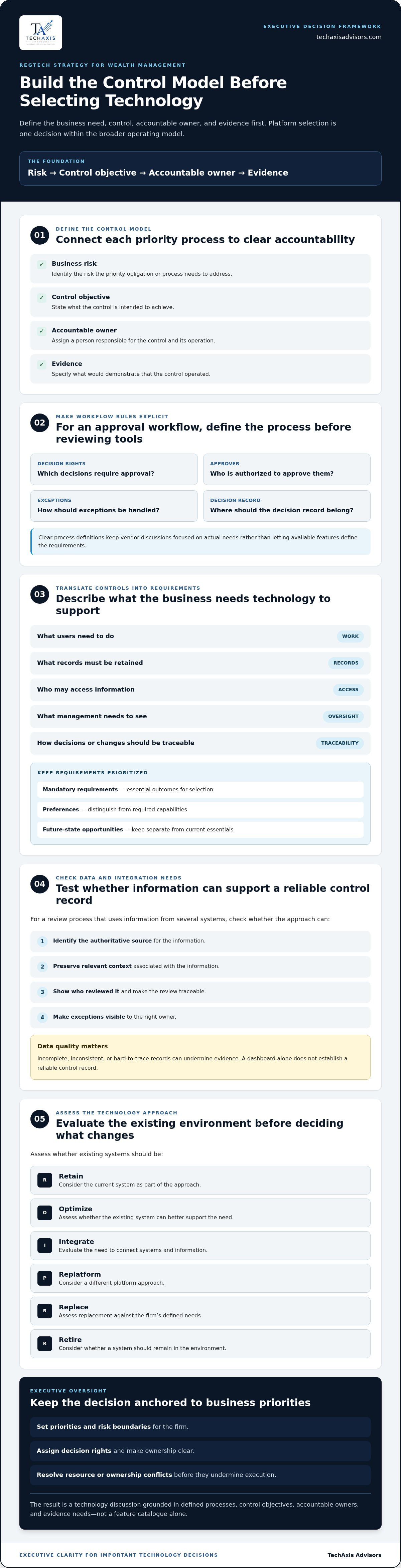
A useful strategy connects business objectives to compliance activities, risk tolerance, and accountable owners. For each priority process, identify the outcome it must support, the control intended to achieve it, the person responsible, and the evidence needed to demonstrate completion. This gives technology requirements a clear business purpose.
Consider an approval workflow. Before evaluating tools, executives should establish which decisions require approval, who can approve them, how exceptions are handled, and where the decision record belongs. Without that process definition, vendor demonstrations can steer discussion toward available features rather than actual needs.
Executive oversight makes the connection explicit. Leaders set priorities and risk boundaries, assign decision rights, and resolve conflicts over resources or ownership. Compliance, operations, and technology teams can then translate those choices into requirements and assess whether existing systems should be retained, optimized, integrated, replatformed, replaced, or retired.
Why wealth management firms have distinct evaluation needs
There is no single operating model for every wealth manager. Firm structure, advisory activities, scale, service model, and existing technology all shape the processes a RegTech approach must support. A firm with centralized operations may need different workflow and reporting arrangements from one with distributed teams or multiple business lines. Those differences affect requirements, integration effort, and ongoing oversight.
Applicable obligations also depend on a firm’s activities and circumstances. Executives should work with qualified compliance and legal professionals to determine which requirements apply, then translate that review into control objectives and ownership. The technology strategy should support those decisions, not presume a uniform regulatory checklist.
This firm-specific perspective matters across wealth management and other regulated organizations, where operating priorities and technology environments can differ substantially. A disciplined regtech strategy for wealth management makes those differences visible before selection. It gives executives a basis for comparing options against actual processes, oversight needs, and the firm’s capacity to manage change.
Build the RegTech control model around risk, evidence, and accountability
A control model turns compliance priorities into defined work. For each priority obligation or process, identify the business risk, control objective, accountable owner, and evidence that would show the control operated. This creates a traceable line from risk to operational evidence and gives executives a clearer basis for oversight and technology decisions.
Keep the model practical. A control that has no owner or supporting evidence is difficult to manage consistently. The model should also distinguish the control itself from the tools that may support it. That separation helps prevent a platform’s features from dictating how the firm defines its responsibilities.
Translate compliance needs into technology requirements
Translate control objectives into requirements expressed in business terms. Specify what users need to do, what records must be retained, who may access information, what management needs to see, and how decisions or changes should be traceable. Separate mandatory requirements from preferences and future-state opportunities to keep selection discussions anchored to essential outcomes.
Consider a review process that relies on information from several systems. The requirement is not simply to “integrate data.” It may be to identify the authoritative source, preserve relevant context, show who reviewed the information, and make exceptions visible to the right owner. Data lineage and quality matter when leaders rely on information as evidence. If records are incomplete, inconsistent, or difficult to trace to their source, a dashboard alone won’t establish a reliable control record.
Organize requirements across distinct control components:
Policy: the standard or decision rule that guides action.
Workflow: the steps, approvals, and handoffs needed to apply it.
Data: the inputs, sources, access, and quality needed to support the process.
Monitoring and escalation: how exceptions are identified, assigned, and resolved.
Reporting: the evidence and status information managers need to oversee performance.
SEC, FINRA, and FinCEN relevance depends on the firm’s activities and circumstances. Qualified compliance and legal professionals should determine applicable obligations. The control model can then capture the resulting objectives, owners, and evidence requirements. Avoid assuming that an organization’s labels or technology stack alone determine which controls it needs.
Establish ownership and governance before configuration
Configuration decisions can embed assumptions about approval rights, exception handling, access, and recordkeeping. Set those decisions first. Compliance can define control intent and review evidence; operations can own workable procedures; technology can assess data, integration, and access needs; executives can resolve priorities, risk tolerances, and accountability gaps.
Name the owner for routine decisions, exceptions, approvals, and periodic control review. Establish how vendor changes, system updates, and process changes will be assessed for control impact. Vendor oversight doesn’t end at selection. Ongoing governance should preserve clear ownership and traceability as the firm’s needs evolve.
A structured regtech strategy for wealth management makes control expectations testable against processes and technology. TechAxis Advisors provides executive decision-support on priorities, ownership, and governance. Details are available through its executive contact page.
Compare RegTech solution approaches by fit, integration, and tradeoffs
Once requirements are clear, compare approaches against the same control needs. A specialist application, a broader platform, improvements to existing systems, or a managed workflow may each be appropriate in different circumstances. Look beyond feature fit: integration effort, data dependencies, governance capacity, and ongoing ownership all affect whether an option is workable.
When a specialist tool or broader platform may fit
A specialist tool may suit a bounded use case with a defined workflow, clear users, and limited dependencies. A broader platform may merit consideration when several processes need coordinated support, but its fit depends on integration requirements and the firm’s ability to govern the wider environment. Neither approach is inherently preferable. The right choice depends on the control objectives and the firm’s capacity to manage the solution over time.
Evaluate retain, optimize, integrate, replatform, replace, or retire
Assess each relevant system against business value, control needs, risk, and operating capacity. Use the six options to keep the review balanced:
Retain when the system continues to meet the need.
Optimize when configuration or process changes may address gaps.
Integrate when better connections can improve workflow or evidence flow.
Replatform when the underlying environment constrains necessary changes.
Replace when another approach better supports defined requirements.
Retire when the system no longer serves a justified business purpose.
For example, a visibility gap might stem from inconsistent handoffs rather than a missing application. Process redesign or integration may address it without replacement, but test that conclusion against control and data requirements. Document dependencies, transition implications, ownership, and the rationale for each decision so executives can compare options consistently.
A disciplined regtech strategy for wealth management treats interoperability as a decision criterion, not an assumption. It also recognizes that technology choices create continuing responsibilities for vendor oversight, change management, and control governance.
Use a practical RegTech buying framework to reduce selection risk
A repeatable buying process keeps a platform decision tied to business needs rather than the appeal of a demonstration. Move through the steps in order, involving compliance, operations, technology, and executive sponsors throughout. Each group sees different risks: compliance focuses on control intent, operations on workable procedures, technology on integration and support, and executives on priorities, accountability, and capacity.
Define outcomes. State what the firm needs to improve, such as clearer oversight, more reliable evidence, or a more consistent workflow.
Map controls. Connect those outcomes to processes, control objectives, owners, and evidence.
Prioritize requirements. Separate essential requirements from preferences and future opportunities.
Evaluate fit. Compare approaches against the same criteria and representative workflows.
Plan governance. Assign decision rights and define ongoing oversight before configuration or rollout.
Create a decision-ready evaluation
Set weighted criteria based on business priorities, not the number of features a solution presents. Score each option against requirement fit, integration demands, data quality and dependencies, usability, vendor oversight, and the firm’s capacity to operate and govern it. Weighting makes tradeoffs explicit, but it doesn’t replace executive judgment.
Test realistic scenarios instead of relying on a presentation. Walk through a routine workflow, an exception, a management report, and retrieval of supporting evidence. Ask stakeholders to record what worked, where manual steps remained, and what assumptions shaped the result. Maintain a decision log with scores, unresolved dependencies, risk considerations, decision owners, and the rationale for the outcome. This creates a useful record if priorities or assumptions change.
For a broader view of technology evaluation in a growing organization, readers can also consider the related article on Technology Due Diligence for Growth-Stage Companies. The same discipline applies: ground decisions in evidence, dependencies, and business priorities.
Plan implementation as controlled organizational change
Selection is not the end of the decision. Sequence the work so data preparation and workflow design inform access decisions, testing, and training. Confirm who approves configuration changes, how incidents or exceptions are escalated, and which owners review ongoing performance. Vendor oversight should have named internal accountability, even when a vendor supports day-to-day activities.
These steps help leadership understand not only what to select, but what the firm must be ready to manage. A regtech strategy for wealth management should connect the evaluation decision to governance and execution capacity. TechAxis Advisors’ structured assessment-to-roadmap process organizes evidence, priorities, and executive decisions.
Turn RegTech priorities into executive decisions and accountable action
A RegTech strategy creates value when it leads to clear decisions and assigned next steps. A structured assessment can bring together evidence about current processes, technology, dependencies, and ownership, then distinguish immediate gaps from longer-term opportunities. The goal isn’t to produce a technical audit or promise a particular outcome. It is to give executives a decision-support basis for determining what to address, in what order, and with whose accountability.
What executives should expect from a decision-support engagement
A structured Executive Intelligence Assessment moves from diagnostic work to findings synthesis and a strategic roadmap. It organizes evidence around business priorities and risk tolerance, making gaps and dependencies visible. The result should help leadership see where a decision is required, what evidence supports it, and which issues need further review.
Useful deliverables support different levels of executive action:
Board-ready findings summarize the current state and key decisions in clear business terms.
A prioritized roadmap sequences recommended actions and highlights dependencies.
An action register records accountable owners and follow-through items.
An executive presentation supports discussion of priorities, tradeoffs, and decisions.
This structure helps leadership distinguish a control gap from a technology limitation, or a technology limitation from an ownership or process issue. Different causes call for different responses. Findings should remain traceable to the evidence reviewed and the business objective they support, so executives can challenge assumptions and make informed choices rather than treat recommendations as automatic instructions.
Choose the right level of leadership support
The right support depends on the decision ahead and the organization’s internal capacity. A focused assessment can clarify a defined question and establish priorities. Retained strategic counsel can help leadership revisit decisions as needs evolve. Fractional leadership can provide ongoing executive-level direction where additional technology or governance leadership is needed.
These roles differ from managing day-to-day IT operations or supplying a software platform. An executive advisor can support governance, vendor oversight, decision-making, and coordination with qualified delivery partners, while firm leaders retain accountability for their decisions and controls. TechAxis Advisors’ executive advisory and fractional leadership approach can provide continuity from assessment into oversight, without assuming every organization needs the same level of involvement.
For a firm building a regtech strategy for wealth management, match the engagement to the priority: clarify the decision first, then determine whether an assessment, strategic advisory, or fractional leadership would best support it. A confidential executive conversation can help frame that choice without presuming the answer.
Move from technology choice to accountable progress
The next useful step isn’t necessarily another platform discussion. It’s agreeing on the decision your firm needs to make, the evidence leadership needs, and who will carry the work forward. That discipline keeps a regtech strategy for wealth management connected to business priorities while leaving room to adapt as the firm’s activities and operating needs change.
TechAxis Advisors founder Aarati Dikshit brings more than 25 years of CIO, CTO, and CISO experience, including in wealth management. The firm also holds recognized federal certifications, including SBA WOSB. This experience informs an executive-focused approach to technology governance and compliance decisions.
A clear first decision can give your leadership team a more deliberate path forward.
Frequently Asked Questions
What does RegTech mean in wealth management?
RegTech refers to technology that helps firms carry out regulatory and compliance activities. In wealth management, that can include tools supporting regulatory change tracking, transaction monitoring, or compliance reporting. These are distinct use cases, not a single required technology category. A firm’s needs depend on what it does and how it operates. Technology can support execution and oversight, but leadership remains responsible for the firm’s compliance program.
How should a wealth management firm choose RegTech software?
Include the people who will use and oversee the software in the evaluation, not only procurement and technology teams. Ask daily users to complete realistic tasks, including correcting an error or handling an unusual case. This can reveal training needs, unclear handoffs, or reliance on manual work that a feature demonstration may not expose. Before procurement advances, executives should identify who will own adoption and how unresolved issues will be escalated.
Does every wealth management firm need a dedicated RegTech platform?
No. A separate platform also creates an additional environment to administer, support, and monitor. Before adding one, consider whether the organization has clear process ownership and the capacity to maintain the system over time. If the use case is narrow, the added operational burden may outweigh its value. The decision should account for the firm’s ability to sustain the tool, not only its initial appeal or purchase rationale.
How do SEC, FINRA, and FinCEN relate to RegTech decisions?
Their relevance varies with a firm’s legal entities, business activities, and regulatory status. A useful starting point is to maintain an internal inventory of the firm’s activities and the obligations qualified professionals determine are relevant. Review that inventory when the business changes, such as when it adds an activity or changes its operating structure. This helps leaders revisit technology support when the underlying compliance context changes, without treating a general checklist as legal advice.
What should a RegTech vendor evaluation include?
Look beyond product demonstrations to the relationship’s longer-term operating terms. Executives can consider how the firm would retrieve its information, manage service changes, address vendor disruptions, and transition away if the arrangement no longer fits. These questions surface dependency and continuity considerations before commitment. Record assumptions and assign an internal owner to follow unresolved contract, operational, or governance matters through the decision process.
Can a RegTech strategy work with existing systems?
Yes, though introducing a new connection or application can create a period when old and new processes operate side by side. Define which system is authoritative for each record, how conflicting entries will be resolved, and when the transition is complete. Establishing those rules helps prevent parallel processes from creating ambiguity for staff. Executives should also consider how the firm will manage a fallback if the transition encounters an issue.
What should executives expect from a RegTech assessment?
Executives should expect clarity about the assessment’s scope, the evidence considered, and the questions it can answer. They can establish which business units and processes are in scope, identify relevant decision-makers, and distinguish findings from assumptions or items requiring further review. This helps leadership use the assessment appropriately: as input to a decision, not as a certification of compliance or a substitute for implementation planning and ongoing oversight.



Comments