

Reducing Technical Execution Risk: 5 Myths Every CEO Must Challenge in 2026
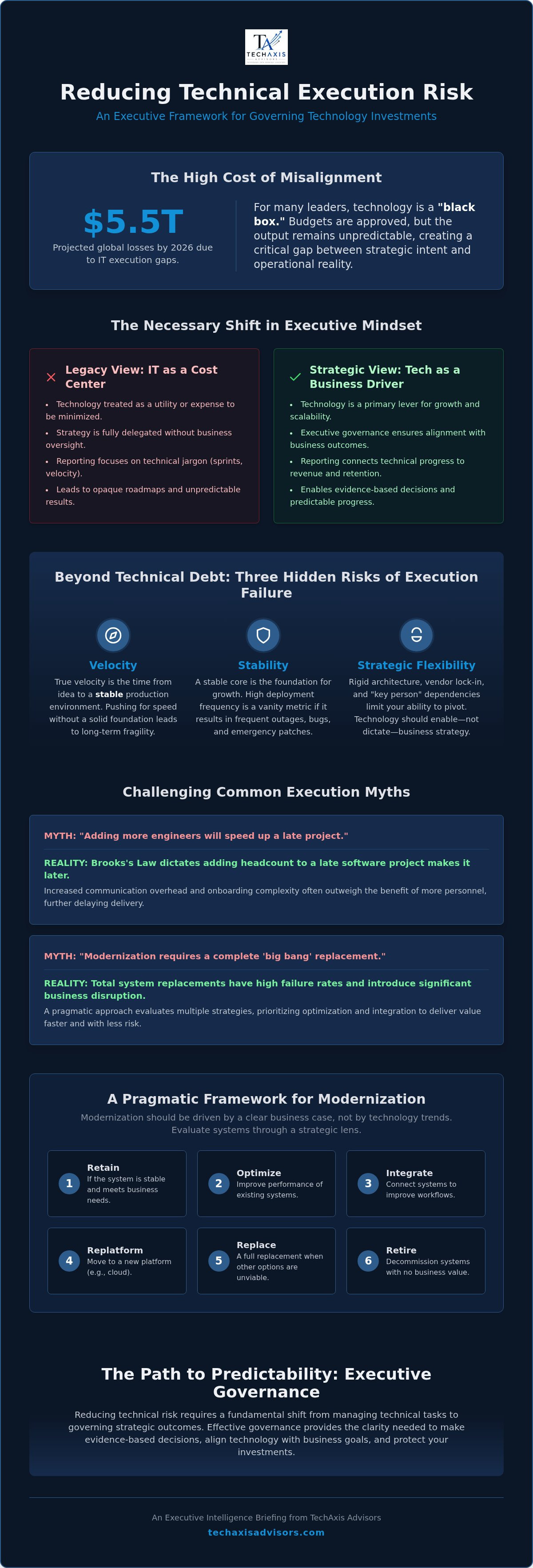
With the IT skills shortage projected to cost organizations $5.5 trillion in losses by 2026, the gap between strategic intent and technical delivery has become a critical liability. You likely recognize the pattern: budgets expand while timelines shift, leaving you with opaque roadmaps and a growing misalignment between IT output and your business goals. It's a frustrating reality for many leaders who find that increasing technology spend doesn't always translate into predictable results. Managing this volatility requires more than just hiring more engineers; it requires a fundamental shift in executive oversight.
This article provides a pragmatic framework for reducing technical execution risk for CEOs by dismantling the persistent myths that lead to operational stagnation. You'll gain clear visibility into your organization's technical maturity and learn how to make evidence-based decisions that protect your technology investments. We'll examine five specific myths you must challenge to ensure your technical execution finally matches the speed of your business strategy.
Table of Contents
The 'Black Box' Fallacy: Why Technical Execution Is a Strategic Business Risk
Beyond Technical Debt: Identifying the Real Drivers of Execution Failure
The 'More Hands' Myth: Why Scaling Teams Often Increases Execution Risk
Transformation vs. Optimization: Navigating the 'Big Bang' Implementation Trap
Establishing Governance: How CEOs Can Manage Technical Execution Risk
The 'Black Box' Fallacy: Why Technical Execution Is a Strategic Business Risk
Technical execution risk isn't a coding problem. It's the measurable distance between your strategic vision and your organization's ability to ship functional, value-generating software. For many leaders, the technology department feels like a "black box." You approve budgets and set goals, yet the output remains unpredictable. This lack of transparency is more than an inconvenience; it's a structural failure in governance. Mastering the mechanics of reducing technical execution risk for CEOs starts with peeling back the layers of this black box. Executive clarity is the only sustainable antidote. It replaces technical jargon with evidence-based reporting that aligns with your operational objectives.
Moving Beyond 'IT as a Cost Center'
Viewing technology as a utility is a legacy mindset that creates significant risk. In growth-stage firms, tech is the engine of scalability. Delegating 100% of your strategy to a lead without business alignment often results in unproductive complexity rather than market-ready solutions. This disconnect is why advisory leadership is no longer optional. It provides the necessary oversight to ensure every line of code supports a specific business outcome. When you stop seeing IT as a bill to be paid and start seeing it as a lever for growth, you begin the process of reducing technical execution risk for CEOs.
The High Cost of Executive Disconnect
Opaque reporting breeds organizational anxiety. When engineering teams report on "velocity" or "sprints" without connecting those terms to revenue or client retention, they're providing vanity metrics. These numbers offer no insight into whether the project is actually on track. This disconnect directly impacts board-level confidence and stalls critical technology investments. Applying foundational risk management principles to your technical roadmap allows you to identify bottlenecks before they become failures. Structured assessments provide the visibility needed to move from reactive firefighting to disciplined, evidence-based progress. Without this clarity, your business strategy remains tethered to a technical foundation you can't see and don't control.
Beyond Technical Debt: Identifying the Real Drivers of Execution Failure
Technical debt is often the most convenient scapegoat for stalled projects. While inefficient code slows progress, it's rarely the primary driver of organizational failure. Real execution risk stems from a lack of a governance-driven foundation that connects technical health to business outcomes. To move forward, leaders must evaluate their systems through a pragmatic lens: retain, optimize, integrate, replatform, replace, or retire. This framework ensures that modernization is driven by a business case rather than a desire for the newest tools. Focusing on these strategic levers is essential for reducing technical execution risk for CEOs who need to scale without collapsing.
Velocity vs. Stability: The Hidden Trade-off
Pushing for speed without a stable core is a recipe for long-term fragility. High deployment frequency is a vanity metric if it leads to frequent outages or patches. True velocity measures the time it takes to move an idea from conception to a stable production environment. You can't simply demand faster delivery without addressing the underlying infrastructure that supports it. Balancing these competing priorities requires senior oversight that understands the technical trade-offs of every "fast" decision. Utilizing fractional cto services provides this balance; it offers the strategic discipline needed to maintain stability while accelerating delivery.
Strategic Flexibility and Talent Risk
Rigid architectures and vendor lock-in create a structural burden that limits your ability to pivot. If your technology stack dictates your business strategy, you've lost strategic flexibility. Talent risk is another misunderstood factor. It isn't simply a matter of hiring more developers; it's the danger of "key person" dependencies. Without documented processes and strong governance, your execution remains vulnerable to turnover. Reducing technical execution risk for CEOs requires moving away from individual heroics toward a structured, team-based approach to delivery. If you're concerned about hidden dependencies in your current stack, you might want to start an executive intelligence assessment to gain clarity on your operational maturity.
The 'More Hands' Myth: Why Scaling Teams Often Increases Execution Risk
When a critical technology project falls behind schedule, the instinctive executive response is often to increase headcount. This approach is rooted in the myth that technical delivery scales linearly with the number of developers. In reality, software development is governed by Brooks’s Law: adding manpower to a late software project makes it later. This phenomenon occurs because new team members require training from the existing staff, which temporarily reduces the total productive capacity of the team. For those focused on reducing technical execution risk for CEOs, understanding these operational physics is vital. A larger headcount often introduces more variables, not more certainty.
The Overhead of Communication and Governance
Communication complexity grows exponentially as teams expand. A team of three has three communication paths; a team of ten has forty-five. Without disciplined governance, this overhead paralyzes decision-making and leads to inconsistent implementation. Fractional leadership provides a more surgical solution for growth-stage firms. It offers the senior oversight needed to streamline workflows without the cultural and financial drag of mass hiring. Use this checklist to evaluate your current technical organizational design:
Are decision rights clearly defined between business and technical leads?
Does the current team structure minimize cross-team dependencies?
Is there a documented onboarding process that doesn't rely on senior developer time?
Vendor Management vs. Vendor Reliance
Many firms attempt to mitigate talent risk by outsourcing to external partners. However, there is a sharp distinction between a strategic partnership and a dangerous outsourcing dependency. Relying on "white-label" development without internal executive oversight often results in a loss of intellectual property and long-term technical stagnation. A robust vendor management strategy ensures that external teams remain accountable to your business goals. Effective strategies for reducing technical execution risk for CEOs involve maintaining a "governance bridge" between your firm and your partners. You can explore how to strengthen this oversight through our specialized advisory services, which focus on vendor and platform management.
Transformation vs. Optimization: Navigating the 'Big Bang' Implementation Trap
The "Big Bang" approach to modernization is often presented as a clean slate. It promises to resolve years of technical baggage in one decisive move. However, for organizations in wealth management and financial services, this path is fraught with hidden dangers. Industry data from early 2026 indicates that 70% of digital transformation projects fail to meet their stated goals. These failures aren't usually caused by poor coding. They're caused by the sheer complexity of replacing legacy systems while maintaining daily operations. A total rewrite often introduces more instability than the system it intends to replace. Reducing technical execution risk for CEOs requires a more disciplined, surgical approach to modernization.
The Case for Iterative Modernization
Iterative modernization allows you to deliver business value while systematically addressing technical debt. Instead of a high-risk replacement, consider the "strangler pattern." This involves gradually replacing specific functionalities with new services until the legacy system is eventually retired. This method provides immediate operational wins and reduces the risk of a catastrophic system failure. Use a structured decision framework to evaluate each component of your stack:
Retain: Keep the system if it still provides a competitive advantage.
Optimize: Improve performance through targeted updates.
Integrate: Use APIs to connect legacy tools to modern platforms.
Replatform: Move to a more scalable infrastructure without changing core code.
Replace or Retire: Only choose these when the business case for modernization is undeniable.
AI Readiness: Avoiding the Hype-Driven Execution Gap
The pressure to adopt AI is immense. Yet, purchasing a tool is not a strategy. AI-powered code generation can actually accelerate the creation of poorly understood technical debt if not governed correctly. Successful execution depends on a solid data foundation and clear governance. Jumping into implementation without these prerequisites increases your exposure to unpredictable delivery timelines and budget overruns. Conducting a formal AI readiness assessment is a critical step in reducing technical execution risk for CEOs. It ensures your organization is prepared for the structural changes AI requires before you commit significant capital.
Establishing Governance: How CEOs Can Manage Technical Execution Risk
Governance is the final bridge between your business strategy and its technical delivery. Many leaders accept execution volatility as an inevitable cost of doing business, but this is a fundamental mistake. You don't need to write code to manage technical outcomes. Effective governance is about shifting your focus from "managing tasks" to "governing outcomes." By utilizing an Executive Intelligence Platform, you can move beyond anecdotal status updates to objective, evidence-based data. This level of oversight is the most reliable method for reducing technical execution risk for CEOs who need to scale with discipline.
The Role of Fractional CTO Leadership
Embedded leadership provides execution oversight without the fixed cost or long-term commitment of a full-time executive. A Fractional CTO acts as a strategic partner, ensuring your technical team remains aligned with your operational goals. This advisor helps you solve complex technical problems by providing the senior perspective required to navigate trade-offs between speed and stability. Because they operate as independent counsel, they offer a neutral viewpoint during high-stakes decisions. This objectivity is vital when evaluating vendor performance or deciding whether to commit to a major platform migration.
Using Executive Assessments for Continuous Decision Support
Executive assessments should not be viewed as one-off audits. Instead, they function as ongoing strategic diagnostics that provide continuous decision support for the C-suite. These structured Executive Intelligence Assessments deliver board-ready briefs and prioritized roadmaps that replace organizational anxiety with a sense of controlled progress. Reducing technical execution risk for CEOs involves maintaining this visibility throughout the project lifecycle, not just when delivery stalls. When you have access to evidence-based findings, you can make confident decisions about whether to retain, optimize, or replace your current systems.
If your technology roadmap lacks the clarity you require, the most pragmatic step is to establish a baseline of oversight. You might start with a confidential executive conversation to explore whether your current priority requires an assessment, strategic advisory, or fractional leadership. Establishing this governance framework ensures that your technology remains a core business driver rather than a strategic liability.
Securing Your Technical Roadmap for 2026
Technical execution is no longer an IT-only concern; it is a strategic business imperative. By challenging the myths of linear scaling and total system rewrites, you position your organization for disciplined growth. Success in 2026 requires a shift toward outcome-driven governance and iterative modernization that respects the operational physics of software delivery. These structural changes replace organizational anxiety with a predictable path toward operational maturity.
Mastering the mechanics of reducing technical execution risk for CEOs requires access to evidence-based findings rather than anecdotal reports. Our proprietary Executive Intelligence Platform provides the visibility needed to align technical roadmaps with business goals. With a founder bringing over 25 years of experience as a CIO, CTO, and CISO in financial services, we offer the senior-level oversight your organization might be missing. As a certified Women-Owned Small Business (WOSB), we focus on delivering executive clarity for your most critical technology decisions.
Aligning your technology with your business strategy is a continuous process of refinement. We look forward to supporting your next phase of growth through disciplined execution and strategic alignment.
Frequently Asked Questions
What is the primary cause of technical execution risk in growth-stage companies?
The primary cause is the structural gap between executive strategy and technical delivery. Projects don't usually fail due to a lack of effort or engineering talent. They fail because the technical roadmap isn't aligned with specific business goals. This disconnect creates a "black box" where visibility is lost and decision-making becomes reactive rather than strategic.
How can a CEO identify hidden technical risks without being a software expert?
Focus on operational signals rather than code quality. Look for unpredictable delivery timelines, opaque reporting, or a reliance on individual heroics from key staff. If your technical lead can't explain how a project supports a specific business outcome, you're likely facing significant execution risk. Evidence-based assessments provide the clarity needed to identify these gaps before they stall your growth.
Is it better to replace legacy systems or optimize them to reduce risk?
Replacement is rarely the safest first step. You should evaluate the business case using a framework of retain, optimize, integrate, replatform, replace, or retire. Optimization or integration often provides a higher return on investment with lower operational risk. Total system rewrites have a high failure rate in regulated industries like financial services because they disrupt daily operations.
How does technical execution risk impact private equity valuations?
Execution risk directly impacts scalability and exit readiness. Private equity firms increasingly view technical debt and rigid architectures as liabilities that hinder future growth. A company with a history of unpredictable technical delivery is often valued lower during due diligence. Clear governance and a stable technical foundation are essential for protecting your organization's valuation and ensuring a successful exit.
What is the difference between a technical audit and an executive decision-support assessment?
A technical audit focuses on granular code quality and security vulnerabilities. In contrast, an executive decision-support assessment evaluates how well your technology supports your business strategy. These assessments provide the evidence-based roadmaps necessary for reducing technical execution risk for CEOs. They translate technical complexity into board-ready briefs that drive confident decision-making and operational progress.
How can a fractional CTO help reduce execution risk in software development?
A fractional CTO provides the senior oversight needed to bridge the gap between business and technology. They establish disciplined governance and manage vendor relationships to ensure every technical decision supports an operational goal. This embedded leadership offers a pragmatic way of reducing technical execution risk for CEOs without the fixed cost of a full-time executive hire.
Can AI implementation increase technical execution risk?
AI can significantly increase risk if it's implemented without a solid data foundation and strict governance. AI-powered code generation often accelerates the accumulation of hidden technical debt. Without proper oversight, these tools can create massive amounts of poorly understood code that becomes impossible to maintain. AI readiness requires a structured assessment of your current infrastructure and data maturity.
What are the 'escalation triggers' that suggest a project is at high risk of failure?
Common triggers include frequent timeline shifts, a lack of measurable milestones, and high turnover within the engineering team. If reporting relies on vanity metrics like "lines of code" rather than business outcomes, the project is likely off track. These signals indicate that the gap between strategic intent and operational reality has become unmanageable and requires immediate executive intervention.


Comments