

Private Equity Technology Advisor: A Strategic Framework for Portfolio Value Creation
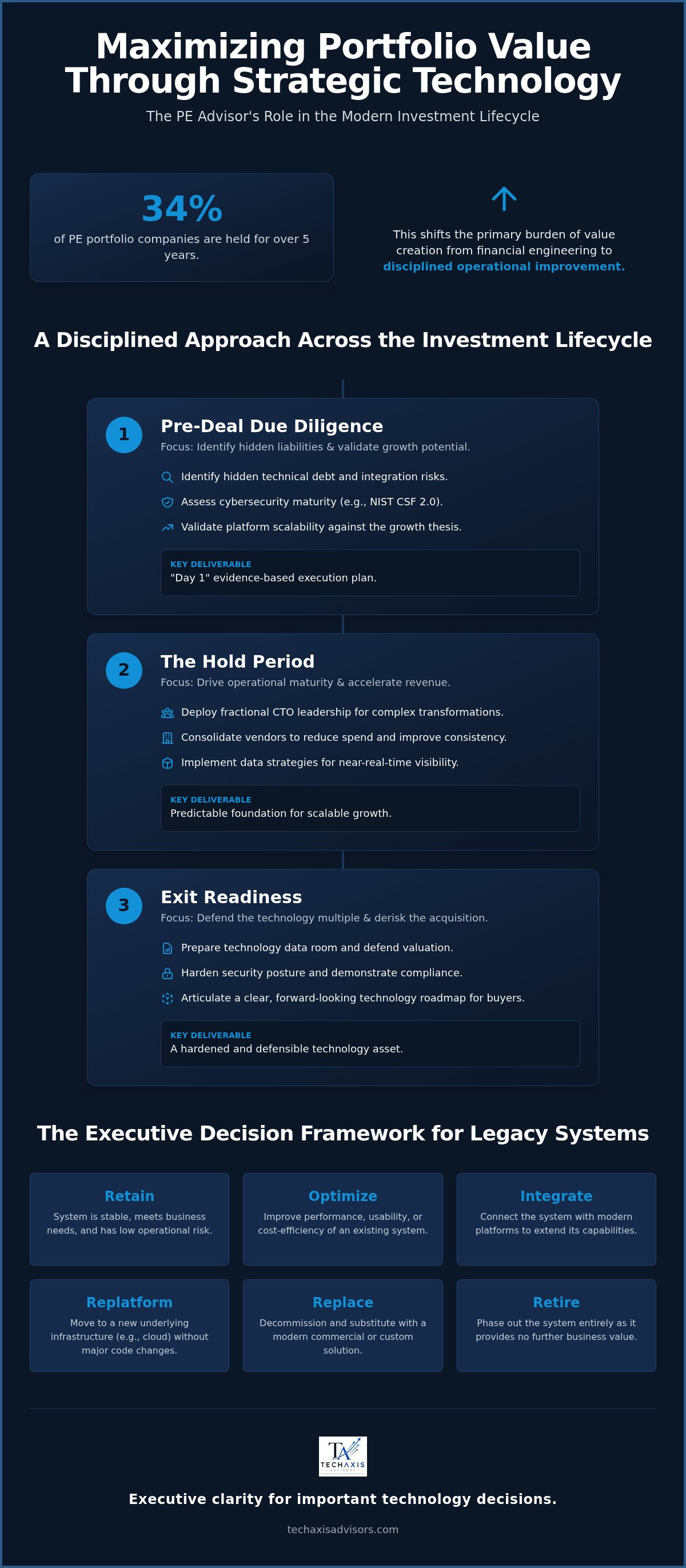
As of March 2026, 34% of private equity portfolio companies have been held for more than five years. This extended holding period shifts the primary burden of value creation from financial engineering to disciplined operational improvement. You likely agree that while technology is the most potent lever for this growth, it's often the most opaque area of the business. Engaging a specialized private equity technology advisor is no longer just a pre-deal requirement; it's a structural necessity for the entire investment lifecycle.
It's common to feel a sense of urgency regarding technical debt that surfaces too late or a lack of visibility into portfolio-level risks. This guide provides an executive-grade framework to mitigate those risks, drive operational maturity, and maximize exit multiples. We'll explore how evidence-based roadmaps and modern data foundations bridge the gap between a high-level growth thesis and tangible execution. You'll gain clarity on how to transition from reactive troubleshooting to a state of controlled, disciplined progress that ensures every dollar of tech spend contributes directly to your bottom line.
Table of Contents
The Evolving Role of the Private Equity Technology Advisor
The 2026 private equity landscape has shifted. With holding periods extending and the federal funds rate at 3.63%, the era of relying solely on cheap capital has passed. Today, a modern private equity firm must look toward operational levers to drive EBITDA growth. This environment makes the private equity technology advisor a structural necessity rather than an optional resource. Unlike a technical auditor who provides a list of defects, an executive advisor serves as the bridge between your investment thesis and technical execution. They ensure technology spend aligns with your growth roadmap.
From Risk Mitigation to Strategic Value Creation
Early technology oversight often focused on basic risk mitigation. While these remain essential, the priority has moved toward aligning the technology operating model with the growth thesis. Technical debt is the silent inhibitor of exit multiples. It creates friction that slows down product launches and complicates integrations. If a portfolio company's infrastructure can't scale, it becomes a major liability during exit due diligence. A strategic advisor helps firms move beyond reactive maintenance to build a competitive moat through operational maturity. You can explore how these services align with specific investment phases to ensure long-term value.
Why Financial Engineering is No Longer Enough
Traditional cost-cutting measures have reached a point of saturation in many portfolios. In mid-market firms, the path to alpha now depends on data visibility and operational scalability. Limited Partners are paying attention; 47% of LPs now monitor how their GPs adopt AI and modern data strategies. A private equity technology advisor provides the leadership needed to turn data into a primary asset for the firm. This transition requires a disciplined approach to modernization that balances immediate performance with long-term valuation. It's about moving from a state of being where tech is a cost center to a desired outcome where it's a driver of market expansion.
Maximizing Portfolio Alpha Across the Investment Lifecycle
Effective technology oversight requires a disciplined approach across three distinct phases. Without a consistent thread connecting due diligence to the exit, value is often lost during the hold period. A private equity technology advisor provides this continuity, ensuring that every technical decision supports the overarching investment thesis. This strategic alignment prevents the common disconnect between a firm's growth goals and the actual technical capacity of its portfolio companies.
Pre-Deal Due Diligence: Beyond the Data Room
Standard technical audits often focus on what's broken. An executive decision-support engagement focuses on what's missing. This involves identifying hidden technical debt, assessing cybersecurity maturity against standards like NIST CSF 2.0, and validating platform scalability. With SEC rules now requiring incident reporting within four business days, understanding a target's governance framework is critical. The goal is to translate technical findings into a "Day 1" execution plan that addresses immediate liabilities while setting the stage for growth. This evidence-based approach ensures that the board understands the exact capital requirements needed to stabilize and scale the asset.
The Hold Period: Driving Operational Maturity
Execution is where most technology strategies fail. During the hold period, firms must transition from identification to improvement. This often involves deploying fractional CTO leadership to oversee complex transformations without the overhead of a full-time executive. Key activities include:
Consolidating vendors to reduce spend and improve architectural consistency.
Implementing data and reporting strategies that provide near-real-time visibility for LPs and GPs.
Aligning software development cycles with market expansion goals to accelerate revenue.
Focusing on improving operational maturity through technology creates a predictable environment for scaling. It's about building a foundation that can handle increased volume without a proportional increase in headcount.
Exit Readiness: Hardening the Tech Stack for Acquisition
The final phase involves defending the technology multiple against aggressive buyer due diligence. If a buyer identifies significant technical debt or poor data governance, they'll use it as a lever to reduce the purchase price. A pre-sale assessment identifies these vulnerabilities six to twelve months before the exit. By documenting a mature technology operating model and ensuring data transparency, you justify a premium valuation. If you're preparing for an upcoming transaction, you might start with a confidential executive conversation to evaluate your current exit readiness.
Navigating Technical Debt and AI Readiness in Portfolios
Technical debt is not merely a software issue. It's a structural liability that compounds over time, often reaching a breaking point during the hold period. A private equity technology advisor views this debt through a financial lens, treating it as a balance sheet item that requires active management to preserve the growth thesis. In regulated sectors like wealth management and lending, failing to address these technical liabilities can lead to significant compliance failures and compressed exit multiples.
Assessing Technical Debt: A Framework for Investors
Investors must distinguish between "good" debt, which allowed a company to reach the market quickly, and "bad" debt, which prevents the platform from scaling. The cost of inaction is high. As the hold period extends, legacy drag consumes an increasing portion of the technology budget, leaving less capital for innovation. We evaluate every technical asset using a disciplined "Retain, Optimize, Integrate, Replatform, Replace, or Retire" framework. This evidence-based approach ensures that remediation efforts are prioritized based on business impact rather than technical preference. By categorizing debt this way, the board can make informed decisions about where to invest capital to reduce execution risk.
AI Governance: Protecting the Growth Thesis
Artificial Intelligence has moved from a back-office efficiency tool to a primary top-line growth lever. Research indicates that 88% of U.S. private equity firms have already invested over $1 million into generative AI. However, a significant execution gap remains. While strategy is high, only 36% of portfolio companies report using AI in daily operations. Closing this gap requires more than just new tools. It requires a structured Executive AI Readiness Assessment to evaluate data foundations, cultural readiness, and infrastructure maturity.
Pragmatic AI roadmaps must prioritize governance and compliance, especially as SEC oversight increases in 2026. Implementing an AI in financial services strategic framework ensures that initiatives drive measurable operational efficiency. This approach moves the portfolio company from experimentation to a state of mastery where "agentic AI" can automate multi-step workflows. The goal is to build a modern data foundation that supports scalable automation while maintaining the transparency required by regulators and future buyers.
Evaluating the Right Advisory Model: Seniority vs. Scale
Selecting a private equity technology advisor requires a critical evaluation of the team's actual operational experience. Many firms choose large global strategy firms for the perceived security of a known brand, often paying a significant premium for the name alone. However, the reality of these engagements often involves senior partners who disappear after the contract is signed, leaving the actual work to junior associates who lack the context of a veteran executive. For growth-stage portfolio companies, this model can lead to misaligned strategies that don't account for the pragmatic realities of scaling a mid-market business.
The Senior-Only Advantage for High-Stakes Decisions
Strategic decisions in the C-suite require evidence-based insights rather than generic consulting templates. A senior-only advantage means your advisor has the wisdom of a veteran executive who understands the friction points of technical debt and regulatory compliance. This level of expertise is essential when translating complex technical findings into board-ready investment language. It allows for a sophisticated balance between high-level strategic confidence and a grounded commitment to execution. Understanding when a growth company needs a fractional CTO is often the first step in replacing organizational anxiety with controlled, disciplined progress.
Reducing Technical Execution Risk
Execution risk remains the primary inhibitor of value creation during the hold period. An advisory model that includes fractional leadership ensures that the strategic roadmap is actually implemented on the production floor. This prevents the "implementation gap," where high-level plans fail to translate into operational changes. A fractional partner provides the necessary oversight for vendor selection, platform management, and data governance. They operate with the agility of a modern innovator while maintaining the disciplined approach of a veteran CIO. This embedded leadership ensures that the technical operating model is constantly optimized to meet the growth thesis, providing the structural integrity needed to maximize exit multiples. By bridging the gap between a strategic roadmap and technical implementation, you ensure that the investment thesis is protected from the start of the hold period to the final exit.
Strategic Technology Leadership with TechAxis Advisors
Execution requires more than a strategic report. It requires a partner who understands the high stakes of growth-stage business challenges. TechAxis Advisors provides the leadership bridge necessary to move from identifying a problem to mastering a solution. As a specialized private equity technology advisor, we replace organizational confusion with controlled, disciplined progress. Our focus remains on the specific needs of wealth management, financial services, and lending firms where regulatory compliance and data integrity are paramount.
The Executive Intelligence Platform: Evidence-Based Decisions
Our methodology centers on the proprietary Executive Intelligence Platform. This system delivers standardized, repeatable diagnostics that provide the executive clarity needed for high-impact decisions. We don't perform technical audits. Instead, we conduct structured Executive Intelligence Assessments that function as executive decision-support engagements. These assessments translate complex technical ecosystems into clear action registers and prioritized roadmaps.
Each diagnostic is designed to be board-ready, focusing on business value and organizational impact rather than granular jargon. By providing evidence-based findings, we help investors and executives understand the exact trade-offs involved in their technology spend. You can explore our full range of Advisory Leadership and Services to see how these diagnostics support the "retain, optimize, integrate, replatform, replace, or retire" framework across your portfolio.
The TechAxis Perspective on Strategic Partnerships
Leadership is the primary differentiator between a failed roadmap and a successful exit. Led by a founder with over 25 years of experience as a CIO, CTO, and CISO, our firm operates with the wisdom of a veteran executive. We act as a fractional partner, someone who is deeply invested in the mechanics of your success rather than just offering advice from the sidelines. This no-nonsense approach values tangible execution over abstract theory.
We provide the oversight and governance required to manage delivery partners and vendor relationships effectively. Our team supports your execution through advisory leadership, ensuring that your IT infrastructure remains aligned with your growth thesis throughout the hold period. This disciplined, analytical persona allows us to bring order to the chaos of aging portfolios or rapid market expansions. We help you build the structural integrity needed to maximize exit multiples and satisfy the increasing scrutiny of Limited Partners.
The path to operational maturity starts with a clear understanding of your current state. Whether you're managing a single growth-stage asset or a diverse portfolio, we provide the steady, reassuring hand needed to navigate 2026's regulatory and technical challenges. Start with a confidential executive conversation to explore whether your priority requires an assessment, strategic advisory, or fractional leadership.
Transitioning to Evidence-Based Operational Mastery
The role of technology in private equity has fundamentally changed. It's no longer enough to treat it as a back-office utility or a pre-deal checkbox. To maximize exit multiples in a market defined by longer holding periods and rising regulatory scrutiny, firms must adopt a disciplined, executive-led approach. This requires moving beyond technical audits and toward structured Executive Intelligence Assessments that provide a clear, prioritized roadmap for the hold period.
As a specialized private equity technology advisor, TechAxis Advisors replaces organizational anxiety with a sense of controlled progress. We leverage our proprietary Executive Intelligence Platform and the wisdom of a founder with over 25 years of experience as a CIO, CTO, and CISO. This senior-only model ensures that your growth-stage assets receive the pragmatic leadership they need to scale. Whether you're remediating technical debt or building an AI-ready data foundation, the goal is consistent: evidence-based clarity for your most important technology decisions. We're proud to be a certified Women-Owned Small Business (WOSB) dedicated to the success of mid-market financial firms.
Your portfolio's next phase of growth depends on the structural integrity of its technology foundation. We look forward to supporting your transition from identification to mastery.
Frequently Asked Questions
What is the difference between a technology advisor and a managed IT provider?
A technology advisor provides strategic guidance and executive decision-support rather than tactical maintenance. Managed IT providers focus on day-to-day support like help desks or server monitoring. TechAxis Advisors explicitly doesn't sell managed services. Instead, we act as a fractional partner to align your infrastructure with your growth thesis. This ensures technology spend drives EBITDA rather than just keeping the lights on. It replaces organizational confusion with a sense of controlled, disciplined progress.
How long does a typical executive technology assessment take during due diligence?
Executive technology assessments are structured for the rapid pace of private equity transactions. The process involves a structured diagnostic followed by intelligence synthesis and a strategic roadmap. While the duration depends on the portfolio company's complexity, the focus is always on identifying hidden liabilities and execution risks. This provides the board with an evidence-based Day 1 action register to stabilize the asset immediately after acquisition. It builds a foundation for long-term operational maturity.
Can a fractional CTO replace a full-time CTO for a growth-stage company?
A fractional CTO provides the same senior-level technology leadership as a full-time executive but at a fraction of the cost. This model is effective for growth-stage companies that need sophisticated governance and transformation support. You gain access to a veteran private equity technology advisor who has lived the role of a CIO or CTO. This ensures your scaling initiatives remain aligned with your long-term business outcomes and risk tolerance. It's a pragmatic solution for scaling leadership.
What are the key components of an AI readiness assessment for PE portfolios?
An AI readiness assessment evaluates three primary pillars: data foundations, cultural readiness, and technical infrastructure. We focus on identifying high-impact use cases that drive measurable operational efficiency rather than mere experimentation. In regulated sectors, this assessment also prioritizes governance and compliance. The result is a pragmatic roadmap that meets the risk requirements of asset managers while preparing the company for scalable automation. It moves the organization from AI theory to practical, evidence-based execution.
How does TechAxis Advisors support exit readiness for portfolio companies?
We support exit readiness by identifying and remediating buyer concerns well before the sale process begins. This involves hardening the tech stack and ensuring data reporting frameworks are transparent and scalable. By documenting a mature technology operating model, we help you justify premium multiples during buyer due diligence. Our structured assessments provide the evidence-based findings needed to defend your valuation against aggressive technical scrutiny from potential acquirers. It ensures the technology multiple is protected during the transaction.
What industries does TechAxis Advisors specialize in?
TechAxis Advisors specializes in regulated and complex enterprise environments. Our primary focus areas include wealth management, financial services, lending, and retail. This specialization reflects our founder's 25 years of experience as a CIO and CISO in these sectors. We understand the specific compliance burdens and data integrity requirements that growth-stage firms in these industries face when scaling their technology operating models. Our approach provides the structural integrity needed to navigate these highly regulated markets.
Does TechAxis Advisors perform direct software implementation or cloud migrations?
We don't perform direct cloud migrations or general IT implementations. Instead, we support execution through advisory leadership, governance, and vendor oversight. For specific digital transformation initiatives, we deliver custom software development and implementation services through a specialized white-label partnership model. This allows us to manage the full development lifecycle to support your business requirements while maintaining our role as an independent strategic architect. It's about providing the necessary leadership bridge that a growing company might be missing.
How do executive assessments differ from standard technical audits?
Executive assessments go beyond identifying technical defects to provide board-ready strategic roadmaps. Standard technical audits often result in a list of bugs or unpatched systems without business context. Our assessments use the proprietary Executive Intelligence Platform to deliver evidence-based findings. This private equity technology advisor approach translates complex technical landscapes into clear action registers. We focus on how technology maturity impacts EBITDA, valuation, and the overall success of the investment thesis. It replaces technical anxiety with clarity.


Comments