

Presenting Cybersecurity Risk to the Board: An Executive Governance Guide
Most cyber briefings fail the moment a slide displays vulnerability counts instead of balance-sheet impact. Successful executives recognize that presenting cybersecurity risk to the board is fundamentally an exercise in capital allocation, not an operational scorecard review. When directors glaze over during discussions of unpatched software flaws, it isn't because they discount enterprise security; it's because technical jargon fails to articulate the commercial trade-offs required to protect enterprise value.
You likely already experience the difficult balance between providing transparent disclosure and avoiding unhelpful panic, particularly as regulatory oversight from the SEC and heightened fiduciary expectations increase direct accountability. You shouldn't have to defend critical budgets with vague warnings or subjective heat maps. This guide delivers the narrative structure, quantitative metrics, and governance frameworks needed to translate technical exposures into confident, defensible executive choices. Ahead, we examine how to establish organizational risk tolerance, justify security investments, and secure unified board alignment.
Table of Contents
Why Board-Level Cybersecurity Reporting Requires an Executive Mindset
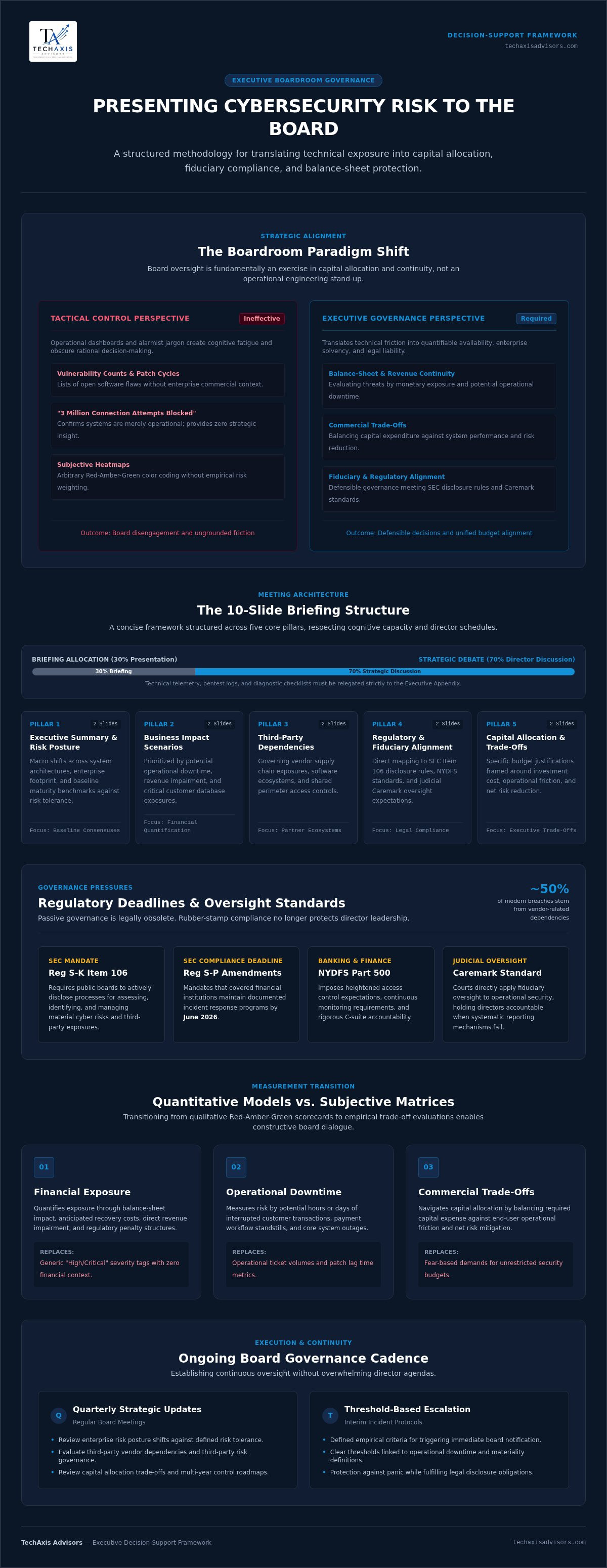
Board oversight is fundamentally about capital allocation, enterprise continuity, and fiduciary duty. When presenting cybersecurity risk to the board, technical leaders often stumble by treating the boardroom as an engineering stand-up. Vulnerability management operates at the tactical control level, tracking software flaws, patch cycles, and endpoint telemetry. Conversely, a board of directors evaluates risk through enterprise solvency, revenue continuity, and legal liability. Raw operational dashboards fail because they highlight administrative activity rather than commercial exposure.
The Disconnect Between Technical Metrics and Director Priorities
Reporting that your perimeter blocked three million unauthorized connection attempts provides zero strategic insight. It merely confirms that your systems are running. Tactical metrics like patch velocity or open vulnerability tickets fail to convey enterprise resilience. Technical jargon isolates directors, leaving them unable to ask constructive questions about organizational exposure. Relying on alarmist warnings is equally counterproductive; fear-based selling degrades executive credibility and obscures rational investment choices. Grounded information security governance replaces technical trivia with business context, translating operational friction into quantifiable operational availability and balance-sheet impact.
Regulatory Pressures Shaping Board Oversight in 2026
Regulatory scrutiny has eliminated passive governance. Directors can't simply delegate cyber posture to IT without ongoing verification. Under SEC Regulation S-K Item 106, boards must actively disclose their processes for assessing, identifying, and managing material cyber risks. Meanwhile, financial institutions face strict compliance deadlines, including the SEC Regulation S-P amendments requiring documented response programs by June 2026, alongside heightened NYDFS Part 500 access control expectations.
Fiduciary standards are shifting rapidly. Courts increasingly apply the Caremark standard of director oversight to operational security, holding boards accountable when systematic reporting mechanisms fail. Third-party vendor dependencies amplify this risk, with vendor-related compromises accounting for nearly half of modern breaches. Rubber-stamp compliance no longer protects leadership. Leveraging independent executive technology advisory services helps establish defensible decision-support frameworks, ensuring that presenting cybersecurity risk to the board delivers the empirical evidence required to withstand regulatory audit and safeguard enterprise continuity.
Structuring the Board Deck: A 5-Part Agenda Architecture
A successful executive briefing respects cognitive load and meeting constraints. When presenting cybersecurity risk to the board, your deck must follow a ten-slide standard: two slides per topic across five structured pillars. Allocate 30 percent of your allotted time to executive briefing, reserving the remaining 70 percent for strategic debate. Segregate technical telemetry, penetration test logs, and diagnostic checklists into an executive appendix. Directors can review the operational details at will, but the core narrative remains focused on commercial direction.
Executive Summary and Current Risk Posture
Open by comparing enterprise posture against defined organizational risk tolerance and baseline maturity benchmarks. Rather than detailing daily incidents, highlight macro shifts across system architectures, operational footprints, or legal mandates. Grounding this overview in the structured diagnostic frameworks outlined in how we work establishes an empirical baseline. This consensus enables leadership to assess security controls through the same lens applied to enterprise financial performance.
Translating Threat Scenarios into Business Impact
Ground threat reporting in three or four enterprise scenarios prioritized by potential operational downtime, regulatory exposure, and revenue impairment. Map core digital infrastructure, sensitive customer databases, and payment workflows to specific operational dependencies. Direct governance mandates require transparency around third parties; the SEC cybersecurity disclosure rules compel organizations to disclose their governance processes for managing third-party risks. Distinguish clearly between internal access safeguards and downstream vendor exposures, illustrating how external supply chain interruptions threaten overall business continuity.
The Prioritized Roadmap and Specific Executive Decisions
Close by transforming technical remediation plans into an actionable, phased investment roadmap. Every project milestone must trace directly to a measurable operational outcome:
Phase 1: Critical Control Remediation: Stabilize foundational access governance and identity controls across primary repositories.
Phase 2: Third-Party Ecosystem Hardening: Enforce rigorous oversight protocols on high-impact external vendors.
Phase 3: Operational Continuity Alignment: Rehearse scenario response to ensure rapid, defensible execution during downtime.
Each milestone must highlight specific decision gates where capital allocation or strategic direction is required. This phased discipline aligns cleanly with institutional standards for technology governance and compliance, replacing open-ended expense requests with discrete, measurable commitments. If you want to refine your board reporting architecture ahead of upcoming committee meetings, you can start with a confidential executive conversation to evaluate your current governance structure.
Replacing Flawed Heatmaps with Business-Aligned Risk Metrics
Subjective 5x5 heatmaps remain common in corporate reporting, yet they provide poor support for executive decision-making. When presenting cybersecurity risk to the board, coloring a risk cell "amber" introduces ambiguity. It lumps high-frequency, low-impact administrative events together with catastrophic tail risks. This ambiguity gives directors false confidence while masking critical single points of failure. Subjective scoring often reflects defensive internal posturing rather than empirical enterprise posture.
Meaningful Key Risk Indicators for Board Oversight
Effective governance demands objective telemetry that connects directly to operational resilience. High-performing boards track indicators that reflect business execution:
Mean Time to Detect (MTTD) and Contain (MTTC): Track incident velocity against operational thresholds. IBM's 2026 data shows the average breach lifecycle reached 247 days, while containment under 200 days saved an average of $1.33 million.
Tier-One Vendor Coverage: Measure the percentage of third parties operating under verified governance frameworks and continuous oversight.
Privileged Access Hygiene: Monitor the prompt decommissioning of administrative credentials and enforce multi-factor authentication coverage.
Quantifying Risk in Economic Terms
Enterprise directors evaluate strategic exposure through financial balance sheets and operational uptime. Instead of reporting theoretical threat categories, express operational exposure using probabilistic models like Factor Analysis of Information Risk (FAIR). Translate exposure into hourly business interruption costs, regulatory penalty liabilities, and remediation capital. For wealth management firms and private equity portfolio companies, downtime directly compromises transaction integrity, fee processing, and regulatory compliance.
Structuring technology metrics through rigorous data modeling ensures that cyber investments compete objectively against other enterprise priorities. Adopting quantitative frameworks transforms presenting cybersecurity risk to the board into a transparent review of business continuity and capital protection.
Navigating Tough Board Questions, Trade-Offs, and Pushback
Audit and risk committees rarely accept high-level risk summaries at face value. Experienced directors interrogate the assumptions underneath your slides. When presenting cybersecurity risk to the board, your success depends on answering difficult, probing inquiries with objective commercial trade-offs rather than defensive technical rationalizations.
Direct Answers to Predictable Board Inquiries
Boards consistently ask three fundamental questions during governance reviews:
"Are we fully secure?" Reframe security immediately as continuous risk management rather than a permanent state. Explain that absolute security is commercially non-viable; enterprise resilience focuses on maintaining operations and containing compromise within defined tolerance thresholds.
"How do we compare to our peers?" Avoid superficial industry benchmark comparisons. Point out that peer spending reflects their historical debt, not your operational architecture. Base comparisons on control maturity against recognized governance standards like NIST CSF 2.0.
"What happens if our primary cloud provider fails?" Provide verified recovery time objectives (RTO) and recovery point objectives (RPO). Cite tested failover procedures and backup integrity rather than theoretical vendor uptime guarantees.
Framing Options: Retain, Optimize, Replatform, or Insure
Budget pushback is inevitable when requests appear as disconnected operational expenses. Overcome this friction by structuring decisions around four clear options: retain, optimize, replatform, or insure. Clarify what residual exposure the organization accepts if an investment is delayed. If capital constraints prevent replatforming legacy core systems, evaluate whether policy optimization or risk transfer through cyber insurance offers adequate interim protection. With cyber insurance premiums forecast to increase 15% to 20% in 2026, insurance cannot replace baseline control hygiene. Presenting these options clearly aligns with the cross-functional priorities covered in problems we solve, turning contentious budget debates into transparent governance decisions.
Addressing the Security Implications of Artificial Intelligence
Directors want clear visibility into how artificial intelligence impacts corporate exposure. Attackers actively exploit machine learning tools to scale sophisticated social engineering campaigns; in 2026, one in four malicious breaches involved AI enablement, raising average incident costs by roughly $1 million. Simultaneously, unmanaged employee adoption of large language models exposes proprietary client portfolios and corporate data. Present a balanced governance posture that establishes explicit usage guardrails and access restrictions. This discipline protects proprietary data assets while allowing business units to test productivity enhancements safely.
Grounding these responses in commercial realities establishes executive trust during difficult exchanges, reinforcing your credibility when presenting cybersecurity risk to the board.
Establishing an Ongoing Governance Cadence and Decision Support
Effective cyber oversight cannot function as an isolated annual appearance before the audit committee. When presenting cybersecurity risk to the board, consistency builds institutional credibility. Establishing a structured, predictable reporting rhythm ensures directors track operational progress over time rather than reacting to acute crises. A deliberate governance calendar transforms oversight from an adversarial compliance check into disciplined executive collaboration.
The Annual Cybersecurity Governance Schedule
A mature governance rhythm separates tactical operational reviews from high-level strategic alignment:
Q1 Posture and Baseline Review: Establish annual performance baselines against the NIST CSF 2.0 framework, focusing on the updated "Govern" function to benchmark organizational accountability.
Q2 Third-Party and Ecosystem Deep Dive: Assess supplier exposure, contractual audit rights, and operational dependencies across tier-one software partners.
Q3 Tabletop Continuity Simulation: Walk directors through a realistic operational disruption scenario, testing executive decision gates and legal notification protocols.
Q4 Capital Allocation and Strategic Sign-Off: Review multi-year security roadmaps and approve following-year capital expenditure based on validated risk reductions.
Between these quarterly sessions, supply a standardized one-page briefing to maintain executive context without creating cognitive overload.
Materiality Thresholds and Incident Escalation Protocols
Out-of-cycle notifications must rely on predefined, objective operational criteria rather than subjective panic. The SEC's four-business-day Form 8-K disclosure window begins when an organization determines an incident is material, not upon discovery. That determination must occur without unreasonable delay. Establish clear quantitative thresholds for escalation: confirmed unauthorized access to primary customer financial records, uncontained ransomware spreading across production clusters, or an operational outage exceeding eight hours on transaction processing pipelines. Predefined criteria protect management and the board, providing the objective structure required to meet fiduciary duties while preventing premature disruption during ongoing containment operations.
Leveraging Independent Executive Advisory
Internal reporting teams often struggle with blind spots or internal friction that cloud objectivity. Structured Executive Intelligence Assessments serve as objective decision-support engagements, delivering empirical evidence and board-ready briefs free from operational bias. For growth-stage firms and regulated institutions, bringing in seasoned former technology leaders via advisory leadership bridges the gap between frontline engineering and committee oversight. This senior guidance ensures that presenting cybersecurity risk to the board remains defensible, commercially grounded, and aligned with enterprise growth.
Start with a confidential executive conversation
Transforming Cyber Oversight into Strategic Leadership
Effective governance transforms technical vulnerability into clear business decisions. Moving from subjective heatmaps to quantitative exposure models clarifies balance-sheet impact, while a disciplined five-part agenda keeps directors focused on enterprise continuity. Mastering the structure and commercial language of presenting cybersecurity risk to the board elevates security from an operational cost center to a critical pillar of organizational resilience.
TechAxis Advisors brings over 25 years of executive CIO, CTO, and CISO experience across regulated financial services. Powered by the proprietary TechAxis Executive Intelligence Platform, our structured decision-support engagements translate complex architectures into evidence-based findings, prioritized roadmaps, and actionable risk registers that satisfy modern fiduciary and regulatory expectations.
Start with a confidential executive conversation
Clear governance builds lasting trust across the boardroom table. With disciplined frameworks and empirical data in place, you can lead your next committee briefing with complete strategic confidence.
Frequently Asked Questions
How often should cybersecurity risk be presented to the board of directors?
Cybersecurity risk should be reviewed quarterly by the audit or risk committee, complemented by an annual full-board strategic session. Quarterly cadences maintain continuity without micromanaging technical teams. In regulated sectors like financial services, interim one-page dashboard updates between meetings track critical remediation milestones. Out-of-cycle briefings should occur only when triggered by predefined materiality thresholds, such as significant operational interruptions or confirmed data compromises.
What are the most effective metrics to present when presenting cybersecurity risk to the board?
The most effective metrics connect security performance directly to balance-sheet protection and business continuity. When presenting cybersecurity risk to the board, highlight Mean Time to Contain (MTTC), peer-benchmarked control maturity against NIST CSF 2.0, third-party ecosystem risk exposure, and probabilistic financial loss estimates. Avoid raw operational counts like blocked intrusion attempts. Directors need business-aligned telemetry that informs capital allocation, regulatory defensibility, and operational resilience.
What is the difference between an operational IT dashboard and a board-level cyber report?
Operational IT dashboards track tactical, component-level telemetry like open Jira tickets, vulnerability scanner counts, and firewall throughput for engineering teams. A board-level cyber report synthesizes that raw data into strategic business intelligence. It translates systemic exposures into financial loss estimates, operational downtime projections, and regulatory compliance posture. Directors require governance-grade summaries that support executive decisions rather than administrative task tracking.
How should a company handle a board presentation following a security incident or near-miss?
Lead with verified operational facts, financial exposure, and containment status rather than speculative root causes. Present a clear timeline establishing when the compromise occurred, when containment began, and what operational dependencies were affected. Detail the immediate compensatory controls deployed, regulatory notification timelines, and specific architectural improvements planned to prevent recurrence. Transparency and disciplined composure preserve executive credibility during high-pressure post-incident reviews.
Why are traditional heatmaps losing favor with corporate boards and audit committees?
Subjective 5x5 red-amber-green heatmaps lack quantitative mathematical rigor. Coloring an operational risk "amber" compresses diverse risk scenarios together, masking catastrophic tail risks behind moderate ratings. Audit committees increasingly reject qualitative matrices because they reflect assessor bias rather than empirical exposure. Boards prefer quantitative methodologies like FAIR, which express exposures in probabilistic monetary ranges and measurable recovery timelines.
When should an organization engage an independent executive advisor or fractional CISO for board reporting?
Engage independent executive advisory when internal reporting lacks board-level business alignment, during leadership transitions, or when facing complex regulatory scrutiny. An objective third-party diagnostic, such as an Executive Cybersecurity & Technology Risk Assessment, validates internal security posture without operational bias. Fractional technology leadership bridges technical teams and executive committees, delivering seasoned advisory expertise to translate complex architectures into defensible governance roadmaps.



Comments