

Part-Time Chief Technology Officer: An Executive Guide to Fractional Leadership
Gartner projects that more than 30% of midsize enterprises will retain at least one fractional executive by 2027. For many CEOs in wealth management and private equity, the pressure to scale often outpaces the ability to recruit a full-time technology leader. You likely recognize the tension between needing a sophisticated data strategy and the substantial capital commitment required for a permanent hire. Engaging a part-time chief technology officer isn't a budget compromise; it's a strategic governance tool. It allows you to address technical execution risk and AI readiness without the delay of a traditional executive search.
This guide provides executive clarity on how fractional leadership aligns technology strategy with your specific business goals. We'll examine how to reduce technical debt, make evidence-based decisions for AI governance, and ensure your IT spend reflects your operational priorities. You'll gain a clear decision framework to evaluate whether your current growth trajectory requires a structured assessment or long-term advisory leadership. This approach replaces organizational anxiety with a sense of controlled, disciplined progress.
Table of Contents
The Technology Leadership Gap in Growth-Stage Firms
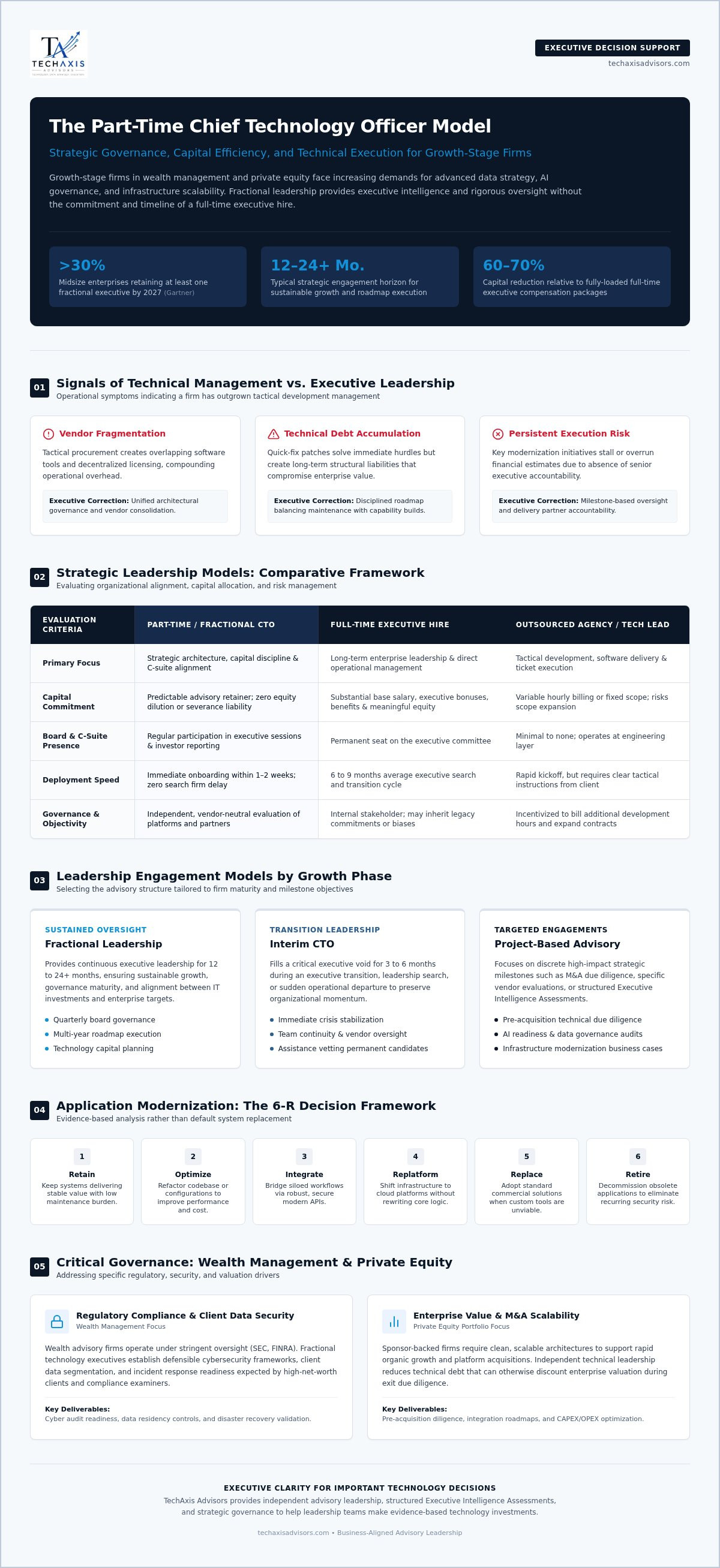
Growth-stage firms often hit an operational maturity wall. Systems that worked for five employees fail at fifty. This isn't just a technical problem; it's a leadership deficit. Many CEOs rely on lead developers or outsourced providers for strategic direction. These roles focus on tactical execution. They don't provide the high-level oversight required to align technology with business outcomes. A part-time chief technology officer bridges this gap by providing executive intelligence without the overhead of a permanent hire.
Technical debt accumulates quietly during rapid scaling. Every quick fix and siloed software purchase creates a future liability. Without a fractional executive leadership model, these liabilities eventually stall growth. Executive technology leadership focuses on structural integrity and long-term scalability. It differentiates itself from technical management by prioritizing the business case over the technical feature. The CEO needs executive clarity to ensure the technology ecosystem supports, rather than hinders, the bottom line.
Symptoms of a Leadership Vacuum
A leadership vacuum manifests in specific, measurable ways. Technology investments often fail to map to long-term business goals. You see capital deployed for tools that solve immediate pains but ignore the broader roadmap. Other symptoms include:
Vendor Management Fragmentation: Multiple platforms performing overlapping functions without a cohesive architecture.
Lack of Application Modernization: Legacy systems remain in place because there's no clear business case for whether to retain, optimize, or replace them.
Persistent Execution Risk: Digital transformation initiatives frequently stall or exceed budget due to a lack of senior governance.
The Cost of Executive Indecision
Indecision is expensive. When technology decisions are made in a vacuum, redundant software spend increases. This creates operational friction that frustrates employees and slows down service delivery. Board members in wealth management and private equity are increasingly demanding rigorous technology governance. They recognize that technical execution risk is directly linked to enterprise value. A part-time chief technology officer provides the evidence-based findings necessary to satisfy these stakeholders. This role ensures that every dollar spent on IT is a deliberate investment in the firm's operational performance rather than a reactive expense.
Defining the Part-Time Chief Technology Officer Model
A part-time chief technology officer functions as a strategic architect within your organization. Unlike a technical lead who manages code, this executive manages risk, capital allocation, and operational alignment. They operate as an embedded partner, participating in board meetings and executive sessions to ensure technology decisions reflect the firm's commercial objectives. This model prioritizes high-level governance over tactical hands-on implementation. It's about having a veteran voice at the table to validate the roadmap and provide executive intelligence to the rest of the C-suite.
This role is fundamentally different from traditional technical outsourcing. It is a leadership position that takes ownership of the technology vision. The focus remains on the business value of systems rather than the granular details of their construction. By integrating a seasoned leader into your team, you gain the ability to make evidence-based decisions without the friction of a full-time executive search or the long-term commitment of a heavy salary and equity package.
Fractional vs. Interim: Which Model Fits Your Phase?
The distinction between these models depends on your firm's current lifecycle and immediate needs. A Harvard Business Review analysis on part-time senior leaders suggests that fractional models provide the highest leverage for growth-stage firms needing long-term strategic continuity. Each model serves a distinct purpose:
Fractional leadership: Provides ongoing strategic alignment for 12 to 24 months or longer, focusing on sustainable growth.
Interim roles: Fills a gap for 3 to 6 months during an executive transition or while a full-time search is conducted.
Project-based advisory: Targets a specific milestone, such as an M&A due diligence process or a specific AI automation readiness assessment.
Core Responsibilities of a Strategic Advisor
The remit of a fractional CTO is defined by oversight rather than execution. They don't write code; they ensure the code being written serves the business. Their core focus includes:
Strategic Alignment: Mapping IT infrastructure directly to business goals. This involves evaluating existing systems to determine whether to retain, optimize, integrate, replatform, replace, or retire them based on a rigorous business case.
Governance and Compliance: Developing frameworks that meet the standards of wealth management and financial services.
Vendor Strategy: Managing high-level relationships to prevent platform bloat and ensure service level agreements are met.
If you're unsure which model aligns with your current growth phase, you can start with a confidential executive conversation to explore whether your priority requires an assessment or fractional leadership.
Part-Time vs. Full-Time CTO: A Decision Framework
Choosing between a permanent hire and a part-time chief technology officer is a matter of organizational design. Scale matters. However, the complexity of your regulatory environment often dictates the level of expertise required more than the size of your headcount. Wealth management and financial services firms frequently face high-stakes technical requirements that don't demand 40 hours of strategic intervention every week. In these instances, a fractional model provides executive intelligence without the excessive capital commitment of a full-time search.
The ROI of a part-time chief technology officer becomes clear when evaluating total compensation. A full-time technology executive in private equity-backed firms can cost between $400,000 and $600,000 annually when bonuses and equity are included. Many firms find that they pay a premium for a full-time title when their actual needs are focused on specific performance outcomes. A part-time expert brings a diverse industry perspective, having seen various architectural failures and successes across multiple firms. This breadth of experience is often more valuable during transformation phases than the depth of a single-company executive.
The Business Case for Fractional Leadership
Strategic oversight must align with FINRA cybersecurity and technology governance guidelines to ensure defensible risk management. By leveraging fractional leadership, you access senior-level perspective without the overhead of executive benefits or search fees. This model ensures you receive direct engagement from a seasoned professional rather than the less experienced staff often assigned by larger generalist firms. It allows you to scale leadership hours based on organizational needs. You might require fifteen hours a week during a platform migration and only five hours during steady-state operations. It ensures that your technology spend remains aligned with your actual business volume.
When to Transition to a Full-Time Executive
A full-time transition is typically triggered by operational volume and team size. When the daily management of a large internal engineering team or 24/7 technical oversight becomes the primary focus, a permanent hire is necessary. This usually occurs when the organization reaches a level of maturity where technology is the primary product rather than a supporting function. A fractional leader often helps design this permanent role. They establish the search criteria, interview candidates, and ensure the incoming executive inherits a clear roadmap rather than a collection of technical debt. This transition strategy reduces the risk of a bad hire and ensures continuity during the handoff.
Leadership for Regulated Industries: Wealth Management and PE
Wealth management and private equity firms operate under a unique set of fiduciary constraints. Technology isn't just an operational support tool; it's a core component of regulatory compliance. A part-time chief technology officer provides the senior oversight needed to navigate complex mandates like the SEC’s amended Regulation S-P. This regulation now requires covered institutions to maintain written incident response programs and notify individuals of unauthorized data access within 30 days. For firms with less than $1.5 billion in AUM, the compliance deadline expired on June 3, 2026. Non-compliance is no longer an option; it's a direct threat to enterprise value and reputation.
Fiduciary duties extend to how data is managed, stored, and protected. In lending and financial services, technology risks are often hidden in fragmented vendor ecosystems. A fractional leader ensures that vendor risk management isn't a check-the-box exercise but a rigorous governance process. This level of executive intelligence is critical for firms that must demonstrate technology oversight to board members and regulators. It replaces organizational anxiety with a disciplined framework for operational integrity.
AI Strategy and Automation Readiness
AI governance is now a direct accountability for technology leaders. According to a 2026 CTO Craft survey, 83.8% of CTOs directly manage AI implementation and governance. In financial services, you can't afford to chase trends without a pragmatic roadmap. Automation readiness involves evaluating whether your data architecture can support AI without compromising privacy or compliance. A part-time chief technology officer helps you move beyond the hype to develop evidence-based AI strategies. They ensure that every automation initiative meets strict risk standards and provides a measurable return on investment.
Technology Due Diligence and M&A
In the private equity space, data strategy is a primary lever for value creation. A fractional leader performs structured assessments of technical debt in portfolio companies before an acquisition is finalized. This due diligence identifies whether a target’s infrastructure can be integrated or if it requires a complete overhaul. Using a framework to evaluate whether to retain, optimize, integrate, replatform, replace, or retire systems, the advisor builds a scalable foundation for post-merger success. This disciplined approach ensures that technology remains an asset during the hold period rather than a drain on capital.
The TechAxis Approach: Evidence-Based Executive Clarity
TechAxis Advisors provides executive clarity through a structured, evidence-based approach. We don't rely on generic consulting templates or abstract theory. Instead, we use the proprietary TechAxis Executive Intelligence Platform to deliver structured diagnostics. This platform ensures that findings are grounded in data rather than subjective opinion. Our leadership team consists of veteran CIOs and CTOs with over 25 years of experience in financial services and wealth management. This background ensures a business-first perspective that prioritizes operational scalability and risk management over technical jargon.
The Executive Assessment Portfolio
Clarity begins with a structured Executive Intelligence Assessment. These are not technical audits; they're executive decision-support engagements designed for the board level. We evaluate your current environment across AI readiness, cybersecurity, and data strategy. The output is a prioritized roadmap and board-ready briefs that inform capital allocation. By using our decision framework, we help you determine whether to retain, optimize, integrate, replatform, replace, or retire specific systems. This data-driven approach removes the guesswork from technology modernization and ensures every initiative has a clear business case.
You can explore our full range of executive decision-support engagements to see how we provide clarity for your specific technical priorities.
Fractional Execution and Governance
Once the roadmap is established, a part-time chief technology officer provides the necessary governance to ensure execution. TechAxis doesn't perform direct software builds or cloud migrations. We support execution through advisory leadership, vendor oversight, and qualified delivery partners. This model maintains independence and ensures that your technology operating model remains aligned with your long-term business strategy. We provide the accountability and transparency that growing firms often lack during transformation phases.
The role of a part-time chief technology officer is to bring order to chaos. We establish the metrics and reporting necessary for board-level visibility into technical progress. This includes managing high-level vendor relationships and ensuring that technical implementations adhere to the defined governance standards. Our goal is to provide the steady, reassuring hand of a seasoned professional, allowing your leadership team to focus on growth while we manage the mechanics of technical execution. This approach replaces organizational anxiety with a sense of controlled, disciplined progress.
Securing Your Technical Roadmap
Effective technology leadership is a requirement for operational scaling, not a luxury. By bridging the gap between tactical management and executive strategy, you ensure that every technical decision reflects your firm's commercial goals. This guide has detailed how structured diagnostics and fractional governance reduce technical debt while maintaining compliance in regulated environments. Engaging a part-time chief technology officer ensures that your technical execution risk is managed with the same rigor as your financial strategy.
TechAxis Advisors provides the executive intelligence necessary for these high-stakes decisions. Led by a founder with over 25 years of CIO and CTO experience, our approach uses a proprietary Executive Intelligence Platform to deliver evidence-based findings. As a Certified Women-Owned Small Business (WOSB), we offer the senior access and pragmatic oversight that growth-stage firms require to thrive. You don't have to navigate complex technology transitions without a veteran voice at the table.
Take the next step toward replacing organizational uncertainty with a sense of controlled, disciplined progress.
Frequently Asked Questions
What is the difference between a part-time CTO and a technical consultant?
A part-time chief technology officer acts as an embedded member of your leadership team, focusing on long-term strategy and executive governance. While a technical consultant often addresses a specific, isolated project, a fractional leader owns the technology roadmap and aligns IT spend with business outcomes. This role involves participating in board meetings and providing ongoing oversight. It's a strategic partnership rather than a tactical engagement, ensuring technology decisions support your overarching organizational goals.
How many hours a week does a fractional chief technology officer typically work?
Commitment levels vary based on your firm's operational maturity and current growth phase. Most fractional engagements range from 5 to 20 hours per week. During a major platform migration or AI implementation, the hours might scale up to ensure rigorous oversight. Conversely, during steady-state operations, the commitment often scales down to maintain essential governance. This flexibility allows you to access senior-level perspective without the capital commitment of a full-time C-suite salary.
Can a part-time CTO manage a full-time engineering team effectively?
Yes, a fractional leader provides the necessary oversight to manage and mentor internal engineering teams effectively. They establish clear accountability, define performance metrics, and ensure developers are working on high-impact priorities. This leadership bridge is especially valuable for firms where the CEO or COO has been informally managing technical staff. The CTO provides the professional distance and expertise needed to translate business requirements into technical execution while reducing execution risk.
Is a fractional CTO suitable for a company in the wealth management sector?
The model is highly effective for the wealth management sector, where fiduciary duties and regulatory compliance are paramount. A part-time chief technology officer ensures that your data strategy and cybersecurity risk management meet the standards required by regulators. TechAxis Advisors specializes in this field, helping firms navigate SEC Regulation S-P and FINRA guidelines. This provides executive clarity for leadership teams who must demonstrate rigorous technology governance to board members and investors.
What are the typical deliverables of a fractional technology leadership engagement?
Deliverables focus on clarity and traceability for the C-suite and board. You can expect board-ready findings, prioritized strategic roadmaps, and action registers with clear next steps. These artifacts are powered by the proprietary TechAxis Executive Intelligence Platform, ensuring evidence-based insights. Unlike generic consulting reports, these deliverables are designed to inform capital allocation and operational scaling. They provide a transparent record of technology decisions and their alignment with business strategy.
How do you evaluate the ROI of hiring a part-time executive advisor?
Evaluating ROI involves comparing the cost of fractional leadership against the fully loaded compensation of a full-time CTO, which often exceeds $400,000 annually. Additionally, fractional executives typically achieve operational alignment within 30 to 45 days, significantly faster than the 6 to 9 months required to recruit and onboard a permanent hire. ROI is also measured through reduced technical debt, improved vendor management, and the successful mitigation of technical execution risks during rapid growth.
What happens if our technology needs grow beyond the part-time model?
If your operational volume requires 24/7 technical oversight or the management of a very large internal department, you may need a full-time executive. A fractional leader manages this transition by helping you design the permanent role and establish search criteria. They ensure the incoming hire inherits a clear, documented roadmap and a scalable foundation. This approach prevents a leadership vacuum and ensures continuity as your organization reaches a higher level of maturity.
Does a part-time CTO handle hands-on software development or cloud migrations?
No, this role focuses on advisory leadership and governance rather than direct coding or system builds. The executive oversees the execution performed by internal teams or qualified delivery partners. They manage vendor relationships and ensure technical implementations adhere to your strategic roadmap. This oversight ensures accountability and prevents technical debt from accumulating. It allows the leader to remain independent and focused on the business value of your technology investments.


Comments