

Operational Scalability Consulting for Startups: An Executive Decision Framework (2026)
Most startups don't fail because they lack product-market fit. They fail because their internal systems collapse under the weight of their own success. When technical debt stalls product releases and manual data entry leads to executive-level inaccuracies, the need for operational scalability consulting for startups becomes undeniable. At this stage, the "move fast and break things" philosophy becomes a structural liability that threatens your board's confidence.
You need a technology operating model that doesn't just support growth but actively accelerates it. This article provides an executive decision framework for 2026, designed to align your technical architecture with your overarching business strategy. We'll examine how to eliminate execution risks, transition away from manual bottlenecks, and establish the high-level technology leadership necessary to guide your organization through its next phase of maturity. You'll learn how to transform your technology from a cost center into a disciplined engine for predictable, scalable performance. By focusing on structural integrity and transparent governance, you can replace organizational anxiety with a sense of controlled, disciplined progress.
Table of Contents
The Scalability Paradox: Why Rapid Growth Often Leads to Operational Friction
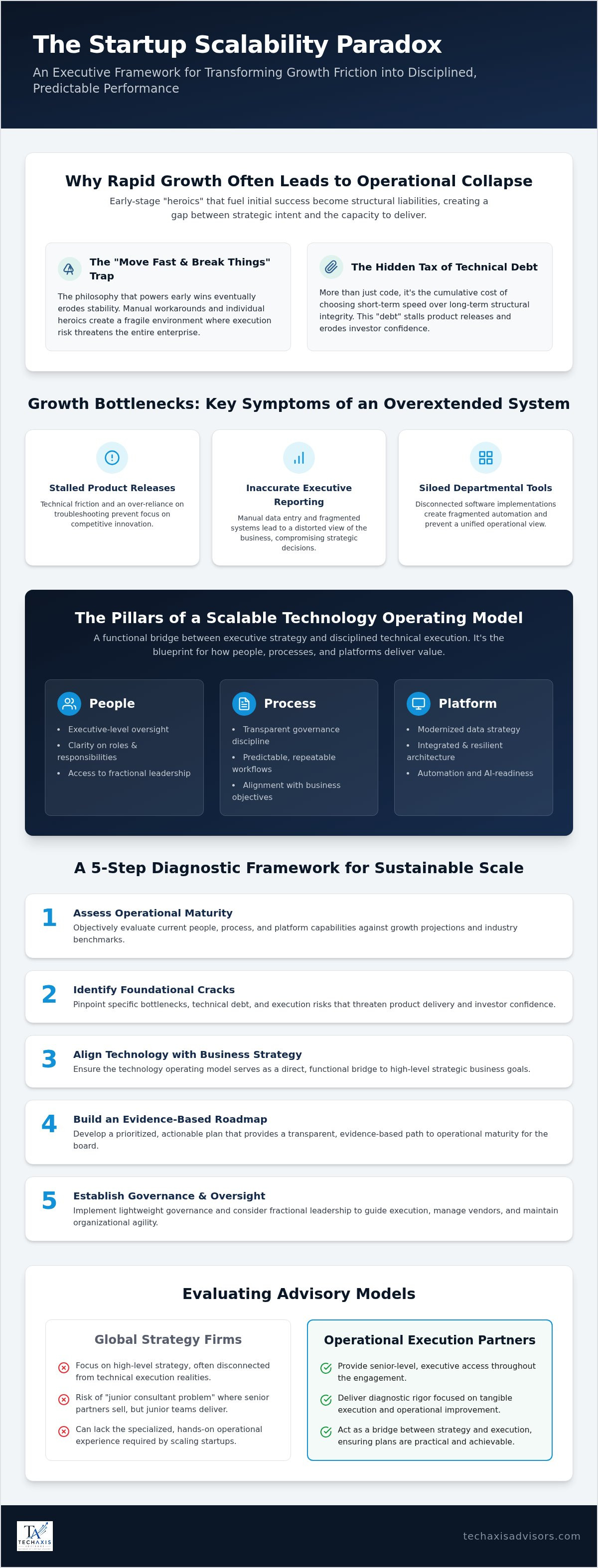
Growth is often a mask for operational inefficiency. While increasing top-line revenue feels like progress, true scalability is the property of a system to handle a growing amount of work by adding resources effectively. Many founders fall into the Scalability Paradox. They achieve market traction only to find their internal processes collapsing under the weight of new demand. At this stage, the manual "heroics" that powered the early days become a structural liability. Relying on individual effort to patch systemic holes creates a fragile environment where execution risk threatens the entire enterprise.
Technical debt is the hidden tax on rapid expansion. It isn't just subpar code; it's the cumulative cost of choosing short-term speed over long-term structural integrity. When a startup's technology stack relies on manual workarounds, the organization loses its ability to pivot. This friction erodes investor confidence. Boards demand predictable, repeatable processes, not a series of near-misses. Engaging in operational scalability consulting for startups allows leadership to identify these foundational cracks before they compromise a major funding round or an IPO.
Identifying Growth Bottlenecks in the Technology Stack
Symptoms of an overextended infrastructure appear as stalled product releases or data inaccuracies in executive reporting. When departments implement disconnected tools, "siloed" automation creates a fragmented view of the business. A legacy system that served the company at its inception often becomes a liability during market expansion. You must determine if your current stack enables growth or merely survives it. Specialized operational scalability consulting for startups provides the diagnostic rigor needed to identify these technical hurdles.
The Executive Cost of Execution Risk
Execution risk is the gap between strategic intent and the organization's capacity to deliver. Technical delays are missed market opportunities. If your team remains in reactive troubleshooting mode, they can't focus on competitive innovation. Transitioning to proactive operational maturity requires executive-level oversight. It involves aligning technology operating models with business strategy to ensure the board receives a transparent, evidence-based roadmap. This structural clarity replaces organizational anxiety with a disciplined path toward mastery.
The Pillars of a Scalable Technology Operating Model
A technology operating model is the functional bridge between executive strategy and technical execution. It's the structural design of how your people, processes, and platforms interact to deliver value. Without this blueprint, technology remains a black box that consumes capital without providing clear accountability. A scalable model ensures that your infrastructure stays ahead of your revenue growth, rather than trailing behind it as a persistent bottleneck. Effective operational scalability consulting for startups focuses on building this model to eliminate the friction that typically stalls mid-stage expansion.
Scalability isn't merely an IT support function or an HR challenge. It's a governance discipline. It requires a framework where technical resources are aligned with business objectives to ensure every development cycle yields measurable ROI. This alignment creates a predictable environment where the board can see the direct link between technology investment and organizational maturity.
Data Strategy: The Foundation of Operational Excellence
Data is the lifeblood of the modern enterprise, yet scaling customer-facing platforms often introduces fragmentation. Modernizing your data reporting framework is essential for real-time business intelligence. This requires shifting from static, historical reports to dynamic, evidence-based dashboards. For those in specialized or highly regulated sectors, understanding the nuances of scaling data foundations for finance provides a critical template for managing high-stakes information with precision and integrity.
AI Readiness and Automation Governance
AI integration often fails because organizations prioritize hype over "automation readiness." You shouldn't automate a broken process. Instead, identify high-impact use cases where AI can reduce manual labor without introducing unmanaged organizational risk. A robust AI roadmap aligns these tools with your specific compliance requirements. This ensures that as you scale, your automated systems remain transparent and accountable to executive leadership. If your current team lacks the bandwidth to architect these guardrails, it may be time to explore a strategic advisory partnership.
Governance provides the structural integrity necessary for sustainable growth. It ensures that vendor relationships and software projects are managed with discipline and transparency. By establishing these pillars early, you move from reactive troubleshooting to a proactive state of operational mastery. This level of oversight is a core component of operational scalability consulting for startups, providing the leadership bridge a growing company needs to succeed in 2026.
Evaluating Advisory Models: Strategy Firms vs. Operational Execution Partners
Selecting the right partner for operational scalability consulting for startups is a strategic pivot point for any growth-stage firm. The decision often centers on a conflict between global prestige and operational depth. Large strategy firms offer brand security. This "prestige" model is appropriate for massive mergers or public filings where the board requires a recognized global name. However, this often leads to the "Junior Consultant Problem." You pay for the partner's reputation but receive the labor of associates who have never managed a technical crisis or sat in a C-suite chair. These generalists lack the practical scars of growth-stage execution.
Boutique advisory firms offer a different value proposition. They prioritize senior access and specialized industry expertise. Instead of receiving a generic strategy report that gathers dust, you gain an embedded partner who understands the mechanics of scaling. The tradeoff is clear. Strategy reports define the "what," while operational execution partners deliver the "how." This embedded approach ensures that advice isn't just theoretically sound but practically implementable within your specific organizational constraints. It replaces high-level observation with grounded, results-oriented commitment.
When to Choose Specialized Tech Advisory
Domain expertise is non-negotiable in regulated environments. Industries like wealth management or healthcare can't rely on generalist advice. You need a partner who understands specific compliance guardrails and data integrity requirements. You can see who TechAxis advisory is for to understand how specialized oversight fits into different growth stages. The cost-to-value ratio of fractional leadership often outperforms full-time executive hires. It provides immediate C-suite oversight without the long-term overhead of a permanent salary and benefits package. This agility is essential when you need to bridge a leadership gap quickly.
The TechAxis Perspective on Independent Advisory
True advisory must be platform-agnostic. When a consultant is incentivized to recommend specific software, their objectivity is compromised. Effective operational scalability consulting for startups relies on evidence-based assessments rather than generic templates. We use proprietary tools to synthesize data into actionable roadmaps. This approach reduces technical execution risk by aligning every vendor choice and software project with your strategic goals. It's about moving from abstract theory to disciplined, measurable progress. By focusing on structural integrity, you ensure your technology stack remains a competitive asset rather than a growing liability.
The Executive Diagnostic: Assessing Your Readiness for Sustainable Scale
Scaling a startup effectively requires more than intuition; it demands a structured diagnostic. You can't build a durable organization on assumptions or gut feelings. Our 5-step process for evaluating operational maturity provides the clarity necessary to move from chaos to control. We utilize the proprietary TechAxis Executive Intelligence Platform to synthesize evidence from across your organization. This platform transforms complex technology ecosystems into board-ready strategic roadmaps. It replaces organizational anxiety with a disciplined, data-driven path forward. This evidence-based approach is a hallmark of professional operational scalability consulting for startups.
A core component of this diagnostic is the "Retain, Optimize, Replatform, or Replace" framework. Every piece of your legacy tech is evaluated against its ability to support future growth. This prevents the common mistake of throwing capital at new software when a process optimization would suffice. Conversely, it identifies when a legacy system has become a structural liability that must be phased out before it causes a catastrophic failure.
Structured Diagnostics vs. Traditional Audits
Traditional audits often focus on technical uptime or narrow compliance checklists. In contrast, executive decision-support engagements focus on business outcomes. We identify "Action Registers" that prioritize high-impact operational fixes. This ensures your team isn't just busy; they're moving the needle on scalability. For a detailed guide on building this vision, you can view our strategic tech roadmap for scale-ups.
Measuring Operational Maturity
Measuring maturity requires specific KPIs that track the efficiency and risk profile of your technology organization. You must assess cybersecurity and technology governance during rapid expansion to maintain structural integrity. This level of documentation is vital for investor scrutiny and M&A technology integration. High-quality operational scalability consulting for startups ensures your data is transparent, defensible, and aligned with your long-term exit strategy. It provides the leadership bridge needed to navigate these high-stakes transitions with confidence.
Implementing Fractional Leadership to Bridge the Scalability Gap
Many growth-stage firms identify their bottlenecks but lack the internal leadership to resolve them. This is where fractional leadership becomes the primary engine of transformation. A Fractional CTO provides the same executive oversight as a full-time hire but without the prohibitive cost of a permanent C-suite salary and equity package. They don't just offer high-level suggestions; they manage vendor relationships and software development projects with a disciplined focus on accountability. This ensures that the strategic roadmap developed during your initial diagnostic actually reaches delivery. Professional operational scalability consulting for startups provides this necessary bridge between identifying a problem and mastering the solution.
Continuity is the most critical factor in long-term transformation. Transitioning from a diagnostic assessment to active execution requires a leader who understands the original evidence and the desired business outcomes. By embedding an experienced advisor into your leadership structure, you ensure that technical decisions remain aligned with your business strategy. This approach reduces execution risk and prevents the "strategy-execution gap" that often occurs when consultants hand off a report and disappear. It replaces organizational anxiety with a sense of controlled, disciplined progress.
Embedded Leadership for Growth-Stage Execution
An advisor acts as a trusted partner for the CEO and the Board of Directors. They provide a level of technology governance that internal teams often lack during periods of rapid expansion. This includes designing the technology organization for its next growth stage, ensuring that hiring plans and reporting structures support your long-term goals. You can learn more about how TechAxis fractional leadership works to see how this embedded model maintains continuity and structural integrity throughout your company's evolution.
Next Steps: Moving Toward Executive Clarity
Determining your next move depends on your current level of operational maturity and the specific risks facing your organization. You might require a one-time diagnostic assessment to identify hidden technical debt, or you may need ongoing advisory to guide your technical teams through a complex replatforming project. Moving toward executive clarity doesn't require a massive commitment upfront. It starts with a low-pressure, confidential conversation to align your technical capabilities with your overarching business strategy. This is the most efficient way to utilize operational scalability consulting for startups to secure your organization's future.
Securing Your Organization's Future Through Structural Mastery
Sustainable growth requires a shift from reactive troubleshooting to disciplined technical governance. Successful leaders recognize that scaling is a structural challenge that demands more than just adding headcount. By implementing a robust technology operating model and leveraging evidence-based roadmaps, you ensure that every technical investment yields measurable business value. Professional operational scalability consulting for startups provides the framework necessary to align your infrastructure with your board's strategic vision.
At TechAxis Advisors, we utilize our proprietary TechAxis Executive Intelligence Platform to deliver the board-level clarity required for high-stakes decision-making. As a certified Women-Owned Small Business (WOSB), we provide the senior-level oversight needed to reduce execution risk and eliminate growth bottlenecks. You can replace organizational anxiety with a sense of controlled, disciplined progress.
The transition from a growth-stage startup to a mature, scalable enterprise is a journey of precision and oversight. You don't have to navigate this complexity alone.
Frequently Asked Questions
What is operational scalability consulting for startups?
Operational scalability consulting for startups is a strategic advisory service that aligns a company's technology operating model with its business goals to eliminate growth bottlenecks. It involves assessing infrastructure, processes, and leadership to ensure the organization can handle increased demand without a proportional increase in costs. This consulting provides a disciplined roadmap for sustainable expansion by addressing technical debt, leadership gaps, and systemic execution risk.
How is a fractional CTO different from a traditional IT consultant?
A fractional CTO operates as an embedded executive partner rather than an outside project-based generalist. While a traditional IT consultant often focuses on specific hardware or software fixes, a fractional CTO provides high-level strategic oversight and governance. They bridge the gap between technical teams and the board, managing vendor relationships and long-term technology roadmaps with a primary focus on business outcomes.
When should a growth-stage company hire an operational scalability consultant?
You should engage operational scalability consulting for startups when internal systems begin to stall product delivery or cause data inaccuracies. Common triggers include preparing for a Series B or C funding round, undergoing a merger, or noticing that manual workarounds are no longer sufficient to maintain quality. At this threshold, strategic intervention is necessary to prevent structural failure and ensure technology remains a competitive asset during rapid market expansion.
Can operational scalability consulting help with AI readiness?
Yes, it provides the governance framework necessary to integrate AI without introducing unmanaged organizational risk. This involves evaluating automation readiness by auditing current processes and data integrity before deploying complex models. A consultant ensures that AI initiatives align with compliance requirements and business strategy, transforming automated tools into disciplined engines for growth rather than isolated technical experiments that lack clear ROI.
How do you measure the ROI of scalability consulting?
ROI is measured through the reduction of execution risk and the improvement of operational efficiency. Key indicators include faster product release cycles, lower technical debt maintenance costs, and increased data accuracy for executive reporting. By eliminating manual bottlenecks, the organization can scale revenue at a lower incremental cost, which directly enhances the valuation and long-term stability of the enterprise for its stakeholders.
Does operational scalability consulting involve direct software implementation?
While the primary focus is on strategy and governance, consulting often includes managing the implementation of custom software through white-label partnerships. The advisor acts as the architect who ensures that new platforms integrate seamlessly with the existing technology operating model. They provide oversight for vendor selection and project delivery to ensure that technical execution remains aligned with the established strategic roadmap and organizational goals.
What industries benefit most from executive technology advisory?
Regulated and data-intensive industries such as wealth management, fintech, and healthcare benefit most from specialized advisory. These sectors face high stakes regarding data integrity and compliance, making structural oversight essential for scaling. Any organization where technology is a core value driver will find that executive-level guidance reduces the risks associated with rapid expansion and complex vendor management during critical growth phases.
How long does a typical executive technology assessment take?
A comprehensive assessment typically takes between four to six weeks, depending on the complexity of the organization. During this period, a proprietary platform is used to synthesize evidence and identify high-priority Action Registers. This structured timeframe allows for a deep dive into the technology stack and operating model while maintaining the agility needed to provide timely, board-ready recommendations that drive immediate progress.



Comments