

Operational Maturity Assessment: An Executive Decision Framework
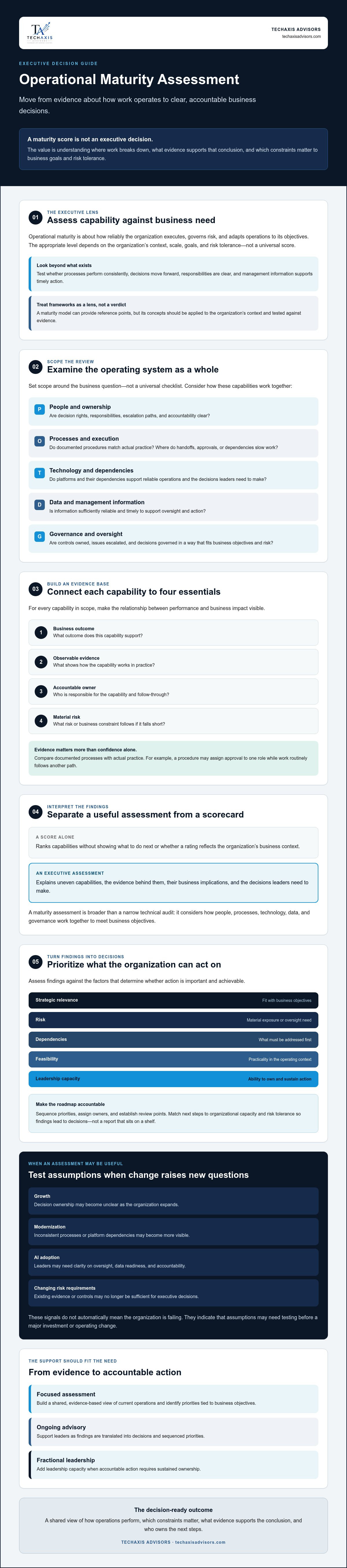
A maturity score is not an executive decision. An operational maturity assessment is useful when it shows leaders where work breaks down, what evidence supports that conclusion, and which constraints put business goals or risk tolerance at odds. Organizations often face unclear ownership, inconsistent processes, and technology and data priorities that do not align. In financial services, those gaps can also complicate oversight and operational resilience.
The answer is not another report that ranks capabilities without identifying what to do next. Executives need a shared, evidence-based view of current operations, with priorities tied to business objectives and owners accountable for action. That means looking beyond whether a process exists to how consistently it performs, where decisions stall, and what dependencies limit progress.
This article explains how to assess operational maturity using business evidence, distinguish material constraints from lower-priority gaps, and translate findings into a sequenced roadmap. It also considers how leaders can weigh options against organizational capacity and risk tolerance, so assessment results support clear decisions and accountable next steps rather than sitting on a shelf.
Table of Contents
What an Operational Maturity Assessment Tells Executive Leaders
An operational maturity assessment is a structured review of an organization’s capabilities, supporting evidence, and constraints in relation to its business needs. It helps leaders see how reliably the organization operates, where practices or oversight fall short of current objectives, and which decisions warrant attention. It does not require a universal maturity scale or reduce complex operations to one score.
A maturity model can provide useful reference points. The Capability Maturity Model (CMM), for example, describes a staged approach to process capability. But a framework is a lens, not a verdict. Apply its concepts to the organization’s context and test conclusions against evidence rather than treating its levels as a universal measure of readiness.
This also distinguishes a maturity assessment from a narrow technical audit. An audit may examine a defined system or control area. An executive assessment considers how people, processes, technology, data, and governance work together to meet business objectives. The question is not simply which tools are in place, but whether the operating model supports reliable decisions and execution.
When does an operational maturity assessment become useful?
An assessment is useful when a material change raises questions about whether current capabilities can support the next phase. Growth may create unclear decision ownership. Modernization may expose inconsistent processes or dependencies between platforms. AI adoption may prompt leaders to clarify oversight, data readiness, and accountability. Changing risk requirements can also make existing evidence or controls insufficient for executive decision-making.
These signals do not automatically mean the organization is failing. They indicate that assumptions may need testing. Before committing to a major investment or operating change, build a shared evidence base from documented processes, decision rights, management information, and examples of how work is handled in practice. This helps separate a material constraint from a perception or isolated issue.
What maturity means in an executive context
For executive leaders, maturity is the ability to execute reliably, govern risk, and adapt operations to business needs. It shows in how decisions are made, whether responsibilities are clear, whether management information supports timely action, and how consistently processes perform. A technology inventory alone cannot establish these capabilities, and subjective confidence cannot substitute for evidence.
The appropriate level of maturity depends on the organization’s objectives, scale, risk tolerance, and operating context. A capability that is adequate for one firm may constrain another with different growth plans or oversight needs. An assessment should explain not only what is present, but whether it is sufficient for the outcomes leaders are accountable for.
Which Operating Capabilities Should an Assessment Examine?
Set the scope around the business question, not a universal checklist. A wealth management firm preparing for growth may focus on decision rights, reporting confidence, and vendor oversight. An organization modernizing operations may need to examine process execution, technology dependencies, and whether data supports the decisions leaders must make.
For each capability in scope, connect four elements: the business outcome it supports, the evidence that shows how it works, the accountable owner, and the material risk if it falls short. This turns the operational maturity assessment into a decision tool rather than a collection of disconnected observations. A NIST Maturity Assessment Tool, for example, illustrates how an assessment can be tailored to a specific operational context. Its manufacturing focus also shows why leaders should adapt assessment dimensions to their own environment.
How do governance, processes, and ownership affect maturity?
Examine who can make key decisions, where issues escalate, who owns controls, and how teams resolve dependencies across functions. Then compare documented procedures with actual practice. A procedure may assign approval to one role while work routinely follows another path. That gap matters when it creates delays, weakens oversight, or leaves accountability uncertain.
Look for evidence such as repeated approvals, handoffs without clear ownership, unresolved exceptions, or processes monitored inconsistently. Validate observations with the people responsible for the work and the leaders accountable for its outcomes. A process map alone will not show whether the process works as intended.
How should technology, data, and risk enter the assessment?
Assess whether technology supports the organization’s strategy, operating scale, reporting needs, and agreed risk tolerance. The question is not simply which platforms are installed. Consider whether capabilities work together well enough to support reliable execution, and whether leaders understand the tradeoffs among retaining, optimizing, integrating, replatforming, replacing, or retiring a system.
For data and reporting, consider whether information is sufficiently reliable, accessible to the right decision-makers, and useful for timely oversight. For technology and cybersecurity risk, focus on governance: who monitors exposure, how issues are escalated, and whether risk decisions align with business priorities. This is an executive assessment of oversight and operating capability, not a substitute for technical testing.
In financial services and wealth management, the evidence should make ownership and risk alignment clear. Leaders can use these dimensions to define a focused assessment scope, or seek executive advisory support to determine which capabilities warrant closer review.
Why an Operational Maturity Assessment Should Not Stop at a Score
A single score can make results easy to summarize, but it can hide the issues executives need to see. One function may have clear ownership and dependable reporting while another relies on informal handoffs and inconsistent records. Combining both into one rating can obscure uneven capability, the effect of business context, and whether a specific gap creates material risk.
An operational maturity assessment should explain what the evidence shows and what leaders can decide as a result. A score-only output offers a label. Evidence-backed findings connect observations to business implications, identify accountable owners, and clarify options for action. For example, a reporting concern might point to a need for better data controls, clearer accountability, or further validation before a broader technology decision. The right response depends on the evidence and the organization’s priorities.
Confidence matters. Interviews may reveal different perspectives, while documentation or management reporting may be incomplete or out of date. Findings should distinguish confirmed facts from stakeholder perceptions, open questions, and assumptions. Without that separation, executives can mistake inference for proof or give equal weight to findings supported by very different levels of evidence.
How should leaders evaluate assessment evidence?
Where possible, look for conclusions supported by more than one source. Interviews can explain how work happens; process documentation can show intended practice; management reports can indicate what leaders monitor; and governance materials can clarify decision rights and oversight. System context may help establish dependencies, but it is not proof of how well a process performs.
Each finding should state its evidence basis and limitations. If records are unavailable or accounts conflict, say so. That gives leaders a reasoned view of confidence and identifies what needs validation before action.
How is an executive assessment different from a technical audit?
An executive assessment connects operational findings to strategy, risk tolerance, and organizational priorities. It supports decisions about where to focus, what tradeoffs to consider, and whether a concern warrants deeper examination. It does not, by itself, certify compliance, test every system, or replace a specialist review.
This distinction sets appropriate expectations. If evidence suggests a control weakness or system-level concern, leaders can commission targeted technical validation from the appropriate specialists. The assessment helps clarify that next decision; it does not imply that every technical question has already been tested.
How to Turn Assessment Findings Into Prioritized Operating Decisions
Findings become useful when leaders can trace each one from evidence to action. For every validated finding, identify the business impact, the decision required, the accountable owner, and a point to review progress or assumptions. This keeps recommendations connected to organizational objectives instead of turning them into unrelated projects.
How should executives sequence improvement priorities?
Prioritization requires more than ranking gaps by apparent severity. Consider strategic relevance, risk exposure, dependencies, feasibility, and leadership capacity together. A high-impact change may need foundational work first, while a lower-risk process improvement may be practical to start sooner. The right sequence depends on objectives and risk tolerance, so two firms may reasonably respond to similar findings in different ways.
Separate priorities into decisions that need attention now, foundational work that enables later changes, and longer-term capability development. Make dependencies explicit. If a reporting improvement depends on clarifying data ownership first, record that relationship rather than treating the work as independent. An action register can capture the decision needed, executive owner, prerequisite, unresolved question, and review point.
A roadmap should reflect the range of available responses. Findings may call for changes to process, governance, data practices, or vendor oversight, not just new technology. For modernization, compare whether to retain, optimize, integrate, replatform, replace, or retire a system. Each option has tradeoffs in effort, dependency, risk, and fit with the organization’s direction. Replacement is one possibility, not the default.
How can leaders keep the roadmap accountable?
Assign an executive sponsor and an owner for each priority. Define what evidence will show progress, which decisions require leadership input, and when the work will be reviewed. Where appropriate, connect checkpoints to existing management or board processes so the roadmap informs governance rather than creating a parallel reporting burden.
Review progress against the intended business outcome, not activity alone. Completing a task does not necessarily resolve the constraint that prompted it. If evidence changes, dependencies shift, or capacity tightens, leaders should be able to revisit sequence and scope. This makes accountability practical while leaving room to adjust decisions as conditions evolve.
When internal execution capacity is constrained, advisory leadership or qualified delivery partners may support governance and follow-through. The organization should retain clear ownership of priorities and decisions.
When to Engage an Operational Maturity Assessment Partner
Outside support can help when executives need an independent view of operating capabilities, when priorities are contested across teams, or when internal leaders lack the capacity to assess evidence and shape a roadmap. The right level of support depends on the decision at hand. A focused operational maturity assessment can clarify a defined issue; ongoing advisory can help leaders work through decisions over time; fractional executive leadership may fit when the organization needs continuing senior-level ownership.
What should executives expect from a structured assessment?
TechAxis Advisors positions its assessments as executive decision-support engagements, not technical audits. The process moves from a structured diagnostic through executive assessment and intelligence synthesis, then translates findings into a roadmap and potential execution leadership. Its named Executive Technology Operating Model Assessment examines the operating model through that lens.
Deliverables include board-ready findings, a strategic roadmap, an action register, and an executive presentation. Together, these give leaders a basis for discussing priorities, ownership, and next decisions. An assessment informs those decisions; it does not guarantee outcomes or automatically prescribe implementation. Leaders can use findings to proceed, adjust the roadmap, or seek deeper technical validation.
Executives evaluating an engagement can review how the engagement works to understand the structured approach and the decision support it is intended to provide.
How does TechAxis Advisors support decisions after the assessment?
Some organizations can move forward with the roadmap using their existing leadership and delivery teams. Others may need continued executive advisory or fractional leadership to maintain decision ownership, governance, and follow-through. Where internal capacity is limited, support can include vendor oversight and coordination with qualified delivery partners. Direct implementation is not assumed; the appropriate delivery approach depends on the decision and the organization’s needs.
TechAxis Advisors’s executive technology services include advisory and fractional leadership options that can complement assessment work. The practical question is whether the organization needs a defined diagnostic, continuing advice, or an executive leader engaged in ongoing decisions.
If a material operating decision is approaching, a confidential conversation can help clarify which form of decision support fits the priority, evidence needs, and available leadership capacity.
Turn Operational Insight Into Executive Action
An operational maturity assessment is valuable when it gives leaders more than a rating. It should clarify which capabilities support business objectives, where evidence points to material constraints, and what decisions deserve attention. The strongest next step is a sequenced set of priorities, with accountable owners and review points, rather than a report that leaves implementation choices unresolved.
TechAxis Advisors structures its assessments as executive decision-support engagements. Deliverables include board-ready findings, a strategic roadmap, an action register, and an executive presentation. Founder Aarati Dikshit brings more than 25 years of CIO, CTO, and CISO experience. TechAxis is certified as a federal SBA WOSB. These credentials provide context for the firm; the assessment itself should remain grounded in your evidence, objectives, and risk tolerance.
If you are weighing a focused assessment, ongoing advisory, or fractional leadership, start by clarifying the decision you need to make and the evidence and support that will help you make it with confidence.
Clear priorities and accountable next steps can help your organization move forward with greater alignment.
Frequently Asked Questions
What is an operational maturity assessment?
An operational maturity assessment is an evidence-based review of an organization’s operating capabilities and how well they support business objectives. It examines observable practices, decision ownership, information, technology, and constraints relevant to the question leaders need to resolve. It is not a universal score or a ranking against every organization. Findings should explain what evidence supports each conclusion and whether current capabilities fit the organization’s goals and risk context.
How do you conduct an operational maturity assessment?
Start by defining the business decision or change the assessment needs to inform, then set a scope that fits that need. Gather relevant evidence, such as interviews, process documentation, management reports, and governance materials. Validate observations across sources and distinguish confirmed facts from perceptions, assumptions, and open questions. Then synthesize the implications for executives and outline prioritized next steps, including decisions, owners, and dependencies. The work should reflect the organization’s context, not a fixed timetable.
What areas should an operational maturity assessment cover?
The scope depends on business objectives, operating conditions, and risk tolerance. Relevant areas may include process execution, governance and decision rights, technology capabilities, data and reporting, organizational accountability, vendor oversight, and risk management. For each area, connect the capability to a business outcome and consider what evidence demonstrates how it works. A financial services firm, for example, may examine whether reporting supports oversight and whether responsibilities for key decisions are clear.
How is an operational maturity assessment different from a technical audit?
An operational maturity assessment is executive decision support. It connects evidence about operating capabilities to strategy, organizational priorities, and risk tolerance, helping leaders decide where attention or further review is warranted. A technical audit has a defined examination scope and may test systems or controls in detail. An executive assessment does not certify compliance, test every system, or replace specialist technical testing or compliance reviews when those are needed.
Can a small or growth-stage company benefit from an operational maturity assessment?
Yes, if a business decision or material change raises questions about whether current operating capabilities are sufficient. Growth can expose unclear ownership, inconsistent processes, or reporting gaps; modernization or AI adoption may introduce new dependencies and governance questions. Company size alone does not determine need. A focused assessment can help leaders establish a shared evidence base, identify relevant constraints, and decide which improvements deserve attention given available capacity and business priorities.
What happens after an operational maturity assessment?
Validated findings can inform decisions about priorities, ownership, dependencies, and further review. A roadmap and action register can translate those findings into sequenced next steps, while executive presentations or board-ready findings can support leadership discussion. The organization then determines how to proceed, who is accountable, and when progress should be reviewed. An assessment informs decisions; it does not guarantee results or mean every recommendation requires immediate implementation.
How often should a company reassess its operational maturity?
Reassess when strategy, scale, risk exposure, or operating conditions change enough to affect the assumptions behind prior decisions. Triggers may include a growth phase, modernization initiative, new use of AI, or changes in how responsibilities and vendors are managed. A fixed interval is not appropriate for every organization. Leaders can monitor material changes and decide whether a focused review or broader assessment is needed to refresh evidence and priorities.



Comments