

Modern Tech Team Org Structure: Executive Guide
The org chart is rarely the real problem. When technology teams create handoffs, compete for priorities, or leave leaders unsure who can make key decisions, the issue is often how work and accountability are designed. Choosing an organizational structure for a modern tech team starts with the business decisions that need clear ownership, not a template to copy.
It’s reasonable to look for a model that balances consistent standards with responsiveness to business units. A centralized, product-aligned, or hybrid structure can each work well, or create friction, depending on how responsibilities and decision rights are defined.
This guide compares common structures and their tradeoffs, then offers a practical way to assess your current model. You’ll clarify ownership of architecture, delivery, data, and risk decisions, and identify whether the issue calls for a reorganization or clearer governance, leadership, and team-level accountability.
Table of Contents
Why organizational structure for a modern tech team is a business decision
An organizational structure is more than a chart of reporting lines. It defines who owns roles and outcomes, how teams relate to one another, and who has authority to make decisions. Those choices affect delivery, oversight, and whether technology teams can focus on business priorities.
An effective structure gives people clear ownership and places decisions with leaders close to the relevant business outcomes, within agreed boundaries. This shifts the discussion from boxes and titles to practical questions: who is accountable, who contributes, and who resolves a conflict when priorities compete?
Keep four concepts distinct. Structure sets reporting relationships and role ownership. The operating model describes how work moves from priorities to delivery and support. Governance establishes oversight, decision processes, and escalation paths. Technology strategy sets the direction for how technology supports business objectives. They influence one another, but changing reporting lines alone won’t resolve a strategy or governance gap.
What does a technology-team structure determine?
It establishes leadership and accountability across engineering, architecture, data, security, operations, and product decisions. These responsibilities may sit in dedicated teams or be distributed, but each still needs a clear owner. A leader might report to the CTO while holding a decision right shared across product teams. Reporting answers who manages a role; decision rights answer who can approve or resolve a specific issue.
Consider a firm preparing to launch a digital service. Product wants a faster release, security needs a review of data access, and architecture has concerns about integration. If no one owns the final tradeoff, each group can complete its own work while the decision stalls. Naming one accountable decision-maker, specifying required input, and setting an escalation route can prevent ambiguity from becoming a delivery bottleneck.
The Organizational structure overview describes common structural principles. Applying them to technology means connecting roles to actual decisions and business outcomes. That is especially relevant for leaders responsible for technology decisions, who need visibility into ownership, risk, and delivery responsibilities.
Why is there no single modern tech-team org chart?
The right design depends on strategy, scale, delivery needs, and risk profile. A business seeking consistent specialist standards may organize differently from one whose teams need sustained alignment with distinct products or business units. Dependencies, sensitive data, third-party services, and operational demands also shape where accountability should sit.
In regulated or otherwise complex environments, explicit governance and escalation paths help make oversight and exceptions visible. That does not mean every decision belongs at the center. Teams need to know which decisions they can make independently, which require specialist review, and who resolves competing priorities. The useful test is whether the structure supports the work and makes accountability clear as priorities change.
Core organizational structures for modern technology teams
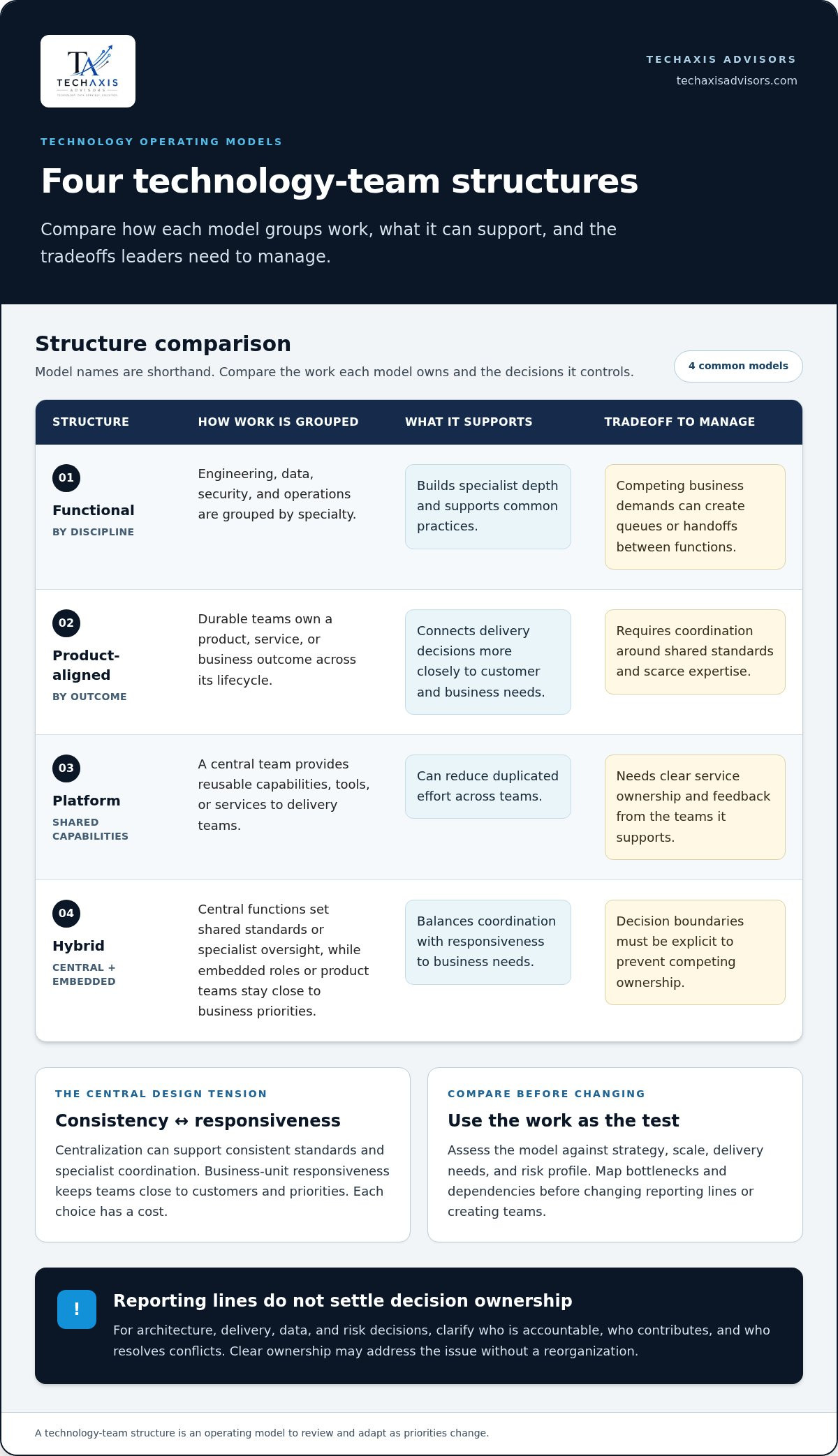
Model names are shorthand, not definitions. One company’s “platform team” may own shared infrastructure, while another uses the term for a broader set of developer capabilities. Compare structures by the work they own, the decisions they control, and how other teams access their support.
Centralization supports consistency and specialist coordination; business-unit responsiveness keeps teams close to customers and priorities. Each choice has a cost, so make both the benefit and the tradeoff explicit.
Functional: Engineering, data, security, and operations are grouped by discipline. This supports specialist depth and common practices, but competing business demands can create queues or handoffs between functions.
Product-aligned: Durable teams own a product, service, or business outcome across its lifecycle. This connects delivery decisions more closely to customer and business needs, but requires coordination around shared standards and scarce expertise.
Platform: A central team provides reusable capabilities, tools, or services. It can reduce duplicated effort, but needs clear service ownership and feedback from the teams it supports.
Hybrid: Central functions establish shared standards or specialist oversight, while embedded roles or product teams stay close to business priorities. This balances coordination and responsiveness, but decision boundaries must be explicit to prevent competing ownership.
Functional and product-aligned structures
A functional structure organizes people around what they do. Engineering leaders may manage engineers across several initiatives, while data or security specialists support multiple business areas. This can build shared expertise and strengthen consistency, but priorities may compete within the function and work can slow as it moves between teams.
Product-aligned teams organize around what they deliver and maintain. A team may bring together the skills needed to improve a service over time, with clear accountability for its outcomes. This can reduce some handoffs, but it does not remove the need for shared architecture, data, and risk decisions. Product ownership should not mean each team sets standards independently when those standards affect the wider organization.
Platform and hybrid structures
Platform teams provide shared capabilities to delivery teams; they don’t replace product ownership. Their remit might include common development environments or deployment support, with priorities shaped by internal users. Team Topologies and DevOps can help leaders think about team interactions and delivery flow, but neither should be treated as a mandatory org chart.
A hybrid model may suit organizations that need enterprise-wide standards alongside business-facing technology roles. For example, central specialists can define architecture guardrails while product teams make routine choices within them. Test whether teams know which decisions they can make, when specialist input is needed, and how exceptions are resolved. Leaders can use a confidential executive conversation to clarify these tradeoffs before drawing a new chart.
How to compare technology-team models and their tradeoffs
Compare structures by how they support the work, not by how familiar their labels sound. Assess business alignment, delivery flow, specialist depth, governance, and adaptability. These criteria show whether a model fits current priorities and where it may introduce friction.
Keep reporting lines separate from decision ownership. An architecture lead may report to a central technology executive while product teams make day-to-day design choices within agreed standards. A business-aligned team may own delivery but rely on a central specialist for a defined risk decision. The organizational structure for a modern tech team should make both relationships visible.
Business alignment: Can teams connect their priorities to business outcomes, or must they compete for attention across a shared function?
Delivery flow: Where do approvals, specialist reviews, or dependencies create queues or handoffs?
Specialist depth: Can experts build consistent practices while remaining accessible to delivery teams?
Governance: Are oversight, decision boundaries, and escalation paths clear, particularly where risk ownership matters?
Adaptability: Can responsibilities shift as products, priorities, or dependencies change without creating confusion?
Where should decision rights sit?
Map recurring decisions, name one accountable owner for each, and specify who provides input. For example, architecture decisions may require central standards while leaving teams room to make choices within them. Product priorities may sit with product leadership; data definitions with an assigned data owner; security decisions with the designated risk owner; and vendor oversight with a named relationship or platform owner.
A lightweight RACI matrix can clarify who is responsible, accountable, consulted, and informed, but only if it resolves genuine ambiguity. Avoid assigning several accountable owners to one decision. Define an escalation route for unresolved dependencies, including who steps in and when. This helps surface conflicts between a delivery team and a shared platform group while leaders can still act, rather than as an executive surprise.
How should leaders evaluate tradeoffs?
Every model balances coordination overhead against consistency, responsiveness, and visible ownership. Centralized expertise can support common standards and make specialist capacity easier to coordinate, but teams may wait for shared decisions. Embedded roles can bring business context closer to delivery, but need clear guardrails to prevent fragmented practices. Assess both the intended benefit and the cost the organization will need to manage.
Shared platforms and product teams can work together: platform teams provide reusable capabilities, while product teams remain accountable for their services and outcomes. Evaluate whether responsibilities and feedback loops make that relationship practical. For financial-services organizations, include how risk decisions are owned, reviewed, and escalated without assuming that one structure determines specific regulatory duties.
Structure is only part of the picture. Leaders assessing operational maturity should also consider whether prioritization, governance, and delivery practices support the chosen model.
A practical framework for designing the right technology-team structure
Test design choices against actual work before changing reporting lines. Define business outcomes, map recurring work, assign decision rights, compare plausible models, and test the dependencies each model creates. This keeps the organizational structure for a modern tech team tied to the operating demands it needs to support.
Start with strategy, work, and constraints
Begin with the outcomes technology must support, the services that matter most, delivery commitments, and constraints such as risk tolerance or reliance on vendors. Then map recurring work across product, engineering, data, cybersecurity, operations, and external partners. Record who performs it, who approves key choices, and where work waits or changes hands.
If you’re also addressing team growth, use the existing scale-up team guide for growth tactics. Keep this design exercise focused on how responsibilities and decisions should be organized, rather than repeating hiring or team-expansion advice.
Define outcomes: Specify the business results and service commitments the team must support.
Map work: Identify recurring activities, dependencies, and handoffs across internal teams and vendors.
Assign decision rights: Name the owner for consequential decisions and clarify who must contribute.
Compare models: Test a functional, product-aligned, platform, or hybrid approach against the needs identified.
Test dependencies: Trace how work and decisions would move under each option before changing reporting lines.
Test the model before changing reporting lines
Choose a real workflow, such as approving a change that affects a customer-facing service, shared data, and a vendor. Trace each handoff from request through decision to delivery. Record where ownership is unclear, decisions wait, or teams repeat work. Document these bottlenecks first; otherwise, a reorganization may move the same friction elsewhere on the chart.
Compare the current state with one or two credible alternatives. The examples below are prompts for analysis, not recommended structures.
Current state: Functional teams provide expertise, but several groups coordinate each cross-functional release. Assess whether decision ownership is clear and whether handoffs slow delivery.
Alternative A, product-aligned teams: Teams own defined services through delivery and ongoing improvement. Assess whether this clarifies outcomes and whether shared standards or specialist coverage need stronger coordination.
Alternative B, hybrid: Central specialists set agreed guardrails while business-facing teams manage work within them. Assess whether this balances consistency and responsiveness, and whether escalation points are explicit.
Set measures before piloting a change. Track decision turnaround, visibility of dependencies, and whether each important outcome has one accountable owner. Specify who communicates the change, who owns the transition, and when leaders will review the evidence. Adjust the design if it adds coordination without improving clarity or flow.
How executive leadership sustains a modern tech-team structure
A technology structure needs active executive ownership. Review it when priorities shift, services change, or teams develop workarounds that obscure accountability. The review may call for clearer governance or leadership, not a reorganization.
When outside executive perspective can help
Growth, modernization, and transformation can expose gaps between technology responsibility and business authority. An experienced advisor can help leaders assess those gaps against strategy and risk tolerance. TechAxis Advisors provides executive technology advisory and fractional leadership. Fractional guidance can support oversight when sustained executive capacity is needed, without making it the default solution. Learn more about advisory leadership.
Turn the design into accountable execution
A structured Executive Intelligence Assessment can help leadership clarify current-state gaps and prioritize next actions. TechAxis Advisors assessments provide evidence-based findings, a strategic roadmap, an action register, and a presentation tailored for executive review. Advisory or fractional leadership can then support governance and execution oversight as the organization puts decisions into practice. The aim is continuity between the design decision and its ongoing ownership, with review as business needs evolve.
Make the next structure decision with confidence
The structure your organization needs can change as business priorities evolve. Rather than treating the org chart as fixed, make its ongoing relevance a leadership question: does it still support the work ahead? A focused review can determine whether the next step is refining responsibilities, adjusting governance, or reconsidering the organizational structure for a modern tech team.
TechAxis Advisors helps executives align business priorities with technology decisions through executive assessments, strategic advisory, and fractional leadership. The right starting point depends on whether you need a focused assessment, ongoing counsel, or embedded executive support.
A clear next decision is a practical foundation for adapting with confidence.
Frequently Asked Questions
What is an organizational structure for a modern tech team?
It’s the arrangement of technology roles and accountability that supports the organization’s priorities. To make it useful in practice, document which teams support critical services, who owns service performance, and where responsibilities cross team boundaries. For example, a service map can show the teams involved in a customer-facing application and identify who coordinates changes that affect multiple systems. This gives leaders a practical reference beyond job titles.
Is a centralized or decentralized technology team better?
Neither is automatically better. Decide at the capability level rather than applying one rule to every technology decision. For example, an organization might set common expectations for data handling centrally while allowing business-facing teams to sequence work around local priorities. Record which decisions are shared, which can be made within a team, and what circumstances require review. This makes the chosen approach easier to apply consistently as new work arises.
How many direct reports should a CTO have?
There’s no universal number. A CTO’s span should reflect the work they must oversee, the maturity of their leadership team, and how much authority those leaders can exercise independently. If routine delivery questions routinely reach the CTO, clarify delegation before adding or removing reporting layers. Track which decisions escalate, why they escalate, and whether direct reports have the information and authority to resolve them.
Can product managers report outside the engineering organization?
Yes. Product managers can report through a product or business function if their mandate and partnership with technology leaders are clear. Set expectations for roadmap ownership, customer research, prioritization, and how scope changes are handled. For instance, a product manager may own the business case and sequencing while engineering provides estimates and advises on technical feasibility. Shared planning routines keep those responsibilities connected without requiring a shared manager.
When should a company revisit its technology-team structure?
Revisit it when a material change makes existing responsibilities hard to sustain, such as entering a new business line, integrating an acquisition, or shifting a critical service to a different delivery approach. A scheduled leadership review can also catch gradual drift before it becomes disruptive. Bring evidence, such as recurring escalations, duplicated work, or service ownership gaps, and define the specific decision the review needs to resolve.
How should a technology team organize for AI adoption?
Start by assigning an accountable business sponsor and setting a consistent path for reviewing proposed AI use cases. Define who evaluates data access, output quality, human review, and ongoing monitoring before teams expand use. A central group can coordinate shared guidance, while domain teams contribute process knowledge and assess whether a use case meets its intended purpose. The structure should match the organization’s risk tolerance and adoption needs.
What is the difference between an org chart and an operating model?
An org chart shows formal reporting relationships and leadership spans. An operating model helps teams understand how work gets prioritized, funded, delivered, and supported across those relationships. Use the chart to clarify a reporting question; use the operating model to diagnose delays in intake, approvals, handoffs, or ongoing service support. Reviewing both helps pinpoint whether a problem calls for a management change or a better work process.



Comments