

Mid-Market Digital Transformation Advisory: An Executive Framework for 2026
Most mid-market digital initiatives fail not because the technology is flawed, but because the executive governance behind it is absent. You've likely felt the friction of a fragmented technology ecosystem that complicates rather than accelerates your growth. It's frustrating when technical jargon obscures actual business risk, leaving your board to make high-stakes decisions with incomplete clarity. Engaging with a mid-market digital transformation advisory partner can bridge this gap between technical capability and strategic oversight.
We understand that growth-stage organizations require more than just technical implementation; they need a disciplined approach to scaling. You'll learn how executive-led technology advisory aligns your digital strategy with operational maturity to reduce execution risk. This framework for 2026 focuses on building a strategic roadmap and improving investment confidence. We'll explore a structured process for translating complex technical needs into board-ready decisions, ensuring your technology investments support long-term stability rather than creating new liabilities.
Table of Contents
Defining Mid-Market Digital Transformation Advisory
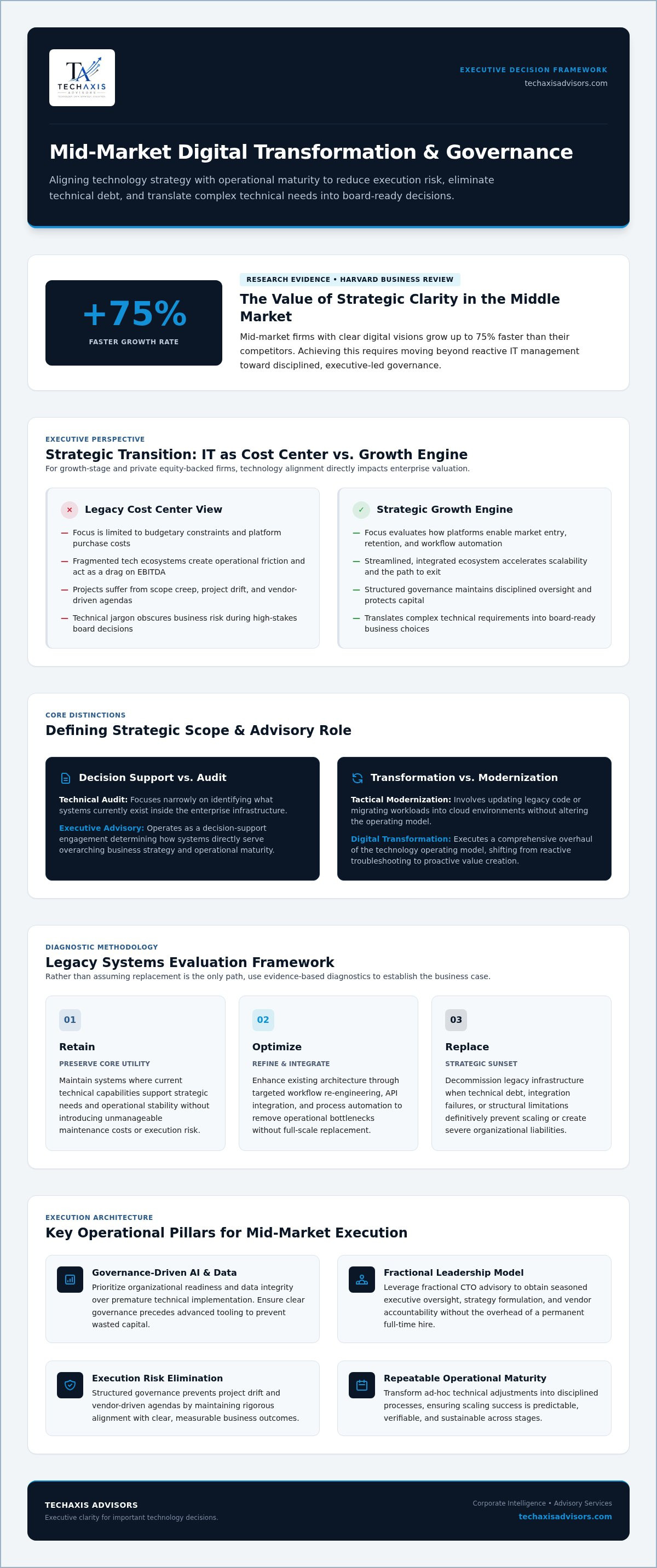
For growth-stage organizations, mid-market digital transformation advisory functions as a structured executive decision-support engagement rather than a standard technical audit. While an audit identifies what systems exist, advisory determines how those systems serve the overarching business strategy. This distinction is critical for leaders in financial services and private equity, where the objective isn't just to update software, but to reduce execution risk and enhance operational maturity. Effective advisory provides the necessary leadership bridge to translate complex technical jargon into board-ready decisions.
Strategic technology alignment differs fundamentally from IT implementation. Implementation focuses on the mechanics of deployment; alignment focuses on the mechanics of scaling. By utilizing evidence-based diagnostics, executives can identify specific operational gaps that hinder growth. These findings offer the clarity required by boards and investors to approve high-stakes investments with confidence. It ensures that every dollar spent on technology is an investment in structural integrity rather than a temporary fix for a fragmented ecosystem.
The Role of an Executive Technology Advisor
An executive technology advisor acts as a vital conduit between technical teams and C-suite leadership. They translate the intricacies of a technology ecosystem into clear, strategic business choices. This role provides independent oversight of vendor and platform management, ensuring that third-party solutions align with internal goals rather than vendor sales targets. For many firms, this advisory leadership provides a level of seasoned expertise that isn't always present in-house, offering a steady hand to guide disciplined progress.
Digital Transformation vs. Modernization
It's important to distinguish between tactical upgrades and strategic shifts. Modernization often involves updating legacy code or migrating to a cloud environment. In contrast, following foundational digital transformation principles requires a comprehensive overhaul of the technology operating model. It's a shift from reactive troubleshooting to proactive value creation. Assessments are leveraged to determine the appropriate scope of change, whether the business case supports a decision to retain, optimize, or replace specific components. This methodical approach ensures that the transformation is grounded in reality, valuing tangible execution over abstract theory.
The Business Case for Executive-Led Technology Strategy
Digital investment in growth-stage companies is often driven by the need for scalability and the pressure to modernize client-facing services. However, without a cohesive strategy, these investments frequently lead to high technical debt and significant execution risk. For private equity-backed firms, technology is no longer a back-office utility; it's a primary driver of portfolio valuation. A fragmented technology stack acts as a drag on EBITDA, whereas a streamlined, integrated ecosystem accelerates the path to exit. The business case for mid-market digital transformation advisory is rooted in the elimination of waste and the acceleration of growth. Research cited in Harvard Business Review's middle-market transformation framework highlights that mid-market firms with clear digital visions grow up to 75% faster than their competitors.
Transitioning from viewing IT as a cost center to a growth engine requires a fundamental shift in executive mindset. This is where mid-market digital transformation advisory provides its most significant value. It moves the conversation from purely budgetary concerns to strategic value creation. Instead of asking what a new platform costs, leaders begin to evaluate how that platform enables faster market entry, improves customer retention, or automates manual workflows that currently bottleneck the organization. It's about ensuring that every technical decision serves a measurable business outcome.
Reducing Execution Risk in Mid-Market Firms
Mid-market projects often suffer from scope creep or vendor-driven agendas when executive oversight is lacking. Structured governance prevents project drift by maintaining a relentless focus on business outcomes. By improving operational maturity through technology, firms can ensure that technical success is repeatable and sustainable. This approach mitigates the risk of "shadow IT" and ensures that all digital initiatives are transparent and accountable to the board.
Centralized oversight reduces the risk of expensive, failed implementations.
Standardized data protocols improve the accuracy of executive reporting.
Disciplined vendor management prevents long-term platform lock-in.
Aligning Technology with Business Strategy
Technology investments must support long-term goals rather than solving isolated, tactical pain points. An Executive Technology Assessment serves as the foundation for this alignment. It provides a prioritized roadmap that matches the organization's specific risk tolerance and capital constraints. It's about making deliberate choices to retain, optimize, or replace systems based on evidence rather than intuition. If you're unsure whether your current roadmap aligns with your 2026 growth targets, you might want to start with a confidential executive conversation to evaluate your strategic options.
Evaluating Digital Maturity: The "Retain vs. Replace" Framework
Mid-market leaders often face a binary choice: maintain aging systems or commit to a complete overhaul. This oversimplification ignores the nuance of operational maturity and the long-term impact of technical debt on EBITDA. A professional mid-market digital transformation advisory engagement replaces technical intuition with an objective evaluation process. It focuses on identifying the path of least risk and highest ROI. Every finding is translated into board-ready briefs that clarify the business impact of technology decisions, ensuring that the C-suite isn't left guessing about the value of their investments.
The Six Pillars of Executive Assessment
TechAxis utilizes the proprietary Executive Intelligence Platform to run diagnostics across six core pillars. These assessments don't just look at code; they look at structural integrity and scalability. Key diagnostics include Executive AI Readiness and Data & Analytics to ensure your foundation can handle automation. We also perform Executive Cybersecurity and Technology Risk assessments to identify liabilities that could threaten your valuation during a private equity exit or audit. Finally, we evaluate the Executive Technology Operating Model to ensure your internal team structure can support the 2026 roadmap. This methodology aligns with McKinsey's research on enterprise rewiring, which suggests that digital success depends on how well technology is integrated into the core operating model.
Decision Framework: Retain, Optimize, or Replace
The decision to modernize should be based on evidence rather than a vendor's sales pitch. Mid-market digital transformation advisory provides a disciplined framework to categorize systems into three primary paths:
Retain and Optimize: Keep systems that provide unique competitive advantages but require better integration or a modern API layer to improve data flow.
Replatform or Replace: Move when technical debt creates a significant drag on growth or when the vendor ecosystem no longer supports your specific compliance needs.
Retire: Eliminate redundant platforms that complicate your data strategy and increase your risk profile through unnecessary exposure.
By evaluating the "Retire" option for high-risk or redundant systems, you simplify your technology stack and reduce operational friction. This structured approach ensures that modernization is a strategic choice, not a reactive one. You can learn more about how these diagnostics provide executive clarity by reviewing how we work with growth-stage firms to build resilient technology foundations.
Pragmatic AI and Data Strategy for Growth-Stage Firms
For mid-market firms in wealth management and financial services, AI isn't a speculative venture. It's an operational necessity that requires a governance-driven lens. Many organizations rush to implement automation before establishing a stable data foundation. This sequence is a primary reason for project drift and inaccurate reporting. A professional mid-market digital transformation advisory engagement ensures that your data integrity supports your AI ambitions. Without structured AI governance frameworks, firms risk regulatory non-compliance and reputational damage. Strategy starts with oversight, not just algorithms.
Building the Data Reporting Framework
Modernizing your data architecture is about more than storage; it's about creating a single source of truth for informed decision-making. Wealth management firms often struggle with data silos that prevent a holistic view of client assets. Real-time business intelligence access allows executives to pivot quickly based on market conditions rather than relying on stale monthly reports. Scaling these foundations ensures that when you're ready for advanced automation, the underlying data is already clean, categorized, and accessible. This approach treats data as a high-value asset rather than a byproduct of operations, reducing the friction often found in growth-stage firms.
High-Impact AI Use Cases for the Mid-Market
High-impact AI use cases for the mid-market focus on driving operational efficiency through targeted automation. This might include streamlining client onboarding workflows or enhancing risk detection in financial transactions. The goal is to develop an AI roadmap that balances innovation with strict compliance requirements. TechAxis utilizes an evidence-based approach to AI readiness, ensuring that every automation initiative has a clear business case and a defined path to execution. By integrating mid-market digital transformation advisory into your AI strategy, you avoid the common pitfall of implementing technology for its own sake. You ensure that every investment supports your 2026 growth objectives.
Fractional Leadership: Bridging the Gap Between Strategy and Execution
A mid-market digital transformation advisory engagement often reveals a leadership gap that internal technical teams aren't equipped to fill. The Fractional CTO model addresses this by providing an embedded executive presence that bridges the divide between board-level strategy and day-to-day technical execution. It's a pragmatic solution for firms that require sophisticated oversight but don't need the overhead of a full-time C-suite hire. This model focuses on structural integrity and the mechanics of scaling. It ensures that your technology roadmap remains aligned with your 2026 growth objectives.
It's vital to contrast fractional leadership with traditional outsourced IT or Managed Service Provider (MSP) services. While an MSP handles tactical maintenance and support tickets, a fractional executive manages the technology operating model. They provide independent oversight of vendor and platform management, ensuring that delivery partners remain accountable to the business goals. This senior-level guidance ensures that your technology investments are disciplined and results-oriented. It replaces organizational anxiety with controlled progress and clear accountability.
Fractional CTOs in Growth and M&A
During periods of expansion or private equity involvement, fractional leaders provide the necessary bridge for long-term continuity. They support technology due diligence, identifying technical debt and operational risks that could impact valuation. Following a deal, they lead post-merger integration and transformation initiatives, ensuring that software development governance remains tight. This embedded presence ensures that the strategic roadmap defined during the assessment phase is actually executed. It prevents project drift and budget overruns, ensuring that technology serves as a reliable growth engine.
Engaging with TechAxis Advisors
TechAxis Advisors follows a methodical workflow that moves from a structured diagnostic to execution leadership. We leverage the deep expertise of former CIOs and CTOs who have spent over 25 years managing complex technology ecosystems in financial services. Our advisory leadership focuses on providing executive clarity for your most important technology decisions. We don't just offer advice from the sidelines. We act as a fractional partner invested in your success. To explore whether your current priorities require a structured assessment or fractional leadership, you can start with a confidential executive conversation to evaluate your options.
Building a Resilient Technology Operating Model
Success in 2026 requires moving beyond tactical IT fixes toward a disciplined technology operating model. Effective growth depends on your ability to align digital strategy with operational reality while maintaining strict governance over AI and data assets. Engaging with a mid-market digital transformation advisory partner provides the executive clarity needed to translate technical complexity into board-ready growth strategies. By utilizing evidence-based diagnostics, you can reduce execution risk and ensure that every investment supports long-term scalability rather than increasing technical debt.
TechAxis Advisors provides this clarity through our proprietary Executive Intelligence Platform and the senior-level expertise of former CIOs, CTOs, and CISOs. As a certified WOSB and MWBE, we offer independent guidance that respects your capital constraints and risk tolerance. You don't have to navigate these high-stakes decisions in isolation or rely on incomplete technical data.
Disciplined progress is achievable when strategy and execution are bridged by seasoned leadership.
Frequently Asked Questions
What is the difference between digital transformation and IT modernization?
Digital transformation overhauls the technology operating model to drive value, while IT modernization focuses on tactical system upgrades. Mid-market digital transformation advisory determines which path supports 2026 growth targets. It's about ensuring technology serves business strategy rather than just fixing technical debt.
How does a mid-market firm assess its AI readiness without a large internal team?
Mid-market firms can use an Executive AI Readiness Assessment powered by a proprietary intelligence platform. This diagnostic identifies high-impact use cases and governance needs without requiring a full-time data science team. It provides a clear roadmap grounded in business reality.
Why should a private equity firm use a fractional CTO for portfolio companies?
Private equity firms use fractional CTOs to manage technology due diligence and post-merger integration. These leaders identify risks that impact valuation and ensure technology remains a growth engine. This senior oversight reduces execution risk across portfolio companies.
What are the key components of a board-ready technology roadmap?
A board-ready roadmap includes prioritized initiatives, measurable business outcomes, and concise briefs. It translates complex technical data into strategic decisions about capital and risk. This ensures leadership has the clarity needed for disciplined progress.
How does TechAxis Advisors differ from Big Four consulting firms?
TechAxis provides direct access to former CIOs and CTOs instead of junior consultants. Our mid-market digital transformation advisory uses a proprietary platform for evidence-based findings. We're an agile, senior-led alternative to the generic reports often provided by larger firms.
What industries do you specialize in for digital transformation advisory?
We specialize in wealth management, financial services, and private equity-backed organizations. Our experience covers regulated environments where structural integrity and compliance are essential for scaling. We also support growth-stage firms in lending and retail.
Can an executive technology assessment help reduce technical debt?
Assessments reduce technical debt by categorizing systems to retain, optimize, or retire based on EBITDA impact. This objective framework identifies liabilities that drain resources. It improves operational maturity by streamlining the technology stack.
How does fractional leadership support long-term technology governance?
Fractional leadership provides embedded oversight of vendor management and technology operating models. Unlike tactical MSPs, fractional executives ensure long-term governance and strategic alignment. They bridge the gap between assessment and tangible results.



Comments