

Interim CTO Services: Technical Leadership for Startups
A sudden vacancy in the CTO seat is rarely just a hiring problem; it's a strategic inflection point that determines whether your startup scales or stalls under its own technical debt. Investors and boards expect immediate stability, yet the gap between a departure and a permanent hire often leaves product delivery in a state of paralysis. This is why many growth-stage firms are turning to interim CTO services for startups to bridge the leadership gap with seasoned executive oversight. You shouldn't have to choose between a rushed hiring decision and a stagnant product roadmap.
By leveraging an interim leader, you can transform a period of organizational anxiety into a disciplined diagnostic phase that clarifies your technology operating model with evidence-based clarity. This approach moves beyond simple gap-filling to focus on improving operational maturity and reducing execution risk. This article examines how to maintain delivery momentum, resolve the technical debt hindering your market expansion, and establish a clear strategic roadmap for the next 12 to 24 months. We will explore the transition from a state of reactive troubleshooting to one of controlled, strategic progress.
Table of Contents
The CTO Inflection Point: When Startups Require Interim Leadership
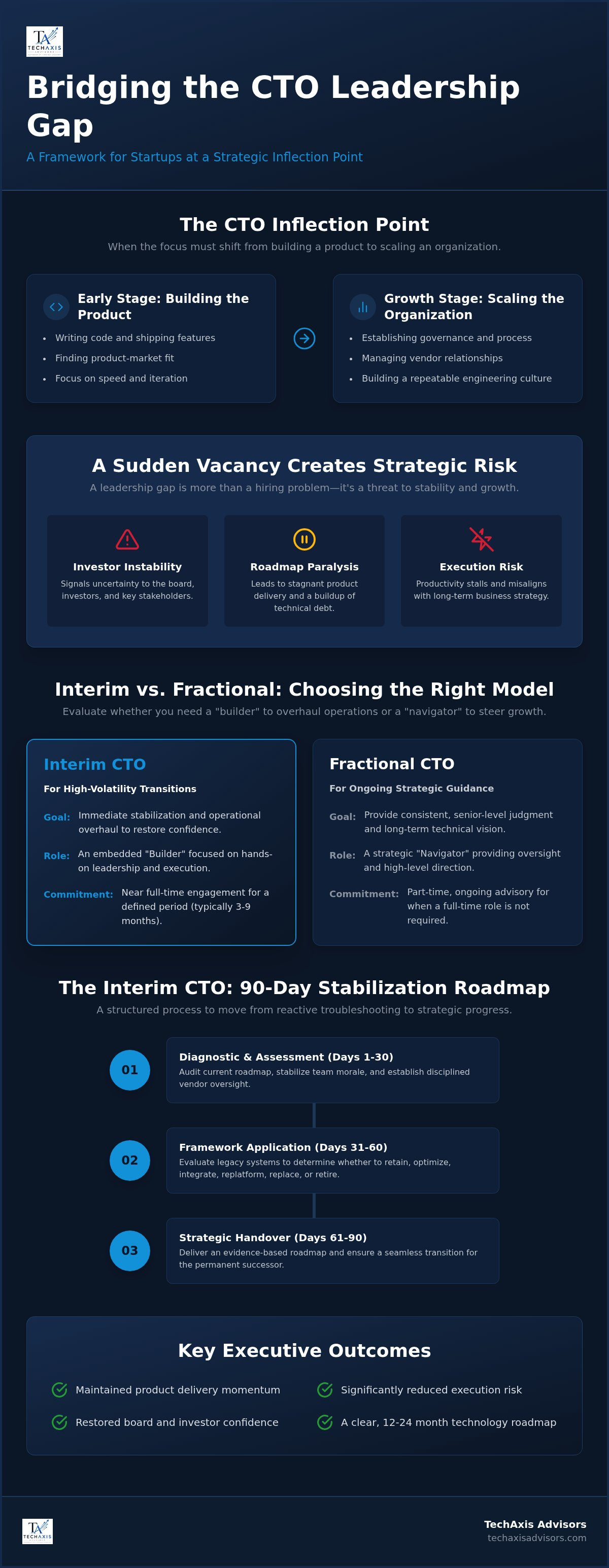
The transition from a seed-stage startup to a growth-oriented organization creates a fundamental shift in technical requirements. Initially, the focus is on building the product. This involves writing code, shipping features, and finding product-market fit. As the company matures, the priority shifts toward scaling the organization. This secondary phase requires establishing governance, managing vendor relationships, and building a repeatable engineering culture. Often, the technical leadership that secured the first million in revenue lacks the executive experience required to manage a fifty-million-dollar operation. When scaling outpaces your current team's experience, the organization reaches a critical inflection point.
A sudden CTO departure during this phase creates more than just a technical gap. It signals instability to investors and puts the product roadmap at risk. Without a steady hand, internal teams often lose focus. This leads to feature creep or a buildup of technical debt that hinders future expansion. Engaging interim CTO services for startups provides an immediate stabilizing force. It ensures institutional knowledge remains intact while the board searches for a permanent successor. It's about maintaining a disciplined focus on the roadmap during a period of potential chaos.
Navigating Technical Execution Risk
Execution risk is the probability that technical failures or delays will prevent the business from hitting its commercial milestones. When a leadership gap exists, a silent stall often occurs in engineering productivity. The team continues to work, but the output no longer aligns with the long-term business strategy. Interim leadership identifies these misalignments early. They provide executive decision support to ensure technology investments directly increase company valuation. This is vital when preparing for upcoming fundraising rounds or M&A activity where technical due diligence will be rigorous.
Industry-Specific Complexity: Wealth Management and Fintech
For firms in regulated sectors, the stakes of a leadership transition are significantly higher. Generalist consultants often lack the depth to manage the intersection of innovation and rigorous compliance. In these environments, technology is a regulated component of the business. Effective technology leadership for wealth management firms requires an understanding of how to maintain agility while satisfying auditors and institutional partners. Using interim CTO services for startups in fintech ensures that growth doesn't come at the cost of regulatory standing. You need a leader who understands SOC2, HIPAA, or SEC requirements as well as they understand software architecture.
Interim vs. Fractional CTO: Choosing the Right Model for 2026
Choosing the correct leadership model depends on the specific nature of your organization's technical friction. While both roles provide executive-level guidance, their deployment differs in intensity and duration. Interim CTO services for startups are designed for periods of high volatility or transition. These are embedded, near-full-time engagements that focus on immediate stabilization. Conversely, fractional CTO services provide ongoing, part-time strategic oversight. This model is often preferred when a startup needs senior-level judgment but doesn't require a forty-hour weekly commitment.
Executives must evaluate whether they need a "builder" to overhaul operations or a "navigator" to steer growth. Early-stage firms often utilize CTO as a Service (CaaS) for foundational architecture. Growth-stage firms require a more sophisticated approach. They need a partner who can manage investor relations and board-level reporting while ensuring the technology operating model remains scalable. Determining the intensity of leadership required is the first step in de-risking your technology roadmap.
Interim Leadership: The 90-Day Stabilization Focus
The primary mandate of an interim leader is to stop the bleed and restore confidence. In the first 90 days, priorities include auditing the current roadmap, stabilizing team morale, and establishing vendor oversight. This period isn't about making permanent changes but about making informed decisions. An interim CTO applies a structured framework to legacy systems to determine the best path forward. They evaluate each component to decide whether to retain, optimize, integrate, replatform, replace, or retire existing assets. This rigorous assessment builds a reliable bridge for your permanent successor while maintaining product delivery momentum.
Fractional Advisory: Long-Term Strategic Alignment
Fractional leadership serves as a strategic partner for companies that have stabilized their core operations but need help with high-impact initiatives. This model allows you to maintain an executive presence without the full-time executive cost. The focus here is often on long-term value drivers such as AI readiness and data strategy. By establishing robust governance and a clear data reporting strategy, a fractional leader ensures your technology remains a competitive advantage rather than a bottleneck. You can explore whether your priority requires an assessment, strategic advisory, or fractional leadership to better align your technology with your business outcomes.
A Decision Framework for Evaluating Interim CTO Firms
Selecting the right firm requires looking past technical proficiency. While coding expertise is foundational for early hires, executive technology leadership demands a different skill set. You need a partner who can translate complex technical debt into business risk for the board. Evaluating interim CTO services for startups involves assessing a candidate's ability to drive business-first alignment. This means prioritizing technology decisions based on their impact on EBITDA, market expansion, and operational maturity rather than technical novelty. Technical skills are the baseline; executive communication is the differentiator.
Independent advisory is another critical factor in your selection process. Many firms suffer from implementation bias, where they recommend solutions they're paid to build. A truly independent advisor focuses on executive decision support rather than billable engineering hours. They help you evaluate whether to retain, optimize, or replace systems based on evidence, not sales quotas. For firms in regulated industries or those pursuing public sector contracts, certifications like SBA WOSB or NJ MWBE/SBE add a layer of necessary compliance and diversity oversight. These credentials often signal a firm's commitment to the rigorous standards required by institutional partners.
Evidence-Based Selection Criteria
Prioritize leaders who have served as CIOs, CTOs, or CISOs for over 20 years. This level of operational experience ensures they've managed through multiple market cycles and technology shifts. A structured approach is essential for success. Look for firms that utilize proprietary intelligence platforms to conduct assessments. These tools provide data-driven findings rather than subjective opinions. Board-level experience is non-negotiable. Your interim lead must be comfortable presenting technical roadmaps to non-technical directors with clarity and authority. They should act as a bridge between the server room and the boardroom.
Avoiding the 'Junior Consultant' Problem
Boutique and global firms often utilize a model where senior partners sell the engagement, but junior staff perform the work. This creates a significant risk for growth-stage startups that need immediate, high-level judgment. You shouldn't settle for a junior consultant learning on your dime. Ensure your agreement guarantees direct, daily access to the senior lead throughout the engagement. This direct engagement model ensures that the person making the strategic decisions has the experience to back them up. You can learn more about our commitment to senior-led partnerships by reviewing the TechAxis Engagement Model and how it prioritizes executive intelligence over billable hours.
The Engagement Roadmap: From Diagnostic to Executive Clarity
A successful engagement follows a logical progression from identification to mastery. This structured approach ensures that interim CTO services for startups provide immediate value while building long-term structural integrity. It's a methodical flow that respects the reader's cognitive load by breaking down complex needs into digestible phases. The roadmap moves beyond temporary gap-filling to establish a repeatable technology operating model.
The Power of the Executive Technology Assessment
Phase 1 centers on a structured Executive Intelligence Assessment. This isn't a technical audit; it's a decision-support engagement. We evaluate data architecture, AI readiness, and cybersecurity risk to identify where technical debt hinders expansion. By replacing organizational anxiety with evidence-based findings, we create a baseline for growth. You can prepare for this phase by reviewing our Technology Due Diligence for Growth-Stage Companies guide.
Board-Ready Deliverables That Drive Action
Phase 2 and 3 involve intelligence synthesis and roadmap development. We move from static findings to dynamic action registers. These deliverables are designed for the boardroom. They provide concise briefs that drive executive action. Every recommendation follows a "state of being" versus "desired outcome" format. This ensures traceability and accountability in every technology investment. We focus on the mechanics of scaling rather than getting bogged down in granular jargon.
Phase 4 and 5 prioritize execution and transition. The interim leader provides vendor oversight and governance to maintain product delivery momentum. As the engagement concludes, we manage the transition for the permanent hire. This includes documenting the technology operating model and prioritizing the roadmap for the next 12 to 24 months. It ensures the new executive enters an environment of controlled, disciplined progress rather than organizational chaos.
De-Risking Your Startup’s Future with TechAxis Advisors
Technology leadership in a growth-stage company requires more than a deep understanding of code. It demands a sophisticated grasp of business mechanics and organizational structural integrity. Through our interim CTO services for startups, TechAxis Advisors provides the steady hand of a seasoned professional to navigate these complexities. Led by Aarati Dikshit, who brings over 25 years of experience as a CIO, CTO, and CISO, our firm bridges the gap between high-level strategy and grounded execution. We replace organizational anxiety with a sense of controlled, disciplined progress.
Our approach is centered on evidence-based clarity. We utilize a proprietary Executive Intelligence Platform to conduct assessments that provide data-driven findings rather than subjective opinions. This platform allows us to identify specific friction points in your technology operating model, from data architecture to cybersecurity risks. Our focus areas include:
Technology Governance: Establishing the mechanics of accountability and transparency.
Vendor Oversight: Managing qualified delivery partners to ensure product delivery momentum.
AI Strategy: Tailoring automation readiness for complex, regulated environments.
Operational Scalability: Building the structural foundation required for market expansion.
TechAxis Advisors supports execution through advisory leadership and governance rather than direct software builds. We don't replace your engineering team; we provide the executive decision support they need to succeed. This independent perspective is vital for wealth management and fintech firms that must balance innovation with rigorous compliance standards. We ensure your technology investments are aligned with long-term business strategy and EBITDA growth.
A Strategic Partnership for Growth
We position ourselves as a fractional partner deeply invested in the mechanics of your success. TechAxis serves as a trusted executive advisor during periods of rapid change, providing the board-ready clarity required to reduce execution risk. Our structured assessments result in prioritized roadmaps that guide your organization through transitions with confidence. Explore our Advisory and Leadership services to learn how we can stabilize your operations and prepare your firm for its next phase of growth.
Next Steps: Starting the Executive Conversation
The transition from organizational confusion to strategic mastery begins with a confidential diagnostic of your technology operating model. We help you determine whether your current priority requires a comprehensive assessment, strategic advisory, or fractional leadership. This process is designed to provide immediate stability while building a scalable foundation for the next 12 to 24 months. You can start a confidential executive conversation to explore the specific requirements of your organization and de-risk your technology roadmap.
Establishing Your Scalable Operating Foundation
Leadership transitions don't have to result in organizational paralysis. By recognizing the inflection point where your technical needs outpace your current structure, you can use interim CTO services for startups to build a more mature technology operating model. This process begins with an evidence-based diagnostic through our proprietary Executive Intelligence Platform. It moves beyond temporary gap-filling to provide a clear, prioritized roadmap for the next 12 to 24 months. This structured approach ensures your firm maintains product delivery momentum while preparing for a permanent successor.
TechAxis Advisors brings the wisdom of former CIOs, CTOs, and CISOs directly to your leadership team. As an SBA WOSB and NJ MWBE/SBE Certified firm, we focus on reducing execution risk through disciplined governance rather than just technical implementation. We help you replace organizational uncertainty with controlled, strategic progress that satisfies both investors and board members.
Your technology should be a driver of company valuation, not a bottleneck to market expansion. We look forward to helping you master your next phase of growth with executive clarity and senior-led oversight.
Frequently Asked Questions
What is the typical duration of an interim CTO engagement for a startup?
Most engagements last between three and nine months. This timeframe allows for an immediate stabilization of the technology operating model while the board conducts an executive search for a permanent successor. The duration is often tied to specific business milestones, such as a product launch or a successful fundraising round. This ensures the organization maintains product delivery momentum without a permanent long-term commitment before the strategic roadmap is fully clarified.
How much do interim CTO services cost compared to a full-time hire?
Interim leadership offers a cost-efficient alternative by eliminating the need for equity grants, executive benefits, and long-term severance packages. While a full-time CTO in the US can cost between $400,000 and $550,000 annually in total compensation, interim CTO services for startups provide senior-level judgment on a fixed-fee or retainer basis. This allows growth-stage firms to access veteran expertise while preserving capital for critical engineering talent and market expansion efforts.
Does an interim CTO manage the existing engineering team directly?
Yes, an interim leader provides embedded oversight for your engineering department. They establish governance, improve operational maturity, and ensure team activities align with business outcomes. Unlike a consultant who only offers advice, an interim CTO takes responsibility for the mechanics of execution. They mentor existing technical leads, resolve team morale issues, and manage the delivery pipeline to ensure the organization hits its commercial targets during a leadership transition.
Can an interim CTO help with technical due diligence during a funding round?
These leaders are essential for reducing execution risk during funding rounds or M&A activity. They conduct structured Executive Intelligence Assessments to identify technical debt, cybersecurity risks, and AI readiness. This evidence-based diagnostic provides the board-ready clarity required by investors during rigorous due diligence. By addressing friction points before the audit, an interim CTO helps protect the company valuation and demonstrates a disciplined approach to technology management.
What is the difference between an interim CTO and a technical consultant?
A technical consultant typically provides a specific deliverable or advice on a narrow problem. An interim CTO provides comprehensive executive decision support and operates as a member of the C-suite. They manage the technology operating model, oversee budgets, and take ownership of the strategic roadmap. This model replaces organizational anxiety with a disciplined, partner-like dialogue focused on long-term structural integrity while maintaining a professional distance that suggests senior-level expertise.
How does an interim CTO handle the transition to a permanent leader?
Transition management is a core phase of the engagement roadmap. The interim leader documents the current state of the technology stack, prioritizes the roadmap for the next 12 to 24 months, and helps define the requirements for the permanent hire. They often participate in the interviewing process to ensure the successor has the right blend of technical skill and executive communication. This ensures a seamless handoff that maintains organizational momentum.
Will an interim CTO help with specific vendor and platform selections?
How quickly can an interim CTO be deployed into our organization?
Deployment is typically much faster than a traditional executive search. While finding a permanent CTO often takes six months or longer, interim CTO services for startups can often be initiated within one to two weeks. This rapid deployment provides an immediate stabilizing force for firms facing a sudden departure or investor pressure. It allows the organization to bridge the leadership gap quickly without sacrificing the quality of executive oversight.



Comments