

Improving Operational Maturity Through Technology: An Executive Framework
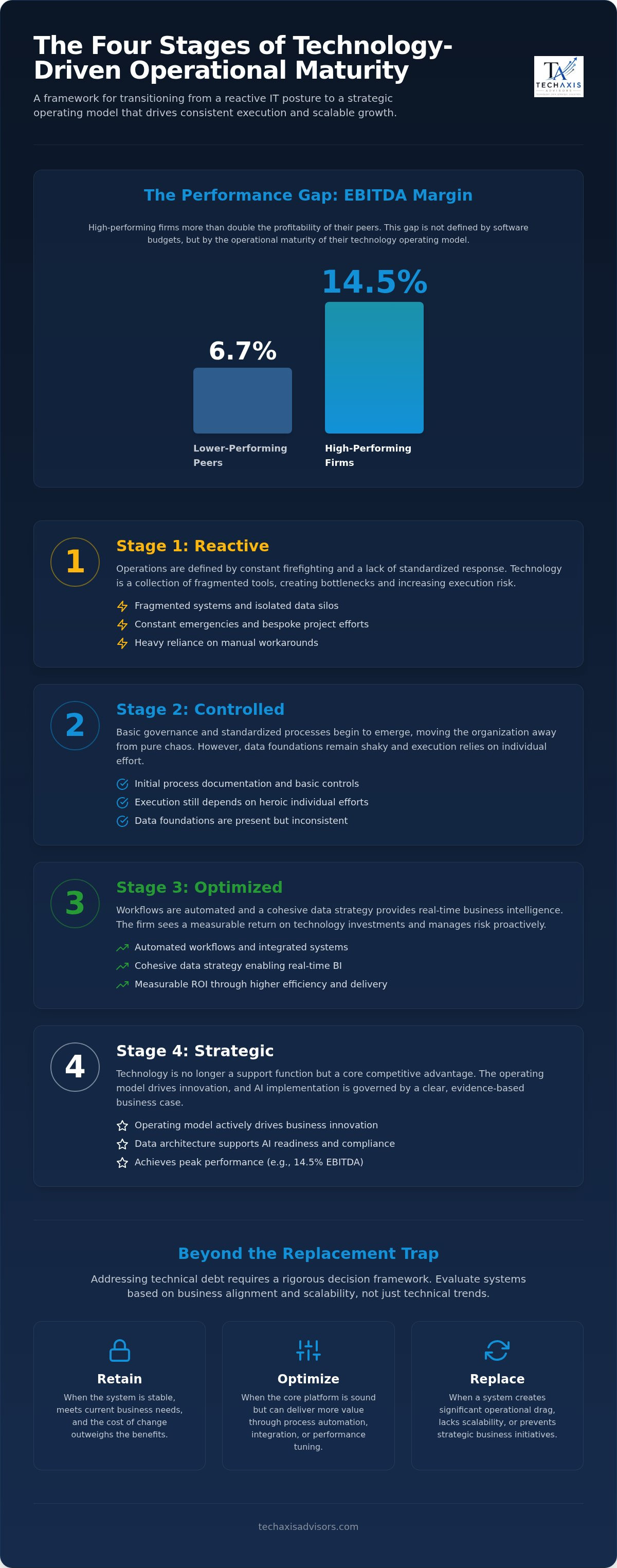
In 2026, high-performing professional services firms achieve an average EBITDA of 14.5%, more than double the 6.7% reported by their lower-performing peers. This performance gap isn't driven by who has the largest software budget. Instead, it's defined by how effectively leadership aligns technology spend with organizational structure. Many executives currently feel the weight of technical debt slowing down product delivery, while a lack of visibility into technology ROI makes future investments difficult to justify. You likely recognize that your current IT setup is often reactive, creating a persistent bottleneck for scalable growth and increasing anxiety over AI readiness.
Improving operational maturity through technology requires moving beyond simple tool acquisition toward a structured technology operating model. You'll learn how to transition from fragmented systems to a cohesive framework that reduces execution risk and aligns with long-term business strategy. This article provides a clear roadmap for scaling your operations, ensuring your data is consistent for decision-making and your organization is prepared for the rigorous requirements of the EU AI Act and DORA. We'll examine the specific trade-offs between retaining, optimizing, or replacing legacy systems to build a foundation for disciplined, predictable progress.
Table of Contents
Defining Operational Maturity in the Age of Digital Acceleration
Operational maturity is the measure of an organization’s ability to execute consistently and scale efficiently. It isn't a technical metric; it's a core business indicator. In growth-stage firms, technology often begins as a series of tactical fixes designed to solve immediate, isolated problems. Eventually, these disconnected tools create a "complexity wall" where the cost of organizational coordination exceeds the value of the actual output. Improving operational maturity through technology involves dismantling this wall. It requires rebuilding a structural foundation that supports expansion rather than acting as a drag on every new initiative.
The traditional view of IT as a cost center is obsolete. Modern leaders view technology as the operational foundation of the entire enterprise. In highly regulated sectors like wealth management or private equity, this shift is a necessity. Technical debt in these environments isn't just a coding issue; it's a direct source of operational drag. It forces senior talent to spend hours reconciling inconsistent data instead of focusing on strategic growth. This drag isn't just a nuisance. It's a drain on profitability that limits your ability to respond to market shifts or regulatory changes.
The Business Impact of Low Operational Maturity
Low maturity manifests as increased execution risk and missed market opportunities. When processes aren't standardized, every project becomes a bespoke effort. This lack of predictability leads to missed deadlines and failed implementations that can damage your reputation with stakeholders. Manual workarounds often become the standard operating procedure to bridge technical gaps. These "quick fixes" inflate operational costs and create a brittle infrastructure that breaks under pressure. Over time, this environment erodes talent retention. High performers don't want to work in systems where their time is wasted on repetitive, low-value manual tasks.
The Role of Executive Clarity in Technical Decisions
Effective leadership requires moving beyond "black box" technology management. You don't need to understand the underlying code, but you must understand the strategic trade-offs of every major investment. Executive clarity ensures that technology decisions are business-aligned and evidence-based. This starts by establishing a common language between the board and the technical team to replace confusion with controlled, disciplined progress. When this bridge exists, technology becomes a powerful lever for scaling. You can explore the problems we solve for growth-stage leaders to see how this clarity reduces execution risk across the organization.
The Four Stages of Technology-Driven Operational Maturity
Operational growth is rarely linear. It's a progression through distinct phases of capability and control. Improving operational maturity through technology requires an honest assessment of where your organization sits today. Without this baseline, investments often fail to address the root causes of inefficiency. Most growth-stage firms find themselves transitioning through four specific stages of development.
Stage 1: Reactive. Operations are defined by constant firefighting. Data exists in isolated silos, and toolsets are fragmented across departments. Every technical issue feels like an emergency because there's no standardized response framework.
Stage 2: Controlled. Basic governance and standardized processes begin to emerge. The organization has moved away from pure chaos, but data foundations remain shaky. While documentation exists, execution still relies heavily on individual effort rather than systemic reliability.
Stage 3: Optimized. Workflows are automated, and a cohesive data strategy provides real-time business intelligence. Risk management is proactive rather than defensive. At this stage, the firm begins to see a measurable return on technology investments through increased billable utilization and higher on-time delivery rates.
Stage 4: Strategic. Technology is no longer a support function; it's a competitive advantage. The operating model drives innovation, and AI implementation is governed by a clear business case. High-performing firms at this level often achieve an average EBITDA of 14.5%, significantly outperforming the 6.7% seen in lower-maturity organizations.
Identifying Your Organization’s Current Stage
The most common indicator of a reactive environment is "spreadsheet-heavy" reporting. If your leadership team spends the first twenty minutes of every meeting debating which spreadsheet has the correct version of the truth, you're likely in Stage 1 or 2. Moving from Stage 2 to Stage 3 requires a focus on automation readiness. The complexity wall occurs when the manual effort required to maintain existing systems consumes all available resources, leaving no capacity for strategic improvements. Breaking through this wall requires a shift in focus from maintaining tools to optimizing the technology operating model. To determine your specific needs, you might start with a confidential executive conversation.
Benchmarking Against Regulated Industry Standards
For wealth managers and asset managers, maturity isn't just about efficiency; it's about compliance. Regulations like the Digital Operational Resilience Act (DORA) and the EU AI Act now mandate strict third-party risk visibility and incident reporting timelines. Firms that lack operational maturity struggle to meet these evidentiary requirements. Operational maturity also directly impacts valuation during private equity due diligence. A mature technology stack suggests lower execution risk and higher scalability, making the firm a more attractive acquisition target. For a detailed breakdown of these requirements, see our Technology Due Diligence for Growth-Stage Companies: An Executive Checklist.
Beyond the Replacement Trap: Evaluating Technical Scalability
Executives often assume that scaling requires a complete overhaul of the current tech stack. This "replacement trap" frequently leads to expensive, multi-year projects that fail to deliver a timely ROI. Improving operational maturity through technology doesn't always require a clean slate. In many cases, the most pragmatic path involves surgical improvements to existing systems rather than a total replacement. A disciplined approach focuses on how technology supports the business operating model, not just the age of the software.
To navigate these decisions, leaders should use an Executive Decision Framework. This involves evaluating each component of the stack through six lenses: Retain, Optimize, Integrate, Replatform, Replace, or Retire. By categorizing systems this way, you avoid the execution risk associated with large-scale migrations that lack a clear business case. This framework ensures that capital is allocated where it will have the most significant impact on operational throughput and risk reduction.
The Cost of Technical Debt vs. The Cost of Change
Legacy software carries a "hidden tax" that manifests as manual workarounds and data reconciliation efforts. These inefficiencies drain your team's capacity and slow down product delivery. However, the cost of change is often underestimated. It includes not just licensing fees, but the disruption to established workflows and the "human element" of change management. Successful firms often choose to optimize current infrastructure to bridge the gap to a new platform. This phased approach allows for incremental improvements in operational maturity while minimizing the shock to the organization.
Vendor and Platform Management for Maturity
Maturity requires evolving from simple vendor dependence to strategic platform management. Many growth-stage firms suffer from "tool sprawl," where overlapping platforms create data silos and redundant costs. A mature organization ensures that every third-party tool aligns with a long-term technology roadmap. This requires active governance and vendor oversight to ensure that platforms remain integrated and secure. When your technology stack is managed as a cohesive ecosystem, it becomes a predictable engine for growth. To understand how to align your vendors with your broader business objectives, you can learn about our Advisory Leadership services.
Strategic Levers: Data Architecture, AI Readiness, and Governance
Data serves as the connective tissue of a mature organization. It allows a firm to move from basic reporting to actionable business intelligence. Improving operational maturity through technology requires a shift in how data is treated; it's no longer a byproduct of operations but the primary asset driving them. For executives, this means having a single, verifiable source of truth that informs capital allocation and risk management. Without this foundation, scaling remains a manual, error-prone process.
The TechAxis Executive Intelligence Platform facilitates this transition by providing evidence-based roadmapping. By using structured diagnostics, leaders can identify exactly where their data infrastructure fails to support growth objectives. This is particularly vital for AI readiness. In 2026, AI-related workloads account for 19% of total cloud spending. However, without high-quality data and a clear use-case viability assessment, these investments often fail to generate a return. A governed AI strategy ensures that you're investing in solutions that provide tangible business value rather than chasing technical trends.
Building Scalable Data Foundations
Modernizing your data architecture is the first step toward real-time executive decision-making. In wealth management, data lineage and accuracy are not optional. They are regulatory requirements. You must be able to trace data from its source to its final report to ensure integrity and transparency. A robust foundation allows you to treat AI as a force multiplier that enhances human expertise. For a deeper look at these trends, see our AI in Financial Services: 2026 Strategic Framework.
Implementing a Governance Framework for Scale
Governance should support growth, not stifle it. As of August 2026, the full application of requirements for high-risk AI systems under the EU AI Act has begun. This includes mandatory technical documentation and conformity assessments. Improving operational maturity through technology means integrating these compliance needs into your daily operating model. The Digital Operational Resilience Act (DORA), which took full effect in January 2026, also mandates real-time risk monitoring and third-party risk visibility. Cybersecurity risk management must be viewed as a core component of maturity. Boards must define clear accountability for technology outcomes to ensure that governance remains a strategic priority rather than a checkbox exercise.
Accelerating Maturity: The Role of Fractional Technology Leadership
Growth-stage firms often hit a ceiling. This occurs when the existing leadership team lacks the specific technical foresight required to manage a stack that has grown beyond its original purpose. Improving operational maturity through technology requires a dedicated focus that internal teams, already managing rapid growth, rarely possess. Most COOs or CEOs don't have the bandwidth to oversee complex technical roadmaps while simultaneously running the business. This leadership gap often leads to tactical, short-term decisions that increase technical debt and operational drag.
Fractional technology leadership provides a pragmatic solution for firms in this transition. A Fractional CTO acts as a strategic architect, providing the wisdom of a veteran executive without the cost of a full-time hire. This role bridges the gap between high-level business strategy and tactical execution. They don't just offer advice; they provide ongoing governance and vendor oversight. This ensures that third-party platforms and delivery partners remain accountable to your long-term business objectives. By embedding senior-level expertise into the organization, you replace reactive firefighting with a disciplined, evidence-based approach to scaling.
Choosing Between Fractional Advisory and Full-Time Hires
Deciding when to hire a full-time CTO versus engaging fractional leadership depends on your current stage of maturity. If your organization requires daily, high-stakes technical oversight across multiple product lines, a full-time executive is likely necessary. However, for many wealth management and private equity-backed firms, fractional leadership is more effective. It provides the ROI of executive-grade insight while preventing costly technical errors that often occur during rapid expansion. For a detailed breakdown of how to evaluate these options, see our Strategic Technology Advisory for CEOs: Buying Guide.
Next Steps: From Assessment to Execution
The path toward improving operational maturity through technology begins with an Executive Technology Operating Model Assessment. This structured diagnostic provides the board with a prioritized, board-ready roadmap. It moves the conversation away from abstract technical needs and toward concrete business outcomes. Once you have a clear understanding of your current baseline, you can determine the best leadership model to support your goals. Explore whether your current priority requires a one-time assessment, ongoing strategic advisory, or the embedded leadership of a fractional CTO to guide your organization through its next phase of growth.
Transitioning to a Strategic Technology Operating Model
Operational maturity is a competitive advantage that directly correlates with consistent execution and reduced risk. Leaders must move beyond reactive firefighting to establish a technology operating model that supports long-term growth. This requires a disciplined evaluation of technical debt and a commitment to data integrity as the foundation for AI readiness. Improving operational maturity through technology is a structured process, not a one-time project.
At TechAxis Advisors, we support this transition through our proprietary Executive Intelligence Platform. This platform delivers evidence-based findings and prioritized roadmaps tailored for the complexities of financial services. Our structured, evidence-based assessment methodology is led by a founder with over 25 years of experience as a CIO, CTO, and CISO. This ensures you receive veteran executive clarity for your most important decisions.
Starting with a structured assessment allows you to replace organizational anxiety with a sense of controlled, disciplined progress. It's the most effective way to define a clear path forward that aligns your technology stack with your business strategy. We look forward to helping you build a more resilient and scalable organization.
Frequently Asked Questions
How does technology improve operational maturity?
Technology improves operational maturity by standardizing workflows and creating a reliable infrastructure for consistent execution. It shifts the organization from manual, person-dependent tasks to systemic, repeatable processes. This transition reduces the variance in output. It allows leaders to scale operations without a proportional increase in headcount or error rates, ensuring the business remains resilient under pressure.
What are the core stages of an operational maturity model?
The core stages typically progress from Reactive to Strategic. Initially, firms operate in a state of constant firefighting with siloed data and fragmented tools. They then move toward Controlled and Optimized stages where governance and automation are introduced. Finally, they reach the Strategic stage. At this level, technology is a competitive advantage that drives innovation and supports long-term business growth.
How do you measure operational maturity in a financial services firm?
Measurement is based on the predictability of outcomes and the integrity of data systems. Key indicators include the percentage of manual workarounds required for daily tasks and the time spent on data reconciliation. High maturity is often reflected in a firm's ability to meet strict compliance timelines. This includes evidentiary requirements for regulations like the Digital Operational Resilience Act (DORA).
When should a CEO consider a technology operating model assessment?
A CEO should consider an assessment when technical debt begins to slow down product delivery or when there's a lack of visibility into technology ROI. It's also critical during growth phases or before major strategic shifts. Improving operational maturity through technology starts with an evidence-based diagnostic. This process identifies current bottlenecks and prioritizes a board-ready roadmap for scaling the organization.
What is the difference between operational efficiency and operational maturity?
Efficiency focuses on doing things right, while maturity focuses on doing the right things consistently at scale. Efficiency might involve a single optimized process. Maturity involves the structural capability of the entire organization to replicate that success across all departments. A mature firm has the governance and infrastructure to sustain high performance even as organizational complexity increases during rapid growth phases.
How does technical debt impact organizational scale?
Technical debt acts as a hidden tax that consumes resources otherwise meant for innovation. It creates operational drag by forcing teams to manage legacy system failures and manual data entry. As a firm grows, this debt compounds. It eventually creates a complexity wall that makes further scaling impossible without a significant structural overhaul of the underlying technology operating model.
Can AI be implemented before an organization reaches high operational maturity?
AI can be implemented, but the risk of failure is significantly higher without foundational maturity. AI requires high-quality, structured data and robust governance to be effective. Firms in lower maturity stages often struggle with pilot projects that fail to scale. This is because their underlying infrastructure cannot support the deployment or the rigorous security requirements of complex AI systems.
What is the role of a Fractional CTO in improving operational maturity?
A Fractional CTO provides the senior-level strategy and governance needed to bridge the gap between business goals and technical execution. They offer executive clarity during growth phases, ensuring that technology investments align with long-term strategy. This leadership model is essential for improving operational maturity through technology by providing veteran oversight and vendor management without the full-time cost of a permanent hire.



Comments