

How to Measure ROI of Technology Investments: An Executive Framework
A technology investment can meet its delivery targets and still fail to create measurable business value. That is why leaders need to decide how to measure ROI of technology investments before approval, rather than reconstructing the case after launch.
The challenge is familiar to executives: expected benefits can be difficult to quantify, technology and business teams may define success differently, and forecasts can overlook adoption, delivery risk, and the full cost of change. A single ROI percentage rarely captures the whole decision.
This article offers a practical framework for building a transparent investment case and reviewing it over time. It covers how to connect financial returns with operational outcomes, risk, adoption, and strategic value; make assumptions explicit; and distinguish forecasts from results the organization can verify. Agree on measures before implementation, assign accountable owners, and define how leaders will respond if evidence changes. The goal is not to make every benefit look certain. It is to give executives a consistent basis for deciding whether to proceed, refine, scale, defer, or stop an investment.
Table of Contents
Why measuring technology investment ROI takes more than tracking savings
A technology project can reduce processing time and still fall short of the value executives expected. The difference often comes down to what the business counts, which costs it includes, and whether the organization can realize the projected benefits. A credible assessment compares benefits attributable to the investment with the full costs of implementing and sustaining it.
Direct financial returns are only one part of the decision. Faster service or fewer manual handoffs may support business goals without immediately translating into cash savings. Risk reduction and strategic capacity, such as better decision-making or the ability to support future priorities, can also matter. Track these outcomes alongside financial measures, but do not present them as guaranteed monetary returns.
What does technology ROI measure?
A common formula is ROI = (total attributable benefits − total investment costs) ÷ total investment costs × 100. Benefits are the financial gains reasonably connected to the investment; costs include the resources required to implement and operate it. This is the basic Return on investment (ROI) calculation, but the result depends on clear boundaries, evidence, and assumptions. Do not credit the investment with benefits that would have occurred without it.
ROI is not the same as payback period, which estimates how long it takes to recover the initial outlay, or net present value (NPV), which assesses future cash flows in relation to their timing and a selected discount rate. Each measure answers a different question. A positive projected ROI alone does not establish that an investment fits the organization’s strategy, risk tolerance, or competing priorities.
Why can a technology investment look successful but underperform?
A forecast can overstate returns if it counts a software or platform expense but omits integration, implementation, training, internal staff time, or ongoing support. Costs can continue after launch, so the investment case should cover the full lifecycle rather than only the initial purchase.
Benefits may also arrive later than planned, particularly when they depend on employee adoption or redesigned workflows. A new platform may be available while teams continue using old processes, preventing the expected efficiency gains. That is why the question of how to measure ROI of technology investments starts with a baseline: document current performance before implementation, then compare results against it.
Assign an accountable business owner to each expected benefit before approval. The owner should define the measure, identify dependencies, and review performance after launch. This helps distinguish delivery success from business impact and gives leaders a basis for adjusting the case when actual adoption, costs, or outcomes differ from assumptions.
How to measure ROI of technology investments in five steps
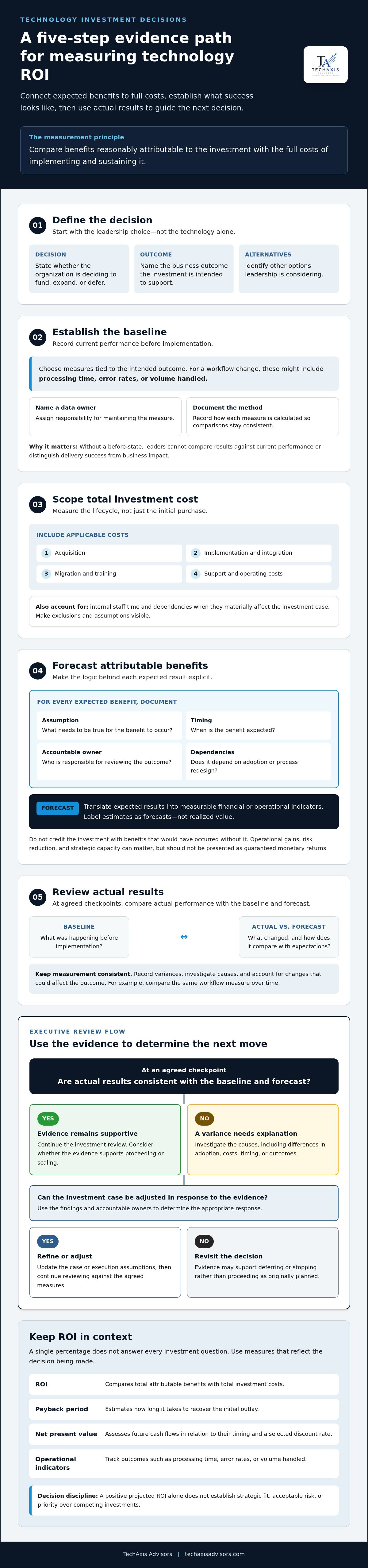
How to measure ROI of technology investments can be reduced to five steps: define the decision, establish a baseline, scope total costs, forecast attributable benefits, and review actual results against the assumptions.
Define the decision. State what leadership needs to decide, such as whether to fund, expand, or defer an investment. Specify the business outcome it is intended to support and the alternatives being considered.
Establish a baseline. Record current performance before implementation, using measures tied to the intended outcome. For a workflow change, this might include processing time, error rates, or volume handled. Name a data owner and document how each measure is calculated.
Scope total costs. Estimate the full investment over the measurement horizon, not only the initial purchase. Include applicable acquisition, implementation, integration, migration, training, support, and operating costs. Capture internal staff time and dependencies when they materially affect the case.
Forecast benefits. Translate expected results into measurable financial or operational indicators. For each benefit, document the assumption, expected timing, accountable business owner, and dependencies, such as adoption or process redesign. Label estimates as forecasts, not realized value.
Review results. At agreed checkpoints, compare actual performance with the baseline and forecast. Record variances, investigate causes, and decide whether to adjust, continue, or revisit the investment.
Build a baseline and define total investment cost
Choose a measurement horizon that reflects the investment lifecycle and the time needed for benefits to emerge. A short review window may miss gradual adoption; an overly long one can make it harder to determine whether results remain attributable to the investment. Make exclusions and assumptions visible, including costs not included and conditions the forecast depends on.
Forecast benefits and validate them after launch
Set review points before implementation and keep measurement consistent. If the projected benefit is faster case handling, compare the same workflow measure over time and account for changes that could affect it. TechSoup also recommends ways to track both short- and long-term impacts, helping leaders avoid judging an investment on launch activity alone.
A concise investment case makes the decision auditable. Include the strategic objective, baseline, total cost, forecast benefits, measurement horizon, assumptions, owners, and review dates. A structured executive assessment can help leadership clarify these elements and connect the rationale to follow-through.
Which technology ROI measures belong in the investment case?
A sound investment case uses measures that answer different questions. Financial metrics estimate economic returns; operational and strategic indicators show whether the investment is producing the conditions for those returns. When deciding how to measure ROI of technology investments, keep hard-dollar benefits distinct from capacity released, risk reduction, and strategic enablement. Do not convert nonfinancial outcomes into arbitrary cash values. Define indicators and the evidence needed to assess them instead.
Financial measures: ROI, payback, and net present value
Pair these measures with total cost of ownership (TCO), which captures costs across the investment lifecycle. TCO can include acquisition, implementation, integration, training, support, and ongoing operating costs. Use the same cost scope across measures so comparisons remain consistent.
Operational and strategic measures: adoption, risk, and capacity
Select a focused set of indicators tied directly to the investment objective. For adoption, track relevant usage or workflow completion, not logins alone. For capacity released, distinguish time saved from cash savings: it becomes a hard-dollar benefit only when it reduces spend or supports a measurable alternative use of resources.
Assess risk reduction through documented exposure or control measures, such as whether a defined process is completed or a control is operating as intended. Do not claim guaranteed losses avoided. Strategic enablement, such as improved access to decision-quality data, also needs an observable indicator and an accountable owner. These measures make value visible without overstating what the investment has delivered.
How to make ROI estimates credible when benefits are uncertain
Uncertainty belongs in the investment case, not in the footnotes. Present conservative, expected, and upside scenarios as conditional forecasts, each tied to explicit assumptions. For example, an automation investment’s expected benefit may depend on staff adoption, redesigned workflows, reliable data, and vendor delivery. Show how outcomes change if those conditions are delayed or only partly met. A forecast is not a result until evidence shows the benefit has been achieved.
To make how to measure ROI of technology investments useful after approval, connect every claimed benefit to its evidence, assumptions, accountable owner, and confidence level. Keep uncertain or indirect benefits separate from validated financial returns.
How should leaders handle uncertain or indirect benefits?
Use leading indicators while lagging outcomes take time to emerge. Usage, workflow completion, or data-quality measures can show whether the conditions for a benefit are developing, but they do not prove a financial outcome. Define in advance what evidence is required to recognize a benefit as realized, such as sustained performance against an agreed measure and confirmation by its owner.
Attribution also has limits. If process redesign, staffing changes, and a new platform all influence the same outcome, do not assign the full improvement to the technology by default. Record other contributing initiatives, explain the attribution method, and present any remaining uncertainty clearly.
When should an investment be adjusted, paused, or reconsidered?
Set review gates and decision criteria before implementation. Revisit scope when costs, adoption, vendor delivery, data quality, or other dependencies diverge materially from the case. An agreed response might be to address a dependency, revise the forecast, pause expansion, or reconsider the investment. Consistent performance governance keeps measures, ownership, and decisions connected as conditions change.
Turn technology ROI findings into an executive decision and action plan
A useful ROI review ends with a decision, not just a percentage. Executives should be able to see how the investment fits strategic priorities, what value it is expected to produce, what it will cost across its lifecycle, and whether the remaining risks fit the organization’s tolerance. Make the decision explicit: approve, stage, revise, defer, or stop.
What should an executive ROI review include?
Bring the evidence into one concise review: baseline, cost scope, benefit measures, assumptions, scenario range, risks, dependencies, and evidence gaps. Identify who owns the decision and who is accountable for each benefit. State the decision requested, including the conditions or new evidence that would change it.
Approval is not the end of oversight. An action register translates the decision into follow-through. For each action, record:
Owner and outcome: the accountable executive or business lead and the result they are responsible for tracking.
Measure and evidence: the indicator, its data source, and the evidence needed to validate progress.
Review date and escalation path: when leaders will reassess performance and who needs to act if cost, adoption, delivery, or risk departs from plan.
This makes it possible to compare actual performance with the investment case and address material variances before they become accepted assumptions. It also gives finance, technology, and business leaders a shared record of what was approved and why.
How can assessment and advisory support improve decision clarity?
Structured Executive Intelligence Assessments are executive decision-support engagements, not technical audits. They organize evidence into board-ready findings, prioritized roadmaps, action registers, and executive presentations. The purpose is to clarify assumptions, accountability, strategic fit, and the choices leaders need to make. Findings can inform a roadmap, but they do not guarantee financial returns.
For organizations strengthening operational maturity and performance governance, this discipline connects investment measures with clear oversight. Executive advisory and fractional leadership can carry findings into governance and execution through strategic guidance, vendor oversight, and coordination with qualified delivery partners. This continuity helps maintain executive visibility as results and assumptions evolve.
For leaders assessing how to measure ROI of technology investments and translate findings into a decision-ready plan, explore whether an assessment, strategic advisory, or fractional leadership fits the decision.
Make the next technology decision with clear evidence
A disciplined approach to how to measure ROI of technology investments goes beyond a projected percentage. It connects the decision to strategic fit, includes the full investment cost, and distinguishes verified financial returns from operational or strategic benefits that still depend on adoption, process change, or other conditions.
Set measures and owners before implementation, then review results against the baseline and the assumptions behind the case. When evidence changes, leaders can adjust scope, timing, or priorities rather than treating the original forecast as a promise. The objective is a transparent decision process that continues after approval.
TechAxis Advisors’ structured Executive Intelligence Assessments provide board-ready findings, strategic roadmaps, and action registers to support executive decisions. Founder Aarati Dikshit brings more than 25 years of CIO, CTO, and CISO experience to this work. These tools support clarity and governance; they do not guarantee investment returns.
With clear assumptions, accountable owners, and consistent reviews, your organization can make technology investment decisions with greater confidence and adjust course as real-world evidence emerges.
Frequently Asked Questions
How do you calculate ROI on a technology investment?
Calculate ROI by subtracting total investment costs from attributable benefits, dividing the result by total investment costs, and expressing it as a percentage. Define the measurement period and include relevant implementation and operating costs. The calculation remains an estimate until actual performance is compared with the baseline and the original assumptions are reviewed. For a decision-ready view, document which benefits are attributable to the investment and how they will be verified.
What costs should be included when measuring technology ROI?
Include costs across the investment lifecycle, such as acquisition, implementation, integration, migration, training, support, and ongoing operations. Define the scope clearly and exclude expenses unrelated to the investment. Document material internal effort, such as staff time needed for adoption or process changes, when it affects the resources required to realize forecast benefits. A consistent cost boundary makes comparisons more useful for executive review.
How long should you measure ROI after implementing technology?
Choose a measurement horizon that reflects when benefits are expected to emerge, the investment’s operating costs, and the decision being made. Some effects may appear early, while others depend on adoption or redesigned processes. Establish review points before implementation. Track leading indicators, such as workflow completion, early, then assess realized business outcomes over a period appropriate to the investment case. Revisit the horizon if key assumptions or dependencies change.
Can technology investments have positive value without a clear financial ROI?
Yes. An investment can support risk management, governance, resilience, or strategic capacity even when those outcomes cannot be reliably converted into cash. Define observable indicators for each outcome and report them separately from financial returns. For example, track whether a specified control is operating or whether decision-makers have access to required data. This keeps the case evidence-based without assigning unsupported monetary values to indirect benefits.
What is the difference between ROI, payback period, and net present value?
ROI compares attributable benefits with costs over a defined period. Payback period estimates how long cumulative benefits take to recover the investment. Net present value (NPV) evaluates expected future cash flows in today’s terms using a discount rate. Each measure answers a different question and has limits when viewed alone. Executives should consider them together with operational and risk measures, while making the time horizon and assumptions clear.
How can you measure ROI when several projects contribute to the same result?
Start with a baseline and document all initiatives that could influence the outcome. Do not credit one project with the entire change unless the evidence supports that attribution. Use relevant operational indicators and input from accountable benefit owners to assess each initiative’s contribution. Record shared dependencies and uncertainty. If precise attribution is not supportable, report a range or describe the contribution as shared rather than presenting an unsupported exact return.
What should leaders do if actual technology ROI falls below the forecast?
Compare actual costs, adoption, and outcomes with the original assumptions, then identify the source of the variance. The gap may reflect delivery issues, unmet dependencies, process design, or benefits taking longer to emerge. Use review criteria set before implementation to decide whether to adjust scope, strengthen governance, defer, or stop the investment. Document the decision, rationale, and accountable owner so the next review reflects what has changed.



Comments