

How to Improve Operational Efficiency With Technology: An Executive Guide
More technology doesn’t automatically mean more efficient operations. Leaders often face the same friction: duplicated work, delayed decisions, and systems that add steps instead of removing them. The real question isn’t how to adopt more tools. It’s how to improve operational efficiency with technology by changing the work that slows the business.
The pressure to improve execution is real, but buying software before defining the operational problem can make complexity harder to manage. Start by identifying where work stalls, what better performance should look like, and whether technology can address the underlying cause.
This guide offers a practical framework for prioritizing operational bottlenecks against business outcomes. You’ll learn how to assess process redesign, automation, data and reporting improvements, or better-connected systems while accounting for governance, adoption, and risk. The goal is disciplined progress: technology that supports clearer decisions and more consistent execution, rather than another layer of work.
Table of Contents
Why Improving Operational Efficiency With Technology Starts With the Work
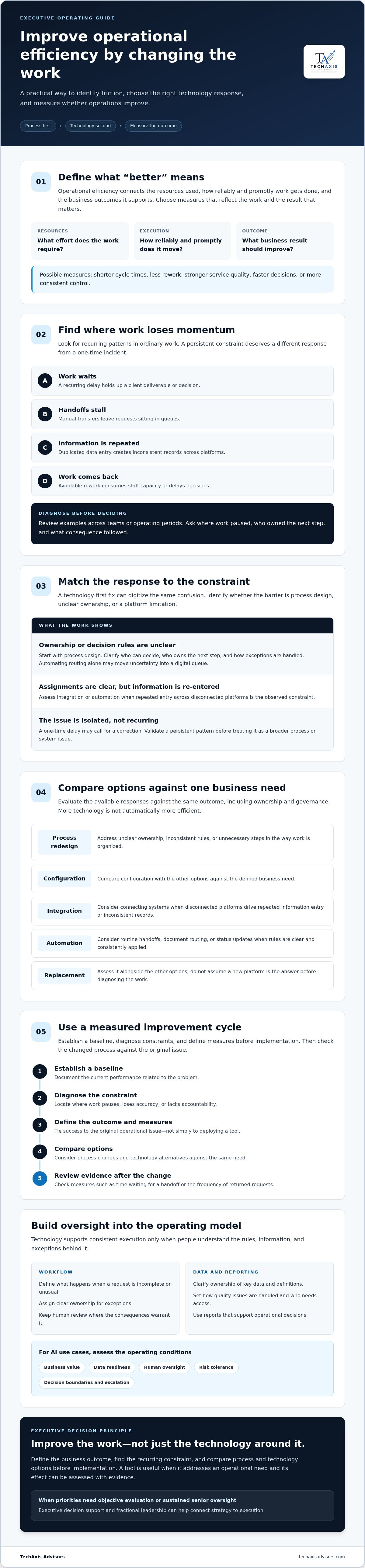
Technology can speed up a process, but speed alone doesn’t show that the process is working better. Operational efficiency is the relationship between the resources used, how reliably and promptly work gets done, and the business outcomes it supports. Leaders may seek shorter cycle times, less rework, stronger service quality, faster decisions, or more consistent control. The right measure depends on the work and the outcome that matters.
Information technology (IT) can support how an organization handles and shares information, but a tool is useful only when it addresses an operational need. To understand how to improve operational efficiency with technology, executives should first identify where work loses time, accuracy, or accountability.
Which operational signals should executives examine first?
Look for patterns in the ordinary flow of work. A recurring delay may hold up a client deliverable. Manual handoffs can leave requests waiting in queues. Duplicated data entry can create inconsistent records, while avoidable rework can consume staff capacity or delay a decision.
Separate a persistent constraint from an isolated incident before choosing a response. Review examples across teams or operating periods, then ask where the work paused, who owned the next step, and what consequence followed. A one-time delay may call for a correction. A repeated pattern may point to a process or system issue.
Why technology-first fixes often miss the real problem
A new workflow tool won’t resolve unclear ownership or inconsistent rules by itself. Consider an approval process where requests sit because no one knows who can make the decision. Automating the routing may simply move the same uncertainty into a digital queue. By contrast, if requests are assigned clearly but staff must re-enter the same information across disconnected platforms, integration or automation may address the constraint.
That distinction matters. One problem is process design; the other may be a platform limitation. Define the desired business outcome first, then evaluate whether process changes, technology, or both are needed. This keeps investment decisions grounded in observable work rather than assumptions about what a tool can do.
How Technology Improves Operational Efficiency Across Workflows and Decisions
Once leaders understand where work gets stuck, technology can address specific sources of friction. Workflow automation can reduce repetitive handling, while integrated data and reporting can give decision-makers a clearer view of workload, exceptions, and results. The objective isn’t to automate every step. It’s to make important work more consistent and easier to oversee.
Where workflow automation can remove friction
Automation may suit routine handoffs, document routing, or repeated status updates when the rules are clear and consistently applied. For example, a system might route a complete request to the appropriate reviewer and flag missing information for follow-up. Before automating, define what happens when a request is incomplete, unusual, or requires judgment. Exceptions need clear ownership, and human review should remain in place where the consequences warrant it.
After a change, assess the process using measures tied to the original issue, such as time spent waiting for a handoff or the frequency of returned requests. Don’t assume automation has improved productivity without evidence from the organization’s own operations.
How data and AI support more consistent operations
Integrated reporting is useful only if teams understand what the data represents. Clarify who owns key data, how quality issues are handled, who needs access, and which reports support operational decisions. Reliable, consistently defined data gives leaders a more dependable basis for comparing performance and choosing next steps. If teams rely on conflicting definitions or delayed updates, a new analytics tool may make information easier to display without making it more trustworthy.
AI may be appropriate for selected tasks, but assess each use case against business value, data readiness, required human oversight, and the organization’s risk tolerance. More complex applications, including AI agents designed to orchestrate work across silos, call for clear boundaries around decision authority and escalation. Start with a defined workflow and accountable owner, not an open-ended mandate to introduce AI.
Leaders assessing automation readiness or the governance required for AI can explore executive advisory leadership to support evaluation and oversight.
How to Compare Technology Options Without Adding Complexity
Compare options against one documented business need, not a vendor’s feature list. If the goal is to reduce delays in a review process, assess process redesign, system configuration, integration, automation, and replacement against the same baseline and intended outcome. This makes tradeoffs visible and helps executives determine how to improve operational efficiency with technology without adding tools that create new ownership or support demands.
For existing platforms, consider whether to retain, optimize, integrate, replatform, replace, or retire them. The right choice depends on the constraint, dependencies, and the organization’s capacity to execute and sustain the change.
When to optimize existing systems versus replace them
Start by testing whether a process change or configuration can address the documented constraint. Map connections to other platforms, reports, teams, and vendors before proposing replacement. A system may appear outdated yet still support critical workflows. Replacement needs a business case that compares expected operational benefits with transition effort, dependencies, and ongoing ownership. Modernization alone isn’t a sufficient rationale.
How to evaluate AI, automation, and platform choices
Assess each option against the same operational measure and baseline. Include data implications, governance, vendor oversight, implementation dependencies, scalability, and the team responsible for ongoing support. If data definitions, quality, or ownership are central to the decision, consult a data strategy framework for asset managers as a related resource.
A Practical Executive Framework for Prioritizing Efficiency Improvements
A defined sequence helps leaders move from an operational concern to a governed improvement effort. It also makes it easier to explain why one initiative should proceed before another. Use these steps to determine how to improve operational efficiency with technology while keeping business outcomes, evidence, and execution capacity in view.
Select a process. Choose a workflow with a clear connection to a business priority, such as service quality, control, or decision speed. Define where the process begins and ends.
Establish a baseline. Record a small set of measures that reflect the work and its intended outcome. Depending on the process, these might include elapsed time, rework, or exception volume. Note the data source, assumptions, and limitations.
Diagnose constraints. Trace delays, handoffs, rework, and decision points. Confirm which issues are recurring and distinguish process problems from platform limitations.
Compare options. Evaluate process changes and technology alternatives against the same outcome and baseline. Consider dependencies, risk, organizational capacity, and strategic relevance, not just potential functionality.
Assign ownership. Name an executive sponsor and process owner. Clarify who can approve changes, manage exceptions, and make decisions when scope, risk, or results differ from expectations.
Set a baseline and define accountable ownership
Measures should show whether the process is improving, not merely whether a tool is being used. Pair an operational indicator, such as time to complete a step, with an outcome measure that reflects the business purpose. Before implementation, document how each measure is calculated and who is responsible for its accuracy. This gives later reviews a consistent point of comparison.
Prioritize initiatives where the evidence supports the case and the organization can manage dependencies and change. A relevant improvement may still need to wait if it relies on unresolved data, vendor, or staffing decisions. For additional context on assessing readiness, see this operational maturity executive framework.
Govern implementation and review results
Track decisions, actions, dependencies, exceptions, and risks in a visible action register. Set executive review points to compare results with the baseline and decide whether to adjust, scale, or stop the work. A review should also confirm that ownership and controls remain clear as the process changes. See how the advisory process works for a diagnostic-to-roadmap approach.
When Executive Technology Advisory Can Help Turn Priorities Into Execution
Knowing how to improve operational efficiency with technology is only part of the challenge. Leaders also need the right level of support to assess options, make decisions, and maintain accountability as work moves forward. The choice depends on what’s missing: a clear evidence base, continued strategic counsel, or sustained executive involvement.
Choosing the right level of executive support
An executive decision-support engagement can help when leadership needs structured evidence about a defined technology or operating domain before committing to a major change. It should clarify the issue, assess relevant options, and provide a prioritized roadmap and action register. Ongoing advisory may fit when decisions require continued strategic counsel and oversight. Fractional leadership may be appropriate when execution and governance need sustained executive involvement, but the organization does not have that capacity internally.
What an evidence-based engagement should make clear
Useful findings connect evidence to decisions. Leaders should be able to see the question under review, what the assessment found, which options were considered, and why priorities were set. A roadmap should identify accountable owners and dependencies, while an action register translates recommendations into trackable next steps. Assumptions and limitations should also be explicit so executives can judge what the findings support.
Advisory support can help maintain alignment through leadership, governance, and vendor oversight. It can also help leaders review progress and address decisions that emerge during execution. The scope should be clear: advisory support informs and guides execution, but it shouldn’t be mistaken for a guarantee of results or an assumption that the advisor will directly implement every change. Explore the executive advisory and leadership approach to understand how senior guidance may fit your organization’s needs.
The right engagement should match the decision in front of you. If you’re weighing an operational priority and need to clarify the next step, start with an executive conversation.
Move From Operational Priorities to Measured Progress
For leaders deciding how to improve operational efficiency with technology, the sequence matters: define the business outcome, understand where work is constrained, then compare process and technology options. Establish a baseline before implementation, assign accountable owners, and review results against a small set of relevant measures.
Technology can support smoother workflows and more timely decisions, but it should address a documented need rather than add complexity. A sound choice also considers governance, dependencies, risk, and the organization’s capacity to sustain the change.
When executive decision support would help clarify next steps, TechAxis Advisors offers structured assessments with board-ready findings, prioritized roadmaps, and action registers. Founder Aarati Dikshit brings more than 25 years of CIO, CTO, and CISO experience. This executive perspective can help leaders assess options and align priorities with business needs, without assuming that every recommendation requires replacement or direct implementation.
Efficiency improves through clear decisions and accountable execution. A focused first step can help your leadership team move forward with greater clarity.
Frequently Asked Questions
How can technology improve operational efficiency?
Technology can improve efficiency by reducing repetitive handling, connecting information across workflows, and helping teams make decisions with clearer, more timely data. To determine how to improve operational efficiency with technology, start with a specific business outcome, such as fewer processing delays or less rework. Then identify the process constraint and assess whether redesign, configuration, integration, automation, or another option addresses it without creating unnecessary complexity.
What technology should a company use to improve operational efficiency?
The right technology depends on the operational constraint, not on a general preference for a particular tool. A stable, repetitive workflow may suit automation; disconnected systems may call for integration; unclear handoffs may require process redesign before any new platform is selected. Compare options against the same business outcome, data needs, governance requirements, implementation dependencies, and ongoing ownership. Replacement should follow a supported business case, not an assumption that newer systems are automatically more efficient.
How do you measure operational efficiency improvements?
Set a baseline before making changes, then track a small set of measures tied to the process and business outcome. Depending on the work, these could include cycle time, rework, service quality, decision speed, or exception volume. Define each measure, its data source, and its limitations so comparisons remain consistent. Review results at agreed intervals, and consider whether changes in workload or process scope affect interpretation. Tool usage alone doesn’t demonstrate operational improvement.
Can AI improve operational efficiency?
AI can support efficiency when a use case has defined business value, suitable data, clear oversight, and an accountable owner. It may assist with selected tasks or workflow steps, but it shouldn’t be adopted simply because it is available. Leaders should determine which decisions require human review, how exceptions will be escalated, and how performance and risk will be monitored. Start with readiness and governance, then evaluate AI alongside simpler process or automation options.
What is the first step in improving operational efficiency with technology?
Start by selecting a specific process and defining the business outcome it should support. Map how work currently moves, identify recurring delays or rework, and establish a baseline using available operational evidence. Clarify who owns the process and decisions before evaluating tools. This sequence helps distinguish a process issue from a platform limitation and gives leaders a practical basis for comparing changes and reviewing whether they address the original need.
How can executives reduce the risk of technology projects that aim to improve efficiency?
Executives can reduce risk by setting measurable objectives, confirming ownership, and reviewing dependencies, data needs, governance, and delivery capacity before committing. Use a visible action register to track decisions, risks, exceptions, and accountable owners. Establish review points to compare results with the baseline and decide whether to adjust, scale, or stop the work. Clear decision rights and vendor oversight help maintain accountability without assuming that implementation will proceed exactly as planned.


Comments