

How to Get Buy-In for Tech Projects: Executive Guide
A technology proposal rarely loses support because the technology is uninteresting. It loses support when executives can’t see the business outcome, agree on the tradeoffs, or identify who owns delivery. If you’re asking how to get buy-in for a technology project, start with the decision leaders need to make, not the features the technology offers.
Connect the initiative to business priorities such as operating efficiency, growth, resilience, or risk management. Then address the questions that can stall approval: why act now, what could change, what resources are required, and how progress will be governed. A presentation may earn a nod; informed sponsorship requires clarity and accountability.
This guide offers a practical executive framework for building support. Learn how to define the business case, present credible options and tradeoffs, surface risks, assign ownership, and set decision gates. The goal is not approval at any cost. It’s a feasible path leaders can support, oversee, and adjust as evidence emerges.
Table of Contents
Why Technology Project Buy-In Starts With a Business Decision
Build a Technology Project Case Around Evidence and Business Outcomes
Address Executive Objections Without Overselling the Technology
How to Get Buy-In for a Technology Project: A Practical Sequence
Sustain Technology Project Sponsorship Through Governance and Execution
Why Technology Project Buy-In Starts With a Business Decision
Executives sponsor outcomes, not technology for its own sake. A proposal for a new platform, automation, or data capability earns serious consideration when it addresses a defined business objective, operating constraint, or strategic decision. Explain what needs to change and why the organization should commit attention, funding, and people to it.
Executive buy-in is informed sponsorship that commits resources, assigns accountability, and supports decisions as project conditions change.
Approval is only one decision point. Sustained support matters when new risks emerge, delivery assumptions prove incomplete, or priorities compete for the same resources. A sponsor who understands the intended outcome and their role can help resolve those tradeoffs without treating every change as a reason to revisit the project’s purpose. A clear project governance framework helps define how decisions, accountability, and stakeholder relationships are managed.
What executives need to understand before they sponsor a project
Begin with the business problem and the people or functions affected by it. For example, if teams reconcile information across disconnected systems, describe the operational consequence, such as delayed reporting or repeated manual work, and identify who experiences it. Explain why action matters now based on current priorities or constraints, not manufactured urgency.
Make the requested decision explicit. Is leadership being asked to fund discovery, authorize a defined initiative, assign an executive sponsor, or commit teams to participate? Name the accountable sponsor and the groups whose workflows or capacity may be affected. A clear view of the organizations and leaders served can also help frame whose needs the proposal addresses.
Why technically sound proposals can still fail to gain support
A technically credible design does not, by itself, establish that the business problem merits investment. Proposals lose confidence when they rely on jargon, leave ownership unclear, or treat assumptions about adoption, data quality, dependencies, or capacity as settled facts. Executives need to understand what is known, what remains uncertain, and who is responsible for resolving open questions.
Separate the problem from the preferred solution. First show the impact of the current condition and the decision it obstructs. Then explain why the proposed technology is a reasonable response, including the evidence behind the choice. That distinction is central to how to get buy-in for a technology project: give leaders a business decision they can evaluate, not a technical answer they are expected to accept.
Build a Technology Project Case Around Evidence and Business Outcomes
A credible project case connects a requested capability to a business objective and the organization’s current operating conditions. Start with a baseline: what happens today, who is affected, and how the issue is measured. Then state the intended outcome, how leaders will assess progress, and which assumptions could affect the result. This gives executives a basis for weighing the proposal rather than relying on a technology vision alone.
The proposed investment supports the business outcome of improving [specific measure] by addressing [defined operating constraint]. Replace the bracketed details with a real objective and a measurable indicator, such as processing time, service quality, or reporting reliability. A useful business case for IT considers quantitative and qualitative benefits, while distinguishing estimates from established facts.
Translate technical capabilities into executive decision criteria
Describe what the capability changes for the business. A CEO may focus on strategic alignment and growth; a CFO may ask how the investment will be evaluated against other uses of capital; a COO may prioritize service quality and operating capacity; and a CIO may assess architecture, dependencies, and delivery feasibility. Board discussion may center on alignment with agreed priorities and appropriate oversight.
Separate evidence from judgment. Identify validated baseline data, estimates, dependencies, and open questions. For example, a proposed reporting platform may support faster decisions, but that benefit depends on data quality, integration work, and whether teams adopt the new process. Naming those conditions strengthens the case. It doesn’t weaken it.
Show options, tradeoffs, and the cost of assumptions
Executives need a choice, not a foregone conclusion. Compare the proposed scope with realistic alternatives: defer the investment, improve existing systems, or begin with a narrower initiative. Explain how each option differs in expected outcome, organizational impact, risk, and dependencies. Before requesting a larger commitment, identify what must be validated, such as data readiness, vendor capabilities, affected-team capacity, or a key integration.
This is central to how to get buy-in for a technology project: show why the investment merits consideration while preserving leaders’ ability to adjust scope or sequence. If material technical risks could change the decision, resolve or document them before treating the business case as settled. The decision should reflect both the outcome sought and the evidence still needed to pursue it responsibly.
Address Executive Objections Without Overselling the Technology
Competing priorities and uncertain value can make sponsorship difficult, even when the underlying problem is real. Acknowledge that tension directly. Show how anticipated benefits compare with delivery effort, dependencies, risk, and the organization’s capacity to absorb change. Don’t promise returns, savings, timelines, or risk reduction unless project-specific evidence supports them.
Separate questions that need evidence from decisions that require leadership judgment. A pilot or discovery phase might help validate data quality or integration needs. Whether the initiative deserves priority over another investment remains an executive choice. If operating capability or readiness is central to that choice, an executive technology operating model assessment can help structure the discussion.
Respond to concerns about cost, disruption, and competing priorities
Make the assumptions visible. Identify which teams must contribute time, which processes may change, and what could interrupt normal operations. Then explain how phased decisions or checkpoints could limit commitment until key conditions are tested. A checkpoint is useful only when leaders know what evidence they’ll review and what decision follows.
Concern: “The value is uncertain.” Response: State what current evidence supports, what is an estimate, and how the intended outcome will be measured.
Concern: “Our teams can’t absorb the work.” Response: Identify affected teams, capacity assumptions, dependencies, and the leadership decision needed if priorities conflict.
Concern: “The change could disrupt operations.” Response: Describe the processes affected, known continuity risks, and what must be validated before broader rollout.
Make risk and uncertainty visible enough to decide
List material dependencies, data limitations, governance needs, and accountable owners. For each open question, clarify whether it blocks approval or can be tested during a bounded next phase. Leaders may be able to authorize further validation now while reserving a larger investment decision until findings are available.
That distinction helps executives decide what they’re supporting and under what conditions. It also gives the team a clear basis for returning to leadership if assumptions change, rather than treating initial approval as an open-ended commitment. If the evidence, ownership, or decision path needs a more structured review, an executive conversation about the decision can help clarify what to validate first.
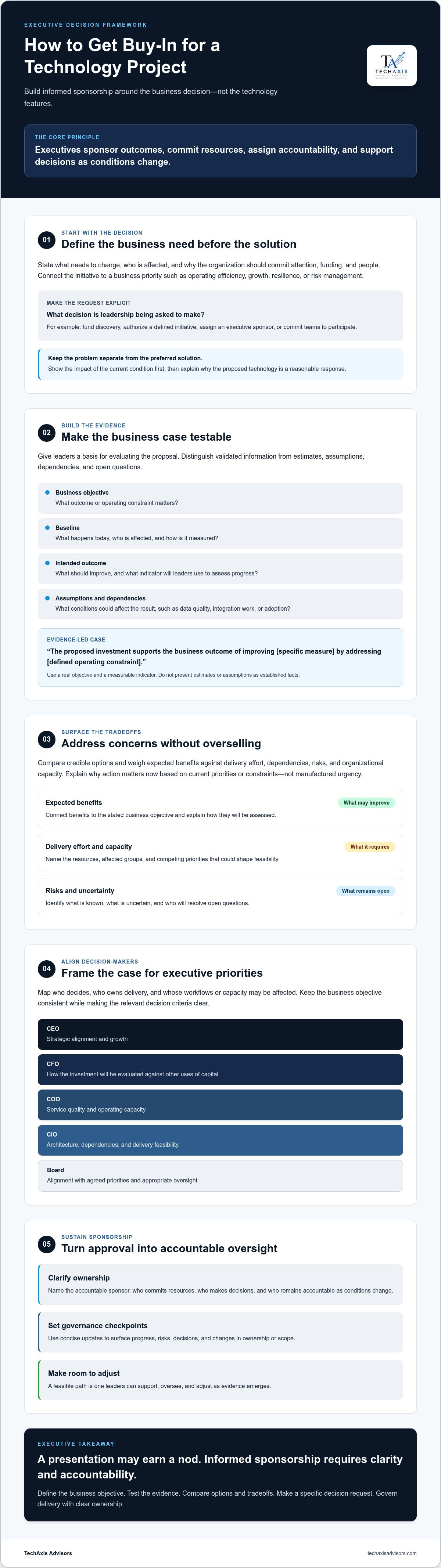
How to Get Buy-In for a Technology Project: A Practical Sequence
Executive support is easier to secure when leaders can see the path from problem to decision. Use a concise brief that summarizes the business case, realistic options, assumptions, material risks, and the specific action you’re requesting. Before presenting it, ask finance, operations, technology, and affected business leaders to challenge the evidence and identify gaps. Tailor the discussion to each person’s decision rights: a CFO may focus on resource allocation, while an operating leader may need to understand workflow impact and team capacity.
A practical sequence for project buy-in
Define the problem. State the business condition, who it affects, and why it merits attention.
Map decision-makers. Identify the approver, accountable sponsor, affected teams, and leaders who must advise or contribute.
Test the evidence. Validate the baseline and intended measures; label estimates, dependencies, and unresolved questions.
Compare options. Present the proposed approach alongside credible alternatives, including a narrower scope or deferral.
Request a decision. Specify what leaders should approve now, name the owner, and agree when the decision will be reviewed.
Keep the request precise. “Approve the initiative” can leave scope and authority unclear. Instead, ask for a defined next decision, such as authorizing validation of a specific dependency, assigning a sponsor, or committing named teams to planning. Set a review point and state what evidence should be available then. This turns initial agreement into an accountable next step, not an assumption of continued support.
Turn initial approval into visible accountability
Record the sponsor, decision rights, success measures, dependencies, and unresolved questions in a decision log or project brief. Clarify how scope changes, emerging risks, and resource conflicts return to leadership, and who can make decisions between checkpoints. A structured assessment-to-roadmap process can organize the work from evidence gathering through recommendations and execution leadership.
If senior decision support is needed, executive advisory or fractional leadership can help maintain clarity on ownership, governance, and decisions as the work progresses. TechAxis Advisors offers structured assessments that turn findings into board-ready reports, strategic roadmaps, and action registers, with advisory and fractional leadership available to support the next steps.
Sustain Technology Project Sponsorship Through Governance and Execution
Approval sets a project in motion. Governance keeps decisions connected to the intended business outcome as delivery unfolds. Sponsors need concise, regular updates that show whether the work remains aligned with agreed measures, what decisions are pending, and where risks or changed assumptions require attention. To sustain buy-in beyond initial approval, make progress and accountability visible throughout execution.
What to report after approval
Keep updates focused on information executives can act on. Report progress against the measures and milestones leadership approved, along with dependencies, material risks, and decisions needed. If a variance emerges, explain its business impact and present options with a clear recommendation. For example, if an essential dependency is delayed, state what can continue, what needs to change, and which decision belongs with the sponsor.
Use agreed governance checkpoints to review tradeoffs and confirm ownership. Record decisions, rationale, and unresolved issues in a form that can be traced for executive or board review. This creates a shared reference point when scope, resources, or priorities shift. It also helps distinguish routine delivery choices from issues that require leadership judgment.
When independent executive decision support can help
Leaders may need an evidence-based view before committing to a major scope, resolving disagreement, or proceeding when key assumptions remain uncertain. A structured assessment can bring relevant findings together, clarify options, and establish priorities without treating approval as a foregone conclusion. TechAxis Advisors’ executive assessments deliver board-ready findings, a strategic roadmap, an action register, and a presentation tailored for executive review.
Advisory leadership can also support governance, vendor oversight, and continuity in executive decision-making. When implementation is needed, TechAxis Advisors offers custom software development and implementation through a specialized white-label partnership model. The right structure depends on the initiative and does not guarantee a particular outcome. To understand the types of organizations and leaders this work is designed to support, see the audiences TechAxis Advisors serves.
Strong sponsorship isn’t a one-time endorsement. It’s an ongoing commitment to review evidence, make timely decisions, and adjust the path when conditions change. Keep reporting disciplined, ownership explicit, and the next decision clear.
Make Executive Support Accountable and Sustainable
Technology projects earn durable sponsorship when leaders can connect the proposal to a business priority, evaluate evidence and tradeoffs, and see who owns the next decision. Define the outcome before advocating for a solution, and make assumptions, risks, and resource needs visible. Then maintain support through clear governance, concise updates, and agreed review points.
For executives still weighing how to get buy-in for a technology project, the objective isn’t to secure approval at any cost. It’s to establish informed support that can adapt as evidence changes. TechAxis Advisors provides executive decision support grounded in senior technology leadership. Founder Aarati Dikshit brings more than 25 years of executive CIO, CTO, and CISO experience. Structured assessments deliver board-ready findings, strategic roadmaps, and action registers to help leaders clarify options and accountability.
A clear decision path gives sponsors and delivery teams a stronger basis for moving forward with discipline. With evidence, ownership, and oversight in place, leaders can support technology initiatives with greater confidence.
Frequently Asked Questions
How do you get executives to support a technology project?
Start with a clear business problem, credible evidence, and a specific decision request. Connect the proposed outcome to current priorities, then make assumptions, risks, resource needs, and ownership explicit. Tailor the discussion to each executive’s responsibilities and decision rights. Informed sponsorship means committing to accountability and follow-through, not simply approving a presentation or agreeing with a list of technical features.
What should a technology project business case include?
A technology project business case should explain the business problem, its strategic relevance, the current baseline, intended outcomes, and how progress will be measured. Include realistic options, resource implications, assumptions, dependencies, and material risks. Leaders also need to understand what is verified, estimated, or unresolved. Compare the proposed approach with alternatives such as narrowing the scope or deferring action, so executives can assess tradeoffs rather than accept a preferred solution without context.
How do you justify a technology investment to a CFO?
Give the CFO a transparent view of the investment’s financial and operational implications. Identify resource requirements, assumptions behind expected benefits, dependencies, and relevant risk exposure. Separate verified figures from estimates and unknowns, and explain how benefits will be monitored after approval. Present alternatives, including a smaller scope or no immediate investment. Don’t claim savings, returns, or other financial outcomes unless project-specific evidence supports them; the decision should rest on credible inputs and clear tradeoffs.
Who should be involved in approving a technology project?
The right participants depend on the organization, project scope, and decision rights. Common contributors include an executive sponsor, finance, technology, operations, affected business leaders, and relevant governance or risk stakeholders. Clarify who supplies evidence, who explains operational impact, and who has authority to approve funding, scope, or resource commitments. Involvement doesn’t mean every contributor is an approver. Assign a decision owner so input informs the choice without leaving accountability unclear.
How can you get buy-in when stakeholders disagree about a technology project?
First identify the source of disagreement: priority, evidence, risk tolerance, capacity, scope, or ownership. Document each position and the assumptions behind it, then compare realistic options against decision criteria leaders agree on. Avoid trying to resolve different concerns with a single technical argument. If evidence is incomplete, define what needs validation, name the person responsible, and return to the decision once leaders have enough information to assess the tradeoffs.
How do you maintain executive support after a technology project is approved?
Set a reporting rhythm before delivery begins. Give sponsors concise updates on progress against agreed outcomes and milestones, along with dependencies, risks, and decisions requiring attention. Establish governance checkpoints and escalation paths so scope changes or resource conflicts reach the right leaders promptly. If assumptions change, explain the implications and available options. Continued sponsorship depends on transparent evidence and timely decisions, not on presenting every update as positive.
When should an organization seek outside technology advisory for project buy-in?
Consider independent executive advice when leaders need a clearer view of technology options, risks, readiness, or alignment with business priorities. TechAxis Advisors provides executive decision-support engagements, including structured assessments that deliver board-ready findings, strategic roadmaps, and action registers. Advisory can support decision-making, governance, and execution oversight, but doesn’t automatically include direct implementation or guarantee a project outcome. Clarify the engagement’s scope, responsibilities, and whether implementation through a white-label partnership is appropriate. Contact TechAxis Advisors to discuss the decision support your organization needs.



Comments