

How to Evaluate Top Fractional CTO Firms for Your Business in 2026
In 2026, the primary risk to your technology strategy isn't a lack of technical talent; it's a lack of executive governance. Many growth-stage leaders find that their IT spend has decoupled from their actual business goals, creating a dangerous gap between technical execution and strategic intent. Evaluating top fractional CTO firms requires more than a checklist of certifications. It demands a partner who understands the mechanics of scaling a regulated business and managing complex vendor relationships.
You shouldn't have to tolerate technical execution risk or organizational anxiety regarding your data infrastructure. This article provides an executive framework for identifying and selecting fractional technology leadership that aligns with your specific operational maturity. We'll examine a structured roadmap for technology investment, focusing on how to reduce risk in AI implementations and build a scalable technology operating model. By the end of this guide, you'll have the clarity needed to bridge the gap between high-level strategy and grounded, results-oriented execution.
Table of Contents
The Evolving Role of Top Fractional CTO Firms in 2026
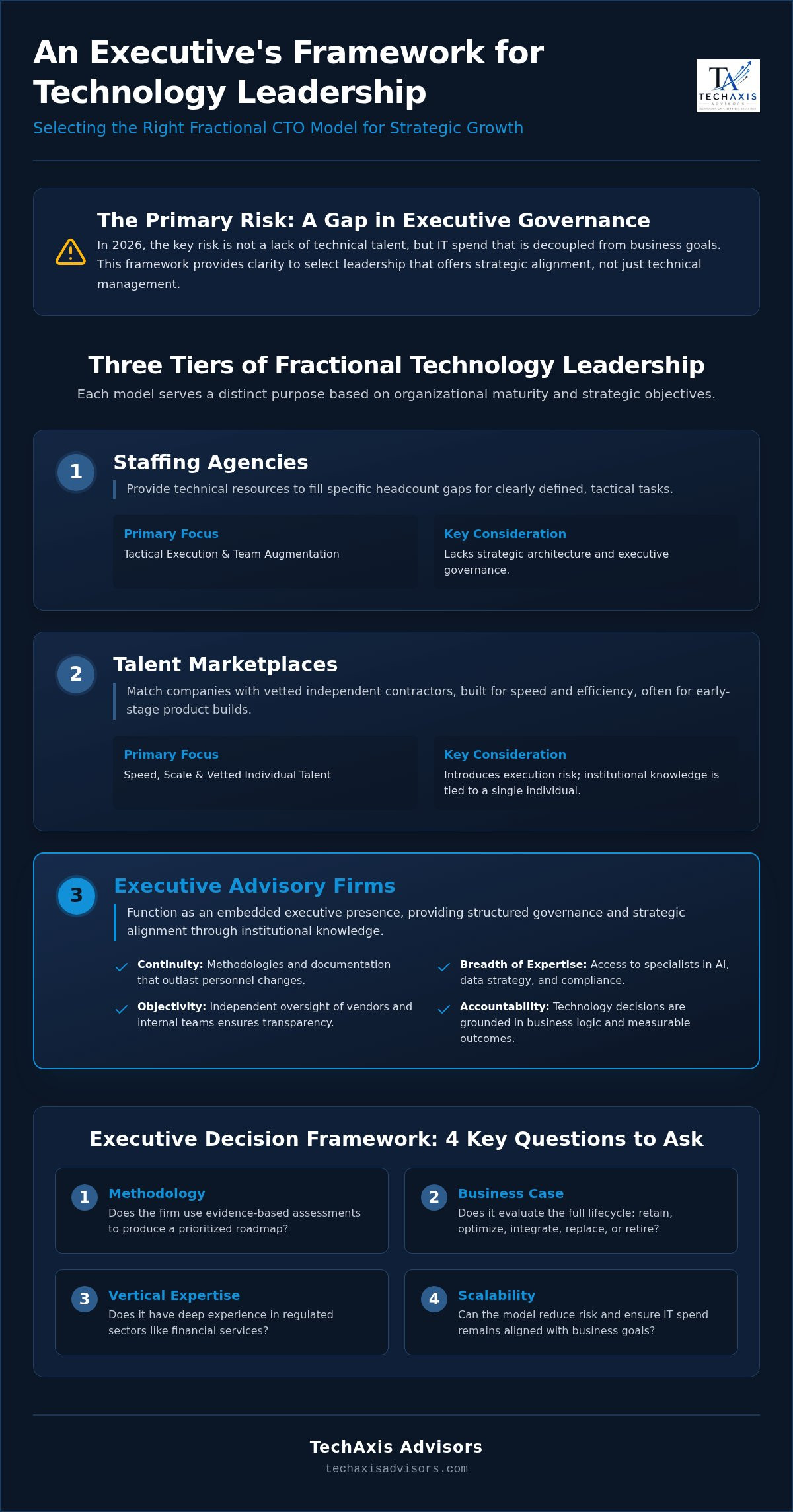
A fractional CTO firm functions as an embedded executive presence, providing high-level technology leadership on a part-time or retainer basis. In 2026, the professional landscape has bifurcated into two distinct categories. On one side, high-volume talent marketplaces offer access to independent contractors for tactical tasks. On the other, boutique advisory firms provide structured governance and strategic alignment. Growth-stage companies increasingly favor the latter. They need more than a manager for their code; they require an architect for their business strategy.
The shift from independent contractors to structured firms is driven by the need for accountability. While a solo developer might keep a platform running, they often lack the executive experience to manage a board's expectations or oversee a complex vendor ecosystem. Selecting from the top fractional CTO firms ensures that your technology decisions are grounded in business logic rather than just technical preference.
Why Executive Clarity is the New Priority
The current technology ecosystem is saturated with noise regarding AI, data architecture, and cybersecurity. This saturation often leads to organizational anxiety as leaders struggle to prioritize investments. Top fractional CTO firms replace this confusion with a methodical approach to decision-making. They shift the internal perception of technology from a recurring cost center to a primary value creator. By establishing clear governance, these firms ensure that every dollar of IT spend directly supports a measurable business outcome.
The Shift from Individual Talent to Institutional Knowledge
Relying on a single independent operator introduces significant execution risk. If that individual departs, they take the institutional knowledge of your systems with them. A structured firm mitigates this through repeatable methodologies and a broader bench of expertise. This evolution is rooted in the broader Fractional executive model, which prioritizes senior-level impact over full-time presence. For a deeper look at the role's scope, understanding the fractional cto meaning is essential for defining expectations. Firms provide several key advantages over solo operators:
Continuity: Documentation and processes that survive personnel changes and ensure long-term structural integrity.
Breadth: Immediate access to specialists in data strategy, AI governance, and compliance without the need to hire multiple full-time heads.
Objectivity: Independent oversight of external vendors and internal teams, ensuring transparency in technical performance.
This institutional approach allows a business to scale its technology operating model without the friction of constant leadership turnover. It provides the steady hand required to move from identifying a problem to mastering a solution.
Three Tiers of Fractional Technology Leadership Models
Identifying the right partner among top fractional CTO firms requires a clear understanding of the three primary market tiers: Staffing Agencies, Talent Marketplaces, and Executive Advisory Firms. Each model serves a distinct purpose based on your organization’s operational maturity and current strategic objectives. The choice between "hands-on" technical assistance and "high-level" strategic leadership isn't just about budget. It's about your specific business milestone. A Series B company preparing for an audit has vastly different needs than a startup building its first MVP. Understanding these tiers prevents the common mistake of hiring a tactical manager for a strategic problem.
Staffing agencies primarily provide technical resources to fill specific headcount gaps. They focus on tactical help for clearly defined tasks. While useful for augmenting a team, they rarely provide the strategic architecture needed for organizational transformation or long-term technology governance. These agencies are best suited for organizations that already have a defined roadmap and simply lack the personnel to execute it.
Talent Marketplaces: Scale and Speed
Talent marketplaces match companies with vetted independent contractors and are built for efficiency. These platforms are often used by early-stage startups needing a technical co-founder surrogate to build a core product. They provide a vetted network, which helps mitigate some hiring risks. However, you should evaluate the platform's fee structure against the actual depth of institutional knowledge provided. These operators are typically focused on technical execution rather than executive governance or aligning IT spend with business goals.
Executive Advisory Firms: Strategic Architecture
Executive advisory firms represent the most sophisticated tier among the top fractional CTO firms. These partners focus on advisory leadership, where the firm oversees external vendors and implementation partners rather than performing the direct builds themselves. This ensures independent oversight and transparency. These firms are typically led by veteran executives with 20 or more years of experience in roles like CIO, CTO, or CISO. They utilize structured assessments to provide evidence-based findings and prioritized roadmaps. This model is essential for regulated industries, private equity-backed firms, and companies undergoing complex AI transformations.
The advisory leadership model ensures technology remains a disciplined driver of growth. It provides a necessary bridge for companies that have outgrown independent contractors but aren't ready for a full-time executive hire. If your organization faces technical execution risk or a lack of technology governance, you might start with a confidential executive conversation to explore whether your priority requires an assessment or fractional leadership. Selecting the right tier ensures your technology operating model can scale without the friction of misalignment.
Evaluating Top Firms: The Executive Decision Framework
Selecting a partner from the top fractional CTO firms requires a shift from technical vetting to executive evaluation. Most organizations prioritize coding proficiency, yet the primary cause of technology failure in growth-stage companies is strategic misalignment. A rigorous framework ensures your leadership choice provides structural integrity rather than just temporary relief. You need an advisor who can bridge the gap between complex infrastructure and the mechanics of scaling a business.
Step 1: Assess Industry Alignment. In 2026, generalist advisors often struggle with the specific regulatory constraints of wealth management or the rapid exit timelines of private equity. Ensure the firm understands your compliance environment.
Step 2: Evaluate Methodology. A structured, repeatable process for assessments and roadmaps is mandatory. Avoid firms that rely on individual intuition over documented frameworks.
Step 3: Verify Executive Presence. Your CTO must translate technical debt into business risk for the Board of Directors. Clear communication is as vital as technical expertise.
Step 4: Analyze Engagement Continuity. A firm should stay through the execution phase to provide vendor oversight. Reports without implementation guidance rarely drive progress.
Step 5: Check for Independence. Ensure the advisor is objective. They shouldn't be incentivized by software commissions or specific platform kickbacks.
Moving Beyond Technical Audits
Technical audits often focus on the "what," but Executive Technology Assessments focus on the "so what." Top firms provide board-ready deliverables and action registers that link technical findings to operational outcomes. This evidence-based approach is central to the how we work philosophy. It replaces technical jargon with executive clarity, allowing leadership to make informed decisions about technology debt and modernization without getting bogged down in granular details.
Understanding the Total Cost of Leadership
Evaluating the budget for leadership requires analyzing the fractional cto vs full time cto cost structures. A full-time executive hire involves salary, equity, and benefits, often exceeding $500,000 annually. Fractional models provide similar strategic depth through retainer or project-based diagnostic fees. The ROI is realized through reduced execution risk and optimized technology spend. This disciplined approach ensures that IT remains a value driver, not a financial drain. It allows you to access veteran leadership while maintaining the agility of a growth-stage firm.
Vertical Depth: Considerations for Wealth Management and Private Equity
Generalist firms often overlook the structural nuances required for regulated sectors. In wealth management and private equity, a technical error is often a compliance failure. The top fractional CTO firms distinguish themselves by understanding these specific operational constraints. They don't just manage systems; they manage risk. For private equity firms, this includes rigorous due diligence during the M&A process. A fractional CTO evaluates a target's technology stack to determine if the business case supports integration or requires replatforming. This oversight improves operational maturity across portfolio companies, ensuring that technology spend aligns with the investment thesis. It prevents post-close technical debt from eroding projected returns.
Technology Leadership for Wealth Management
Asset managers require precise data strategy and reporting frameworks that support complex custodial integrations. Technology must provide client transparency while maintaining high standards for data integrity. Managing a specialized financial stack involves more than vendor selection; it requires ongoing governance to ensure systems remain scalable. A partner focused on technology leadership for wealth management ensures that these platforms remain compliant with SEC and FINRA standards. This leadership bridge is essential for firms moving from legacy operations to modern, data-driven models. It allows executives to focus on asset growth while the CTO manages the mechanics of the digital infrastructure.
AI Readiness in Regulated Environments
The distinction between AI hype and AI governance is critical in 2026. While many advisors promote generative tools without oversight, top fractional CTO firms focus on roadmaps that meet strict risk requirements. Governance ensures that data privacy and algorithmic transparency are prioritized before any implementation begins. Developing a strategy for AI for financial services requires a disciplined approach to automation readiness. This process replaces organizational anxiety with a structured, evidence-based path toward modernization. It ensures that AI initiatives provide measurable business value without introducing unforeseen regulatory liabilities or cybersecurity vulnerabilities.
The TechAxis Perspective: Aligning Technology with Strategy
TechAxis Advisors operates on a foundational principle: provide executive clarity for important technology decisions. In an environment where technical debt and operational silos often hinder growth, we position technology as a primary driver of business value. We don't view technology as an end in itself. It’s a tool that must serve the broader organizational strategy. Our model focuses on a "Business-First" alignment, ensuring that every infrastructure investment or data initiative directly supports your long-term goals. While many top fractional CTO firms focus solely on technical oversight, we provide the strategic architecture required to bridge the gap between initial diagnostics and successful execution.
Our approach is powered by a proprietary Executive Intelligence Platform. This tool allows us to move beyond anecdotal evidence and provide data-driven findings that ground every recommendation in objective reality. By utilizing this platform, we replace organizational anxiety with a sense of controlled, disciplined progress. We act as your fractional partner, offering the wisdom of veteran executives who've managed large-scale technology transformations in regulated industries. This leadership bridge ensures that your technology operating model remains scalable and transparent.
Evidence-Based Assessments and Strategic Roadmaps
We deliver results through structured Executive Intelligence Assessments. These aren't static technical audits; they're executive decision-support engagements designed to provide a prioritized roadmap. We offer six structured diagnostics tailored to the needs of wealth management and private equity firms. These include AI Advisory and Automation Readiness, Data and Reporting Strategy, Vendor and Platform Management, Technology Governance and Compliance, Operational Scalability, and Fractional CTO Services. You can explore the full range of our advisory services to understand how these engagements fit your current maturity level.
Rather than delivering dense, technical reports that sit on a shelf, we provide concise, board-ready briefs. These deliverables are designed for the C-suite and board members, focusing on action registers and clear tradeoffs. We evaluate whether to retain, optimize, integrate, replatform, replace, or retire existing systems based on the specific business case. This methodology ensures that your technology spend remains disciplined and that your leadership team has the evidence needed to make high-stakes decisions with confidence.
Next Steps for Your Organization
Navigating the complexities of 2026 requires a partner who understands the mechanics of scaling a business. You don't have to commit to a long-term leadership engagement to start seeing results. Many organizations find the most value by starting with a targeted assessment to evaluate current technology risks and identify immediate opportunities for optimization. This initial step provides the clarity needed to determine if your priority requires ongoing fractional leadership or specific strategic advisory. We invite you to start with a confidential executive conversation to explore how we can bring structural integrity and governance to your technology ecosystem.
Securing Strategic Integrity for 2026 and Beyond
The landscape of fractional leadership has matured significantly. Selecting from the top fractional CTO firms now requires an evaluation of strategic architecture rather than just technical staffing. Successful technology leadership in wealth management and private equity depends on the ability to bridge the gap between technical execution and board-level governance. You need a partner who understands the mechanics of scaling and the nuances of regulatory compliance.
TechAxis Advisors provides this executive clarity through a team of former CIOs, CTOs, and CISOs. We utilize our proprietary Executive Intelligence Platform to ensure every recommendation is evidence-based and aligned with your specific business thesis. As a certified Women-Owned Small Business (WOSB), we are committed to replacing organizational anxiety with a sense of controlled, disciplined progress.
Your technology operating model should be a value creator that drives growth. By establishing a structured framework for evaluation and oversight, you ensure that your organization remains agile, compliant, and ready for the next stage of maturity.
Frequently Asked Questions
What is the typical engagement length for a top fractional CTO firm?
Engagement length for a fractional CTO typically ranges from 6 to 18 months. This duration allows for a methodical progression from initial diagnostics to the stabilization of a scalable technology operating model. Short-term project fees are also common for specific executive decision-support engagements, such as pre-fundraise audits or M&A due diligence. The goal is to provide a leadership bridge during periods of significant organizational transformation or growth.
How do fractional CTO firms handle data security and confidentiality?
Firms manage data security by establishing robust technology governance and compliance frameworks. Unlike solo operators, structured advisory firms often utilize veteran CISOs to provide oversight and independent risk assessments. They prioritize structural integrity and transparency, ensuring that all data implementations meet specific regulatory requirements. This objective approach replaces organizational anxiety with a disciplined process for managing sensitive information in wealth management and private equity environments.
Can a fractional CTO firm help with vendor selection and management?
A fractional partner provides essential oversight for vendor and platform management. They act as an independent advisor during the selection process, ensuring that third-party solutions align with your long-term business goals. By managing the mechanics of the RFP process and holding delivery partners accountable, the CTO reduces the risk of technical misalignment. This governance ensures that your technology stack remains integrated and efficient as your organization scales.
Is a fractional CTO firm better than a solo independent consultant?
Choosing among top fractional CTO firms is generally more effective than hiring a solo consultant for growth-stage companies. Firms provide institutional knowledge and a broader bench of expertise that survives individual personnel changes. They utilize repeatable methodologies and proprietary platforms to deliver evidence-based findings. This institutional approach offers greater continuity and reduces the execution risk associated with relying on the subjective intuition of a single independent operator.
What is the difference between a fractional CTO and a managed service provider (MSP)?
A fractional CTO provides strategic technology leadership, whereas a Managed Service Provider (MSP) handles tactical day-to-day IT support. The CTO operates at the executive level to align IT spend with business strategy and provide vendor oversight. While the MSP ensures that hardware and networks function, the CTO focuses on governance, data strategy, and AI readiness. They provide the necessary bridge between technical operations and board-level decision-making.
How do firms ensure technology strategy aligns with our long-term business goals?
Alignment is achieved through structured assessments that link every technical decision to a specific business outcome. This evidence-based approach ensures that technology remains a disciplined driver of growth rather than a recurring cost center. By evaluating the business case for whether to retain, optimize, or replace systems, the CTO provides a clear roadmap for investment. This process guarantees that your technology infrastructure supports your operational maturity and long-term strategic intent.
What are the common signs that my growth-stage company needs a fractional CTO?
Signs that your company needs fractional leadership include technical execution risk and a lack of executive-level technology governance. You may notice a persistent misalignment between your IT spend and your actual business goals. If your board requires technical clarity for an upcoming exit or AI transformation, a fractional CTO provides the necessary expertise. They offer a grounded, results-oriented solution for organizations that have outgrown their current technical management but don't need a full-time hire.
Do fractional CTO firms provide direct software development services?
Most advisory-focused firms don't provide direct software development services to maintain objective independence. Instead, they support execution through advisory leadership, vendor oversight, and qualified delivery partners. This ensures the advisor remains a neutral party when evaluating the quality of technical builds or cloud migrations. By focusing on governance and strategy, top fractional CTO firms ensure that implementation work meets the high standards required for regulated financial environments.


Comments