

How to Consolidate Technology Vendors: A Strategic Executive Framework for 2026
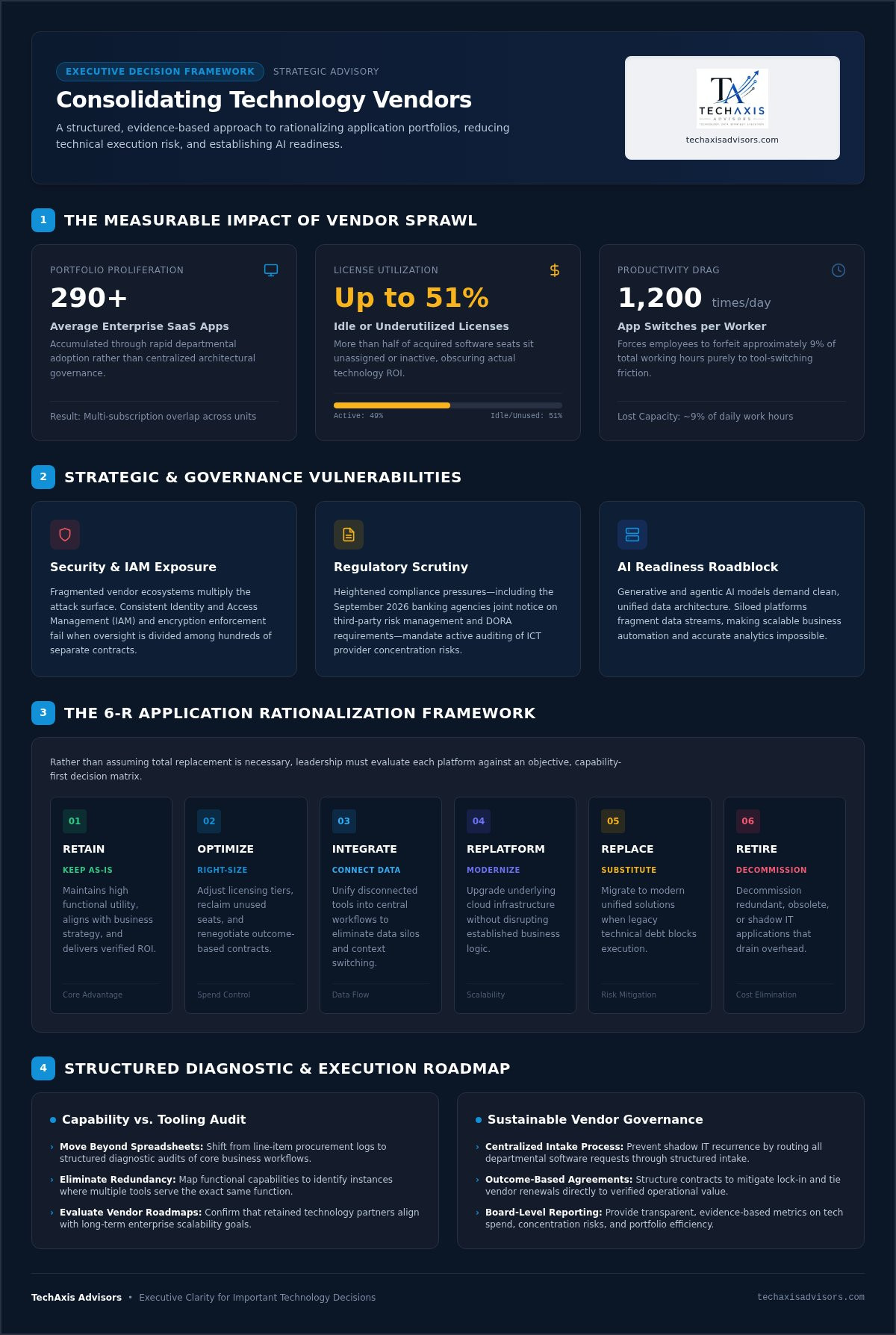
The average enterprise now manages over 290 distinct SaaS applications, yet research shows that up to 51% of these licenses sit idle or underutilized. This fragmentation creates a heavy operational drag that slows execution and obscures visibility into actual technology spend. For leadership teams, the priority isn't just about cutting costs. It's about understanding how to consolidate technology vendors to reduce technical execution risk and close security vulnerabilities. Managing hundreds of disparate contracts and siloed platforms has become a primary source of organizational friction in 2026.
You likely recognize that your current technology stack grew through rapid adoption rather than disciplined architecture. This reality often leads to inconsistent reporting and fragmented oversight. This article provides a strategic executive framework to move from unmanaged proliferation to a streamlined operating model. We'll explore an evidence-based approach using the 6-R framework, evaluating whether to retain, optimize, or retire specific platforms. This structured process helps you gain clearer visibility into ROI and builds the necessary foundation for AI readiness.
Table of Contents
Identifying the Business Impact of Vendor Sprawl
Vendor sprawl represents the uncontrolled accumulation of redundant, siloed, or underutilized platforms within an organization. For wealth management firms and private equity portfolios, this typically manifests as a patchwork of legacy systems and specialized niche tools. Understanding how to consolidate technology vendors is no longer just a cost-saving measure; it is a requirement for maintaining operational integrity. When software is procured by individual lines of business without central governance, the resulting sprawl creates significant technical execution risk.
The Operational Drag of Fragmented Systems
The impact on productivity is measurable. Research indicates workers often navigate disparate applications an average of 1,200 times per day, forfeiting approximately 9% of their working hours to tool-switching friction. This fragmentation erodes data integrity, as critical information remains trapped in disconnected silos. To address this, leadership must adopt a structured application portfolio management framework to identify functional overlaps. Without this clarity, growth-stage companies often pay for the same capability across three or four different subscriptions. This drives up administrative overhead for finance teams and complicates real-time business intelligence reporting.
Security Risks and Governance Gaps
Fragmented systems introduce severe security vulnerabilities. Maintaining consistent identity and access management (IAM) becomes nearly impossible when oversight is spread across dozens of vendors. Regulated entities now face heightened scrutiny following the September 2026 joint notice from federal banking agencies regarding third-party risk management. Compliance with the Digital Operational Resilience Act (DORA) also requires an active audit of ICT providers to mitigate concentration risks. A fragmented ecosystem expands the threat surface. It makes it difficult to ensure every vendor meets current encryption and data sovereignty standards, particularly in highly regulated financial environments.
Sprawl directly hinders AI readiness. Generative and agentic AI tools require clean, unified data streams to provide meaningful outputs. When data is siloed across fragmented platforms, the business cannot leverage automation effectively. Consolidating the stack is the prerequisite for building a scalable operational scalability strategy that supports long-term growth. Clearer visibility into technology spend and ROI is only possible when the underlying infrastructure is rationalized and governed by a single, cohesive strategy.
The Executive Intelligence Approach to Vendor Assessment
Effective consolidation requires moving beyond simple procurement spreadsheets. Spreadsheets alone don't solve sprawl. They merely catalog it. A structured diagnostic identifies functional overlaps that simple cost comparisons miss. This approach moves the conversation from line-item expenses to strategic capability. Understanding how to consolidate technology vendors requires an objective audit of the "why" behind each investment. Leadership must determine if a platform supports current growth or if it's a legacy remnant draining resources. You can explore our Executive Technology Assessment services to understand how these diagnostics provide the necessary clarity for high-stakes decisions.
Auditing Capability vs. Tooling
Shadow IT often emerges when departments purchase niche tools outside central governance to solve immediate problems. These isolated acquisitions lead to redundant capabilities across the enterprise. Mapping existing tools to core business processes reveals where you're paying for overlapping functionality. It's not just about the current state. Evaluating vendor roadmaps is essential to ensure long-term alignment with your scaling goals. According to McKinsey's research on vendor consolidation, shifting toward outcome-based agreements helps mitigate vendor lock-in and reduces operational friction. The goal is to identify which tools provide a genuine competitive advantage and which are merely administrative burdens.
Evidence-Based Findings for the Board
Board members and stakeholders require evidence-based findings rather than technical jargon. Translating technical sprawl into clear, board-ready reporting on risk and efficiency is vital for securing buy-in. Data-driven insights justify the initial investment in consolidation by projecting long-term gains in agility and security. This level of transparency replaces organizational anxiety with a sense of disciplined progress. For more on this, see our framework for Improving Operational Maturity Through Technology. When findings are grounded in objective data, the path toward a rationalized stack becomes a logical business decision rather than a technical hurdle. If you're ready to evaluate your current landscape, you might start with a confidential executive conversation to define your specific requirements.
The 6-R Framework: Strategic Options for Consolidation
Consolidating a technology stack isn't a binary choice between keeping or firing a vendor. A sophisticated approach evaluates every asset based on its contribution to the firm's operating model. Understanding how to consolidate technology vendors requires a nuanced application of the 6-R framework: Retain, Optimize, Integrate, Replatform, Replace, and Retire. This methodology ensures that decisions aren't made in a vacuum but are aligned with the firm's broader strategic trajectory. By categorizing each tool, leadership can move from a reactive posture to a proactive, governed architecture.
Retain: Keep niche tools that provide a distinct, non-commoditized competitive advantage.
Optimize: Refine high-performing platforms to extract latent value and improve user adoption.
Integrate: Build connections between siloed systems to eliminate manual data entry and improve data integrity.
Replatform or Replace: Move to unified systems that serve multiple departments, reducing the total software footprint.
Retire: Sunset legacy platforms that offer no clear ROI or represent significant security risks.
Evaluating the Business Case for Each Option
Analyzing the Total Cost of Ownership (TCO) against the cost of migration is the first step. While replacing a legacy system might reduce annual licensing fees, the migration cost, including training and potential downtime, must be factored into the decision. A niche tool is only necessary if its specific functionality cannot be replicated by a larger platform without sacrificing core performance. Balancing short-term disruption against long-term operational scalability is a primary executive responsibility. Adhering to NIST supply chain risk management standards helps ensure that consolidation choices don't inadvertently introduce new vulnerabilities during the transition phase.
Addressing Technical Debt in Acquisitions
For private equity-backed organizations, consolidation serves as a critical value-creation lever. Technical debt is often hidden within overlapping vendor contracts and incompatible data structures discovered post-acquisition. Identifying these redundancies early is vital for maintaining the investment thesis. Our framework for Technology Due Diligence for Growth-Stage Companies details how to uncover these hidden liabilities before they impact the bottom line. Addressing technical debt through the 6-R framework allows firms to integrate acquisitions faster. It turns a bloated IT landscape into a scalable foundation, reducing execution risk and improving the eventual exit valuation.
Executing the Consolidation Roadmap Without Disrupting Growth
Executing a consolidation strategy requires more than just identifying redundancies. It demands a prioritized roadmap that balances business impact against technical complexity. A common mistake is treating consolidation as a one-time project rather than a sustained leadership initiative. When considering how to consolidate technology vendors, the focus must remain on maintaining business continuity during high-stakes transitions. A phased approach prevents the operational paralysis often associated with large-scale migrations. Transitioning core systems while scaling requires a level of oversight that many growth-stage companies lack internally.
Phased Implementation Strategies
Phased implementation strategies mitigate the risks inherent in "big bang" migrations. Such aggressive shifts often fail in dynamic environments because they underestimate the depth of interdependencies between legacy systems. Instead, set clear milestones and KPIs to measure progress at each stage. This methodical pace ensures that critical workflows remain functional. You can learn how our Advisory Leadership supports execution by providing the necessary governance to oversee these complex transitions. By breaking the roadmap into digestible stages, leadership can validate the success of each move before committing to the next.
Stakeholder Communication and Change Management
Stakeholder communication is the most frequent point of failure in vendor rationalization. Internal teams are often wedded to specific tools, even when those tools create silos or manual work. Addressing this resistance requires a clear articulation of the "why" behind the change. It's not just about cost; it's about improved data integrity and reduced execution risk. Providing the training and support necessary for successful adoption is essential to prevent a return to shadow IT practices.
Managing vendor negotiations and contract terminations requires a professional, evidence-based approach. Many organizations struggle with vendor lock-in or punitive exit clauses that were signed during periods of rapid, unmanaged growth. Fractional CTO leadership provides the steady, experienced hand needed to manage these peer-level dialogues with vendors. By using objective performance data, leadership can negotiate from a position of strength, ensuring that transitions are financially and operationally sound. This level of oversight ensures that the roadmap for how to consolidate technology vendors remains aligned with the long-term technology strategy.
Building a Sustainable Vendor Governance Model
Success in learning how to consolidate technology vendors is measured by the ability to maintain a lean stack over the long term. Without a centralized intake process, the same silos that necessitated consolidation will inevitably return. Leadership must implement a formal gateway for new technology requests. This ensures every acquisition aligns with the broader architecture and demonstrates a clear business case before a contract is signed. This process requires a functional gap analysis to prove that an existing platform cannot already perform the requested task.
Ongoing vendor performance reviews are equally critical. Organizations often let contracts auto-renew without verifying if the platform still meets functional requirements or security standards. Implementing structured contract lifecycle management allows the firm to identify underutilization early. This disciplined oversight ensures that the technology budget remains focused on high-impact tools rather than legacy overhead. It also provides the documentation required for regulatory audits, particularly in financial services where third-party risk oversight is a mandatory board-level concern.
Ongoing Strategic Counsel
For wealth management and private equity firms, maintaining this discipline is difficult without a dedicated technology leader. Fractional executive advisory provides the senior-level oversight needed to enforce governance without the overhead of a full-time CIO. This independent perspective is vital for ensuring that vendor relationships remain objective and performance-based. It ensures that strategic decisions are guided by experienced professionals who understand the mechanics of scaling. You can learn more about who TechAxis Advisors serves to see how this model fits regulated environments.
Preparing for AI and Modernization
A rationalized technology stack is the prerequisite for AI-driven automation. Fragmented data across disparate vendors makes it impossible to train or deploy effective AI agents. By establishing a governance framework that evolves with emerging technologies, firms can use their consolidated stack as a springboard for modernization. Our AI in Financial Services: 2026 Strategic Framework outlines how clean data architecture enables these advanced capabilities. Governance isn't about restriction. It's about creating a stable, scalable foundation for the next generation of business intelligence. This long-term discipline ensures that the organization remains agile enough to adopt new capabilities without recreating the sprawl of the past.
Establishing a Scalable Foundation for 2026
Strategic rationalization is no longer optional for firms aiming to lead in a data-driven market. By moving beyond simple procurement audits and adopting a structured approach to how to consolidate technology vendors, you replace organizational drag with disciplined execution. The 6-R framework provides the clarity needed to identify which assets drive competitive advantage and which ones merely expand your threat surface. This process ensures that your technology operating model supports long-term growth and AI readiness.
Effective consolidation requires the steady hand of a veteran leader. TechAxis Advisors supports this transition through senior advisory from former CIOs and CTOs who specialize in wealth management and private equity. Our evidence-based Executive Intelligence Assessments provide the prioritized roadmaps necessary to secure board-level buy-in. You don't have to navigate these complex transitions alone. With the right governance in place, your technology stack becomes a catalyst for operational excellence rather than a source of friction.
Frequently Asked Questions
How many technology vendors is too many for a growth-stage company?
Benchmarks for 2026 suggest that enterprises manage an average of 291 to 305 SaaS applications. For a growth-stage company, "too many" is reached when contract management creates operational drag or oversight gaps. If technical debt hinders execution speed, it's time to learn how to consolidate technology vendors. The goal is to regain visibility into spend and ROI while reducing the administrative burden on your finance and IT teams.
What are the first steps in a vendor consolidation project?
The process begins with a structured diagnostic to audit your current landscape. You must catalog every active contract, seat utilization rate, and functional overlap across departments. Mapping these tools against core business processes reveals redundancies that simple spreadsheets often miss. This evidence-based approach is essential when learning how to consolidate technology vendors. It provides the foundation for a prioritized roadmap; ensuring that your operating model aligns with strategic growth goals.
How do I handle vendors with long-term contracts during consolidation?
Apply the 6-R framework to determine if a platform should be optimized or integrated rather than retired. If you face punitive exit clauses, focus on extracting maximum value until the renewal window opens. Use this time to establish a centralized intake process that prevents future sprawl. Professional vendor oversight allows you to negotiate from a position of strength when contracts expire; ensuring your future stack remains lean and governed.
Is it better to have one 'all-in-one' platform or a few specialized ones?
This decision requires balancing the simplicity of a unified ecosystem against the deep functionality of specialized tools. All-in-one platforms reduce integration complexity and administrative overhead. However, they may lack the specific capabilities required by regulated sectors like wealth management. Evaluate the business case for each; if a niche tool provides a genuine competitive advantage, it should be retained and integrated into your core enterprise systems.
How does vendor consolidation improve cybersecurity for financial firms?
Consolidation significantly shrinks the enterprise threat surface by limiting third-party points of entry. Fragmented oversight makes it nearly impossible to maintain consistent identity and access management across dozens of disparate platforms. A streamlined stack ensures that technology governance meets the standards of 2026 regulations, such as DORA and updated federal banking risk guidance. Reducing vendor count simplifies compliance and allows for more rigorous monitoring of your remaining critical providers.
What role does a Fractional CTO play in vendor management?
A Fractional CTO provides the senior leadership needed to oversee high-stakes transitions and maintain long-term discipline. They act as a strategic architect; ensuring technology investments align with business outcomes. By offering independent advisory, they help leadership teams manage vendor performance and establish a sustainable governance model. This embedded executive presence allows companies to scale their technology operating models without the overhead of a full-time executive hire.
How can we measure the ROI of a consolidation initiative?
Track metrics like reduced annualized software waste and lower administrative overhead for finance teams. Beyond direct cost savings, measure the improvement in data integrity and the reduction in employee context-switching friction. A rationalized stack is a prerequisite for AI readiness. You can measure ROI through the successful deployment of automation and more accurate real-time business intelligence reporting that was previously hindered by disconnected data silos.
How do we ensure we don't lose critical data during a vendor migration?
Use a phased implementation strategy that includes rigorous data mapping and validation at every milestone. Avoid aggressive migrations that increase execution risk. Instead, maintain business continuity by running parallel systems during the transition phase. Establishing clear governance and working with qualified delivery partners ensures data remains secure and accessible. This methodical approach protects the integrity of your information while you execute the roadmap for how to consolidate technology vendors.



Comments