

How to Build a Scalable Technology Foundation: An Executive Framework
What if the systems that helped your firm grow are now constraining its next stage? For executives asking how to build a scalable technology foundation, the challenge is rarely a single platform decision. Technical debt can slow releases, manual reconciliation can delay reporting, and unclear ownership or dependencies can raise execution risk.
These are familiar signs that growth has outpaced the systems and decisions supporting it. Whether your ambition is to grow fivefold or tenfold, scaling isn’t simply a matter of adding capacity or replacing legacy platforms. It means aligning architecture, data, governance, and investment priorities with business outcomes.
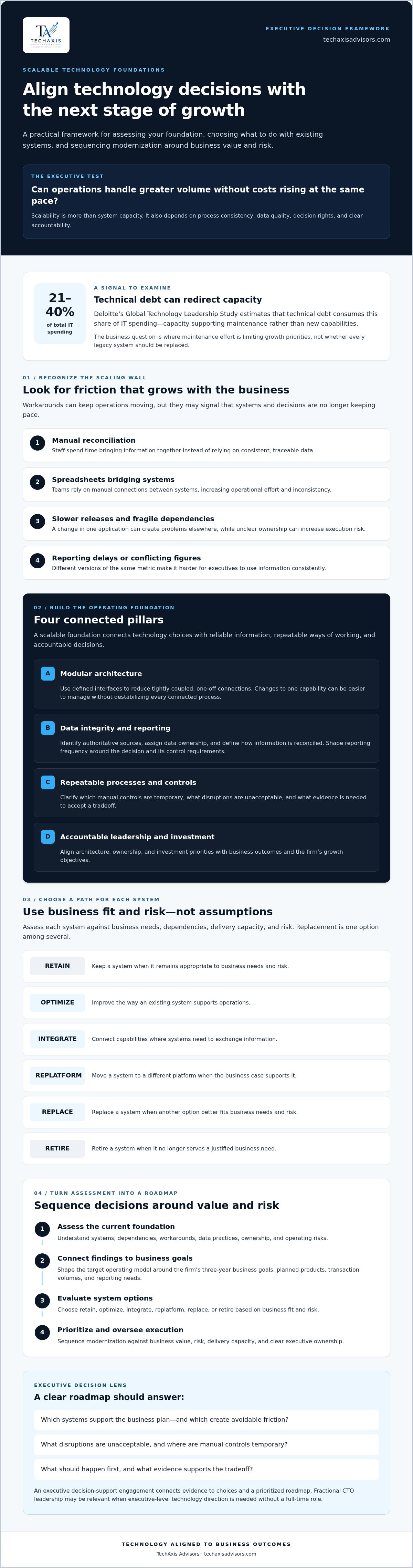
This article presents an evidence-based framework for building that alignment. You’ll learn how to assess your current foundation, decide what to retain, optimize, integrate, replatform, replace, or retire, and sequence modernization around business value and risk. The result should be a clearer roadmap, stronger oversight of technology initiatives, and a foundation that enables growth rather than constraining it.
Table of Contents
Beyond Technical Debt: Why Scalability is a Governance Priority
The scaling wall appears when growth increases operational friction faster than the business can absorb it. Staff reconcile data manually, teams rely on spreadsheets to bridge systems, and product releases slow because changes in one application create problems elsewhere. These workarounds may keep operations moving for a time, but they also signal that the technology foundation is no longer keeping pace with business needs.
For executives, scalability means handling greater volume while the marginal cost of serving each additional customer, transaction, or business unit decreases. The technical concept of Scalability matters, but growth also depends on decision rights, process consistency, data quality, and accountability. A system may perform well in isolation yet remain difficult to operate as the organization grows.
The Real Cost of a Fragile Foundation
Technical debt redirects capacity. Deloitte’s 2026 Global Technology Leadership Study estimates that it consumes 21% to 40% of total IT spending. That investment supports maintenance rather than new capabilities, narrowing the budget and attention available for growth priorities.
Fragile dependencies also increase execution risk. A change to support higher transaction volume can expose bottlenecks in connected systems, especially when ownership and recovery plans are unclear. During a peak period, the result may be an interruption to customer service or reporting. Poor tools create another operational cost: skilled employees spend time compensating for systems instead of doing higher-value work. Over time, that frustration can contribute to retention challenges, particularly where growth depends on experienced teams.
Aligning Technology with Business Strategy
Technology becomes a growth engine when investment is assessed against business outcomes, not just immediate operating expense. Leaders should ask whether systems can support planned products, transaction volumes, reporting needs, and organizational changes, then weigh those requirements against cost, risk, and delivery capacity.
That requires executive agreement on risk tolerance. The board and leadership team should clarify which disruptions are unacceptable, where manual controls are temporary, and what evidence is needed before accepting a tradeoff. These decisions shape modernization priorities and shouldn’t be left solely to technical teams or vendors.
A traditional IT audit can document assets, controls, or gaps, but that snapshot may not answer executive questions: What should we do first? Which systems should we retain or change? How does each option support the business plan? An executive decision-support engagement connects evidence to choices and a prioritized roadmap. This also links technology choices to operational maturity, as explored in executive technology advisory leadership.
Understanding how to build a scalable technology foundation starts with treating it as a governance priority. Architecture matters, but so do investment discipline, clear ownership, and alignment with the firm’s growth objectives.
The Four Pillars of a Scalable Technology Operating Model
A scalable foundation isn’t just a faster server or a new database. It connects architecture, reliable information, repeatable controls, and accountable leadership. For wealth and asset management firms, these elements need to work together: more clients, accounts, or reporting demands shouldn’t require a matching increase in manual effort and operational risk.
1. Modular Architecture
Systems should exchange information through defined interfaces rather than depend on tightly coupled, one-off connections. This makes it easier to change or expand one capability without destabilizing every connected process. Modularity doesn’t eliminate failure, but it can limit how far a disruption spreads and make changes easier to govern.
2. Data Integrity and Reporting
Executives need consistent definitions and traceable data, not several spreadsheets that produce different versions of the same metric. A governed reporting framework identifies authoritative sources, assigns ownership, and establishes how information is reconciled. For an asset manager, that could mean clarifying which system supplies client, portfolio, and transaction data before automating reports. Real-time reporting may suit some decisions; others require validated, periodic reporting. Design the approach around the decision and its control requirements.
Security and compliance considerations belong in data design from the outset. Build access, handling, retention, and evidence requirements into processes and system choices, then review them as business needs change.
3. Automated Governance
Manual oversight becomes difficult to sustain as platforms, users, and vendors multiply. Where appropriate, systematic checks can standardize approvals, flag exceptions, and record evidence. Automation doesn’t remove accountability: leaders still need named control owners, clear escalation paths, and a process for reviewing exceptions. The goal is consistent oversight, not automation for its own sake.
4. Executive Leadership
A technology roadmap needs an accountable executive who can connect investment choices to business priorities, risk tolerance, and delivery capacity. That leader helps resolve tradeoffs across finance, operations, compliance, and technology, while ensuring vendors support the intended operating model.
Data, Cloud, and Platform Decisions
Moving spreadsheets into automated reporting can reduce reconciliation effort, but only after data definitions and ownership are clear. Cloud migration isn’t a scalability strategy by itself. A lift-and-shift approach may move existing constraints without addressing them. Cloud-native services may suit specific workloads, but leaders should assess security, control, integration, resilience, and operating costs before choosing an approach.
Vendor and platform management is part of that assessment. For guidance aligning leadership and technology decisions, explore executive advisory leadership. These four pillars offer a practical starting point for building a scalable technology foundation around business needs, not infrastructure alone.
Evaluating Your Foundation: The Retain-Replace-Retire Matrix
Modernization doesn’t require replacing every legacy system. Evaluate each platform against its business value, operating risk, adaptability, and ongoing support needs. The appropriate decision may be to retain, optimize, integrate, replatform, replace, or retire it. Consider dependencies and data flows, too. A platform that appears outdated in isolation may still support a critical process, while a newer system may create unnecessary complexity if it duplicates existing capabilities.
Choose the path based on business fit
Retain or optimize: Keep a system that meets business needs and can be supported. Targeted changes to configuration, controls, or processes may address specific constraints.
Integrate: Connect systems when their capabilities remain useful but information gaps or manual handoffs hinder operations.
Replatform or replace: Consider a change when maintenance demands, supportability concerns, or limitations on needed business capabilities outweigh transition risks.
Retire: Decommission redundant or unused systems after confirming that their data, workflows, and dependencies have been addressed.
A system’s age alone doesn’t determine when it has reached the point of diminishing returns. That point emerges when repeated workarounds and upkeep no longer provide a reasonable path to required business capabilities, and incremental fixes add complexity without addressing the underlying constraint.
Build a business case the board can evaluate
Modernization value extends beyond direct savings. Consider whether an initiative could reduce release delays, manual reconciliation, or reporting friction, or improve the firm’s ability to support planned growth. Technical debt is an operational liability for decision-making because it consumes capacity and can limit future choices. This is a strategic framing, not a statement about balance-sheet accounting.
For board review, connect each investment to a business objective, the evidence behind the need, options considered, key risks, dependencies, and measures of progress. Present a sequenced roadmap with decision points rather than an all-or-nothing commitment. Make assumptions visible, including the implications of maintaining the current state and the disruption involved in change.
Balance continuity with change
Short-term stability matters, especially when a system supports client service or core operations. Phased changes may help preserve continuity while addressing longer-term constraints, but they require clear ownership and controls during transition.
Build versus buy is another tradeoff. Buying may meet requirements without adding responsibility for custom functionality. Custom software may fit a material business need that available platforms don’t serve, but it brings ongoing ownership and support considerations. Compare the options against business fit, integration needs, and internal capacity. A structured assessment helps executives determine how to build a scalable technology foundation without treating wholesale replacement as the default.
A Structured Roadmap for Foundation Modernization
Modernization needs a sequence, not a collection of disconnected projects. A structured executive assessment can help leaders turn technical evidence into decisions about risk, investment, ownership, and timing. The roadmap should reflect the firm’s business goals and its capacity to manage change.
1. Assess risk and establish a baseline
Begin with an executive technology assessment that examines critical systems, data flows, dependencies, vendor relationships, operating controls, and known technical debt. Compare documentation and system evidence with interviews across technology, finance, operations, and compliance. Internal perspectives are useful, but they can be incomplete or shaped by individual priorities. A shared evidence base helps leaders distinguish urgent exposure from isolated concerns.
Translate findings into a board-ready summary and action register. For each issue, identify its business impact, accountable owner, proposed response, dependencies, and decision required. TechAxis Advisors’ Executive Technology Assessments use a structured diagnostic approach to connect findings with executive decisions, rather than producing technical inventories without a clear business decision attached.
2. Define the target operating model
Set the target against the firm’s three-year business goals. If the plan includes new products, additional clients, or expanded operations, specify the capabilities, data, controls, and decision rights required to support that growth. This gives technology teams and business leaders a common reference point for evaluating options, including whether to retain, optimize, integrate, replatform, replace, or retire systems.
3. Prioritize value against effort and risk
Rank initiatives by expected business value and implementation effort, then account for dependencies, operational risk, and available capacity. A quick improvement to reporting may deliver value sooner than a large platform change, but the larger effort may still be necessary to address a material constraint. Make assumptions visible and identify what evidence would change the priority. The aim is a sequence executives can govern, not a list of projects that all appear equally urgent.
4. Govern delivery and manage technical debt
Phased rollouts can limit the scope of change and allow teams to learn before expanding. A broader, coordinated implementation may make sense when dependencies require it, but it concentrates transition risk and demands careful readiness planning. Neither approach is right by default.
Set governance checkpoints for progress, risks, decisions, exceptions, and technical debt accepted during delivery. Confirm vendor responsibilities and alignment with the target operating model. Assign internal owners, communicate process changes, and provide appropriate training. New technology won’t deliver its intended value if employees don’t understand how it changes their work. A disciplined roadmap turns how to build a scalable technology foundation into a sequence of accountable decisions and managed changes.
Executing the Strategy: The Role of Advisory Leadership
A modernization roadmap still needs someone to maintain executive focus as priorities compete for attention. Growth-stage firms may have strong technical teams but limited senior capacity to connect delivery decisions with business objectives, resolve tradeoffs, and maintain continuity when plans change. Without that bridge, teams can make locally sound decisions that don’t add up to the intended business outcome.
Fractional leadership or a full-time CTO?
A full-time CTO may be appropriate when technology strategy, team leadership, and delivery oversight require sustained executive attention. Fractional CTO Services may suit a firm that needs senior guidance and strategic continuity without filling a full-time executive role. The decision should reflect the breadth and duration of leadership needs, internal capability, and the accountability required to carry priorities forward.
In either model, the executive leader helps translate the CEO’s objectives into clear direction for technical teams, while explaining delivery constraints and risks in business terms. This role can also support decisions across finance, operations, and technology, helping teams understand why a priority matters and what tradeoffs it involves. Learn more about executive advisory leadership.
Turn the roadmap into accountable delivery
Strategic continuity depends on translating priorities into decisions teams can act on. Leaders can clarify who owns each decision, how competing requests are resolved, and when a change in business direction should trigger a roadmap review. For example, a new growth priority may change the order of planned platform work. An executive advisor can help assess that shift against dependencies and agreed objectives, rather than allowing priorities to change informally.
Independent advice also supports a more disciplined relationship with vendors. Leaders can test recommendations against business requirements, compare options without assuming a particular platform is the answer, and keep accountability for decisions within the organization. Advisory leadership supports governance and oversight; it doesn’t mean every implementation is performed by the advisor.
Retained executive advisory can provide ongoing counsel as leadership priorities and operating needs evolve. Its purpose is to preserve alignment and help executives make informed decisions, not to replace internal ownership. Building for scale remains a continuing governance responsibility: business leaders must keep technology direction connected to strategy, risk tolerance, and the organization’s changing needs.
How to Build a Scalable Technology Foundation: Make It a Leadership Priority
Building for growth is an ongoing executive responsibility, not a one-time infrastructure project. The central lesson in how to build a scalable technology foundation is to connect technology choices to business priorities, make risk and ownership visible, and revisit decisions as the organization changes. Modernization can be selective: retain what still serves the business, address constraints, and sequence change according to value and delivery capacity.
That work requires clear evidence and sustained leadership. TechAxis Advisors brings experience from a founder with more than 25 years as a CIO, CTO, and CISO, along with evidence-based roadmaps developed using its proprietary TechAxis Executive Intelligence Platform. TechAxis is also a Certified Women-Owned Small Business (WOSB). These credentials inform its advisory work; the right next step depends on your organization’s specific priorities and needs.
With clear priorities and accountable governance, your technology decisions can support growth with greater discipline and confidence.
Frequently Asked Questions
How do I know if our current technology foundation is actually holding us back?
Look for recurring friction that affects business performance: delayed releases, manual reconciliations, inconsistent reports, or workarounds that grow as transaction volumes increase. Ask teams to connect each issue to a decision, service, or growth goal. These signals warrant investigation, but don’t automatically mean a system needs replacing.
What is the difference between an IT audit and an Executive Technology Assessment?
An IT audit generally examines a defined scope, such as controls or system records. An Executive Technology Assessment connects evidence about technology, data, and risk to business priorities, producing findings and actions for leadership to consider. Confirm the scope and intended decisions before commissioning either engagement.
Can we build a scalable foundation without replacing our legacy systems?
Yes. Depending on business fit and risk, a legacy system may be retained, optimized, integrated, or replatformed. Replacement is one option, not the default. Consider retirement when a system is redundant, after accounting for its data, workflows, and dependencies.
How long does it typically take to modernize a technology foundation for scale?
There’s no universal timeline. Duration depends on scope, system dependencies, data quality, vendor involvement, and internal capacity. Build estimates from a defined delivery plan, with dependencies and decision points made visible. Revisit the timeline as discovery clarifies the work.
What is the role of the CEO in building a technology foundation?
The CEO sets business priorities and ensures technology decisions support them. Clarify desired outcomes, acceptable risk, and executive accountability. Technical specialists can recommend designs, while leadership resolves cross-functional tradeoffs and reviews whether investment remains aligned with business goals.
How do we manage cybersecurity risk while rapidly scaling our technology?
Include risk considerations in system, data, and vendor decisions from the outset. Assign ownership, assess how proposed changes affect controls, and establish a process for escalating exceptions. Appropriate safeguards depend on the firm’s environment and obligations, so avoid relying on a generic checklist alone.
What are the most common mistakes growth companies make when building foundations?
Common missteps include selecting platforms before defining requirements, automating unclear processes, and launching more initiatives than teams can govern. Another is treating replacement as the only modernization path. Define outcomes and ownership first, then sequence work according to business value, risk, dependencies, and delivery capacity.
When should a firm consider a Fractional CTO for foundation building?
Consider Fractional CTO Services when the organization needs executive technology direction but doesn’t yet require a full-time CTO. The role can connect business priorities with roadmap decisions and provide leadership continuity. Compare the options based on the duration, scope, and accountability of the firm’s needs.



Comments