

Generative AI Strategy for Business: The Executive Decision Framework
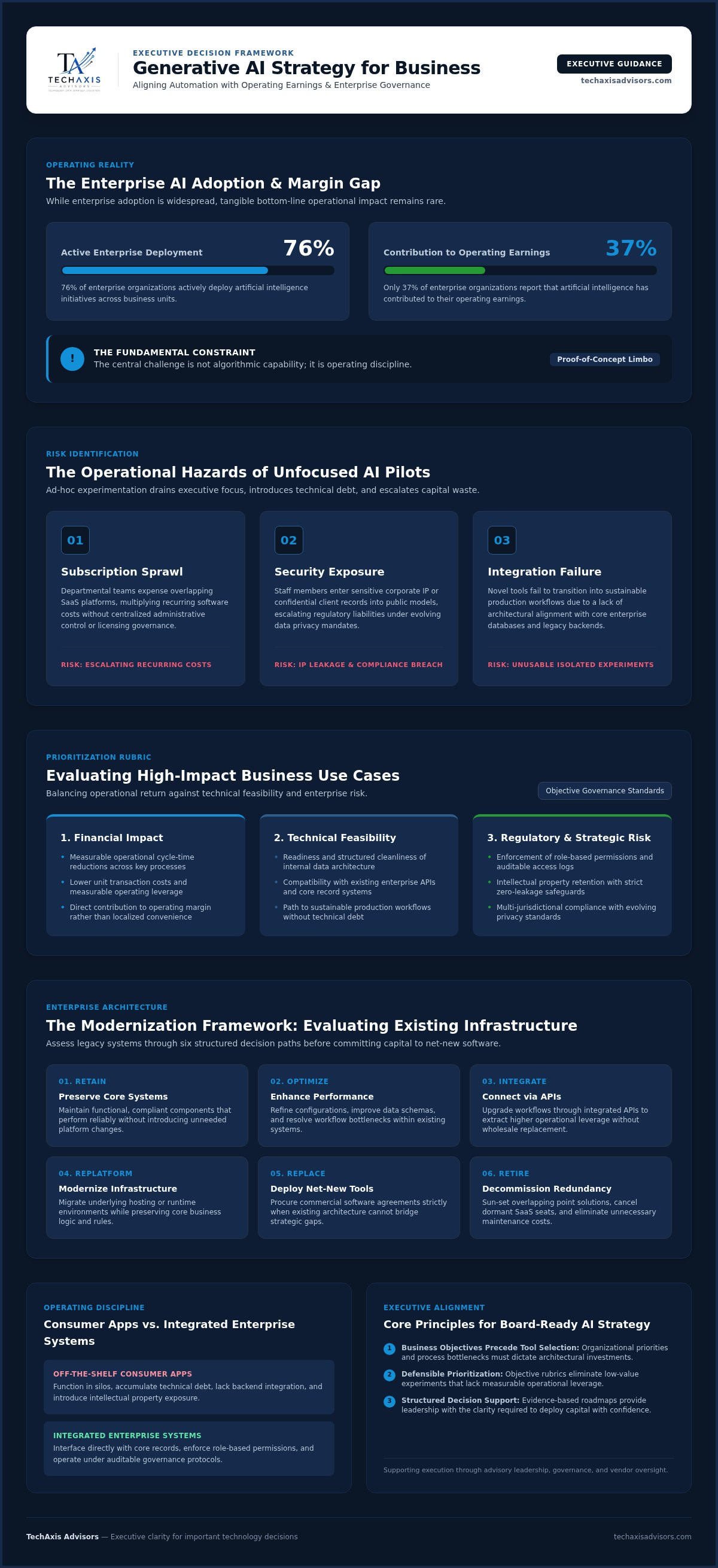
While 76% of enterprise organizations actively deploy artificial intelligence, only 37% report that it has contributed to their operating earnings. The central challenge isn't algorithmic capability; it's operating discipline. Without a pragmatic generative AI strategy for business, executive teams end up funding disconnected experiments that never reach production, all while software licensing costs escalate and board anxieties regarding intellectual property leakage multiply.
You already recognize that uncoordinated adoption introduces compliance risk rather than durable enterprise value. Sustainable advantage requires moving past isolated novelties to anchor automation in strategic business outcomes. In this guide, you'll discover how executive leaders evaluate, govern, and execute a generative AI strategy that drives measurable operational performance. We outline a defensible decision framework to prioritize high-impact use cases, manage regulatory exposure, and modernize technical architecture with confidence.
Table of Contents
Defining a Generative AI Strategy: Moving Beyond Proof-of-Concept Fatigue
The Strategic Decision Framework: Evaluating High-Impact Business Use Cases
Enterprise AI Governance: Mitigating Regulatory, Security, and Data Risk
Modernizing the Operating Model: Data Architecture, Infrastructure, and Talent
Executing with Executive Clarity: Advisory Leadership and Roadmaps
Defining a Generative AI Strategy: Moving Beyond Proof-of-Concept Fatigue
Most corporate initiatives stall in proof-of-concept limbo. Across mid-market enterprises, functional teams launch fragmented experiments with chatbots and text summarizers, mistaking sporadic software trials for digital transformation. An enterprise generative artificial intelligence deployment requires disciplined operational alignment rather than isolated experimentation. Real adoption links algorithmic automation to strategic enterprise goals, replacing curiosity-driven pilots with measurable operating improvements.
Developing an actionable generative AI strategy for business demands drawing a clear line between consumer productivity tools and deeply integrated operational systems. Off-the-shelf consumer apps function in silos. Integrated business applications, by contrast, interface with core records, enforce role-based permissions, and operate under auditable governance protocols. Without this operational discipline, decentralized experiments simply accumulate technical debt and introduce regulatory liabilities while returning negligible bottom-line impact.
The True Cost of Unfocused AI Pilots
Ad-hoc experimentation drains executive focus and capital. Uncoordinated pilots produce several distinct organizational hazards:
Subscription sprawl: Departmental teams expense overlapping SaaS platforms, multiplying recurring software costs without centralized administrative control.
Security exposure: Staff members enter sensitive corporate IP or client records into public models, escalating regulatory liabilities under evolving data privacy standards.
Integration failure: Novel tools fail to transition into sustainable production workflows because they lack architectural alignment with core databases and legacy backends.
Boards now demand fiscal accountability over algorithmic novelty. Technology leaders must show clear operational value through margin expansion, cycle-time reductions, or structural risk mitigation.
Strategic Alignment: Business Objectives Precede Tool Selection
Tool selection should never lead your roadmap. Organizational priorities dictate your architectural investments. Before committing to commercial software agreements, executive teams must establish consensus around process bottlenecks and evaluate whether automation will yield measurable operational leverage.
This discipline forms the foundation of our work at TechAxis Advisors. By consulting who it's for across financial services, wealth management, and private equity platforms, leadership teams evaluate technology investments through structured operational maturity rather than market hype. True leverage comes from identifying repeatable workflows, establishing clear data ownership, and confirming executive buy-in long before signing vendor contracts. When business outcomes lead the conversation, generative capabilities become reliable drivers of operational performance.
The Strategic Decision Framework: Evaluating High-Impact Business Use Cases
Technology leaders frequently mistake individual worker efficiency for enterprise performance. Drafting emails faster or summarizing meetings creates localized convenience, but it rarely moves the needle on gross margin. A defensible generative AI strategy for business demands an objective evaluation rubric that weighs operational impact against implementation feasibility and regulatory exposure.
Instead of pursuing isolated point solutions, organizations must assess their core technology stack through a disciplined modernization framework. Leadership teams evaluate whether to retain, optimize, integrate, replatform, replace, or retire existing components before deploying capital on net-new tools. Upgrading workflows through an integrated API often creates higher operational leverage than forcing a complete platform replacement. As outlined in IBM's step-by-step generative AI guide, sustainable implementations prioritize business value and architecture readiness long before selecting model providers.
Scoring Feasibility, Value, and Strategic Risk
Executive committees should evaluate every potential deployment across three core dimensions:
Financial Impact: Will the initiative reduce operational cycle times, lower unit transaction costs, or expand servicing capacity without increasing headcount?
Implementation Feasibility: Does the organization possess accessible, well-structured internal data, or does the use case require clean-up across distributed legacy databases?
Regulatory and Security Exposure: Could algorithmic hallucinations or unintended data leakage create brand damage or compliance violations under active state and federal oversight?
Prioritize low-risk initiatives supported by structured, internal knowledge assets. Postpone high-risk applications involving unsupervised autonomous actions on external client accounts until governance protocols are tested.
Evaluating Core Enterprise Use Cases
Strategic value emerges when generative models integrate into high-friction operational workflows. In document-heavy environments, automated intake extraction eliminates manual data re-entry across underwriting files, legal agreements, and performance disclosures. Combining proprietary data stores with retrieval-augmented generation architectures allows employees to query institutional knowledge without exposing intellectual property to public training sets.
In highly regulated sectors, these capabilities require careful validation. High-friction processes require strict data provenance and verification layers to prevent compliance failures, especially as automated agents assume multi-step administrative duties. If your organization is navigating these trade-offs, you can start with a confidential executive conversation to evaluate your deployment roadmap against your risk profile.
Enterprise AI Governance: Mitigating Regulatory, Security, and Data Risk
Governance is often mischaracterized as organizational friction that delays technical execution. In practice, disciplined governance serves as a strategic accelerator. A sound generative AI strategy for business relies on unambiguous operational boundaries. Without established guardrails, leadership teams hesitate to move projects past initial testing phases, leaving operational gains unrealized. Clear policies provide executive committees and boards with the defensibility required to scale automation across core business units.
The regulatory environment leaves little margin for ambiguity. With 80% of organizations concerned about proprietary data exposure through commercial AI platforms, proactive compliance controls are non-negotiable. Emerging frameworks, such as the EU AI Act enforcement guidelines active since August 2026 and state statutes like California's AI Training Data Transparency Act, require explicit model transparency, documented system boundaries, and clear operational provenance. These standards mandate verifiable accountability rather than informal assurances.
Protecting Corporate Intellectual Property and Client Data
Protecting confidential records and proprietary IP requires strict structural separation. Every enterprise deployment should enforce clear controls:
Zero-retention policies: Execute commercial agreements with third-party model providers that strictly prohibit using organizational inputs or query logs for foundation model retraining.
Role-based access management: Restrict model connections to internal repositories using existing directory permissions, ensuring automated systems cannot access unauthorized personnel records or financial data.
Data lineage tracking: Maintain auditable logs of document ingestion, transformation paths, and system outputs to satisfy compliance reviews during internal or external audits.
Treating data boundaries as an afterthought exposes firms to severe intellectual property contamination and regulatory penalties.
Establishing an Executive AI Governance Committee
Effective oversight cannot reside solely within technical engineering teams. Sustainable governance requires a multi-disciplinary committee composed of the Chief Technology Officer, General Counsel, Chief Risk Officer, and relevant operational unit leaders. This executive body meets regularly to review model changes, evaluate third-party software vendors, and maintain a centralized risk register.
The committee audits system performance to detect drift, track factual accuracy, and confirm that automated outputs align with company standards. This level of cross-functional oversight ensures that technical capabilities match business objectives, a priority central to who our advisory services support across mid-market and private equity-backed enterprises. Establishing structured oversight transforms compliance from a defensive chore into a reliable foundation for enterprise growth.
Modernizing the Operating Model: Data Architecture, Infrastructure, and Talent
Algorithms deliver value only when supported by functional data infrastructure. When organizations jump straight to selecting tools without assessing their underlying architecture, projects stall. A durable generative AI strategy for business requires an operating model that connects data repositories, workflow pipelines, and human teams into a unified execution process.
Executing this transformation requires a disciplined, four-step sequence:
Data assessment: Evaluate enterprise data hygiene, catalog unstructured files, and verify permissions across production databases.
Modular integration: Deploy API-based integration layers to connect modern models directly to core business systems, avoiding costly replatforming.
Strategic sourcing: Determine whether each workflow component requires proprietary development, commercial vendor integration, or specialized partner support.
Workforce enablement: Establish clear operational standards, training internal teams to supervise automated outputs with defined review checkpoints.
Preparing the Enterprise Data Foundation
Generative applications depend entirely on reference data hygiene. In banking and professional services, 40% of organizations cite poor data quality as a primary obstacle to operational automation. Siloed repositories, outdated internal file shares, and conflicting transaction records distort model outputs.
Bridging this gap requires pragmatic data management rather than multi-year database migrations. Organizations must catalog their unstructured operational records, standardize metadata tagging, and sanitize reference files before indexing them for retrieval. Validating source records at the ingest stage prevents downstream hallucinations and ensures automated workflows reflect accurate institutional facts.
The Build vs. Buy vs. Partner Calculation
Executive teams must balance licensing expenses against ongoing engineering maintenance overhead. Building custom foundation models in-house is rarely economically defensible for mid-market operators. Conversely, off-the-shelf commercial platforms frequently introduce restrictive vendor lock-in, recurring per-seat subscription inflation, and limited visibility into third-party API dependencies.
The pragmatic middle path combines commercial foundation models with proprietary retrieval architectures. By integrating open APIs with internal databases, firms retain full ownership over their institutional intelligence while avoiding custom model training expenses. Navigating these trade-offs requires objective evaluation, an approach detailed across our suite of executive technology services.
Executing with Executive Clarity: Advisory Leadership and Roadmaps
Translating strategy into operating performance demands senior leadership rather than theoretical slide decks. Mid-market organizations frequently struggle during this transition. They lack the dedicated in-house technical leadership to direct complex integrations, yet retaining traditional global consultancies introduces excessive overhead and multi-layered staffing models. Executing an effective generative AI strategy for business requires independent, high-touch oversight focused strictly on capital efficiency, risk mitigation, and operational delivery.
Sustainable execution relies on objective diagnostics rather than open-ended consulting engagements. Structured Executive Intelligence Assessments evaluate current architecture, quantify technical debt, and establish an actionable risk register. This evidence-based approach produces a board-ready roadmap detailing specific initiatives, realistic resource requirements, and measurable operational milestones, ensuring capital allocation remains defensible to audit committees and investors.
Structured Executive Diagnostics vs. Traditional Consulting
Traditional advisory engagements frequently suffer from misaligned incentives, billing extensive hours while deploying junior analysts to conduct generic industry surveys. Growth-stage enterprises require direct access to veteran operators who evaluate challenges through an owner's mindset.
By leveraging structured diagnostics through our proprietary Executive Intelligence Platform, leadership teams secure clear operating blueprints without prolonged discovery cycles. The diagnostic process focuses entirely on operational clarity: establishing system inventories, mapping regulatory exposures, and identifying where automation creates verified enterprise value. To see how these transparent benchmarks drive organizational alignment, review how we work with leaders to eliminate operational friction.
Fractional Executive Leadership in AI Execution
Bridging the leadership gap does not require hiring an expensive full-time corporate executive before your roadmap warrants it. Fractional CTO leadership provides seasoned, C-suite guidance tailored to your execution timeline. A fractional executive operates as an embedded strategic architect who manages delivery partners, enforces technical governance, and negotiates third-party software agreements.
This leadership model maintains strict vendor neutrality. Because an independent advisor sells neither commercial software licenses nor proprietary hosting capacity, their guidance remains uncompromised by vendor quotas or commission structures. They ensure external delivery partners adhere to enterprise architecture standards and deliver against verified business requirements. If your organization is weighing how to scale its technology leadership responsibly, you can review our advisory leadership approach or start with a confidential executive conversation to evaluate your execution priorities.
Executing Your Generative AI Roadmap with Defensible Clarity
Moving past proof-of-concept fatigue requires operational discipline, proactive governance, and technical architecture aligned directly with gross margin performance. Constructing an actionable generative AI strategy for business isn't about chasing market novelties. It's about establishing structured evaluation rubrics that safeguard corporate intellectual property while methodically modernizing enterprise workflows.
TechAxis Advisors provides independent, vendor-neutral counsel to help leadership teams make defensible capital decisions. Led by a veteran CIO, CTO, and CISO with over 25 years of executive experience across complex enterprises, our firm uses the proprietary TechAxis Executive Intelligence Platform to deliver evidence-based diagnostics and prioritized roadmaps. As a certified SBA Women-Owned Small Business, we offer objective decision support grounded in execution reality.
Ready to align your technology investments with executive vision? Start with a confidential executive conversation today.
With disciplined oversight and clear operational milestones, your organization can deploy automated capabilities with complete board confidence.
Frequently Asked Questions
What is the difference between a traditional digital transformation and a generative AI strategy?
Traditional digital transformation focuses on migrating workflows to the cloud and digitizing manual records. In contrast, an enterprise generative AI strategy for business redesigns how decisions and operational outputs are produced. It treats algorithmic models as active reasoning engines within established software stacks rather than static tools. While traditional digital transformation modernizes your records, generative strategy focuses on automating complex workflows and synthesizing institutional knowledge.
How much should an enterprise budget for a generative AI strategy and roadmap?
Strategic diagnostic assessments typically represent an initial fraction of total technology program expenditures. For implementation, industry benchmarks indicate that focused enterprise pilots generally run between $15,000 and $250,000, while multi-department deployments can exceed $500,000 in software infrastructure and integration costs. Establishing a clear evaluation roadmap first prevents redundant software licensing and ensures capital is directed strictly toward high-leverage business operations.
How do we prevent our proprietary enterprise data from training commercial AI models?
Preventing data leakage requires commercial-tier API agreements that contractually enforce zero-retention policies. Standard consumer accounts frequently reserve rights to use prompt inputs for model training, whereas enterprise licensing explicitly disables data mining and telemetry retention. Organizations should implement private tenant deployments within secure cloud environments, deploy access proxies to strip confidential client identifiers, and restrict employee use of public consumer tools through enforceable corporate policies.
What happens if our underlying enterprise data infrastructure is currently fragmented?
Fragmented data infrastructure doesn't require a total database overhaul before starting an automation roadmap. Instead of launching multi-year migrations, organizations can deploy retrieval-augmented generation architectures connected to specific, sanitized subsets of operational data. Prioritize high-value workflows by indexing isolated document stores, clean knowledge bases, and standard operating procedures. This tactical approach delivers operational progress while broader enterprise data hygiene initiatives continue in parallel.
Is it necessary to hire a full-time Chief AI Officer to oversee our corporate strategy?
Most mid-market organizations do not need a full-time Chief AI Officer to govern technology investments effectively. Establishing an internal executive steering committee alongside fractional technology leadership delivers structured governance without excessive executive overhead. A fractional CTO provides senior architectural oversight, vendor management, and risk mitigation, aligning your overall generative AI strategy for business with corporate goals while avoiding the commitment of a permanent executive hire.
How should executive leadership measure the return on investment for generative AI initiatives?
Return on investment should be measured through unit economics and operating margin improvements rather than vanity metrics like prompt volume. Leadership teams should track reductions in manual processing cycle times, decreases in external contractor expenditures, and increased throughput per employee across core departments. Demonstrable ROI links operational automation directly to EBIT contributions, validating whether specific automated workflows scale organizational capacity without requiring additional headcount.


Comments