

Fractional Tech Officer: Guide for Executive Buyers
A fractional technology officer can add another voice without closing an ownership gap if the role has no authority over priorities, vendors, or delivery. The arrangement creates value when the mandate gives the leader clear decision rights and a defined role in execution.
This distinction matters when growth, modernization, or AI initiatives are moving faster than internal leadership capacity. You may need senior judgment and stronger oversight, but not necessarily a permanent executive hire. The right choice depends on which decisions need an owner, what work is already underway, and how closely leadership needs to stay involved.
This guide explains how fractional technology leadership differs from an advisor, an interim executive, and a full-time CTO. It also shows how to define the mandate, scope, and accountability, then select an engagement model that connects strategy with delivery. The aim is practical clarity: a leadership arrangement aligned with your organization’s priorities, risk tolerance, and capacity to execute.
Table of Contents
When Does a Fractional Technology Officer Address an Executive Need?
Fractional CTO, CIO, CISO, Advisor, or Delivery Partner: What Changes?
How to Evaluate Whether a Fractional Technology Officer Fits
How to Scope the Engagement, Governance, and Measures of Progress
From Assessment to Fractional Leadership: A Practical Path Forward
When Does a Fractional Technology Officer Address an Executive Need?
Technology decisions can stall when no executive owns the tradeoffs. A vendor proposes a platform, business leaders need faster reporting, and modernization work competes with day-to-day demands. Without consistent oversight, priorities can drift, risks become harder to compare, and accountability for progress can blur.
A fractional technology officer is a part-time executive who leads defined technology decisions and priorities without serving as a full-time employee. The role differs from an individual specialist completing a technical task, a help desk handling support requests, or a project team delivering a defined output. Fractional executives work with organizations on an ongoing, part-time basis. Their specific authority and responsibilities depend on the engagement.
What does a fractional technology officer lead?
The work starts by connecting business priorities to technology choices. If a firm is expanding its services, for example, executives may need to sequence platform changes, data improvements, and operational readiness rather than treating each request as a separate project.
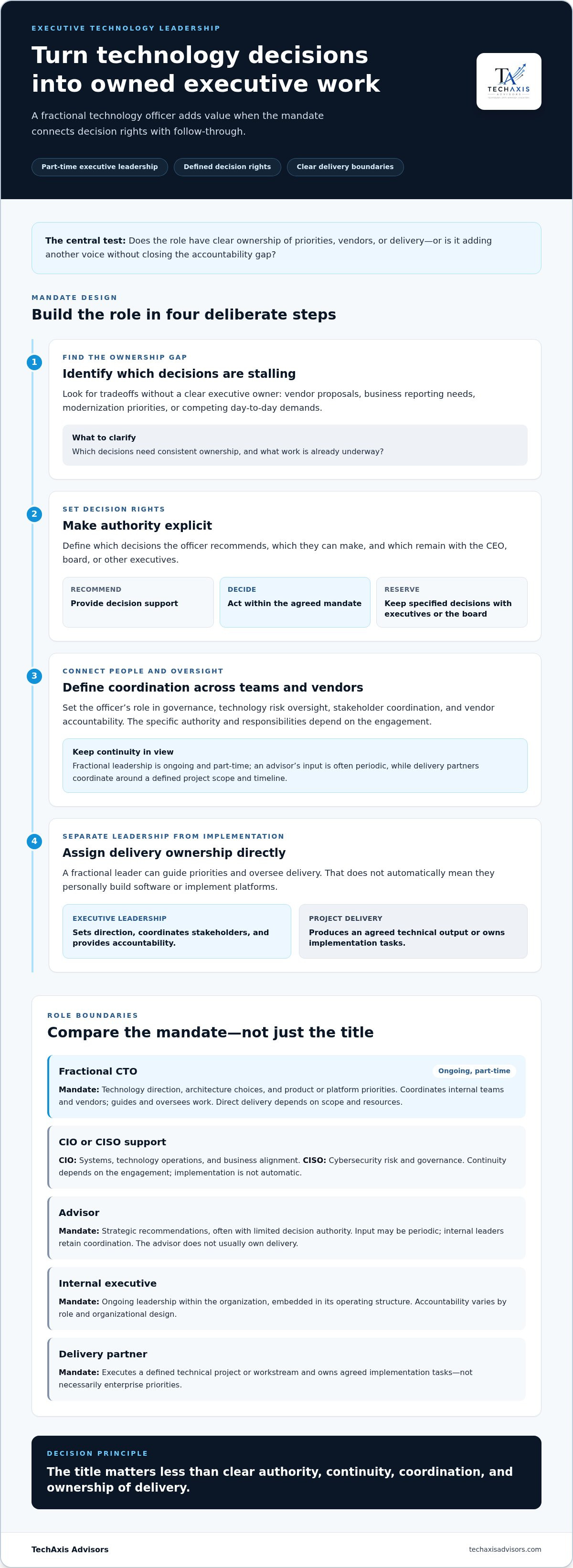
Depending on the agreed mandate, the officer may provide decision support, establish governance, oversee technology risk, coordinate internal stakeholders, and strengthen vendor accountability. The role can also guide transformation priorities, such as evaluating AI readiness or planning modernization. Make the officer’s authority explicit: which decisions they recommend, which they can make, and which remain with the CEO, board, or other executives.
Leadership sets direction and accountability; project delivery produces a defined output. A fractional leader may guide priorities and oversee delivery, but that does not mean they personally build software or implement platforms.
Which organizations may need fractional leadership?
The model can suit an organization that needs sustained executive judgment but does not currently require a full-time technology executive. Rapid growth may strain existing systems and decision processes. Modernization can raise competing questions about what to retain, optimize, integrate, replatform, replace, or retire. AI adoption can prompt decisions about business value, governance, and readiness. A leadership transition may also leave technology priorities without a clear owner.
These situations arise in wealth management, financial services, private equity-backed firms, and other organizations with complex technology decisions. Industry alone does not determine fit. The key question is whether business priorities require ongoing executive ownership across teams, vendors, risk, and delivery. Explore situations technology advisory addresses to see how common decision and oversight gaps can be framed.
Fractional CTO, CIO, CISO, Advisor, or Delivery Partner: What Changes?
These roles may touch the same initiative, but they do not carry the same mandate. A fractional technology officer may provide continuing executive leadership, while an advisor may offer periodic counsel and a delivery partner may own a defined technical workstream. Titles vary across organizations, so compare responsibilities and decision rights rather than relying on labels.
How do CTO, CIO, and CISO responsibilities differ?
A CTO commonly focuses on technology direction, architecture choices, and product or platform priorities. A CIO typically leads technology operations and systems in alignment with business needs. CISO support centers on cybersecurity risk and governance. These areas can overlap, but they are not interchangeable. Set the mandate around the organization’s actual decisions and risks.
How does executive advisory differ from delivery services?
An advisor helps leaders assess options and make decisions. A delivery partner builds, configures, or implements agreed work. Executive oversight can connect these roles by aligning internal teams, vendors, and delivery partners around business priorities, surfacing issues, and tracking decisions. That oversight should not be confused with implementation ownership. For software initiatives, fractional CTO leadership for software projects can help clarify how executive direction and delivery coordination work together.
Choose the arrangement that matches the gap. A defined implementation may call for delivery capacity; a sustained need to set priorities and coordinate work may call for executive leadership. Put the mandate, decision rights, continuity, and delivery ownership in writing before work begins.
How to Evaluate Whether a Fractional Technology Officer Fits
A fractional technology officer is most relevant when technology decisions recur across the business and need accountable executive leadership. Use this four-part fit test to distinguish a leadership gap from a discrete project need:
Decision bottleneck: Are technology choices repeatedly waiting on executive direction, or are priorities competing without a clear way to resolve tradeoffs?
Business priority: Is technology central to a current objective, such as growth, modernization, or AI adoption, rather than an isolated request?
Internal capacity: Can current leaders coordinate the work and maintain oversight, or are existing responsibilities creating a sustained leadership gap?
Required authority: Does the role need to shape recommendations, coordinate stakeholders, oversee vendors, or make decisions within delegated boundaries?
One signal alone is not a diagnosis. A delayed platform decision, for example, may reflect unclear ownership, competing business priorities, or incomplete project requirements. Look at the wider pattern: whether similar decisions keep resurfacing, whether they involve tradeoffs across investment and risk, and whether an executive owner can resolve them.
What signals indicate a leadership gap rather than a project gap?
Recurring decisions about technology investment, risk tolerance, growth priorities, and operating needs point to a leadership question. A defined technical deliverable with clear requirements, an internal sponsor, and an accountable project owner is more likely a scoped project need. The distinction is continuity: does the organization need someone to direct connected decisions, or a team to complete a specific piece of work?
Which mandate and decision rights should be explicit?
Before the engagement begins, name the executive sponsor and identify who retains final authority. Specify whether the fractional leader recommends roadmap priorities, establishes governance, oversees vendors, or coordinates execution, and where those responsibilities stop. Set the meeting cadence and escalation path for decisions beyond delegated authority. This prevents overlap with existing executives and makes accountability visible to internal teams.
For example, a fractional leader might coordinate a roadmap and surface a vendor delivery issue, while the executive sponsor approves a material investment or a change in business priorities. Set the boundary to fit the organization’s structure, risk tolerance, and decision process. Explore organizations suited to executive technology support for additional context.
Decision rule: Use fractional leadership when recurring executive decisions need accountable technology leadership. If the work is isolated and already has clear internal ownership, define the project and its deliverables instead.
How to Scope the Engagement, Governance, and Measures of Progress
A fractional technology officer needs a mandate that connects business priorities to decision authority and follow-through. A concise engagement charter gives executives and delivery teams a shared reference point, while allowing the scope to adapt as priorities or internal capacity change.
Build the scope in sequence:
1. Define outcomes. State the business priorities the engagement supports, such as advancing an agreed roadmap, improving visibility into technology risks, or clarifying investment decisions.
2. Set the mandate. Specify responsibilities for recommendations, governance participation, vendor coordination, and execution oversight. Separate decisions the officer can make from those reserved for the executive sponsor or board.
3. Name stakeholders. Identify the sponsor, internal decision-makers, operational owners, and relevant vendors. Clarify who provides input, who approves decisions, and who owns each action.
4. Establish governance cadence. Agree on executive check-ins, working sessions, reporting, and escalation routes. Set a rhythm that supports timely decisions without adding meetings that do not serve the mandate.
5. Choose review measures. Tie progress reviews to the agreed priorities and available evidence, not generic benchmarks.
What should the engagement charter define?
Record the sponsor, priorities, boundaries, stakeholders, decision rights, meeting cadence, and escalation path. Be specific about the leader’s responsibilities, such as recommending roadmap priorities, participating in governance, overseeing vendor commitments, or coordinating execution across teams. Note how the scope can be revisited if business conditions shift or internal leaders take on additional capacity.
Clear boundaries matter. For example, the charter might make the fractional leader responsible for surfacing delivery dependencies and recommending tradeoffs, while investment approvals remain with the executive sponsor. This supports accountability without creating a parallel chain of command.
How can leaders assess progress without arbitrary metrics?
Use review points that show whether the engagement is improving decision-making and moving agreed work forward. Track roadmap milestones and priority changes; whether decisions have a clear owner and rationale; whether material risks have accountable actions; and whether dependencies are resolved or escalated. The right measures depend on the organization’s objectives, risk tolerance, and starting position.
Use regular executive reviews to examine evidence, resolve blocked decisions, and adjust priorities when business conditions change. A useful review asks what moved, what remains at risk, and what decision is needed next. Explore the right engagement model through a discussion with TechAxis Advisors.
From Assessment to Fractional Leadership: A Practical Path Forward
The right engagement depends on the decision leaders need to make and the continuity required to act on it. An executive assessment can clarify a specific technology domain. Retained strategic advisory provides ongoing counsel on selected decisions. Fractional executive leadership adds a sustained mandate for governance, prioritization, and coordination.
When should leaders start with an executive assessment?
Start with an assessment when decision-makers need an evidence-based view of a defined area before choosing a course of action. A structured executive decision-support engagement can synthesize relevant information into board-ready findings, a prioritized roadmap, an action register, and an executive presentation. These materials help leaders understand the choices, implications, and next steps without treating the work as a technical audit.
The path can move from an initial diagnostic to assessment and synthesis, then to a roadmap. The findings may give internal teams enough direction to proceed, or they may point to a need for continued advice or leadership. See how TechAxis Advisors structures its work.
When does fractional leadership provide continuity?
A fractional technology officer can fit when priorities require recurring executive attention rather than a single decision or deliverable. Ongoing leadership can maintain governance, revisit tradeoffs as conditions change, coordinate stakeholders and vendors, and help keep agreed priorities moving. The mandate should distinguish executive oversight from direct implementation, with delivery responsibilities assigned to clear owners.
TechAxis Advisors founder Aarati Dikshit brings more than 25 years of executive experience as a CIO, CTO, and CISO. That experience informs the judgment needed to connect technology decisions with business priorities, risk, and organizational capacity. An assessment, strategic advisory, and fractional leadership can be distinct steps or a practical progression, depending on the need.
Explore executive advisory and fractional leadership to understand how ongoing counsel can be scoped. A confidential executive conversation can help clarify which engagement aligns with your current decisions and required level of continuity.
Put Technology Leadership Behind the Decisions That Matter
Start with the need: an assessment when executives need evidence to choose a direction, ongoing advisory for recurring strategic decisions, or fractional leadership when priorities require sustained executive ownership. In each case, clarify the mandate, decision rights, and how progress will be reviewed.
TechAxis Advisors executive assessments provide board-ready findings, prioritized roadmaps, action registers, and presentations. Founder Aarati Dikshit brings more than 25 years of CIO, CTO, and CISO experience. TechAxis Advisors is certified as an SBA WOSB.
If a fractional technology officer may fit your organization, a confidential conversation can help clarify the decision gap and the engagement model that aligns with it.
A clear mandate and accountable leadership help your organization approach technology priorities with greater focus and confidence.
Frequently Asked Questions
What does a fractional technology officer do?
A fractional technology officer provides part-time executive technology leadership under an agreed mandate. Responsibilities can include aligning technology strategy with business priorities, establishing governance, overseeing risk, directing vendor relationships, and guiding transformation priorities. The role is not routine IT support or simply a team assigned to implement a defined solution. The executive sponsor and officer should document authority, decision boundaries, expected deliverables, and how the role coordinates with internal leaders.
Is a fractional technology officer the same as a fractional CTO?
Not necessarily. Fractional CTO is a common title, while fractional technology officer can signal a broader executive remit. The distinction depends on the organization and agreed responsibilities, not a universal title standard. One mandate may focus on technology strategy and platform decisions; another may also cover operating oversight, cybersecurity governance, data, or transformation priorities. Define decision authority and boundaries with the executive sponsor rather than relying on the title alone.
When should a company hire a fractional technology officer?
Consider fractional leadership when technology decisions recur at the executive level, growth or modernization creates competing priorities, or internal leaders lack capacity for sustained oversight. A defined project with clear requirements and internal ownership may need delivery support instead. Before choosing, assess the business priorities involved, who is already accountable, and whether the work requires delegated executive authority or a scoped technical deliverable.
How is a fractional technology officer different from an IT consultant?
A fractional executive typically holds an ongoing, business-aligned leadership mandate covering decisions and governance. An IT consultant may provide focused advice or technical project work, though scopes vary. Compare the mandate, access to leadership, decision rights, continuity, and delivery ownership. The engagement agreement should explain how the role works with internal teams and delivery partners, so executive oversight and technical implementation have clear, distinct accountability.
Can a fractional technology officer oversee AI, data, and cybersecurity priorities?
Yes, these areas can fall within the mandate when they match the organization’s priorities and agreed scope. Oversight should connect AI, data, and cybersecurity decisions to business objectives, governance, risk tolerance, and accountable owners. The executive may coordinate internal leaders and qualified delivery partners, but that does not mean one person performs every technical implementation or guarantees compliance. Define responsibilities and decision boundaries for each area in the engagement scope.
How much time does a fractional technology officer work with a company?
The level of involvement depends on the mandate, priorities, stakeholder needs, and organizational context. There is no single schedule that fits every engagement. At the outset, agree on executive access, decision forums, expected deliverables, escalation paths, and review points. Revisit those arrangements as business needs or internal capacity change, so the engagement stays aligned with the decisions and oversight the organization requires.
What should executives expect from a fractional technology leadership engagement?
Expect a clearly scoped mandate, regular executive decision support, governance, and review of progress against agreed priorities. When an assessment is appropriate, TechAxis provides board-ready findings, a strategic roadmap, an action register, and an executive presentation. These deliverables support decisions, but outcomes are not guaranteed. Direct technical implementation may be owned by internal teams or qualified delivery partners, while the fractional leader provides advisory leadership, governance, and coordination as defined in the scope.



Comments