

Fractional CTO vs. Full-Time CTO: An Executive Framework for Growth-Stage Leadership
Hiring a full-time CTO too early isn't a sign of organizational maturity. It is often a significant capital commitment that creates more technical debt than it solves. Many growth-stage CEOs feel pressured to secure a permanent executive to signal stability to the board, yet they find themselves overpaying for high-level strategy when the business still requires foundational execution. When evaluating a fractional cto vs full time cto, the decision must be driven by your current operational scale rather than a desire for a full-time headcount. You likely recognize the high stakes of your current technology projects and the urgent need for a coherent AI strategy, but a total compensation package exceeding $600,000 may not be the most disciplined use of your capital today.
This article provides an evidence-based framework to help you determine which leadership model aligns with your specific business outcomes. We'll examine the clear criteria for hiring, the impact on your data strategy, and how to reduce technical debt without inflating your executive payroll. We'll also break down the trade-offs in cost, accountability, and long-term scalability to ensure your technology spend yields a measurable return.
Table of Contents
The Technology Leadership Gap in Growth-Stage Organizations
Growth-stage companies often reach a critical inflection point where technical complexity begins to outpace the existing leadership's ability to manage it. This is the "CTO Gap." At this stage, the organization's technology needs shift from simple execution to high-level strategic alignment. Many firms attempt to bridge this gap by rushing into a permanent hire, often overpaying for executive status before the business actually requires that level of daily oversight. The debate between a fractional cto vs full time cto often centers on cost, but the real issue is the scope of leadership required for your current operational maturity.
The symptoms of a leadership gap are quiet but destructive. You might see stalled product roadmaps, an accumulation of technical debt, or AI initiatives that lack a clear business case. These issues don't just slow down operations. They create significant execution risk that can erode enterprise value. Fractional technology leadership acts as a strategic bridge, providing the necessary oversight to stabilize your foundation while you prepare for future scaling.
Understanding the Fractional CTO Meaning
A fractional leader provides senior-level oversight on a retained, part-time basis. It's important to distinguish this role from an outsourced IT provider or Managed Service Provider (MSP). While an MSP manages your help desk and hardware, a fractional Chief Technology Officer (CTO) focuses on governance, data strategy, and board-ready reporting. This model offers a disciplined approach to advisory leadership, ensuring your technology roadmap is driven by business goals rather than technical convenience.
The Business Case for Strategic Technology Advisory
For CEOs in wealth management and private equity, technology is no longer a back-office function. It is a primary driver of enterprise value. Investors and boards now demand evidence-based data strategies and rigorous security standards. Strategic advisory ensures that every dollar of technology spend aligns with broader business outcomes. This clarity is essential during acquisitions or rapid growth phases, as it allows leadership to evaluate whether to retain, optimize, or integrate existing systems rather than defaulting to expensive replacements. When comparing a fractional cto vs full time cto, the fractional model allows you to access 25+ years of executive experience to reduce execution risk without the long-term commitment of a permanent C-suite salary.
Fractional CTO vs. Full-Time CTO: A Structural Comparison
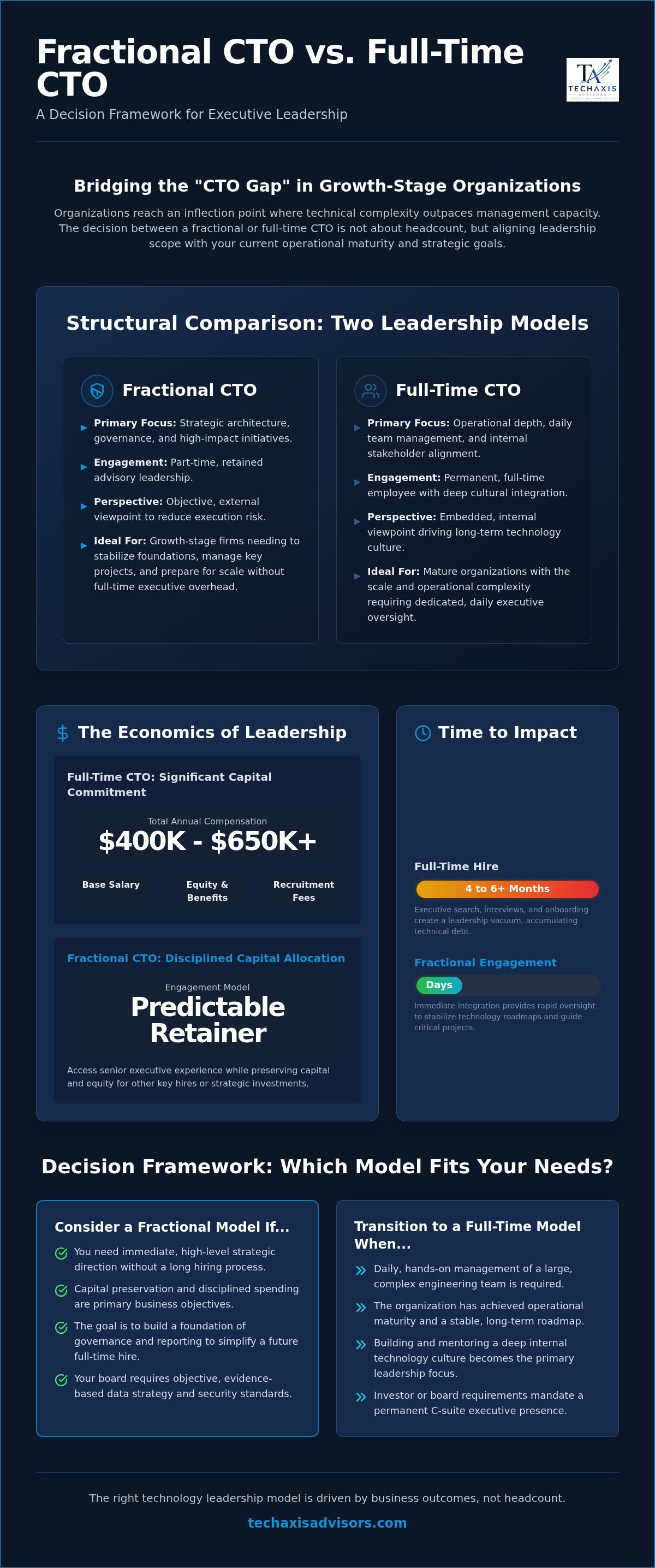
The choice between a fractional cto vs full time cto is not a binary decision about talent. It is a strategic decision about the nature of the leadership your organization requires. A full-time executive is an internal stakeholder, deeply embedded in the daily mechanics of team culture and personnel management. This model prioritizes operational depth. Conversely, a fractional leader operates as a strategic architect. They provide an objective, outside perspective that is often missing when leadership is too close to the internal politics of a growing firm. This model prioritizes strategic breadth and executive clarity.
The financial implications are significant. A full-time CTO at a growth-stage company typically commands a total compensation package between $400,000 and $650,000 annually. This figure includes base salary, equity grants, and benefits. You must also account for recruitment fees, which generally range from 20% to 25% of the first-year salary. A fractional engagement replaces these heavy capital outlays with a predictable monthly retainer. This allows a CEO to access high-level advisory leadership while preserving equity for future rounds of funding or key engineering hires.
Time to impact is another critical differentiator. The search for a permanent C-suite executive often consumes four to six months. During this vacancy, technical debt accumulates and critical projects may stall. A fractional CTO can be integrated into the organization within days, providing immediate oversight and stabilizing the technology roadmap. If you are uncertain about your current leadership requirements, you might request a confidential executive conversation to evaluate your options.
The Full-Time CTO: When Absolute Focus is Required
A full-time leader becomes a necessity once a technology organization reaches a certain scale, typically around 50 engineering staff. At this level, the demands of organizational development, cultural stewardship, and daily personnel management require a permanent presence. However, hiring this role too early can lead to a sunk cost bias. CEOs often feel obligated to follow a flawed roadmap simply because they have invested heavily in the executive who created it. The permanent model is most effective when the primary challenge is scaling a proven team rather than defining a new strategic direction.
The Fractional CTO: The Strategic Architect Model
Fractional leaders excel at building scalable operating foundations and optimizing technology spend. They bring "executive intelligence" across multiple domains, such as AI adoption, cybersecurity governance, and data reporting strategy. Because they serve multiple clients, fractional CTOs possess a broader market perspective. They can identify patterns and risks that a single-company executive might miss. This model is particularly effective for growth-stage firms that need to professionalize their technology function before committing to the long-term expense of a full-time hire.
A Decision Framework for CEOs and Boards
Determining the right leadership model requires a disciplined assessment of your current state. It's not a matter of prestige. It's a matter of utility. CEOs must evaluate whether their primary need is for a cultural steward or a strategic architect. The choice between a fractional cto vs full time cto should follow a structured progression of logic rather than an emotional reaction to a recent system failure.
Step 1: Assess Operational Maturity. Determine if your technical processes are repeatable or if every project is a rescue mission. High technical debt suggests a need for an architect rather than a manager.
Step 2: Evaluate the 12-Month Roadmap. Identify critical milestones. If your primary goal is a specific platform migration or AI integration, a fractional leader provides the necessary expertise without the long-term overhead.
Step 3: Calculate the Cost of Inaction. Industry data indicates that technical debt can cost between $300,000 and $600,000 annually for a team of just ten engineers. Compare this loss against the cost of a full-time executive.
Step 4: Define the Leadership Type. Decide if you need steady-state management to keep the lights on or transformational leadership to overhaul your data strategy.
Trigger Points for a Full-Time Hire
There are specific moments when the fractional model should transition into a permanent role. If your engineering headcount exceeds 50 staff, the demands of personnel management and cultural development usually require a 24/7 executive presence. Additionally, post-Series B or C funding rounds often include investor mandates for a permanent C-suite. In these scenarios, the full-time role is less about strategic architecture and more about maintaining organizational momentum and stakeholder management.
Industry-Specific Considerations: Wealth Management and PE
In regulated sectors, the stakes for technology leadership are higher. CEOs in these fields require a specific type of technology leadership for wealth management that prioritizes governance and compliance. For Private Equity-backed firms, fractional leadership is a powerful tool for technology due diligence during acquisitions. It allows for a rapid, objective assessment of a target's technical maturity. When weighing a fractional cto vs full time cto, firms in these sectors often find that the fractional model provides the executive clarity needed to align technology spend with rigorous regulatory requirements and business outcomes.
The Economics of Technology Leadership: ROI and Risk
The financial logic of technology leadership is often obscured by the perceived need for full-time headcount. For growth-stage firms, a permanent executive represents a significant capital commitment that extends far beyond a base salary. When weighing a fractional cto vs full time cto, CEOs must account for the fully loaded cost of a permanent hire. Total compensation for a full-time CTO in 2026 often reaches $650,000 when factoring in equity, bonuses, and benefits. This does not include the 20% to 25% recruitment fee required to secure high-level talent. A fractional model typically reduces these costs by 60% to 70%, allowing you to reallocate capital toward product development or market expansion.
This model provides an immediate efficiency gain by providing access to over 25 years of executive experience as a CIO or CTO for a predictable monthly retainer. This senior-level access eliminates the risk of delegating critical strategy to less experienced staff, a common challenge when engaging larger consulting firms where senior partners lead the initial sale but leave the actual execution to junior associates. A fractional leader remains hands-on, identifying silent technical debt and execution risks before they impact your P&L. They act as a disciplined partner in business transformation, ensuring that technology serves as a foundation for growth rather than a drain on resources.
Measuring the ROI of Fractional Advisory
The return on investment for fractional leadership is found in operational clarity. It begins with vendor consolidation and platform optimization, often uncovering redundant software spend that has accumulated during rapid growth phases. By establishing a rigorous governance framework, a fractional leader accelerates AI readiness and data modernization. This reduces execution risk by replacing guesswork with evidence-based strategic roadmaps. These roadmaps provide the board with the transparency required to approve technology investments with confidence.
Evaluating 'Retain, Optimize, or Replace' Decisions
New full-time hires often feel a systemic pressure to replace existing systems to prove their value. This replacement syndrome can lead to unnecessary capital expenditure and organizational friction. A fractional CTO provides an objective, independent perspective. They utilize structured Executive Intelligence Assessments to evaluate systems based on their actual business utility. The goal is to determine the most effective path: retain, optimize, integrate, replatform, replace, or retire. This business-first alignment ensures that your technology strategy is driven by operational needs rather than industry trends or personal bias.
Beyond the Hire: Building a Scalable Operating Foundation
The decision between a fractional cto vs full time cto is rarely about choosing one model forever. It's often about sequence. A fractional leader establishes the governance, cybersecurity, and data reporting frameworks that a full-time executive will eventually inherit. By professionalizing these areas early, you ensure that when you finally hire a permanent CTO, they can focus on growth and innovation rather than technical debt and system stabilization. This approach provides the CEO with independent, objective decision support during the most volatile stages of scaling.
Building this foundation requires a shift from reactive troubleshooting to proactive architecture. A fractional partner doesn't just manage the current state; they prepare the organization for its desired future state. This involves creating a transparent technology operating model where every project has a clear business case and every dollar of spend is accounted for. This level of discipline is what ultimately reduces execution risk and allows a growth-stage firm to scale without the structural failures that often plague rapid expansion.
The TechAxis Perspective: Advisory-Led Leadership
TechAxis Advisors moves your organization from "outsourced IT" to an "embedded executive presence." We don't just manage vendors. We provide the strategic architecture required to drive enterprise value. Our approach leverages a proprietary Executive Intelligence Platform to deliver evidence-based, board-ready findings. This platform replaces organizational anxiety with disciplined progress, allowing you to see exactly how your technology spend aligns with business outcomes. You can learn more about our advisory leadership model to see how we bridge the gap between high-level strategy and grounded execution.
Next Steps for Growth-Stage Leadership
Choosing between a fractional cto vs full time cto requires an honest assessment of your current trajectory. Growth-stage firms in regulated industries like wealth management and private equity can't afford execution risk. Selecting a partner with deep regulatory experience is essential for maintaining compliance while pursuing AI adoption and automation. The first step is often a structured Executive Technology Operating Model Assessment. This engagement provides a prioritized roadmap that defines whether your immediate priority is strategic advisory or operational oversight. We recommend you start with a confidential executive conversation to evaluate your current technology leadership requirements and determine the most effective path forward.
Aligning Technology Leadership with Operational Maturity
The choice between a fractional cto vs full time cto is a fundamental decision about capital efficiency and strategic clarity. Growth-stage firms must prioritize building a scalable operating foundation before committing to the long-term overhead of a permanent executive. You've seen that leadership should match your current technical complexity, focusing on governance and data strategy to reduce execution risk. This approach ensures your technology spend is an investment in future value rather than a reaction to immediate chaos.
TechAxis Advisors brings the perspective of a seasoned CIO, CTO, and CISO with over 25 years of experience to your leadership team. As a Certified Women-Owned Small Business (WOSB), we utilize our proprietary Executive Intelligence Platform to deliver evidence-based roadmaps that satisfy board-level scrutiny. We provide the disciplined oversight necessary to align your technology roadmap with tangible business outcomes and regulatory requirements.
Your organization deserves a technology roadmap that is both ambitious and grounded in reality. By selecting the leadership model that fits your current operational stage, you're securing the competitive advantage your firm needs for the next phase of growth. It's time to replace organizational anxiety with a sense of controlled, disciplined progress.
Frequently Asked Questions
What is the typical cost difference between a fractional and full-time CTO?
A fractional CTO generally costs 60% to 70% less than a full-time executive. While a permanent hire requires a base salary, equity, and benefits often exceeding $600,000, the fractional model operates on a predictable monthly retainer. This allows growth-stage firms to preserve capital for engineering hires or market expansion. The primary financial benefit when comparing a fractional cto vs full time cto is the elimination of recruitment fees and long-term equity dilution.
Can a fractional CTO manage my existing engineering or IT team?
Yes, a fractional CTO provides direct leadership and governance for your internal engineering or IT teams. They don't just provide advice from the sidelines; they are embedded executives who manage roadmaps, oversee vendor performance, and mentor technical staff. Their goal is to professionalize the technology function and ensure that the team's output aligns with the CEO's business objectives. This leadership bridge is essential for firms transitioning from a founder-led technical approach to a scalable operating foundation.
How many hours per week does a fractional CTO typically work?
Most fractional CTO engagements range from 10 to 20 hours per week, depending on the complexity of your technology roadmap. However, the focus is on executive clarity and strategic outcomes rather than a specific hourly count. A seasoned leader can often provide more impact in a few hours of high-level architecture than a less experienced manager can in a full work week. This model ensures you receive senior-level decision support exactly when it's needed.
Is a fractional CTO suitable for a company in a highly regulated industry like finance?
Fractional leadership is highly effective in regulated sectors like wealth management and private equity. A specialized fractional CTO brings specific experience in governance, compliance, and data reporting that is often missing in general technical hires. They help firms navigate the complexities of AI adoption and cybersecurity while ensuring all technology initiatives meet rigorous regulatory standards. This objective oversight provides boards and investors with the transparency required for high-stakes financial environments.
What is the difference between a fractional CTO and a technical consultant?
The primary difference lies in the nature of the relationship and accountability. A technical consultant is typically hired for a specific, project-based deliverable and departs once the project is complete. A fractional CTO is an ongoing, embedded member of your leadership team. They take responsibility for the long-term technology strategy, vendor oversight, and team performance. They operate as a partner in your business transformation rather than a temporary service provider.
How do I know when it’s time to transition from a fractional to a full-time CTO?
You should consider transitioning to a permanent hire when your engineering team exceeds 50 staff or when your board mandates a 24/7 executive presence. Post-Series B or C funding rounds are common triggers for this shift. If your primary challenge has moved from strategic architecture to daily cultural stewardship and personnel management, a full-time leader may be necessary. Until that point, a fractional model often provides a more efficient path to operational maturity.
Does a fractional CTO handle the actual software development or coding?
No, a fractional CTO does not typically perform software development or coding. Their role is to act as a strategic architect and executive leader. They define the technology roadmap, manage the development lifecycle, and oversee qualified delivery partners or internal teams. By staying out of the code, they maintain the objective perspective required to evaluate whether to retain, optimize, or replace systems based on business utility rather than technical preference.
What should I look for when interviewing a fractional CTO firm?
Prioritize firms that offer senior-level access and evidence-based methodologies. When evaluating a fractional cto vs full time cto firm, look for a founder with at least 25 years of experience as a CIO or CTO. Ensure they have deep expertise in your specific industry, such as financial services or wealth management. A firm that utilizes a structured platform for assessments will provide more board-ready findings than one relying on subjective technical audits.


Comments