

Fractional CTO Services: Mid-Market Decision Guide
A fractional CTO is valuable when technology decisions have clear executive ownership. For mid-market companies, fractional CTO services for mid-market companies should connect business priorities to decisions, accountable owners, and governed execution, not simply add senior advice to the calendar.
That distinction matters when growth, modernization, AI, or vendor decisions compete for attention. A company may have capable technology teams and external partners, yet still lack a clear sequence of priorities, authority to resolve tradeoffs, or consistent oversight of delivery and risk. A fractional CTO can help address that leadership gap, provided the role has defined responsibilities and decision rights.
This guide explains which business problems fractional technology leadership can address, what the role should own, and how to set practical measures of progress. It also shows how to connect an executive assessment and roadmap to governance, vendor oversight, and delivery accountability, so strategy translates into action.
Table of Contents
When Mid-Market Companies Need Fractional CTO Services
Technology responsibility can grow faster than executive ownership. A company may have capable teams, established systems, and trusted vendors, yet lack a consistent leader to connect technology decisions with business priorities. The issue is not necessarily a shortage of technical skill. It may be a leadership gap: no clear owner to sequence initiatives, resolve tradeoffs, and maintain oversight from decision through delivery.
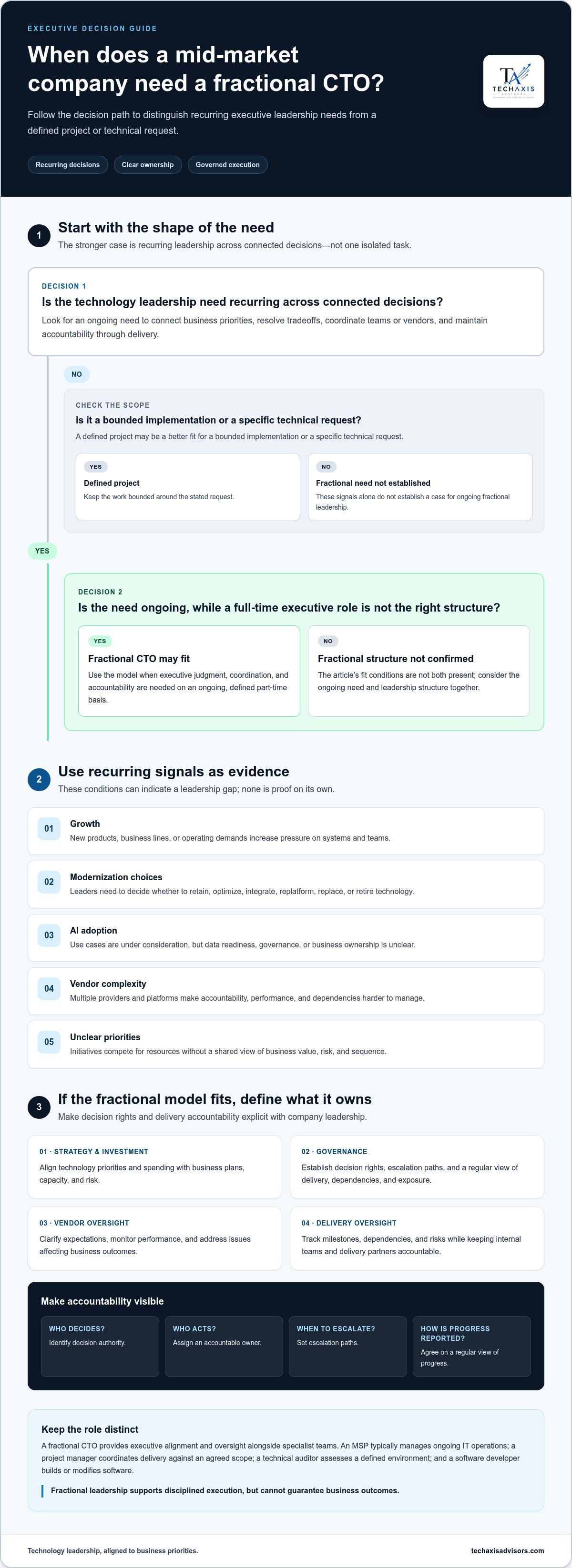
Fractional CTO services for mid-market companies can fit when the leadership need is ongoing but a full-time executive role is not the right structure. Common triggers include:
Growth: New products, business lines, or operating demands increase pressure on systems and teams.
Modernization: Leaders need to determine whether to retain, optimize, integrate, replatform, replace, or retire existing technology.
AI adoption: Teams are considering use cases, but data readiness, governance, or business ownership is unclear.
Vendor complexity: Multiple providers and platforms make accountability, performance, and dependencies harder to manage.
Unclear priorities: Initiatives compete for resources without a shared view of business value, risk, and sequence.
These are indicators, not proof that a fractional model is necessary. A bounded implementation or specific technical request may call for a defined project instead. The stronger case for fractional leadership is a recurring need for executive judgment, coordination, and accountability across connected decisions.
Signals that technology leadership needs to change
Look for recurring decision bottlenecks. Investment choices may wait for executive attention, business units may pursue overlapping initiatives, or teams may be unable to identify who owns a delivery outcome. These patterns matter because technology complexity needs to be managed in line with operating maturity, risk tolerance, and strategic priorities. The Chief Technology Officer role provides a useful baseline for executive technology responsibility. The fractional model applies that leadership on a defined, part-time basis. Consider when a growth company needs a fractional CTO if these accountabilities recur across the business rather than around one isolated project.
Why mid-market needs differ from startup needs
Mid-market organizations often have established operations, previous technology decisions, vendor relationships, and dependencies across finance, operations, and customer-facing teams. Growth can outpace existing governance without indicating organizational failure. The need may be to strengthen decision rights and coordination while preserving what already works. For context on who fractional leadership is designed to support, consider the company’s scale, complexity, and need for sustained executive oversight.
What Fractional CTO Services Should Own Beyond Technical Advice
A fractional CTO should provide executive leadership, not just recommendations. The role connects technology choices to business objectives and risk tolerance, then establishes who will decide, deliver, and report on each priority. Fractional CTO leadership turns technology priorities into governed decisions with clear owners and visible next steps. It supports disciplined execution, but cannot guarantee business outcomes.
Agree the remit with company leadership. It may include:
Strategy and investment: Align technology priorities and spending with business plans, capacity, and risk.
Governance: Establish decision rights, escalation paths, and a regular view of delivery, dependencies, and exposure.
Vendor oversight: Clarify expectations, monitor performance, and address issues that affect business outcomes.
Delivery oversight: Track milestones, dependencies, and risks while keeping internal teams and delivery partners accountable.
The role is distinct from adjacent functions. An MSP typically manages ongoing IT operations; a project manager coordinates delivery against an agreed scope; a technical auditor assesses a defined environment; and a software developer builds or modifies software. A fractional CTO can work alongside these teams, providing executive alignment and oversight without replacing their specific responsibilities.
Decision rights, accountability, and executive relationships
The fractional CTO works with the CEO and leadership team to frame decisions, surface tradeoffs, and identify who has authority to approve them. Finance can assess investment implications, operations can clarify process impact, and internal technology teams can inform feasibility. The CTO makes ownership explicit: who decides, who acts, when an issue escalates, and how progress is reported. Explore executive advisory and fractional leadership services when the need spans ongoing decisions rather than a single technical deliverable.
From assessment findings to governed execution
An executive decision-support engagement can translate findings into a prioritized roadmap and action register. Leadership can assign owners, sequence work, review dependencies, and adjust priorities as conditions change. The fractional CTO supports this cadence through advisory leadership, governance, and vendor oversight, coordinating with qualified delivery partners where needed. For software initiatives, define the executive remit separately from build work, including scope decisions, escalation, and delivery visibility. This is the distinction behind fractional CTO leadership for software development projects.
If technology decisions need clearer ownership, a confidential executive conversation can help clarify whether the need is ongoing leadership or a bounded engagement.
A Decision Framework for Scoping Fractional CTO Services
A useful engagement starts with a defined business decision, not a general request to “improve technology.” Use this framework to determine whether the need calls for an evidence-based assessment, ongoing advisory, or embedded fractional leadership.
Define the business outcome. State what the company needs to decide or improve. A modernization priority might be reducing operating friction; a vendor concern might be determining whether performance meets business requirements.
Assess constraints. Identify risk tolerance, budget boundaries, internal capacity, existing commitments, and dependencies. For AI readiness, clarify the intended use case and whether data quality, governance, or ownership could limit progress.
Set the remit. Translate objectives into a short, ranked set of technology decisions. Specify what the leader owns, influences, delegates, and escalates. Distinguish decision leadership from technical delivery.
Assign ownership. Name the executive sponsor, decision-makers, action owners, and delivery leads. For data reporting, clarify who sets business definitions and who is accountable for implementing reporting changes.
Review progress. Agree on milestones, decision records, risks to surface, and how open actions will be tracked. Set a reporting cadence that fits the organization’s governance needs.
A clear executive mandate turns a broad technology concern into decision criteria, named owners, and progress leadership can review.
Set priorities and boundaries before work begins
Prioritization requires explicit tradeoffs. A modernization assessment may compare whether to retain, optimize, integrate, replatform, replace, or retire a system. The choice should be informed by evidence, not an assumed replacement plan. An executive decision-support assessment can establish findings and priorities. Ongoing advisory helps leadership work through decisions as they arise, while fractional leadership adds sustained ownership of governance and execution oversight. Scope should specify which need the engagement addresses.
Define executive-ready measures of progress
Measure progress through agreed milestones, documented decisions, visible risks, and action-register items with accountable owners. These measures show whether decisions are advancing and where leadership intervention is needed, without implying a guaranteed business return. Board materials and review frequency should reflect the company’s governance requirements. See how the advisory engagement works for an overview of the structured approach.
Fractional CTO, Full-Time Hire, or Project Advisor: Compare the Tradeoffs
The right model depends on how long the leadership need will last, how broadly it reaches across the organization, and whether internal executives can sustain ownership. Fractional CTO services for mid-market companies can provide continuing senior direction and governance without assuming every company needs a full-time technology executive. A full-time hire or bounded advisory engagement may fit better in other circumstances.
When fractional leadership can fit
A fractional model may suit a company with capable internal teams but recurring needs for senior direction, governance, or coordination across vendors and business functions. Fit depends on priorities, available leadership capacity, and risk profile, not simply company size. If technology decisions require consistent executive attention but not a full-time role, weigh the tradeoffs between fractional and full-time CTO leadership.
When another engagement model may fit better
A defined question, such as evaluating reporting priorities or assessing readiness for a proposed initiative, may call for an executive decision-support engagement with clear scope and deliverables. Ongoing counsel is different: leaders may need continuing help interpreting findings and making decisions. Project delivery is different again. A team can build or implement against an agreed scope, while executive oversight sets direction, governs tradeoffs, and tracks accountability.
Choose based on the responsibility the organization needs covered. A full-time CTO may be more appropriate when sustained, organization-wide leadership requires daily executive attention. A fractional leader can provide continuity where the remit is narrower. A project advisor can inform a bounded decision when internal leadership can own what follows.
How TechAxis Connects Fractional CTO Leadership to Executive Decisions
Fractional leadership is most useful when evidence, priorities, and ownership stay connected. TechAxis Advisors links structured assessment to executive decisions, then supports follow-through through advisory leadership and governance. This gives leaders a clearer basis for deciding what to address, who should own it, and how progress should be overseen.
A structured path from diagnosis to leadership
The work begins with a structured diagnostic and Executive Intelligence Assessment. Findings are synthesized in the context of business strategy, governance, and risk tolerance, so recommendations address decision needs rather than technology in isolation. Assessment deliverables include:
Board-ready findings
A prioritized roadmap
An action register
An executive presentation
These materials help leadership assess priorities, understand tradeoffs, and assign accountable owners. If the need continues beyond assessment, fractional CTO services for mid-market companies can connect the roadmap to ongoing decision-making and execution oversight. Support may include advisory leadership, governance, and vendor oversight, with qualified delivery partners involved where appropriate. The leader provides executive direction and oversight; this does not mean every implementation or technical build is performed directly by the fractional CTO.
Founder Aarati Dikshit brings more than 25 years of CIO, CTO, and CISO experience. That background informs executive guidance, but experience does not guarantee a particular outcome. The objective is to support clear, evidence-based decisions aligned with the company’s priorities and risk tolerance. Learn more about executive advisory leadership.
Choose a next step based on the decision at hand
The appropriate engagement depends on what leadership needs next. A defined question may call for an executive decision-support assessment. A continuing need for counsel may suit strategic advisory. If the organization needs sustained ownership of priorities, governance, and delivery oversight, fractional leadership may be the relevant model. These needs can evolve: assessment findings can inform an advisory or leadership remit without assuming every company requires the same path.
Start with the decision to be made, the accountability gap, and the support needed to carry decisions forward. A confidential conversation can help clarify whether assessment, advisory, or fractional leadership fits the situation.
Make the Next Technology Decision with Clear Ownership
The right leadership model depends on the work ahead: a defined assessment for a specific decision, advisory for continuing counsel, or fractional leadership when ongoing executive ownership is needed. Effective fractional CTO services for mid-market companies connect priorities to accountable decisions, governance, and execution oversight.
TechAxis Advisors assessments provide board-ready findings, a prioritized roadmap, an action register, and an executive presentation. Founder Aarati Dikshit brings more than 25 years of CIO, CTO, and CISO experience to executive technology leadership. TechAxis Advisors is certified as an SBA WOSB.
Start by clarifying the decision, the accountability gap, and the support required to move forward. A defined mandate helps your leadership team make technology choices with greater clarity and keep responsibility visible as work progresses.
A measured next step can help your organization turn complex technology priorities into a clear path forward.
Frequently Asked Questions
Is a fractional CTO a good fit for a mid-market company?
It can be a good fit when a company needs senior technology direction, governance, or execution oversight but not a full-time CTO. The decision depends on business priorities, internal leadership capacity, technology complexity, and risk profile. Before engaging, define the mandate and decision rights. Then determine whether fractional leadership, an executive assessment, or retained advisory best addresses the need. Fractional CTO services for mid-market companies should match a clear, ongoing leadership requirement.
What do fractional CTO services typically include?
Fractional CTO services may include technology strategy, investment prioritization, governance, vendor oversight, data or AI direction, and executive decision support. The appropriate scope depends on the company’s objectives and operating context. Define responsibilities, escalation paths, deliverables, and how progress will be reviewed before work begins. A clear remit distinguishes continuing leadership from a one-time assessment or a specific technical delivery request.
How is a fractional CTO different from an IT provider?
A fractional CTO provides executive-level technology leadership, aligning priorities and decisions with business strategy and risk tolerance. An IT provider generally focuses on operational support or defined technical services. The distinction is accountability: the CTO helps leadership set direction and governance, while internal teams and delivery partners perform work within that structure. The roles may complement each other, but executive oversight is not the same as day-to-day technical support.
Can a fractional CTO lead internal teams and vendors?
Yes. Within an agreed remit, a fractional CTO can provide executive direction, governance, and vendor oversight. The engagement should clarify how the leader works with internal managers, delivery teams, and vendors, including who approves decisions and owns implementation tasks. For example, the CTO may oversee a vendor’s progress against agreed priorities while an internal manager coordinates day-to-day work. This keeps leadership oversight distinct from direct responsibility for every technical activity.
How do you decide between a fractional CTO and a full-time CTO?
Compare the sustained leadership workload, organizational complexity, internal capability, and need for continuous executive ownership. A full-time CTO may fit when technology leadership is an enduring, organization-wide responsibility requiring daily executive attention. Fractional leadership may suit a defined need for senior direction and governance. An executive decision-support assessment can clarify priorities and accountability needs before leadership selects an operating model.
What happens after a fractional CTO assessment?
An executive decision-support assessment can produce evidence-based findings, a prioritized roadmap, an action register, and an executive presentation. Leadership can use these deliverables to assign decision owners, sequence recommended actions, and connect follow-through to business priorities and governance. The next step depends on the need: advisory for continuing counsel, fractional leadership for ongoing executive ownership, or another execution approach when internal leaders are ready to carry the work forward.



Comments